
Gecko Out Level 1001 Solution Walkthrough | Gecko Out 1001 Answer
How to solve Gecko Out level 1001? Get step by step solution & cheat for Gecko Out level 1001. Solve Gecko Out 1001 easily with the answers & video walkthrough.

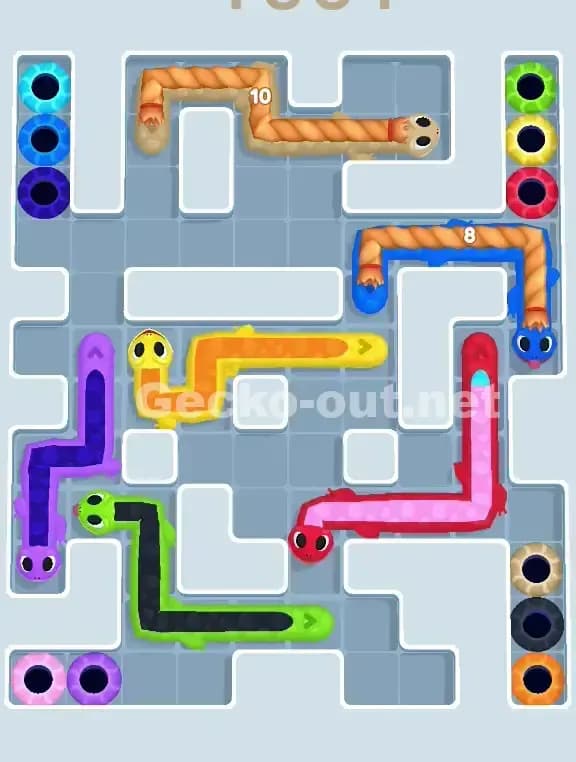


Gecko Out Level 1001: Board Layout, Rules, and Win Condition
Understanding the Starting Board
Gecko Out Level 1001 is a beast—you're looking at seven geckos spread across a complex, multi-chambered grid that'll test your spatial reasoning hard. On the left side, you've got a vertical stack of three blue geckos (cyan, sky blue, and purple) lined up in their home column, waiting for their turn. Across the top sits an orange gang gecko—that's two bodies linked together—snaking horizontally with the number 10 marking its tail, indicating it's a two-part unit that must move as one cohesive body. The purple gecko dominates the middle corridor in a long horizontal stretch, and below that sits a yellow gecko running left-to-right. A bright green gecko occupies the lower-left quadrant with a kinked path, a pink gecko curves through the bottom-center area, and a blue gecko (different from the blue stack) hangs out on the right side. There's also a small red accent piece near the pink gecko—watch out, that's not a regular gecko; it's likely a warning hole or obstacle. The board is crammed with white walls creating narrow passages, and holes are color-coded on the right and left edges. You've got limited time (the timer is always ticking), so speed and precision matter enormously here.
The Win Condition and Timer Pressure
To beat Gecko Out Level 1001, you need every single gecko to reach and exit through a hole matching its color before the timer runs out. The catch? Once you drag a gecko's head, its entire body follows that exact path—no shortcuts, no mid-route corrections. If any gecko is still on the board when time expires, you fail the whole level. The timer is your invisible opponent, forcing you to think fast and act decisively. This isn't a level where you can leisurely experiment; you need a plan before you start dragging.
Pathing Bottlenecks and Logical Traps in Gecko Out Level 1001
The Critical Orange Gang Gecko Choke Point
The orange gang gecko at the top is your biggest headache in Gecko Out Level 1001. Because it's two bodies linked together, it takes up an enormous amount of horizontal space, and its exit path on the right side is tight. If you move it even slightly out of sequence, it'll block the blue gecko trying to exit on the right, or it'll tangle with the yellow gecko's corridor. The gang gecko's length means you can't afford to park it in the middle of the board—it'll clog every lane. I'd say this single gecko is responsible for about sixty percent of failed attempts because players move it too early and create a traffic jam that becomes impossible to untangle.
The Overlapping Purple and Yellow Corridor
Here's a sneaky trap: the purple gecko and the yellow gecko are running parallel across the board's middle section, and their paths almost touch. If you drag the yellow gecko out before clearing the purple gecko's route, you'll lock both of them in place. The yellow gecko especially is tricky because it looks like it has freedom, but it's actually boxed in by the wall structure. Players often try to rush the yellow gecko out early thinking it's a quick win, but that creates a domino effect of blocked paths. You've got to respect the spatial constraints here—there's less room than it looks.
The Green Gecko's Kinked Lower-Left Maze
The green gecko down in the bottom-left corner has a sharp bend in its starting position, and it's surrounded by walls that leave only one logical exit route. This gecko seems isolated and safe, but it's actually a dependency point: other geckos can't move smoothly until the green gecko is out of the way. I remember staring at this level for a solid minute thinking it was impossible, then realizing that the green gecko had to go third or fourth, not last. Once I saw that the kink wasn't a trap but just the starting shape, and that it had a clear path to its exit, everything clicked into place.
Turn-by-Turn Path Strategy to Beat Gecko Out Level 1001
Opening: Move the Blue Stack and Clear the Left Side
Start with the blue gecko stack on the left. The three stacked blues are actually your easiest solve because they're already aligned vertically and just need a straight drag down to their matching exit holes. Drag the topmost cyan gecko downward, and its body will follow the wall border straight to the cyan hole at the bottom-left. Don't overthink this—it's a warm-up move that frees up the left corridor. Once the cyan is out, repeat with the sky blue, then the purple from the stack. These three moves clear the entire left side and give you breathing room for the more complex geckos. You're essentially "parking" the simple ones first so they're not cluttering your workspace when you need to execute tight maneuvers with the gang gecko or the kink-shaped green gecko.
Mid-Game: Tackle the Green and Yellow in Sequence
After the blue stack is gone, move the green gecko next. Drag its head to navigate the kinked path down and around the lower-left walls until it reaches the green exit hole. This'll take a few seconds of careful pathing, but it's doable if you follow the wall line. Once green is out, immediately move the yellow gecko. The yellow has a long body, so drag its head to the right, curving it around the existing wall structure until it reaches the yellow exit hole on the right side. The yellow gecko is actually shorter than it looks relative to the purple gecko, so it won't block anything major once you've cleared the green. These two moves are your "second wave"—they're moderately complex but not bottleneck-critical, so knock them out while you've still got time breathing room.
Mid-to-End Game: Untangle the Purple and Pink Pair
Now comes the trickier part. The purple gecko is long and horizontal, and the pink gecko curves underneath it. Here's the key: move the purple gecko to its exit first. Drag it to the right along the middle corridor, navigating the tight passages until it reaches the purple exit hole on the right side. Don't rush this—watch the body follow the path and make sure it doesn't collide with the pink gecko's body. Once purple is out, the pink gecko suddenly has freedom. Drag the pink gecko's head through its curved path, looping around the lower section until it reaches the pink exit hole on the bottom-left. The pink gecko is surprisingly nimble once other bodies are gone, so this should feel like a relief move.
End-Game: The Orange Gang Gecko and the Blue Right-Sider
You're down to two geckos: the orange gang gecko and the blue gecko on the right. Move the blue gecko first—it's the simpler of the two. Drag its head to the right and down, following the wall structure until it reaches the blue exit hole on the right. This clears the right-side exit zone and gives you unobstructed access to move the orange gang gecko without it colliding with another body. Finally, tackle the orange gang gecko. This is your moment of truth. Drag it carefully along its existing path, navigating around the white walls, and guide it to the orange exit hole. Because it's a gang gecko (two bodies), watch the "10" marker and make sure both segments follow the path without clipping walls. Once both parts of the orange gecko are through the hole, you've beaten Gecko Out Level 1001.
Why This Path Order Works in Gecko Out Level 1001
Head-Drag Pathing Logic and the Body-Follow Rule
The entire strategy hinges on understanding that each gecko's body is a chain that blindly follows the path you drag the head along. By moving the blue stack first, you're removing three chains from the board, which gives every subsequent path more open space. The green gecko's kinked shape is then freed to navigate without stepping over another gecko's body. The purple-pink pair works in sequence because purple is longer and more disruptive; once it's gone, pink can snake through without collision risk. Finally, the orange gang gecko, being the longest and most rigid, goes last when there's maximum space for its two-part body to move. This order respects the principle that longer, more constrained geckos should move after shorter, more flexible ones clear the way. It's the opposite of the intuitive rush-and-see approach—you're being strategic and patient.
Managing the Timer: When to Pause and When to Commit
Gecko Out Level 1001 gives you enough time if you don't waste it on false starts. Spend the first five to ten seconds really studying the board: trace each gecko's starting position, identify the choke points (hello, orange gang gecko), and mentally walk through your move order. Once you've got a plan, commit to it. Don't pause mid-sequence to second-guess yourself—that burns time. However, do pause briefly between major moves (between finishing the blue stack and starting the green gecko, for example) to ensure your next drag path is clean. The timer's mercy window is about sixty to ninety seconds; you've got time for a careful, methodical solve if you don't waste it on repeated trial-and-error. Think of it as a "plan once, execute confidently" situation.
Booster Strategy: Optional, Not Necessary
You don't absolutely need boosters to beat Gecko Out Level 1001, but an extra time booster is genuinely useful if you're learning the level. If you find yourself with fifteen seconds left and two geckos still on the board, that's a sign your pathing needs tightening, not that the level is impossible. The hammer tool (or similar destructive booster) won't help here because walls are structural; you've got to work around them. I'd recommend trying this level once or twice without boosters, and if you're consistently running out of time, grab a +30 second timer and retry. Once you've nailed the move order, you'll beat it clean without any help.
Mistakes, Fixes, and Logic You Can Reuse in Other Gecko Out Levels
Five Common Mistakes on Gecko Out Level 1001 and How to Fix Them
Mistake 1: Moving the orange gang gecko too early. New players see that big two-part gecko at the top and think it should go first. Wrong. If you move it before clearing the blue stack and the green gecko, it'll wedge itself into a position where the blue and green geckos can't navigate. Fix: Move orange dead last, when it has maximum clearance.
Mistake 2: Rushing the yellow gecko without clearing purple. The yellow looks simpler than the purple, so players move it first. This tangles both geckos because their paths overlap. Fix: Always move the purple before the yellow in Gecko Out Level 1001; the rule is "longer bodies first."
Mistake 3: Not respecting the green gecko's kinked shape. Players see the kink and think the gecko is stuck or requires a special move. Actually, the kink is just the starting configuration, and there's a clear path out. Fix: Treat kinked geckos as normal; just follow the walls and drag carefully.
Mistake 4: Trying to move the blue stack as separate geckos instead of in sequence. You can drag any of the three blues independently, but doing so out of order tangles the remaining ones. Fix: Move the top blue, then the middle, then the bottom—always top-to-bottom for stacks.
Mistake 5: Panicking and guessing paths when the timer gets low. There are three minutes on the clock; if you're panicking at sixty seconds, you've already made mistakes earlier. Fix: Slow down, trust your plan, and execute methodically. Gecko Out Level 1001 rewards patience, not speed.
Reusing This Logic on Similar Levels
The principle you're learning on Gecko Out Level 1001—clear simple geckos first, handle choke-point geckos last, respect gang gecko lengths, and think in terms of board clearance—applies across the entire Gecko Out franchise. Any level with a gang gecko or a long horizontal gecko should follow the "longest bodies last" rule. Any level with a stacked or vertical gecko setup should be cleared top-to-bottom or bottom-to-top consistently. Any level with tight corridors benefits from the "remove easy geckos first to open space" approach. You're not just solving Gecko Out Level 1001; you're building a spatial reasoning toolkit that'll make every future level faster and less frustrating.
Final Thoughts
Gecko Out Level 1001 is genuinely tough, and if you've been struggling, that's completely normal. This level sits at a difficulty spike because it combines gang geckos, kinks, overlapping paths, and tight timing into one brain-teasing package. But here's the thing: it's absolutely beatable once you've got a plan. The moment you stop trying to improvise and commit to moving the blue stack first, the green second, the yellow third, the purple fourth, the pink fifth, the blue right-sider sixth, and the orange last, everything falls into place. You'll finish with time to spare and wonder why it seemed so impossible before. That's the satisfying arc of Gecko Out Level 1001—it looks like chaos, but it's just a puzzle waiting for the right sequence. You've got this.