Gecko Out Level 715 Solution Walkthrough | Gecko Out 715 Answer
How to solve Gecko Out level 715? Get step by step solution & cheat for Gecko Out level 715. Solve Gecko Out 715 easily with the answers & video walkthrough.
Gecko Out Level 715: Board Layout, Rules, and Win Condition
Understanding the Starting Board
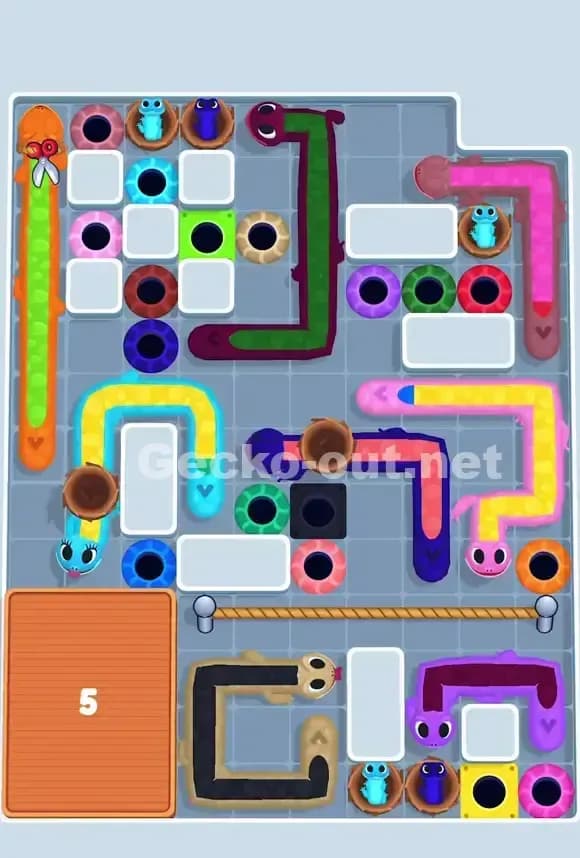
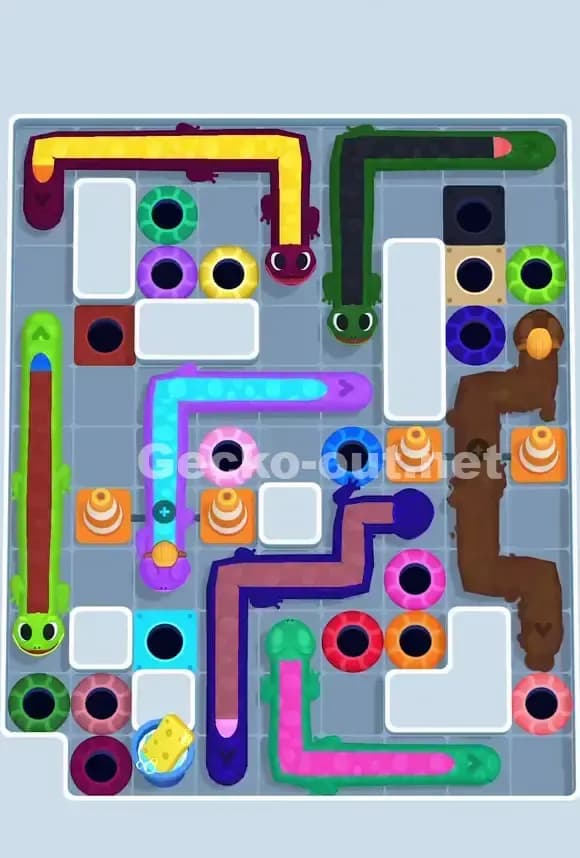
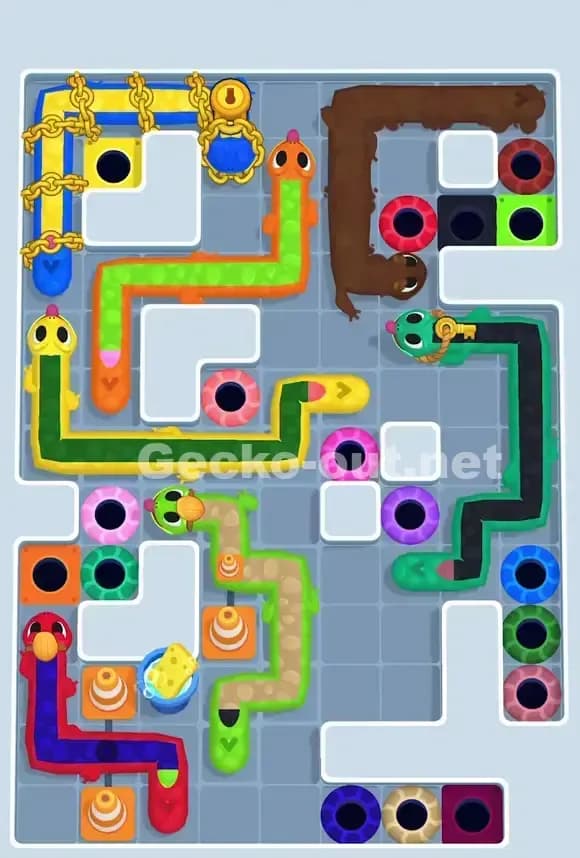
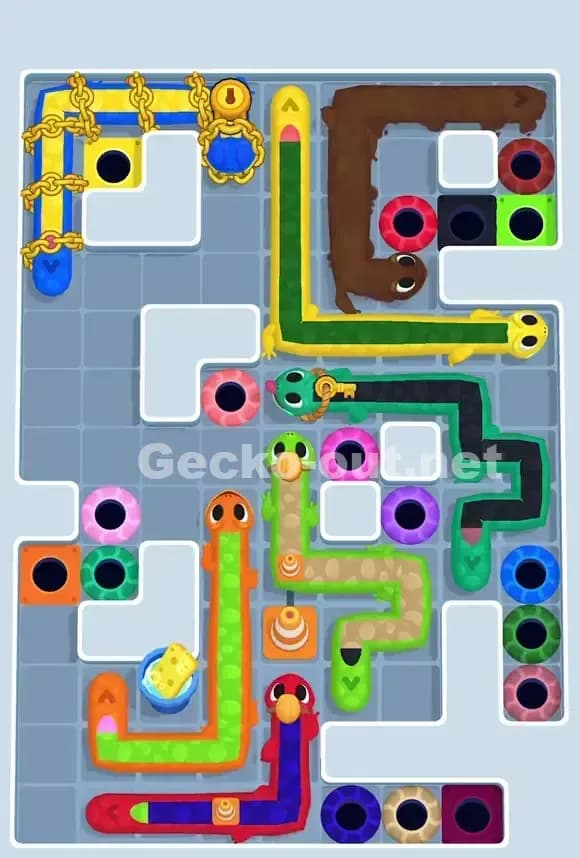
Gecko Out Level 715 is a dense, multi-colored puzzle with seven geckos scattered across a vertically oriented grid. You're looking at a red gecko gang on the left side (three linked geckos that move as one unit), a blue gecko in the bottom-right corner, green geckos positioned in the middle-right area, an orange gecko in the upper-middle section, and yellow geckos anchored near the top-left. The board is crammed with white obstacle blocks that create natural corridors and choke points. There are also several colored exit holes—red, green, blue, pink, orange, and yellow—each locked to its matching gecko color. The timer sits at the top, and you'll notice warning holes (orange striped circles) scattered throughout, which act as decoys and won't accept any gecko. The brown walls on the right side of the board create a nasty maze that funnels movement into tight spaces.
Win Condition and Timer Pressure
To beat Gecko Out Level 715, every single gecko must reach its corresponding colored hole before the timer expires. The challenge here isn't just pathing—it's sequencing. Because movement is path-based (your gecko's body follows exactly where you drag its head), poor routing early on will block corridors later. The timer adds urgency: you can't afford to restart paths or waste moves. You need to commit confidently and work with intention. The gang of three red geckos is your biggest constraint because they move together, occupying three times the space of a single gecko and requiring a single unbroken corridor to all three separate exits.
Pathing Bottlenecks and Logical Traps in Gecko Out Level 715
The Red Gang Choke Point
The three linked red geckos on the left are Gecko Out Level 715's main bottleneck. They're anchored near the top-left and must travel down and around the board to reach three different red exit holes. Because they're linked, you can't split them up mid-journey—they move as one rigid unit. This means you must drag a path wide enough for all three bodies to follow without overlapping any white obstacles or other geckos. The corridor they need curves downward and then loops around the bottom section. If you drag them too early or too greedily, they'll block the path for green or yellow geckos trying to escape from the left side. Conversely, if you leave them until last, you might not have enough time to complete their lengthy route.
The Right-Side Maze Trap
The brown walls on the right side create a deceptive maze. There's a blue exit hole in the bottom-right and several pink/red exit holes clustered nearby. The narrow brown corridors force you to pick a very specific path, and if you drag your gecko head through the wrong opening, you'll either dead-end or accidentally create a body that blocks a second gecko's escape route. I found myself restarting twice before I realized that the seemingly "obvious" path through the brown maze was actually a dead end. The real route requires dragging your gecko head away from the exit initially, looping around a white obstacle, and then approaching the exit from an unexpected angle.
The Orange and Yellow Double-Crossing Issue
The orange gecko sits near the center-top, and the yellow geckos are locked in the upper-left corner behind a chain of obstacles. Both need to move through overlapping corridor zones. If you free the orange gecko first by dragging it directly downward, its body will sprawl across the board and block the only viable exit path for the yellow geckos. Similarly, if you try to move the yellow geckos too early, they'll collide with the orange gecko's starting position. This cross-blocking is where Gecko Out Level 715 really punishes hasty decisions. I spent about three minutes staring at the board, tracing imaginary paths with my finger, before the right order clicked into place.
Turn-by-Turn Path Strategy to Beat Gecko Out Level 715
Opening: Prioritize the Yellow Gang Exit
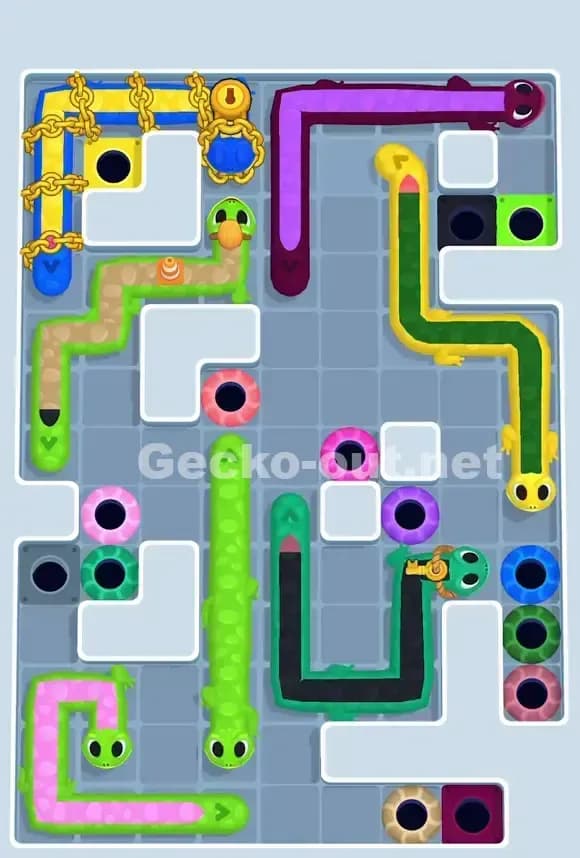
Start by clearing the yellow geckos from the upper-left. Drag their head downward and slightly right, guiding them along the left-side corridor (avoiding the red gang's path below them). The yellow geckos need to curve around and eventually reach the yellow hole in the middle-left area. Moving them first accomplishes two things: it opens up valuable horizontal space on the left side, and it prevents them from becoming a static obstacle for larger geckos like the red gang. This move should take no more than 15–20 seconds. Once the yellow geckos are safely in their hole, you've bought yourself time and breathing room.
Mid-Game: Reposition the Orange Gecko and Free Green Passages
Next, move the orange gecko. Drag its head downward, but not straight down—curve it slightly left to avoid the path you just cleared for yellow. Route it toward the bottom-center area, where it can reach the orange exit hole without crossing any other gecko's escape route. The orange gecko should be parked early because it occupies a critical junction. After orange is out, immediately tackle one of the green geckos from the middle-right section. Green exits are available on the right side, so drag the green gecko head rightward, navigating it through the upper-right corridors and into the brown maze. This is your first interaction with the tricky brown-wall section, so move carefully—the green gecko's body is long, and one wrong turn will block the blue gecko's path. Once the first green is out, the second green can follow a similar but offset route.
End-Game: The Red Gang and Blue Finisher
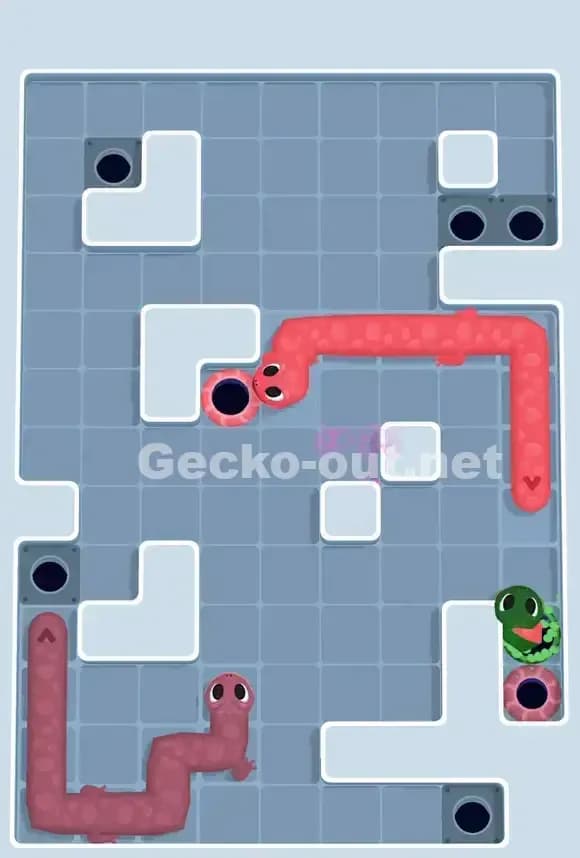
By now, you should have about 35–40 seconds remaining (depending on your pace). Drag the three linked red geckos downward along the left side. Their path curves around the bottom and loops rightward toward the red exit holes scattered at the bottom-center and bottom-right. The red gang's body is wide and clunky, so this route will take 20–25 seconds. If you're watching the timer closely and see fewer than 30 seconds remaining, commit to the path decisively—hesitation will waste precious time. Finally, drag the blue gecko from the bottom-right. It has the shortest distance to its blue exit hole (bottom-right corner), making it the perfect finisher. Even if the timer is running low, the blue gecko can usually reach its hole in 5–10 seconds, giving you a comfortable margin.
Why This Path Order Works in Gecko Out Level 715
The Logic of Sequential Unlocking
This strategy works because it follows a "clear the clutter, then move the heavy pieces" philosophy. By removing the yellow and orange geckos early, you're not moving them against the clock—you're moving them while your mind is fresh and your board awareness is highest. The green geckos are single units with moderate path complexity, so they're natural middle-game targets. Finally, the red gang (which requires the most careful coordination) gets the full board width and a clear corridor. This reverses the intuition that you should tackle the hardest obstacle first; instead, you reduce variables before tackling the knottiest problem.
The body-follow rule is crucial here. When you drag the yellow gecko's head, its body trails behind in a perfect line. If you'd started with the red gang, their massive body would've sprawled across multiple corridors, and you'd have no clean lane for yellow or orange to use later. By moving small or medium geckos first, you're essentially "painting" the board with occupied spaces in a way that leaves the maximum flexibility for later moves.
Timer Management: Pause, Plan, Execute
Gecko Out Level 715 rewards a specific rhythm: spend the first 5–10 seconds pausing and visually tracing each gecko's optimal path. Use your mental roadmap to identify which geckos share corridor zones and which can move independently. Once you've got your sequence locked in, execute each move with confidence—no second-guessing mid-drag. If you get stuck on a particular gecko (say, the orange gecko won't fit your proposed route), pause, reconsider the order, and reset. Restarting an individual move is faster than restarting the entire level, and Gecko Out Level 715 gives you about three "restart points" before you run out of time.
Booster Strategy
I'd recommend holding off on boosters for your first few attempts on Gecko Out Level 715. The level is absolutely beatable without them if you nail the sequencing. However, if you're consistently failing with fewer than 10 seconds remaining, a time booster (adds 30 seconds) used at the 20-second mark will give you the runway to finish the red gang without panic. A hint booster is less useful here because the bottleneck is obvious once you see it—what you need is execution time, not information.
Mistakes, Fixes, and Logic You Can Reuse in Other Gecko Out Levels
Mistake #1: Moving the Red Gang Too Early
The Problem: Players often drag the red geckos first, thinking "get the hardest obstacle out of the way." This backfires because the red gang's triple body spans the entire left corridor, leaving no room for yellow or orange to pass.
The Fix: Always map out which geckos share corridors before moving any of them. If two geckos need the same lane, move the smaller or faster one first, then move the larger one. This principle applies across all gang-gecko levels in Gecko Out.
Mistake #2: Routing Through Warning Holes
The Problem: The orange striped circles (warning holes) look like they might be shortcuts or alternative exits. Players occasionally drag a gecko head directly into one, wasting time and energy on a dead-end move.
The Fix: Before dragging any gecko, visually confirm its exit hole color matches the gecko color. Warning holes are visual noise—ignore them completely. Gecko Out Level 715 has enough genuine obstacles without second-guessing yourself on fake exits.
Mistake #3: The Brown Maze Wrong Turn
The Problem: New players see the blue exit hole in the bottom-right and assume the shortest path through the brown walls will reach it. The brown maze is designed to punish this assumption; the "obvious" path is a dead end.
The Fix: Trace the path with your eyes before dragging. Notice which brown corridors actually connect to the exit hole. In Gecko Out Level 715, the correct path loops counterintuitively: right, then down, then left, then down again. This teaches you that mazes in Gecko Out levels are often non-intuitive, so always trace first, drag second.
Mistake #4: Colliding the Green Geckos
The Problem: Both green geckos can reach their exits, but if you route them too similarly, their bodies will cross or their heads will hit each other, causing a collision failure.
The Fix: When multiple geckos of the same color exist, route them through different corridors, even if one route seems longer. The extra distance is worth avoiding a head-on collision. In Gecko Out Level 715, route the first green through the upper-right brown maze and the second green through the center-right corridor. They'll never touch.
Mistake #5: Losing Track of Time While Repositioning
The Problem: You move yellow, then orange, then start carefully adjusting a green gecko's path, and suddenly you realize 60 seconds have evaporated. Now you're rushing the red gang, and you make an error.
The Fix: Set a mental timer: if any single gecko move takes more than 20 seconds, you're overthinking it. Trust your initial plan. Hesitation on Gecko Out Level 715 is your enemy because the timer is tighter than on earlier levels.
Reusable Logic for Similar Levels
This Gecko Out Level 715 strategy transfers directly to other gang-gecko or frozen-exit puzzles. Whenever you see linked geckos, prioritize clearing the board around them before moving them. The universal rule: move small obstacles first, large obstacles last. For mazes (like the brown section in Gecko Out Level 715), always visually trace the full path before committing. And for multi-gecko levels with shared corridors, map dependencies on paper or mentally before you move anything.
Gecko Out Level 715 is genuinely tough—it combines gang mechanics, a maze, overlapping corridors, and a tight timer. But it's absolutely beatable. The moment I stopped trying to "solve" the whole level at once and instead asked "which gecko must move first to unblock everyone else?" everything clicked. You've got this.