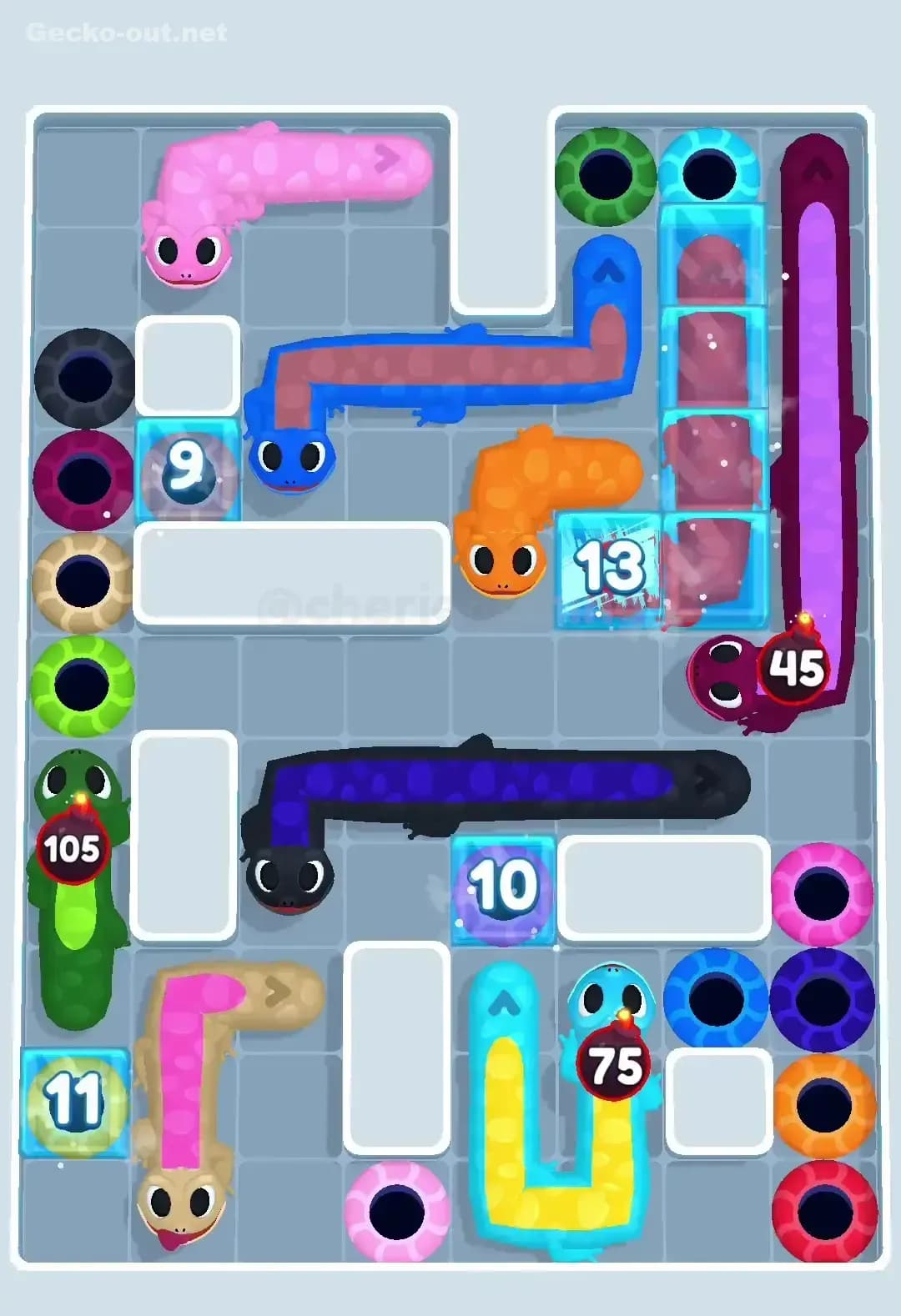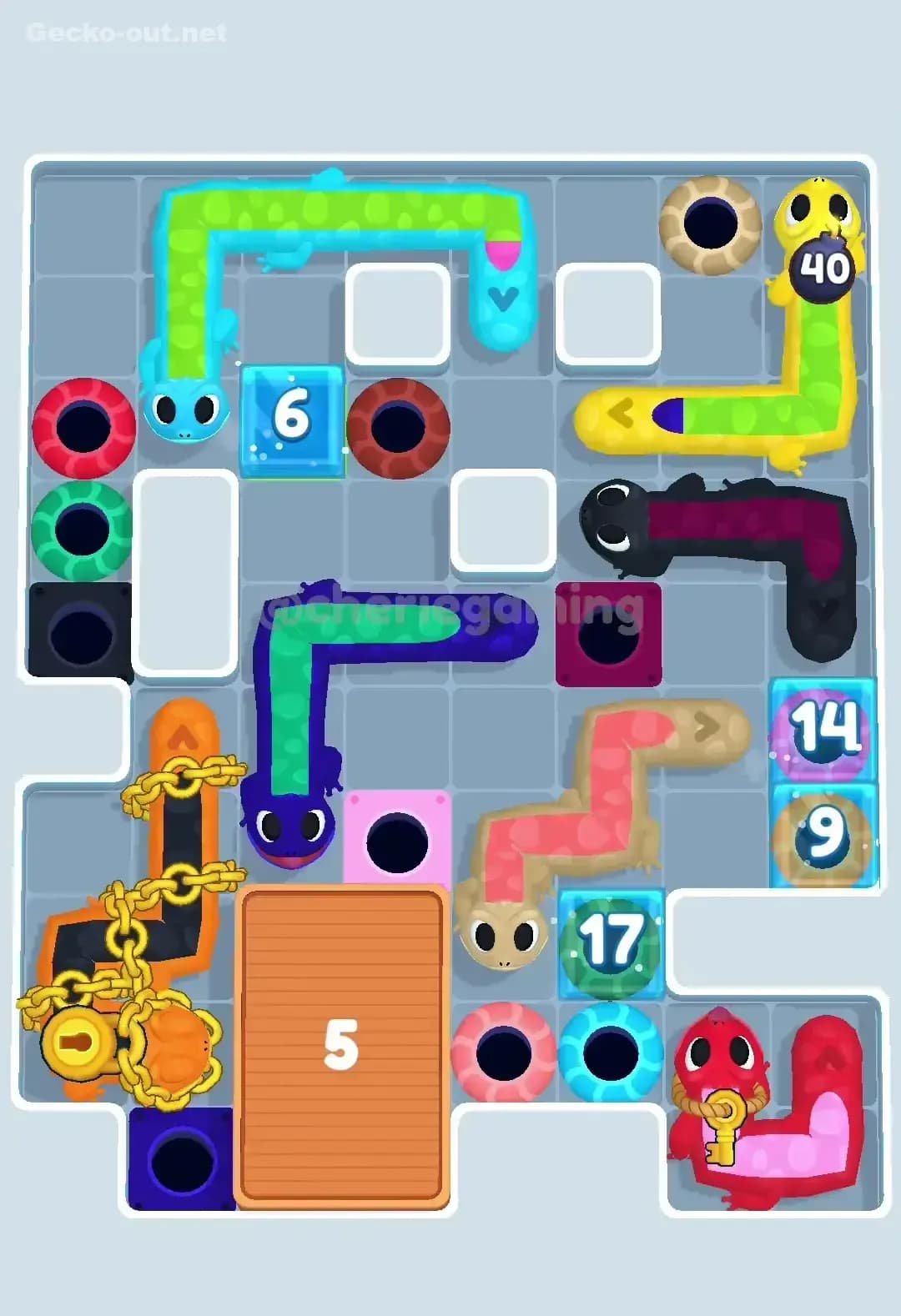
Gecko Out Level 386 Solution Walkthrough | Gecko Out 386 Answer
How to solve Gecko Out level 386? Get step by step solution & cheat for Gecko Out level 386. Solve Gecko Out 386 easily with the answers & video walkthrough.
Gecko Out Level 386: Board Layout, Rules, and Win Condition
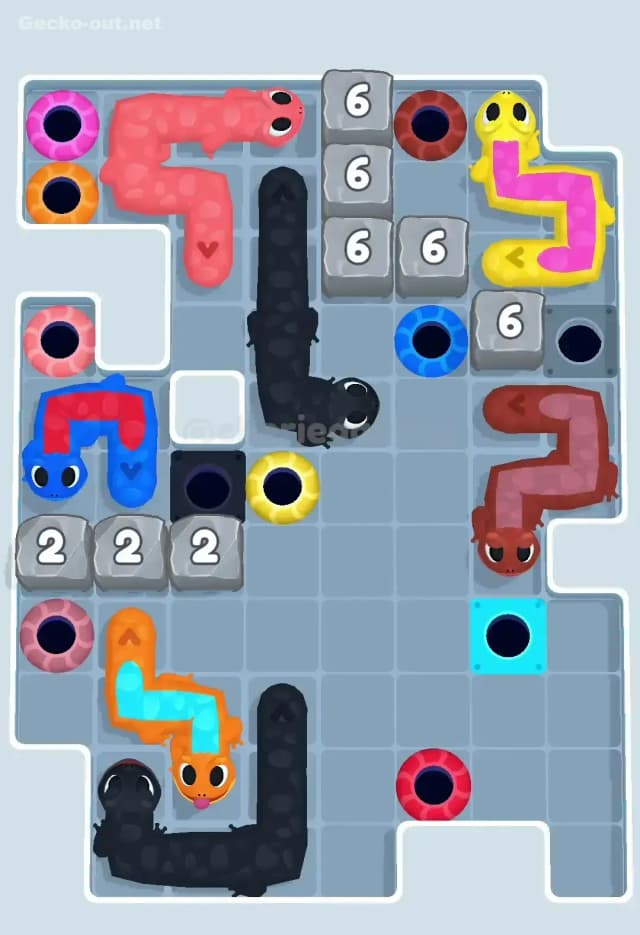
What The Board Looks Like In Gecko Out 386
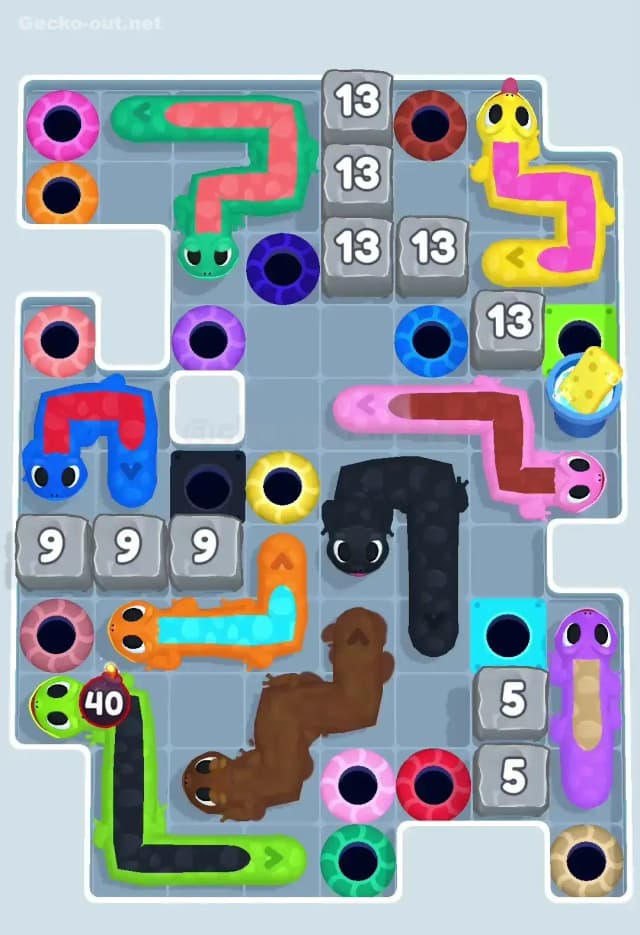
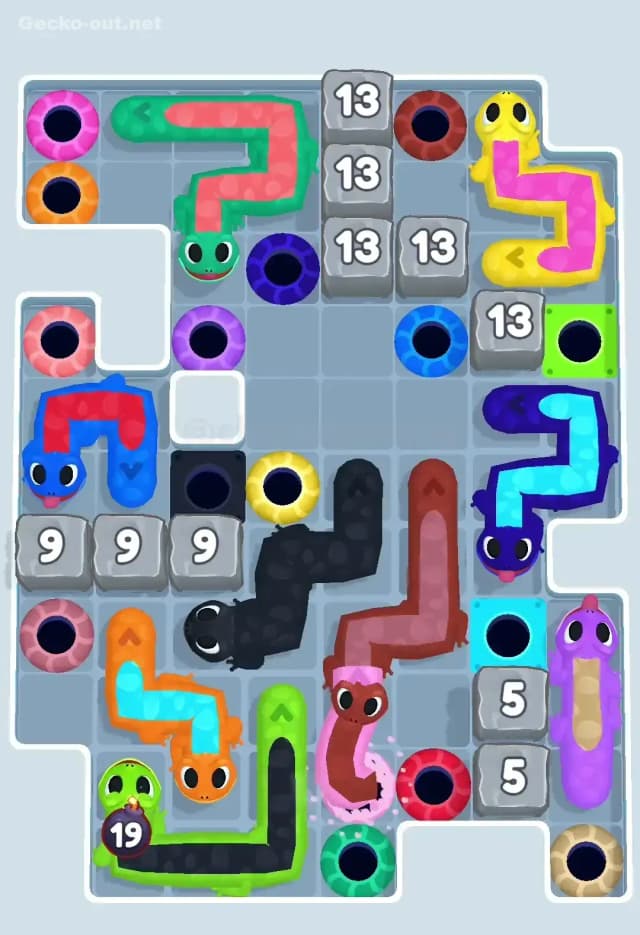
In Gecko Out Level 386 you’re thrown straight into a tightly packed knot. You’ve got a bunch of geckos (around nine) squeezed into a tall, narrow board:
- A green–pink gecko curled in the upper-left corner, wrapped around several colored exits.
- A yellow–pink gecko stuck on the upper-right, boxed in by gray “13” blocks.
- A blue–red gecko wedged in the mid‑left pocket, beside a line of “9” blocks.
- A long black gecko running vertically in the middle of the board, acting like a moving wall.
- An orange–cyan gecko and a chunky brown gecko tangled in the lower center.
- A long green–black gecko with the main timer icon near the bottom-left corridor.
- A purple gecko on the lower-right, squeezed between “5” blocks and several exits.
- A pink–brown gecko near the right side, sharing space with a blue exit and a cheese bucket.
The gray blocks with numbers (13, 9, 5) behave as solid obstacles in Gecko Out 386: you can’t pass through them, so they define permanent choke points. Almost every exit is pressed against a wall or a numbered block, so you usually only have a single direction you can approach each one from.
How To Win And Why The Timer Matters
The win condition in Gecko Out Level 386 is the same as usual: drag each gecko’s head so its body follows a path that ends at a hole of the same color. Bodies can’t overlap walls, numbered blocks, other geckos, or locked/icy exits. If any gecko is still on the board when the timer hits zero, it’s a fail.
The twist in Gecko Out 386 is how path‑dragging interacts with the narrow channels:
- Every long, wiggly path you draw turns into a solid tube of gecko body afterward.
- If you lazily zigzag a long gecko through the center, you basically cement a wall that other geckos can’t cross later.
- Because the timer starts around 40 seconds, you don’t have time to redraw everyone three times. You need one clean plan, then fast execution.
So the real puzzle isn’t just “which gecko goes where,” it’s “which lanes must stay empty until the very end.”
Pathing Bottlenecks and Logical Traps in Gecko Out Level 386
The Main Bottleneck Corridor
The single biggest bottleneck in Gecko Out Level 386 is the vertical corridor controlled by the big black gecko in the middle:
- While the black gecko sits there, the top and bottom halves of the board barely interact.
- Several exits (especially for the purple, brown, and orange–cyan geckos) effectively live “below” that block, while the green–pink and yellow geckos are “above.”
- If you drag the black gecko sideways too early, you seal off the central lane and trap someone permanently.
Your whole solution for Gecko Out 386 revolves around unlocking that central lane at just the right moment and then not reclogging it with another long body.
Subtle Problem Spots You Need To Respect
A few traps are easy to ignore until it’s too late:
-
The blue–red pocket on the left.
That gecko’s short, so it feels harmless, but its tiny alcove is glued to the 9‑block wall. If you park anything across its exit route, you’ll need to redraw half the board to free it. -
The yellow gecko around the 13‑blocks.
Its exit path requires approaching from a specific side. One sloppy black‑gecko move or pink–brown path and you’ll never squeeze yellow through the gap without undoing half your work. -
The lower-right cluster around the 5‑blocks.
Purple, brown, and several exits all share the same small space. If you let brown or green‑black snake across the front of those exits mid‑game, you’ll lock someone in behind them.
When Gecko Out 386 Starts To “Click”
I’ll be honest: Gecko Out Level 386 feels brutal the first few tries. I kept solving “half” the board—getting two or three geckos out—then realizing my black or brown path had welded a wall across an exit.
The turning point is when you stop thinking “free this gecko right now” and start thinking “how do I keep this lane clean for later?” The moment it clicked for me was realizing the black gecko doesn’t leave early; it acts as a controlled gate until nearly the end. Once you treat black and brown as movable walls instead of “things to rescue ASAP,” the solution path becomes much more logical.
Turn-by-Turn Path Strategy to Beat Gecko Out Level 386
Opening: Clean Up Small Geckos And Create Space
In Gecko Out 386, your priority is to clear short geckos near exits and carve some breathing room:
-
Free the green–pink gecko in the upper-left.
Drag its head along the top wall and hook it into its matching exit without crossing the middle column. Try to keep its path tight against the wall so you don’t clutter the central rows. -
Clear the blue–red gecko from the left pocket.
Pull it straight out of its nook and curve it into its matching exit using the narrow lane between the 9‑blocks and the nearby holes. Park its path hugging the left wall; you want that section permanently stable. -
Make a small adjustment with the black gecko, not a full move.
Slide the black gecko just enough to open a vertical lane but don’t snake it horizontally across the board. Think “door on a hinge,” not “new wall.” -
If your version has easy yellow access, send yellow early.
Once there’s a gap near the 13‑blocks, thread the yellow–pink gecko through to its exit while the center is still relatively empty.
By the end of the opening, you want the top-left and left-middle areas mostly cleared and a narrow but workable passage between upper and lower halves.
Mid-game: Protect Lanes And Reposition Long Bodies
Mid‑game in Gecko Out Level 386 is all about not sabotaging yourself:
-
Reposition the orange–cyan gecko.
Route it toward its exit using the lowest available lane, staying under the black gecko where possible. Avoid zigzags; minimum turns mean minimum blockage. -
Shape the brown gecko as a side wall, not a barrier.
Drag brown along the very bottom or far-right edge, keeping exits visible. You want brown “parked” against a border so it stops interfering. -
Keep the central vertical lane partially open.
Any time you move black or brown, double-check: can at least one more gecko still reach both top and bottom zones? If the answer is no, undo immediately. -
Thread the pink–brown gecko through while the middle’s clear.
Guide it around the blue exit and cheese bucket carefully, making sure it doesn’t wrap across the front of late-game exits (especially purple’s).
The mid‑game ends when the majority of short/medium geckos are out and only the longest bodies (usually black, brown, green‑black, and possibly purple) are left.
End-game: Exit Order And Timer Panic Management
The end‑game of Gecko Out Level 386 is mostly about discipline:
-
Exit purple from the lower-right before sealing that area.
Use the remaining gaps around the 5‑blocks to slide purple into its hole. After purple leaves, it’s fine if brown or green‑black end up blocking that corner. -
Send the green‑black timed gecko next.
It’s long and starts near the timer icon; by now you should have a clean channel upwards or sideways to its exit. Draw a smooth path that doesn’t cross remaining exits. -
Finish with the black gecko as the last or second‑to‑last exit.
Because black has been acting as your movable gate, it’s safest to remove it only when everyone else has a clear outbound route.
If you’re low on time (single digits), switch from analyzing to committing: go for the simple, straight-ish paths you already visualized earlier, even if they aren’t perfectly optimized. In Gecko Out 386, hesitation kills more runs than slightly imperfect routes.
Why This Path Order Works in Gecko Out Level 386
Using Head-Drag Pathing To Untangle, Not Tighten
The plan for Gecko Out Level 386 works because it respects the body-follow rule:
- Short geckos leave first so their bodies don’t occupy key lanes for long.
- Long geckos (black, brown, green‑black) are either “parked” along outer walls or held as temporary gates until they can exit safely.
- You only draw complex paths when you’re sure no other gecko needs that corridor later.
Instead of treating every free spot as fair game, you treat central rows and the lower-right cluster as protected areas until the exact moment you need them.
Balancing Thinking Time And Fast Execution
On Gecko Out Level 386 you can’t solve on pure instinct. I’d suggest:
- Spend the first 5–8 seconds just reading the board and mentally sketching exit order.
- Use pauses after each gecko exits to quickly re-evaluate: which corridor must stay empty now?
- Once only 2–3 geckos remain, stop pausing and just execute; you already know the lanes you’re using.
This “plan, then commit” rhythm is how you beat the timer without feeling rushed the whole time.
Are Boosters Needed In Gecko Out 386?
Boosters in Gecko Out Level 386 are helpful but optional:
- Extra time booster: Nice if you’re still learning; pop it just before you start moving the last three long geckos.
- Hammer-style block breaker: If you truly struggle, using it on a central numbered block (for example, part of the 13‑cluster) can dramatically open the board, but the level is designed to be solved without it.
- Hints: I’d treat hints as a last resort. Use them only if you repeatedly trap the same gecko and can’t see an alternative lane.
If you follow the path order for Gecko Out 386 above, you shouldn’t need any boosters.
Mistakes, Fixes, and Logic You Can Reuse in Other Gecko Out Levels
Common Mistakes In Gecko Out Level 386
-
Exiting the black gecko too early.
Fix: Keep black vertical and central until most other geckos are gone; think of it as a sliding door between zones. -
Zigzagging long geckos through the middle.
Fix: Hug outer walls whenever possible and draw the shortest, straightest routes, especially for brown and green‑black. -
Blocking the blue–red pocket.
Fix: Clear blue–red in the opening or at least keep its lane empty until you’re ready to exit it. -
Ignoring the lower-right cluster until the end.
Fix: Plan purple’s route during mid‑game and don’t let brown or green‑black park in front of those exits until purple is already out. -
Overthinking under low time.
Fix: In the last 10 seconds, stop re‑planning. Use the corridors you already cleared and just draw.
Reusing This Logic On Other Knot-Heavy Levels
The strategy you learn in Gecko Out Level 386 transfers well to other brutal puzzles:
- Identify the “gate gecko” (often the longest one in the middle) and delay its exit.
- Clear short, pocketed geckos first so they don’t become future obstacles.
- Reserve one or two “highway” lanes that you refuse to block until everyone has used them.
- Park long bodies as static walls along edges, not crisscrossing the board.
Any time you see numbered blocks forming tight channels in future Gecko Out levels, ask yourself how Gecko Out 386 handled them—you’ll see the same logic repeat.
Final Encouragement For Gecko Out Level 386
Gecko Out Level 386 looks overwhelming, but it’s absolutely beatable once you treat it like a traffic puzzle instead of nine separate rescues. Plan your exit order, respect the central bottleneck, and park your long geckos smartly. After a few runs, you’ll stop feeling stuck and start seeing the pattern—and when that last gecko finally dives into its hole with a couple seconds left, it feels incredibly satisfying.