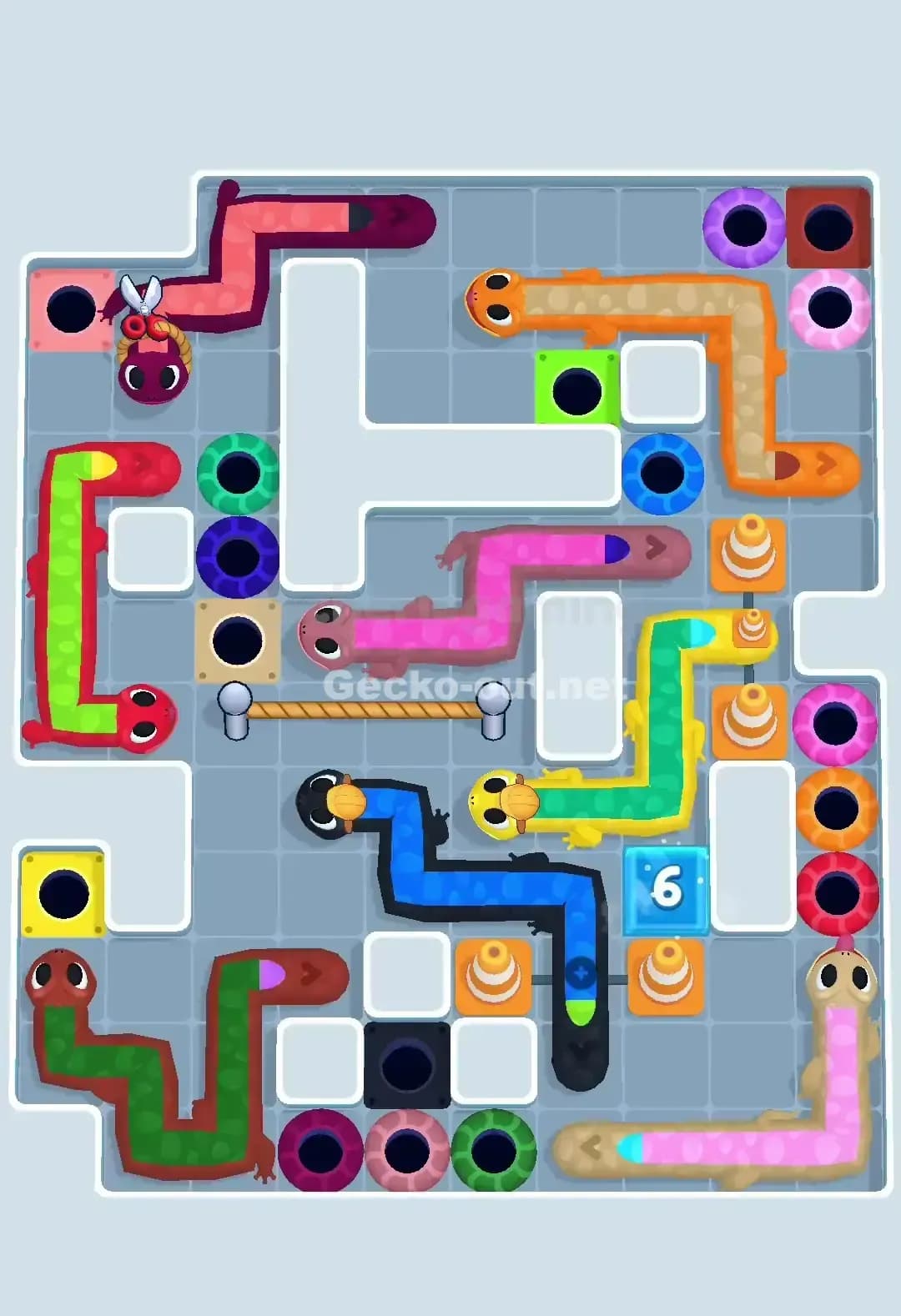
Gecko Out Level 683 Solution Walkthrough | Gecko Out 683 Answer
How to solve Gecko Out level 683? Get step by step solution & cheat for Gecko Out level 683. Solve Gecko Out 683 easily with the answers & video walkthrough.




Gecko Out Level 683: Board Layout, Rules, and Win Condition
Starting Setup and Visual Chaos
Gecko Out Level 683 is a beast of a puzzle, and I'm not going to sugarcoat it—this level is packed with geckos, obstacles, and some seriously tangled paths. You're looking at a grid crammed with roughly eight to ten geckos in various colors (magenta, green, blue, orange, yellow, cyan, and red), and they're scattered across multiple zones separated by walls, locked gates, and warning holes. The board is essentially divided into several chambers, which is both a blessing and a curse: each chamber feels like its own mini-puzzle, but connecting them requires careful planning. What makes Gecko Out Level 683 especially tricky is that several geckos are already lined up in queue-like formations or wrapped around obstacles, and the timer is unforgiving—you've got roughly 120–140 seconds to orchestrate every single gecko to its matching colored hole.
The Core Win Condition and Timer Pressure
To beat Gecko Out Level 683, every gecko must reach a hole of the same color before the clock runs out. The drag-based pathing system means you're not moving geckos discretely; instead, you're drawing a continuous line from the gecko's head, and its body faithfully follows that exact route. This creates a cascading problem: if you drag one gecko along a path that later blocks another gecko's exit route, you've just created a gridlock. The timer doesn't forgive mistakes, and there's no "undo" button—you commit to a path, and the gecko moves. This makes Gecko Out Level 683 a level where planning three moves ahead isn't optional; it's mandatory.
Pathing Bottlenecks and Logical Traps in Gecko Out Level 683
The Central Corridor Bottleneck
The most punishing choke point in Gecko Out Level 683 is the central vertical corridor that connects the upper and lower sections of the board. I'm talking about that narrow passage where multiple geckos need to pass through to reach their respective exit holes. This corridor is the single biggest traffic jam you'll face, and if you're not careful, you'll route one gecko through there early and watch helplessly as its body blocks two or three other geckos from even entering. The magenta and green geckos seem naturally drawn toward this corridor, and if you drag the magenta gecko through first without parking it carefully at a waypoint, you'll find the green gecko literally unable to navigate around it. This is where Gecko Out Level 683 becomes a routing puzzle rather than just a movement challenge.
The Locked Gate and Warning Hole Trap
There's a secondary obstacle that'll catch you off guard: a locked or frozen exit hole somewhere in the middle-right zone that's not immediately obvious. Players often drag a gecko toward what looks like its exit, only to discover the hole is frozen or gated, and they've wasted precious seconds. Additionally, Gecko Out Level 683 features at least one "warning hole"—a decoy exit of a different color—positioned right where you'd naturally guide a gecko. The number of times I've almost sent an orange gecko into a blue hole is embarrassing, but it's a real trap here.
The Gang-Gecko Entanglement
What really tests your patience on Gecko Out Level 683 is the presence of linked "gang" geckos—two or more geckos tethered together that move as a single unit. If these gang geckos are positioned horizontally or diagonally, they occupy a lot of board real estate, and moving them requires a wide, sweeping path. If you try to shortcut or zigzag, their linked bodies will collide with walls or other geckos. I remember staring at the board for a solid thirty seconds, watching one gang-gecko pair and thinking, There's no way this fits through that gap. Then it clicked: I had to route them through the longer, looping path around the eastern wall, sacrificing a bit of time but gaining the clearance they needed.
Turn-by-Turn Path Strategy to Beat Gecko Out Level 683
Opening: Secure the Perimeter and Park Strategically
Start by identifying which gecko is easiest to extract—usually one on the edge or in a corner. In Gecko Out Level 683, I recommend tackling the red gecko on the left side first, dragging it along the left wall down to its matching red exit hole. This accomplishes two things: it clears a relatively unobstructed path, and it removes a gecko from a crowded zone, giving you more room to maneuver in the center. Next, move one of the blue geckos, but here's the key—don't send it directly to its exit hole yet. Instead, drag it to a "parking spot" near its destination but not occupying the hole itself. This keeps the path open for other geckos while allowing the blue gecko to move quickly at the end. The same logic applies to the orange gecko: route it to a safe intermediate position along the top corridor where it won't block the central traffic later.
Mid-Game: Untangle Without Retightening
Once you've cleared the edges, you're left with the gang geckos and the tightly clustered center. This is where Gecko Out Level 683 demands precision. Take the horizontal gang-gecko pair and drag it along the eastern loop—yes, it's a longer path, but it avoids the central corridor entirely and keeps that critical lane open for single geckos. While that pair is moving, mentally note where the green and magenta geckos are. You want to route the green gecko through the central corridor first (since it's slightly smaller or positioned higher, depending on your board state), parking it just outside its hole. The magenta gecko follows immediately after, using the exact same corridor before any other gecko can enter it. This sequential approach prevents the body-blocking problem. Keep an eye on the timer; if you're past the 60-second mark and still have more than three geckos on the board, pick up the pace—you don't need perfect paths anymore, just paths that work.
End-Game: Last Gecko Rush and Avoiding Final Choke Points
With maybe 30–40 seconds remaining, you should have only two or three geckos left. At this point, Gecko Out Level 683 becomes a race against the clock. Drag the remaining geckos in rapid succession toward their exit holes, trusting that you've cleared enough space by now. If you've parked geckos near their holes earlier, you can simply extend a short drag path to complete their escape. Watch out for the last-second collision: sometimes a gecko you thought was parked will shift slightly as the board updates, and a newly moving gecko will crash into it. If you're running dangerously low on time (under 20 seconds) and one gecko is still stuck in a knot, use a booster if available—specifically, a time-extension booster is more valuable here than a "hint" booster, since you likely know the path; you just need more seconds to execute it.
Why This Path Order Works in Gecko Out Level 683
Head-Drag Physics and the Body-Follow Rule
The reason this sequential strategy works for Gecko Out Level 683 is rooted in how the drag-path mechanics function. When you drag a gecko's head, its body follows the exact line you've drawn, one cell at a time. This means the entire gecko is "consumed" by that path for several seconds, and other geckos cannot occupy any cell that the moving gecko currently occupies. By routing geckos in order of their complexity (simple edge cases first, gang geckos second, single central geckos last), you ensure that the most movement-constrained units get their dedicated paths while there's still room to work with. For Gecko Out Level 683 specifically, this means the gang gecko gets the long eastern loop when the board is still relatively empty, and the nimble single geckos tackle the central corridor once it's been temporarily vacated.
Timer Management: When to Pause and When to Sprint
On Gecko Out Level 683, pausing to think is valuable during the first 45 seconds—this is when you're identifying bottlenecks and mapping parking spots. After the 60-second mark, hesitation becomes your enemy. You should be moving geckos nearly continuously, one after another, without stopping to overthink. The mid-game (45–75 seconds) is your transition zone: you're executing your plan but staying flexible enough to adjust if a gecko collides unexpectedly. The difference between a win and a loss on Gecko Out Level 683 often comes down to whether you can commit to a path and move on, or whether you second-guess yourself and waste precious ticks of the timer.
Booster Strategy: Optional but Sensible
Gecko Out Level 683 doesn't strictly require a booster to complete, but if you find yourself stuck after two or three attempts, a time-extension booster (usually worth 20–30 extra seconds) is a game-changer. Avoid using a "hint" booster here; the puzzle's challenge isn't figuring out where to go, it's executing the sequence quickly enough. If you do use a booster, deploy it around the 30-second mark when you still have two or more geckos remaining—this gives you a genuine second wind to finish cleanly. Some players prefer a "hammer" or path-clearing tool if one is available, as it can destroy a problematic wall or obstacle, but Gecko Out Level 683's obstacles are mostly functional (gates that should stay locked, walls that define the puzzle), so a hammer isn't the best choice here.
Mistakes, Fixes, and Logic You Can Reuse in Other Gecko Out Levels
Five Common Gecko Out Level 683 Mistakes and How to Fix Them
Mistake #1: Sending a Gang Gecko Through the Center Too Early Many players think the gang gecko should take the shortest path, which leads straight through the central corridor. This immediately blocks everything else. Fix: Always route multi-unit geckos around the perimeter first, even if it takes longer. The time you "lose" on the longer path, you gain back by avoiding traffic jams.
Mistake #2: Not Checking Hole Colors Before Dragging With so many holes on the board, it's shockingly easy to drag an orange gecko into a yellow hole and waste seconds recovering. Fix: Before dragging, visually trace the gecko's color to its matching hole and mentally rehearse the path. On Gecko Out Level 683, this 3-second pause saves 10 seconds later.
Mistake #3: Ignoring the Locked Gate Until Too Late There's at least one frozen or locked exit on Gecko Out Level 683, and beginners often discover it the hard way—by trying to exit a gecko through it. Fix: Do a full board scan at the start, marking which holes are accessible and which are locked. This takes 10 seconds initially but prevents failed attempts.
Mistake #4: Parking Geckos Too Close to Their Holes If you park a gecko right at the entrance to its hole, you're blocking that hole for any other gecko that needs to pass through the same area. Fix: Park geckos one or two cells away from their holes, at an angle or on a side corridor. This keeps the hole itself clear for the final approach.
Mistake #5: Rushing and Drawing Erratic Paths When the timer gets low, panic sets in, and players draw wild, looping paths that cause geckos to collide with walls or other geckos. Fix: Even when time is tight, take one full second to plan each path mentally before dragging. A deliberate, slightly slower path beats a frantic, collision-prone one every time.
Transferable Logic for Similar Levels
Gecko Out Level 683's strategy applies directly to any level with gang geckos, frozen exits, or tight central corridors. The principle is simple: route constrained units first, use perimeter paths to avoid central traffic, and keep exit holes clear until the final moments. If you encounter another level with a similar layout—multiple color geckos, a central bottleneck, and linked units—use the exact sequence from Gecko Out Level 683. The specific gecko colors and hole positions will differ, but the flow (edge geckos first, gangs second, singles last) is universally effective.
Final Encouragement
Gecko Out Level 683 is definitely a tough nut to crack, and frustration is warranted—this level punishes impatience and rewars strategic thinking. But here's the honest truth: once you see the solution, it feels obvious. The geckos actually have plenty of room to move; they're just moving in the wrong order. After beating Gecko Out Level 683, you'll approach similar puzzles with new confidence. Stick with the plan, trust the paths you've drawn, and remember that the gecko who escapes first isn't always the one who should move first. You've got this, and Gecko Out Level 683 is absolutely beatable with the right mindset.