Gecko Out Level 945 Solution Walkthrough | Gecko Out 945 Answer
How to solve Gecko Out level 945? Get step by step solution & cheat for Gecko Out level 945. Solve Gecko Out 945 easily with the answers & video walkthrough.

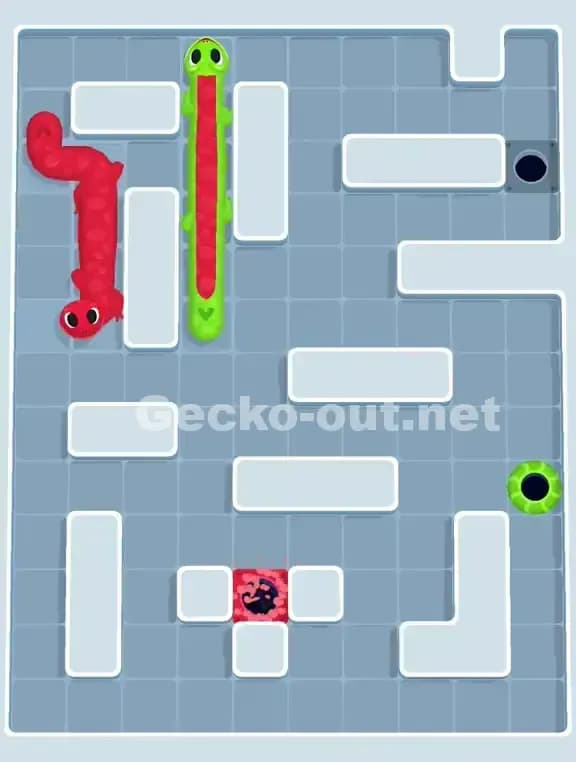
Gecko Out Level 945: Board Layout, Rules, and Win Condition
Starting Board: Geckos, Colors, and Layout
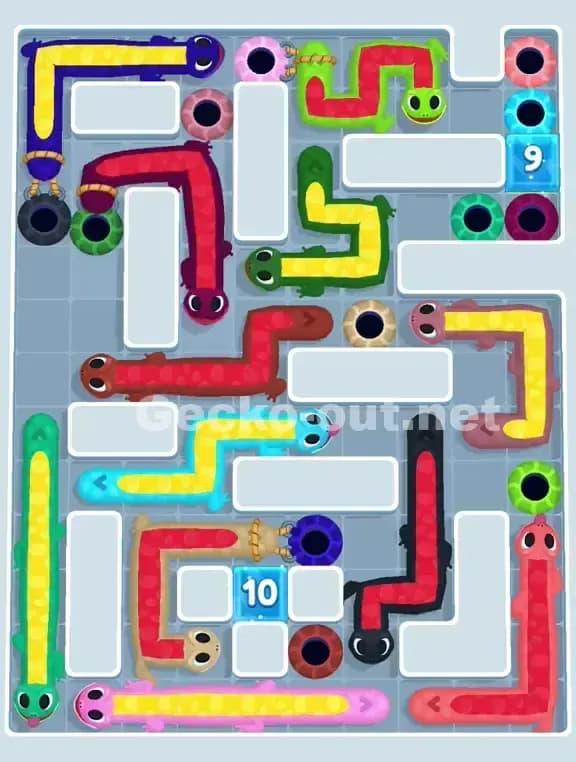
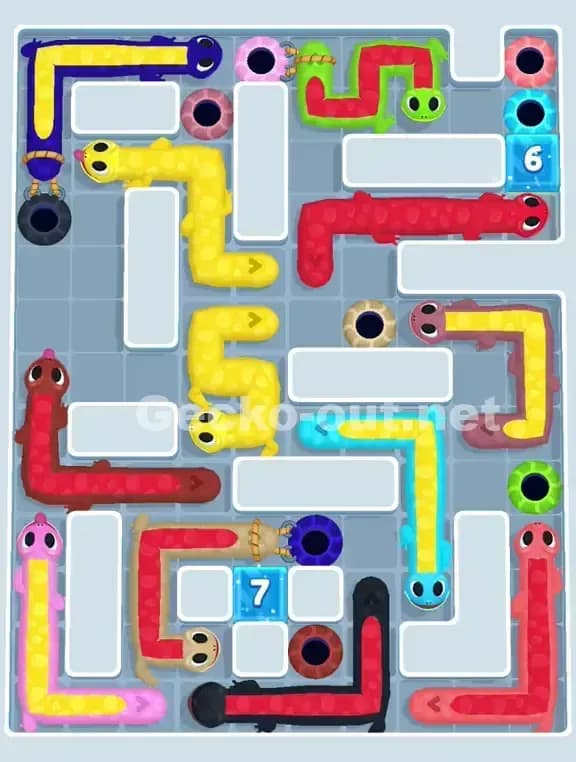
Gecko Out Level 945 is a densely packed puzzle with six geckos spread across a complex maze of white barriers and tight corridors. You've got a blue gecko in the top-left corner, a red gecko dominating the left-center area, a green gecko in the upper-middle section, a yellow gecko on the left side, a cyan gecko in the lower-middle region, and a magenta/pink gecko at the very bottom. Each one needs to reach its matching-colored hole to escape. The board is essentially a vertical stack of interconnected chambers separated by walls, with exit holes positioned in the top corners and edges—none of them are conveniently close to their starting positions. The timer shows you have roughly 9–10 seconds to complete the puzzle, which sounds generous until you realize how many individual paths you need to draw and how easy it is to accidentally trap a gecko mid-route.
Win Condition and Why the Timer Matters
You win when all six geckos have reached their colored exit holes before the timer runs out. The challenge here isn't just about finding any path to each hole—it's about sequencing them so that earlier geckos don't block later ones' escape routes. Because the body follows the exact path you drag the head through, a poorly chosen route can leave your gecko's body sprawled across a critical corridor, making it impossible for another gecko to pass through. The strict timer forces you to work fast but think ahead; pausing mid-level to study the board is often smarter than rushing and creating a tangled mess you can't undo.
Pathing Bottlenecks and Logical Traps in Gecko Out Level 945
The Major Choke Point: Red Gecko's Escape Route
The red gecko is the single biggest bottleneck in Gecko Out Level 945. It's a long, multi-segment body that sprawls across nearly half the left side of the board, and its exit hole is in the top-left corner. To get its head all the way up and around the blue gecko without collision, you must drag it through a narrow vertical corridor that also happens to be on the path several other geckos need to traverse. If you move the red gecko last, you'll find its body blocking the green gecko's route downward, and the cyan gecko won't have room to maneuver either. If you move it too early without planning the others, you'll box yourself in. The trick is routing the red gecko in the second or third position, after the blue gecko is safely out, but before the center-area geckos start their journeys.
Subtle Trap #1: The Yellow Gecko's Long Tail
The yellow gecko on the left side is deceptively long and needs to route downward and then across to reach its exit on the bottom-right area. Players often drag its head straight down without realizing its body will coil back on itself or block the cyan gecko's path upward. You must drag the head in a wide, deliberate curve—down first, then around the perimeter—to keep its tail out of everyone else's way.
Subtle Trap #2: The Green Gecko's Narrow Middle Passage
The green gecko sits in the upper-center area and needs to navigate a bottleneck between the red gecko's path and several white walls. If you've already routed the red gecko through the center corridor, the green gecko has no way through. Timing is everything: green should move before red to claim that space, or after red has fully exited the board.
Subtle Trap #3: The Cyan and Magenta Squeeze
Both the cyan gecko (lower-middle) and magenta gecko (bottom) need to reach exits in the right or bottom-right area. Their starting positions and body lengths mean they'll collide if you route them simultaneously. One must go up and around while the other goes down and sideways—but you have to pick the right gecko for each path, or you'll waste precious seconds undoing the move.
A Moment of Clarity
I'll be honest: the first time I tackled Gecko Out Level 945, I felt genuinely stuck. The board looked like spaghetti, and every path I tried seemed to create a new jam. Then I realized the solution wasn't about finding the fastest route for each gecko individually—it was about sequencing them in an order that kept lanes open. Once I mapped out the blue gecko first, red second, green third, and reserved the center-bottom area for the last three, the whole puzzle clicked. It's frustrating until you shift your thinking from "where does this gecko go?" to "when does this gecko move so others can pass?"
Turn-by-Turn Path Strategy to Beat Gecko Out Level 945
Opening: Blue Gecko First, Clear the Top-Left
Start by moving the blue gecko out of the top-left corner. Its head is positioned near its exit hole, so you need only a short, deliberate drag upward and slightly right to get it into the blue exit hole in the top-left corner area. This move takes seconds but is critical: it clears the starting bottleneck and gives the red gecko room to begin its escape journey without immediate collision. Once blue is out, the rest of the left side opens up considerably. Don't rush this—make sure the head is aligned with the hole and the body isn't twisted awkwardly across a potential route.
Mid-Game: Red Second, Green Third, Park the Others
With blue safely exited, drag the red gecko's head upward and around the left side, routing it through the vertical corridor toward the top-left area where the red exit hole sits. This is a longer drag than the blue gecko's, so keep your finger steady and move deliberately. The body will follow your entire path, so ensure you're not cutting through the center of the board where green and yellow geckos still need to travel. Once red is out, immediately move the green gecko, routing its head downward from the upper-center area, then leftward and around to its green exit hole. Green needs to claim the center corridor before other geckos crowd it.
Now comes the parking phase: the yellow gecko and cyan gecko need to stay put temporarily or move to neutral zones where they won't block each other. Drag the yellow gecko's head in a wide loop—down the left side, then around the bottom-left, avoiding the paths red and green have already carved—toward the yellow exit hole in the lower-left corner. Yellow's body is long, so this route must be generous and curved, not cramped. As you're doing this, keep an eye on the timer; you should still have several seconds left.
End-Game: Cyan and Magenta in Sequence
With three geckos exited, the board is much clearer, but cyan and magenta are still in tight quarters. Drag the cyan gecko's head upward from its starting position in the lower-middle area, routing it through the now-open center lanes, and guide it toward the cyan exit hole in the top-right or right side. Cyan's path should be nearly clear by now, so this move is straightforward—just keep the head aligned and steady. Finally, move the magenta gecko's head from the bottom center, routing it downward and then rightward along the bottom perimeter toward the magenta exit hole in the bottom-right area. This is the last gecko, so even if you're down to 1–2 seconds, as long as the path is clear, you'll make it.
Why This Path Order Works in Gecko Out Level 945
Using Head-Drag Pathing to Untangle, Not Tighten
Gecko Out Level 945's core trick is that the body follows the head's exact path. If you drag each gecko's head in a wide, generous arc—rather than trying to find the shortest route—you naturally create space for the next gecko. The red gecko's path clears the left corridor only if you route it away from the center; the green gecko's path claims the center only if red has already exited. By sequencing moves so that later geckos inherit a board with fewer bodies sprawled across critical lanes, you're essentially "untangling" the puzzle step by step rather than tightening it into an unsolvable knot. Each gecko's exit makes the next one's job easier, not harder.
Timing and the Timer: Pause to Plan, Commit to Execute
You have roughly 9–10 seconds, which is enough if you don't second-guess yourself. My advice: take 1–2 seconds at the start to trace each gecko's intended path with your eyes (blue up-left, red up-left, green center, yellow down-left, cyan up-right, magenta down-right). Then execute each drag without hesitation. Don't pause between moves to reassess; keep your finger on the screen and flow from one gecko to the next. If you realize mid-drag that you're on the wrong path, abort and try again—but don't spend time re-planning every move. Confidence and speed matter more than micro-optimization here.
Boosters: Optional, Not Essential
Gecko Out Level 945 doesn't require boosters, but they're useful if you're running low on time or get stuck in the mid-game. An extra-time booster can buy you 3–5 extra seconds, which is the difference between a panicked last-minute race and a calm final exit. A hint booster can show you the optimal sequence if you're truly lost. I'd recommend attempting the level twice without boosters—the first attempt teaches you the sequence, the second lets you execute it smoothly. Only spend boosters on your third attempt if you're consistently timing out, and prioritize extra time over hints.
Mistakes, Fixes, and Logic You Can Reuse in Other Gecko Out Levels
Common Mistake #1: Moving Geckos in Random Order
The Mistake: Players often grab whichever gecko is easiest to route first, without thinking about how it affects others. This typically leads to long bodies sprawled across the center of the board, blocking subsequent geckos' exits.
The Fix: Always map out a sequence before you start dragging. Ask yourself, "Which gecko's exit is most accessible right now?" and "Which gecko, if moved now, will block the fewest others?" In Gecko Out Level 945, that's blue first, then red, then green—not the order of easiest individual paths, but the order that keeps lanes open.
Common Mistake #2: Dragging Heads in Straight Lines
The Mistake: New players try to drag gecko heads in the shortest possible line to their exit holes, forgetting that the body follows that exact path. A straight-line drag often means the body coils through the center of the board, blocking other geckos.
The Fix: Drag heads in wide, generous arcs along the perimeter of the board whenever possible. Yes, it's a longer path for the head, but it means the body clears critical corridors faster and leaves room for other geckos to maneuver. Think of the path as a highway around the board's edge, not a shortcut through its center.
Common Mistake #3: Forgetting About Body Length
The Mistake: Players focus only on where the head is going and forget to visualize where the body will be. This is especially true for longer geckos like the red gecko or yellow gecko in Gecko Out Level 945, whose bodies can span multiple board sections.
The Fix: Before dragging, trace the gecko's body with your eyes and imagine the full path it will take. If the body will pass through a corridor another gecko still needs to use, reconsider your route or sequencing. This one habit alone eliminates most "stuck board" scenarios.
Common Mistake #4: Timing Out on the Last Gecko
The Mistake: Players get three geckos out smoothly, then panic when they realize there's only 2 seconds left and still have three more to exit. They rush, make errors, and fail.
The Fix: Keep a steady pace throughout. Don't spend 5 seconds on the first gecko and 0.5 seconds on the last five. Aim for roughly 1–1.5 seconds per gecko, with slightly longer for complex early moves (like red's route) and shorter for simple final moves (like magenta's). If you hit the mid-game (three geckos exited) with more than 3 seconds left, you're on pace.
Common Mistake #5: Not Aborting Failed Drags
The Mistake: Players commit to a drag they realize mid-path is wrong and complete it anyway, wasting time and creating a tangled board state they can't recover from.
The Fix: If you're dragging a gecko's head and realize the path is going to cause a collision or block another gecko's exit, lift your finger immediately. The drag will cancel, and you can re-plan or sequence differently. This takes practice, but it's faster than completing a bad move and then undoing it manually.
Reusing This Logic on Similar Levels
Gecko Out Level 945's approach—sequence long geckos to clear corridors early, drag heads in wide arcs along the perimeter, and time the moves so that later geckos inherit an open board—works on any level with gang geckos, frozen exits, or tight choke points. Whenever you see a long gecko or multiple geckos competing for the same corridor, apply this logic: move the gecko that clears the most space first, route it around the board's edge rather than through the center, and let subsequent geckos benefit from the newly opened lanes. It's not always the optimal strategy for every individual gecko, but it's optimal for the board as a whole.
Conclusion: Gecko Out Level 945 Is Tough but Beatable
Gecko Out Level 945 is genuinely challenging—six geckos, a dense board, and a tight timer create a puzzle that feels impossible until you find the rhythm. But I promise you, it's not about reflexes or luck; it's about understanding that sequencing and pathing are inseparable. Once you accept that moving the right gecko at the right time is more important than finding the fastest individual path, Gecko Out Level 945 becomes a satisfying logic puzzle rather than a frustrating scramble. Plan your sequence, drag deliberately, stay calm, and trust your plan. You've got this.