Gecko Out Level 26 Solution Walkthrough | Gecko Out 26 Answer
How to solve Gecko Out level 26? Get step by step solution & cheat for Gecko Out level 26. Solve Gecko Out 26 easily with the answers & video walkthrough.
Gecko Out Level 26: Board Layout, Rules, and Win Condition
How the board starts
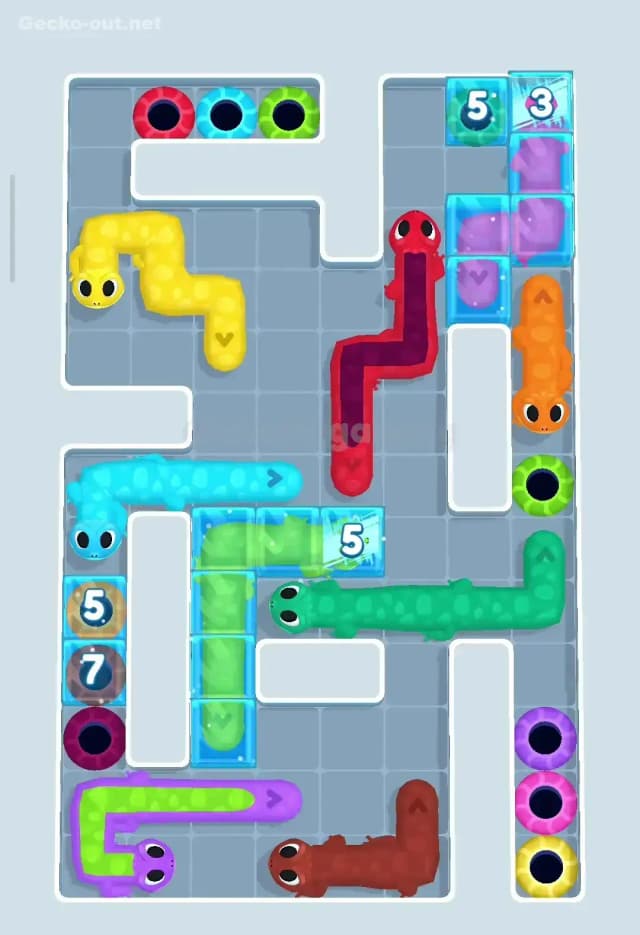
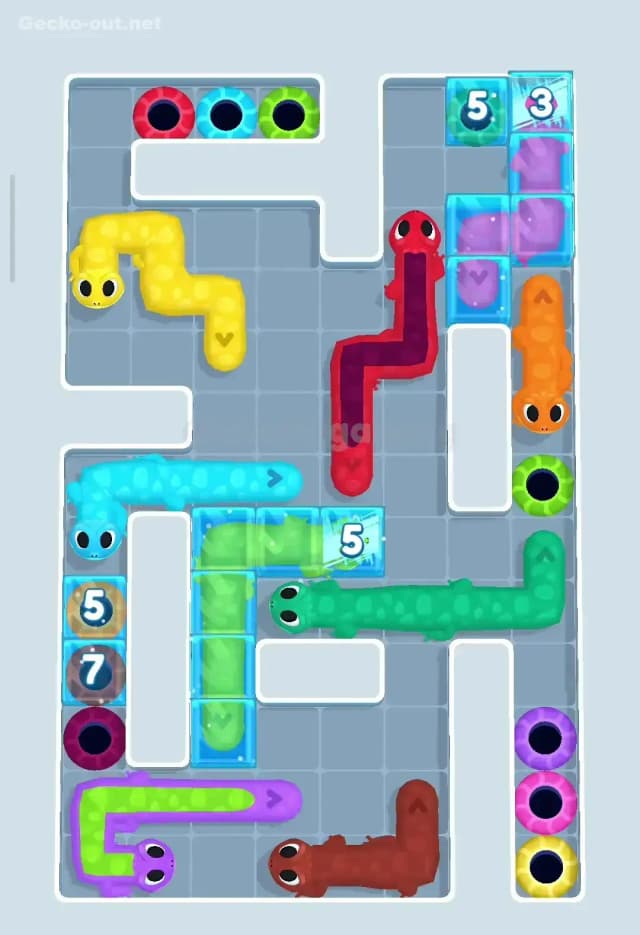
In Gecko Out Level 26 you’re dropped into a tall, narrow maze with seven geckos already woven through each other:
- A chunky yellow gecko camps in the upper‑left, curled in a small pocket just under a row of three colored exits.
- A long red gecko runs vertically in the upper middle, almost like a pillar that divides left and right.
- An orange gecko stands against the right wall in the middle, guarding the only straight lane down to the lower exits.
- A light blue gecko is stretched across the mid‑left, sitting just above the central obstacles.
- A long green gecko snakes across the middle on top of several icy tiles, bending down toward the lower half of the board.
- In the bottom‑left, you have a purple‑headed, lime‑bodied “gang” style gecko wedged into the corner corridor.
- A brown gecko lurks near the bottom‑right, right next to the vertical stack of four colored exit holes.
On top of that, Gecko Out 26 throws in a strip of numbered ice tiles (with 5s and 3s) that restrict movement across the middle and around the right wall. There are also a couple of numbered toll‑style tiles near a dark warning hole in the lower‑left that you never actually need to use if you route cleanly.
What you need to do (and why it’s tricky)
The win condition in Gecko Out Level 26 is the same as always: every gecko has to reach a hole of its own color before the timer hits zero. Because you drag the head and the tail follows the exact drawn path, every curve you make becomes permanent body until you move that gecko again.
That’s the real challenge here:
- Corridors are very tight, so a single bad S‑curve can permanently block an exit.
- The central ice band splits the board into a top section and a bottom section. Until you free the long green and orange geckos from their choke points, traffic between those halves is awful.
- The timer is strict enough that you can’t brute‑force random paths; you need one clean plan that avoids rewinding or re‑drawing big geckos.
Once you see Gecko Out 26 as a “traffic control” puzzle instead of a “draw something pretty” puzzle, it starts to feel much more manageable.
Pathing Bottlenecks and Logical Traps in Gecko Out Level 26
The main bottleneck you must respect
The biggest bottleneck in Gecko Out Level 26 is the right‑hand vertical lane controlled by the orange gecko and the brown gecko near the bottom exits.
That lane:
- Connects the central area to the vertical stack of exits at the bottom‑right.
- Is the only reasonably straight path that long bodies can take without wrapping awkwardly around walls.
- Gets locked instantly if you park orange or brown in the wrong direction.
If you try to clear the top geckos first and leave orange/brown “for later,” you’ll almost always discover that somebody’s body now seals off the entire right side. So the plan has to start by stabilizing that lane.
Subtle problem spots that cause softlocks
There are a few nasty little traps in Gecko Out 26:
- If you send the red gecko straight to its top exit too early, its body can sit across the main horizontal crossing, making it impossible for yellow and blue to weave out later.
- It’s tempting to drag the long green gecko wildly to “get it off the ice,” but big loops in the center create walls that neither the top group nor the bottom group can cross.
- The purple‑lime gang gecko at the bottom loves to form a plug across the left entrance to the lower corridor if you rotate it the wrong way, cutting off the blue gecko’s escape route.
None of these lose instantly; they just make you realize, 20–30 seconds later, that you’ve created a maze inside the maze.
When the level finally starts to make sense
For me, Gecko Out 26 clicked the moment I stopped thinking “How do I free this one gecko?” and instead thought “Where can I park each body so the board stays open?”
Once I accepted that:
- Orange and brown need to be handled first to open the right lane.
- Green’s job is to sit quietly along the outer edges, not dominate the center.
- The top trio (yellow, red, blue) should only really start moving after the mid‑lane is cleared.
…everything fell into place. The level still feels tight, but it stops feeling unfair.
Turn-by-Turn Path Strategy to Beat Gecko Out Level 26
Opening: secure the right lane and bottom exits
In Gecko Out Level 26, your opening is all about the right edge and bottom exits:
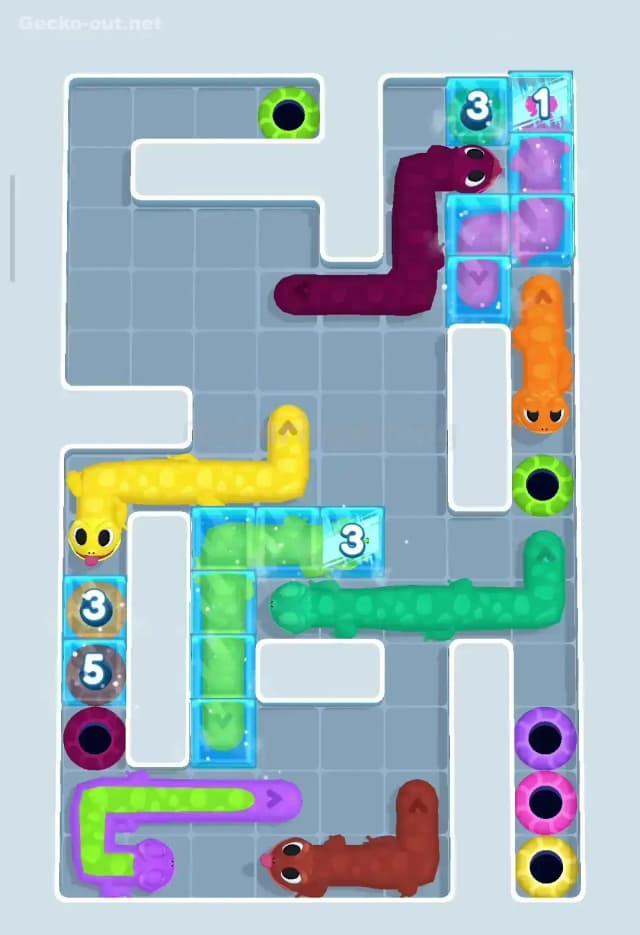
- Slide the orange gecko up and slightly left into the small pocket above the mid‑right, keeping its body tight against the wall. You’re not exiting it yet; you’re simply clearing the straight shaft downwards.
- Guide the brown gecko into its matching hole in the bottom‑right exit column. Use the now‑open right lane to draw a short, neat curve into the correct exit. Keep the path as straight as possible so you don’t sprawl across the center.
- With brown gone, re‑park orange: drag it so its body hugs the right wall but stops short of covering any exits. This keeps the vertical lane open for other geckos while orange waits its turn.
You’ve now removed the most awkward tail and created a clear path between the middle of the map and the bottom‑right exits.
Mid‑game: free the center without blocking yourself
The mid‑game of Gecko Out 26 is where most runs fail, so slow down and read the board for a second:
- Tame the long green gecko. Drag its head so the body runs along the lower outer edges instead of slicing through the middle. Think of green as a border: hug the bottom wall and one side wall, avoiding big loops in the central rows.
- Use the cleared central strip to free the blue gecko. From its mid‑left start, weave blue through the middle and up toward its matching top exit. Keep its body mostly horizontal so it doesn’t cut off vertical access for red and yellow.
- Exit or park the red gecko next. Draw red straight upward through any gap you left and into its top exit. If you can’t immediately reach the hole, at least park red tight against the top wall, leaving both middle and right lanes open.
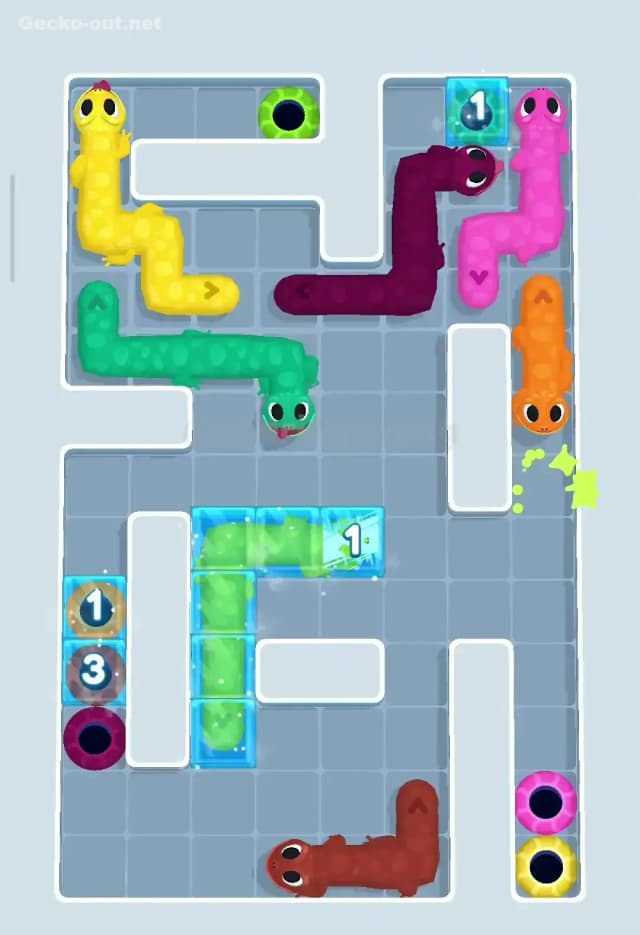
At this stage, the top of the board should be almost empty: blue and red are gone or tightly parked, and the only big bodies left are yellow, green, orange, and the purple‑lime gang at the bottom.
End‑game: finishing order and avoiding last‑second jams
The end‑game in Gecko Out Level 26 is surprisingly calm if you’ve kept your lines tidy:
- Exit the orange gecko using the right lane you’ve been preserving. Make a short, direct path from its parking spot into its matching exit (either in the central right or bottom‑right column).
- Uncurl the purple‑lime gang gecko. Now that brown and orange are gone, you can drag the head out of the bottom‑left corner and run its shared body along the path green is already tracing. Send the lime segment into its hole first if needed, then finish with the purple head.
- Finally, free yellow from the upper‑left. With red and blue gone, there’s space to weave yellow along the top corridor and then down through the central passage or right lane to its exit.
If you’re low on time near the end, prioritize straight routes over perfectly “clean” parking. By now, there’s so much space that a slightly messy yellow or gang path won’t trap anyone.
Why This Path Order Works in Gecko Out Level 26
Using follow-the-body rules to untangle the knot
The whole Gecko Out 26 plan revolves around how bodies follow your drag path:
- Clearing brown and parking orange early prevents long vertical bodies from sealing the exit column.
- Re‑drawing green along the outer edges converts it from a mid‑board wall into a harmless frame.
- Sending the small/medium geckos (blue and red) out through the top as soon as the mid‑lane is open means fewer bodies to navigate around when you finally handle yellow and the gang gecko.
Instead of pulling geckos randomly and tightening the knot, you’re deliberately assigning each big body a safe “lane” it’s allowed to occupy.
Managing the timer: when to think vs. when to move
Gecko Out Level 26 feels fast, but you do have time to think if you use it well:
- Pause at the start for 5–10 seconds and mentally trace where each color’s exit sits relative to its starting position.
- Move slowly but decisively in the opening and mid‑game. Those are the moments where a single bad path can ruin the board.
- Speed up in the end‑game. Once half the geckos are gone and the central arena is open, you can draw more confidently because there are fewer ways to trap yourself.
If you’re losing only by a second or two, it usually means you’re doing too many redo moves early. The cleaner your first drag for each gecko, the safer your time.
Are boosters needed for Gecko Out 26?
You can absolutely beat Gecko Out Level 26 with no boosters. They’re optional here:
- An extra time booster helps if you’re still learning the path order; pop it just before you start moving the top group (blue/red/yellow) so you don’t panic.
- A hammer‑style unblocker is overkill; if you need it, it probably means you let green or orange sprawl into the center instead of hugging the edges.
- A hint can be useful once, just to see which gecko the game wants you to move first. After you’ve seen that, try to solve the rest yourself so you actually learn the pattern.
Mistakes, Fixes, and Logic You Can Reuse in Other Gecko Out Levels
Common mistakes on Gecko Out Level 26 (and how to fix them)
- Clearing the top first. Players rush yellow, blue, and red, then realize the exits at the bottom are walled off. Fix: always stabilize brown/orange in the right lane before spending time on the top half.
- Letting green dominate the center. Big spirals from green look satisfying but cut the map in half. Fix: redraw green as a border along the outer walls.
- Parking orange across the exit column. Even one extra bend can block a color from ever reaching its matching hole. Fix: park orange vertically, hugging the wall, until you’re ready to exit it.
- Dragging the gang gecko too early. Purple‑lime flails around and plugs your left lower corridor. Fix: leave the gang gecko for the end‑game when the right side is clear.
- Over‑correcting paths. Repeatedly undoing and redrawing burns time. Fix: plan a short, straight path in your head, then draw it once.
Reusing this logic in other Gecko Out levels
The habits you build in Gecko Out 26 carry over to a lot of knot‑heavy or gang‑gecko stages:
- Always identify the main traffic lane and protect it like a highway.
- Turn the longest gecko into a border, not a divider.
- Solve from largest constraint to smallest: first the geckos that control exits or chokepoints, then the free‑floating ones.
- Treat gang geckos and frozen exits as end‑game puzzles after you’ve opened up space elsewhere.
Once you get used to assigning each gecko a “role” instead of just “get out now,” later levels make much more sense.
Final encouragement
Gecko Out Level 26 looks chaotic the first few times you open it, and it’s easy to feel like the timer is impossible. But with a clear order—right lane first, green to the edges, top group in the middle, and gang/yellow last—the whole level turns into a clean, repeatable pattern. Stick with that plan for a few runs, and Gecko Out 26 goes from frustrating to one of those satisfying “I’ve got this” levels you can beat on the first try every time.