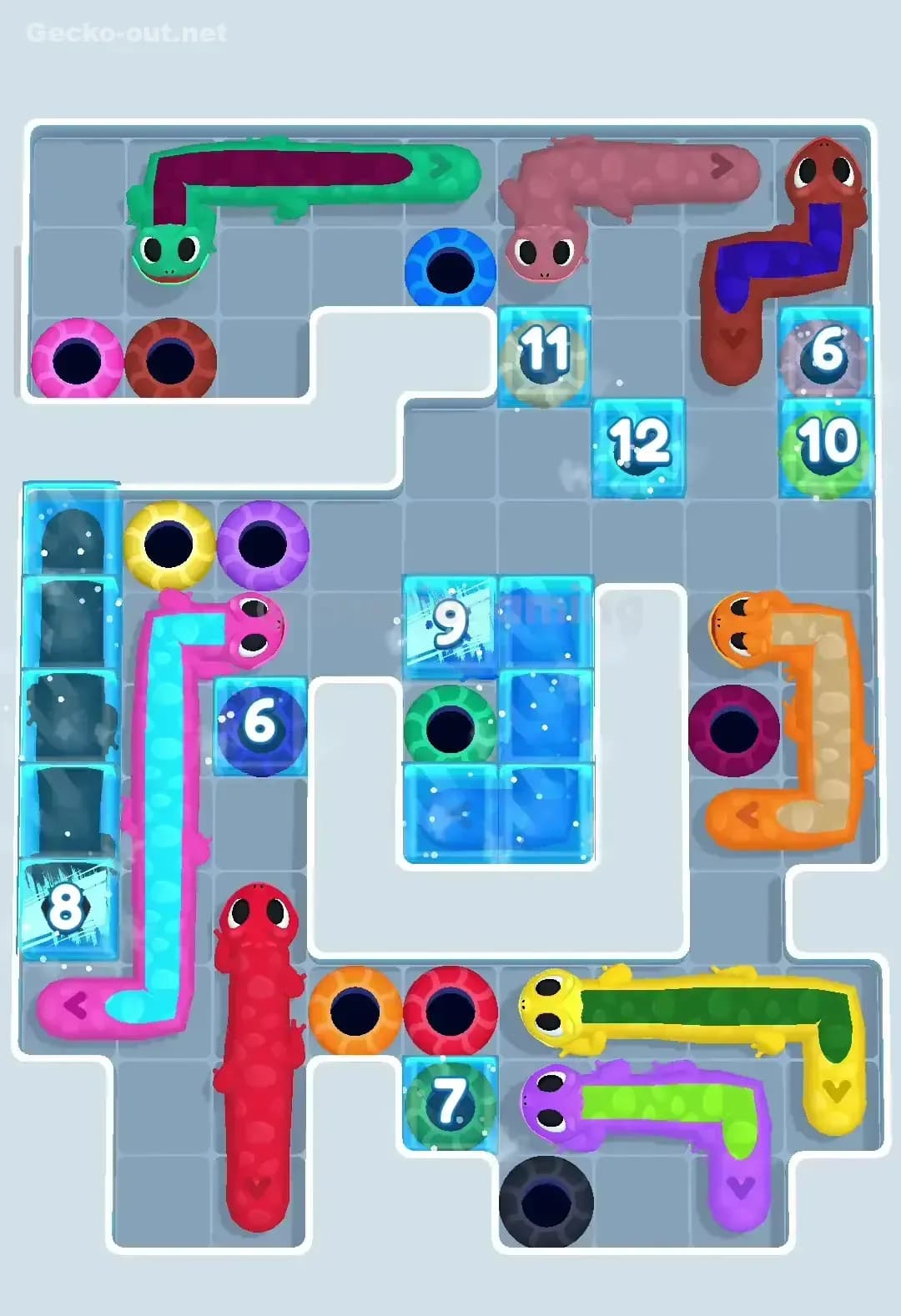
Gecko Out Level 220 Solution Walkthrough | Gecko Out 220 Answer
How to solve Gecko Out level 220? Get step by step solution & cheat for Gecko Out level 220. Solve Gecko Out 220 easily with the answers & video walkthrough.
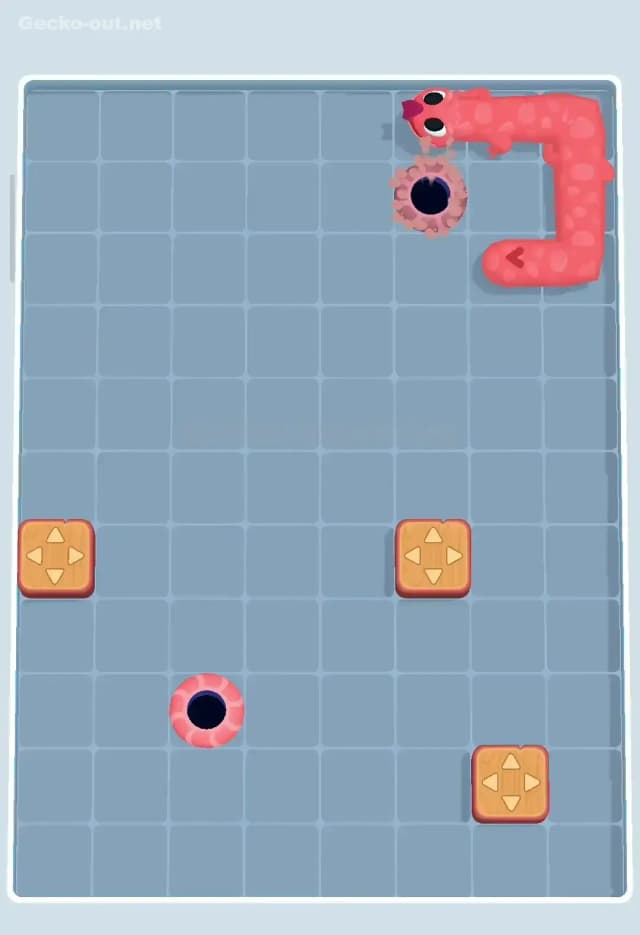
Gecko Out Level 220: Board Layout, Rules, and Win Condition
Starting board: crowded center, long bodies, frozen exits
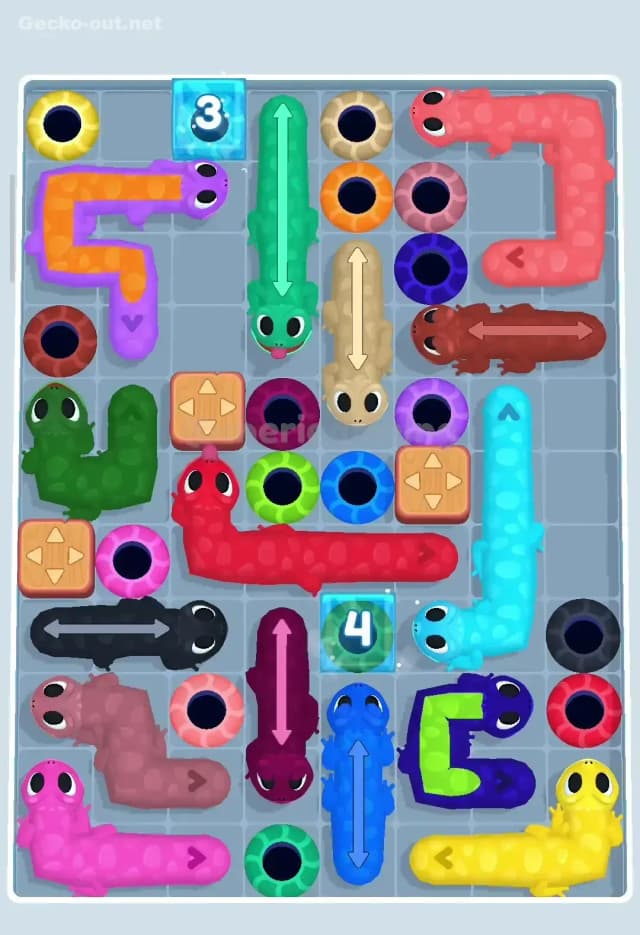
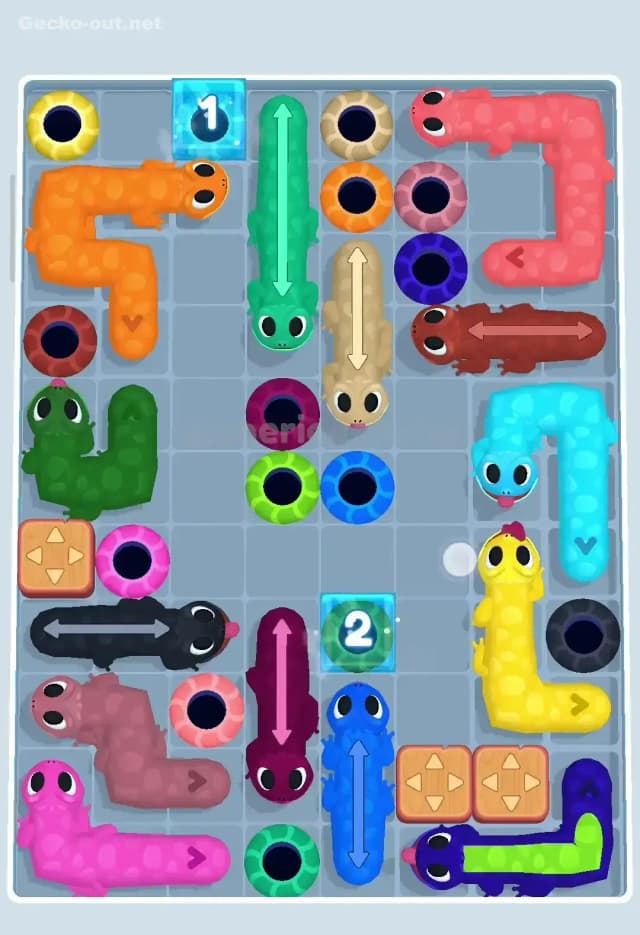
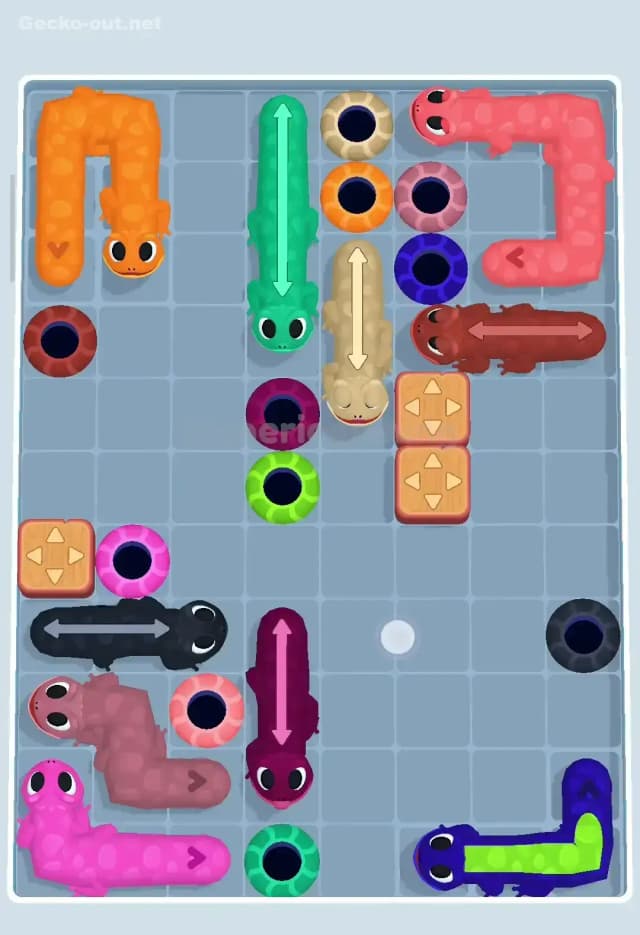
In Gecko Out Level 220 you’re dropped onto a very packed grid: around a dozen geckos in different colors, most of them long and twisty, with just a few short L‑shaped ones at the edges. The whole center of the board is a tangle of exits and tails.
The biggest things you’ll notice:
- A tall green gecko and a tall beige gecko stand almost straight in the middle column, like two pillars.
- A very long red gecko snakes horizontally through the middle rows.
- On the right side, an equally long light‑blue gecko wraps around several exits.
- At the bottom, a vertical blue gecko and a vertical purple gecko sit side‑by‑side, with a cluster of exits under and around them.
- Corner L‑shapes (pink, brown, yellow, dark green) hug the edges and look easy, but they’re trapped behind the long bodies.
- Wooden arrow blocks act as solid obstacles in the left‑center and right‑center.
- Two exits are frozen in ice with counters “3” and “4” on them; they only unlock after that many geckos have escaped.
Most exits are crammed into the central lanes, and many geckos already sit on top of or just in front of their matching colors. Gecko Out 220 looks like it should be quick to clear, but everything is parked in exactly the wrong order.
Win condition and how the timer shapes the puzzle
As always, you win Gecko Out Level 220 by dragging each gecko’s head so its body follows a path to a same‑colored hole. You can’t cross walls, other geckos, or frozen exits, and you can’t share tiles. Whatever path you drag, the body retraces exactly, so any weird loop you make becomes a permanent knot for later.
The timer is tight here. You don’t have time to freestyle every run. The trick in Gecko Out 220 is to:
- Spend a bit of time upfront reading the layout and choosing a path order.
- Use long, smooth drags that park bodies in safe “lanes” along the edges.
- Avoid unnecessary wiggles, because every extra tile is extra time and extra tangle.
Once you understand which gecko is the real blocker and which exits only open later, the level stops feeling chaotic and starts feeling like a planned unweaving.
Pathing Bottlenecks and Logical Traps in Gecko Out Level 220
The main choke lane in the center
The single biggest bottleneck in Gecko Out Level 220 is the vertical corridor made by the tall green gecko, the tall beige gecko, and the long red gecko that cuts across them.
- The green and beige bodies block most vertical movement through the middle.
- The red gecko’s long horizontal body blocks the main left‑right crossing.
- Several exits, including ones for those same geckos, sit just beyond this cross, teasing you.
Until you move those three in a controlled way, nothing else can reach its hole cleanly. Treat that central cross as the “lock”; the rest of the level is just finding enough space to rotate those three around without jamming everyone else.
Sneaky problem spots that bite later
I ran into the same three subtle traps over and over:
- Lower‑left cluster. The black horizontal gecko and the pink L‑shaped gecko share a small pocket. If you send pink out too early without parking black cleverly, black ends up blocking multiple central exits.
- Right‑side wrap. The light‑blue gecko on the right wants to sit against the outer wall, but if you drag it straight to its exit, its body can slice across future routes for the blue and purple vertical geckos at the bottom.
- Frozen exits with “3” and “4”. It’s tempting to plan paths through those frozen tiles, then realize mid‑run that they still act as solid blocks. If you’re not counting how many geckos have already escaped, you’ll keep trying routes that literally can’t exist yet.
These aren’t obvious at the start; they’re the places where a run looks good until the last two geckos, and then you realize you’ve drawn a permanent wall with someone’s tail.
When the solution starts to make sense
For me, Gecko Out 220 clicked when I stopped trying to solve it “exit by exit” and started solving it “lane by lane.” Instead of asking “How do I get red to its hole right now?” I asked, “How do I turn the center into a clear + shape of open space?” Once that mindset changes, you see:
- Left edge and right edge are your parking lanes.
- The bottom third of the board is where you temporarily park long vertical geckos.
- Exits attached to frozen holes are late‑game targets, not early goals.
After a couple of restarts with that idea, the level becomes a controlled sequence rather than a frantic scramble.
Turn-by-Turn Path Strategy to Beat Gecko Out Level 220
Opening: clear corners and create parking lanes
Your opening in Gecko Out Level 220 is all about making room:
- Free the lower‑left. Slide the black horizontal gecko tightly along the left wall, parking it just above or below the dark‑green L. You want that black body out of the central exit cluster.
- Send one quick early escape. The pink L‑shaped gecko near the bottom‑left usually has the shortest, safest route to its pink hole. Take that exit first to start the counter ticking toward unlocking the “3” tile.
- Tuck the corner L‑shapes to the edges. Move the dark‑green and brown L‑geckos so they hug the left or bottom borders, not drifting into the center. Think of them as wall decorations for now.
- Shift the long red slightly down and toward the bottom. Don’t send red home yet. Just nudge it so its body lines up more with the lower rows, giving the middle more vertical breathing room.
At the end of the opening, you want both side edges mostly filled with parked bodies and the central rows starting to feel a little less claustrophobic.
Mid-game: rotating the long geckos without blocking exits
The mid‑game of Gecko Out 220 is where you untie the main knot:
- Reposition the tall green gecko. Drag the green head in a smooth loop that ends with its body hugging either the far left or far right wall, avoiding crossing holes. The goal is to clear that central vertical lane.
- Immediately follow by straightening the beige gecko. With green out of the way, you can drag beige through the now‑open center, again ending against an outer wall or in a clean vertical line leaving exits exposed.
- Use the freed center to exit 1–2 mid‑length geckos. Often the brown or dark‑red mid‑length gecko near the middle can now reach its exit. Take these “cheap” exits to push the count up toward unlocking the 3‑ and 4‑gecko frozen holes.
- Handle the right‑side blue and light‑blue pair. Once the central cross is looser, drag the light‑blue gecko along the right edge, then feed it into its matching hole without crossing the lane needed by the vertical blue gecko. After that, send the vertical blue down or up through the gap you just created.
All through this phase, the rule is: any time you drag a long gecko, end its path flush against a wall, never drifting diagonally through the exit cluster. If you’re drawing a path that weaves around multiple exits, you’re tightening the knot instead of loosening it.
End-game: exit order and what to do when the timer is low
In the end‑game of Gecko Out Level 220, most of the bodies should already be resting along the outer edges, leaving the exits in the middle mostly visible.
A solid closing sequence looks like this:
- Use the newly opened “3” frozen exit. As soon as three geckos are out, check which color owns that now‑unfrozen hole and send that gecko next. You planned its route earlier by keeping that lane relatively clear.
- Clear the last mid‑length blockers. The remaining mid‑sized geckos in the center (often the dark purple vertical and any leftover L‑shapes) should now have almost direct paths to their exits.
- Finish with the longest red or yellow bodies. Save the truly massive snakes, like the red horizontal and the long yellow near the bottom‑right, for last. By now nothing else needs those lanes, so it doesn’t matter if their tails carve through the board.
If you’re low on time at this stage, stop over‑planning. Fire off the geckos that already have nearly straight paths. It’s often better to win with a slightly messy last route than to restart trying to be perfect.
Why This Path Order Works in Gecko Out Level 220
Using body-follow pathing to untangle the knot
Gecko Out Level 220 punishes greedy “shortest path” drags. The plan above works because you:
- Move long geckos early but park them on walls, turning them from moving obstacles into static boundaries.
- Use the body‑follow rule to your advantage: every loop is intentional, placing tails where they won’t matter later.
- Delay exits that would cause permanent walls (like sending the huge red gecko home too early) until nobody else needs those rows.
You’re not just getting geckos out; you’re redesigning the traffic lanes of the board.
Managing the timer: think first, then commit
For Gecko Out 220, I recommend:
- First attempt: spend 20–30 seconds just reading lanes and imagining where the long geckos will park.
- Subsequent attempts: repeat the same opening moves quickly, almost from muscle memory, then slow down again only at the mid‑game pivot where you rotate the green, beige, and red bodies.
This rhythm—plan → execute fast → pause → finish—uses the timer efficiently without stressing you out.
Boosters: optional, and when they help
You don’t need boosters to beat Gecko Out Level 220, but they can bail you out:
- Extra time booster: Best used right after your opening, if you know you’re a slow dragger and want breathing room for the central rotation.
- Hammer/clear tile booster: If you really hate one specific bottleneck (often a single wooden arrow block), removing that obstacle makes the level trivial.
- Hint booster: Useful once just to see which gecko the game thinks is next; don’t rely on it for every move, or you’ll never learn the lane logic.
If you’re aiming to improve, treat boosters as practice tools, then replay Gecko Out 220 booster‑free.
Mistakes, Fixes, and Logic You Can Reuse in Other Gecko Out Levels
Common errors on Gecko Out Level 220
Here are the big mistakes I see on Gecko Out 220 and how to fix them:
- Sending the longest geckos out first. Fix: Park long bodies along walls early, but delay their exits until the board is mostly clear.
- Drawing wiggly “scribble” paths. Fix: Aim for straight segments and big gentle curves; every extra bend is another future block.
- Ignoring frozen exits. Fix: Always ask, “How many geckos are out?” before relying on paths through the “3” and “4” tiles.
- Parking on top of exits. Fix: Never end a temporary path on an exit unless you’re actually finishing that gecko; it blocks the hole for later.
- Clearing random geckos instead of lanes. Fix: Think in terms of freeing the central cross first, then the side pockets.
Reusing this approach on other knot-heavy levels
The logic that beats Gecko Out Level 220 is gold on similar puzzles:
- Identify the single lane that everything must pass through and clear that first.
- Park long or “gang” geckos along the outermost walls so they stop cutting the board in half.
- Treat frozen exits and toll gates as late‑game routes; don’t base early plans on them.
- Always visualize where a tail will end up before you start dragging the head.
Once you get used to solving the traffic lanes rather than individual exits, other knot‑heavy and frozen‑exit stages feel much more manageable.
Gecko Out 220 is tough, but absolutely beatable
Gecko Out Level 220 looks brutal at first glance, and I won’t lie—my first few runs were a mess of tangled tails and timeouts. But once I focused on the center bottleneck, used the edges as parking lanes, and respected the frozen exits, the solution felt clean and repeatable.
Stick to the lane‑first plan, keep your paths smooth, and don’t panic when the timer starts flashing. With a clear sequence, Gecko Out 220 goes from “impossible traffic jam” to a really satisfying untangle.