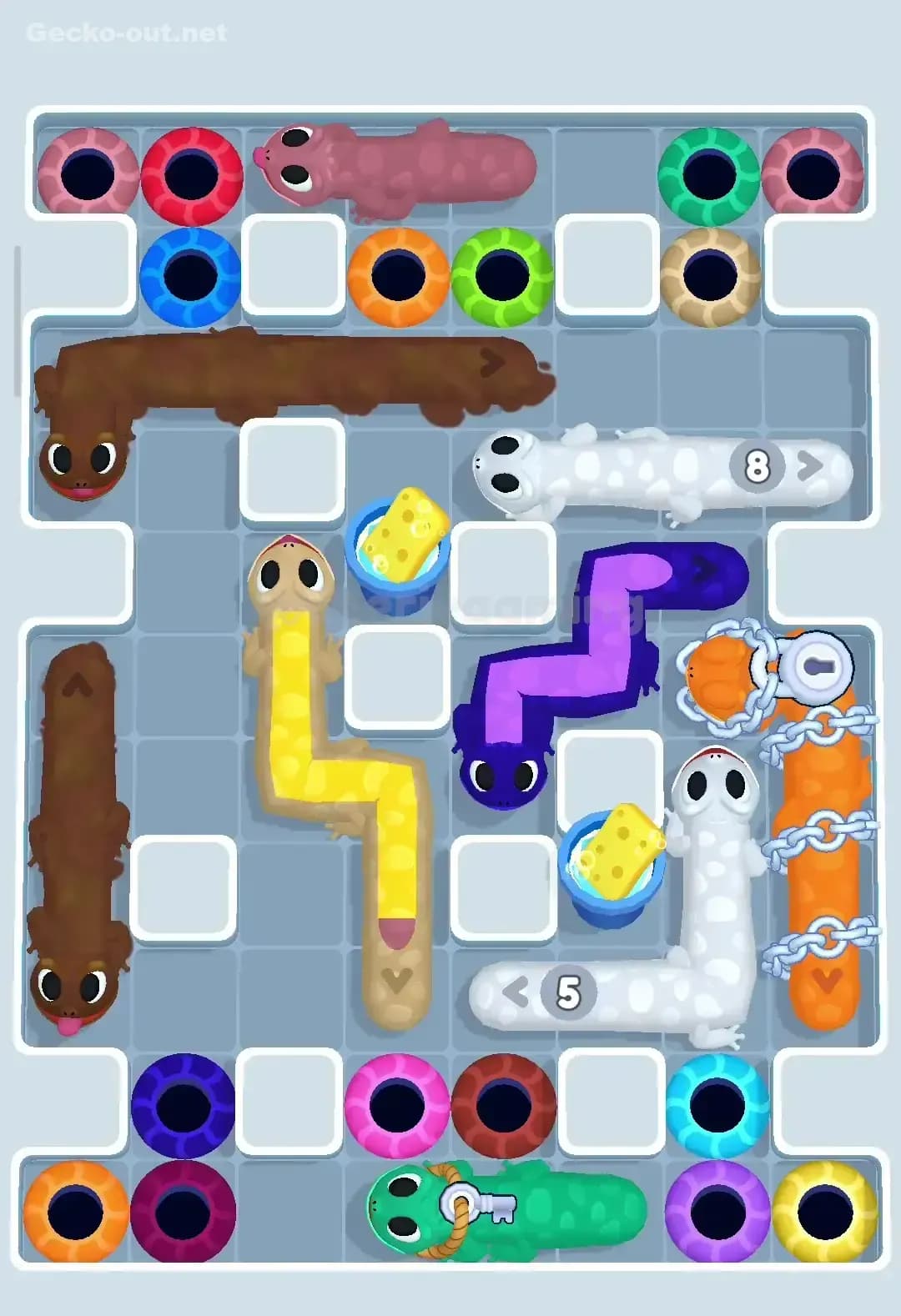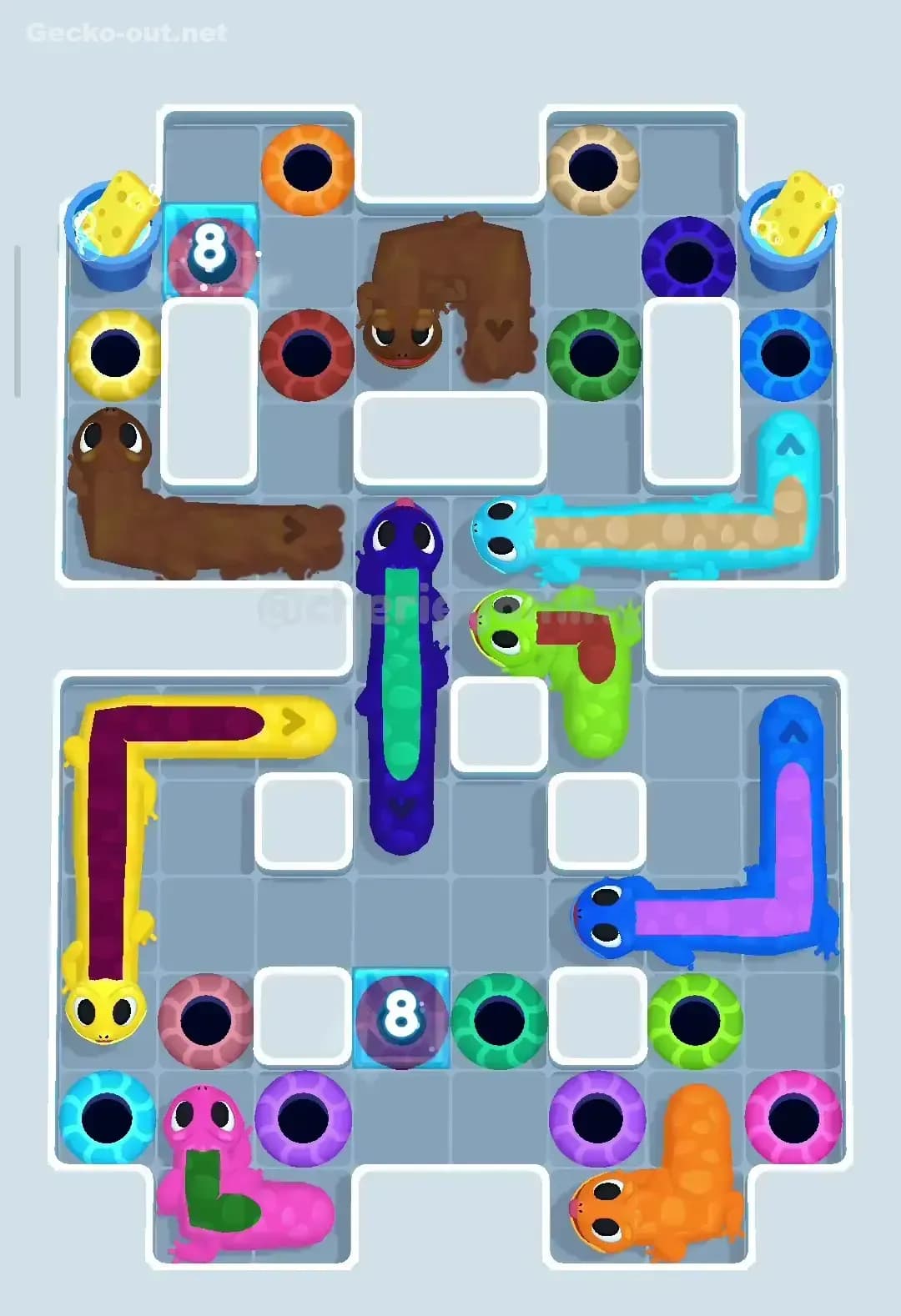
Gecko Out Level 250 Solution Walkthrough | Gecko Out 250 Answer
How to solve Gecko Out level 250? Get step by step solution & cheat for Gecko Out level 250. Solve Gecko Out 250 easily with the answers & video walkthrough.
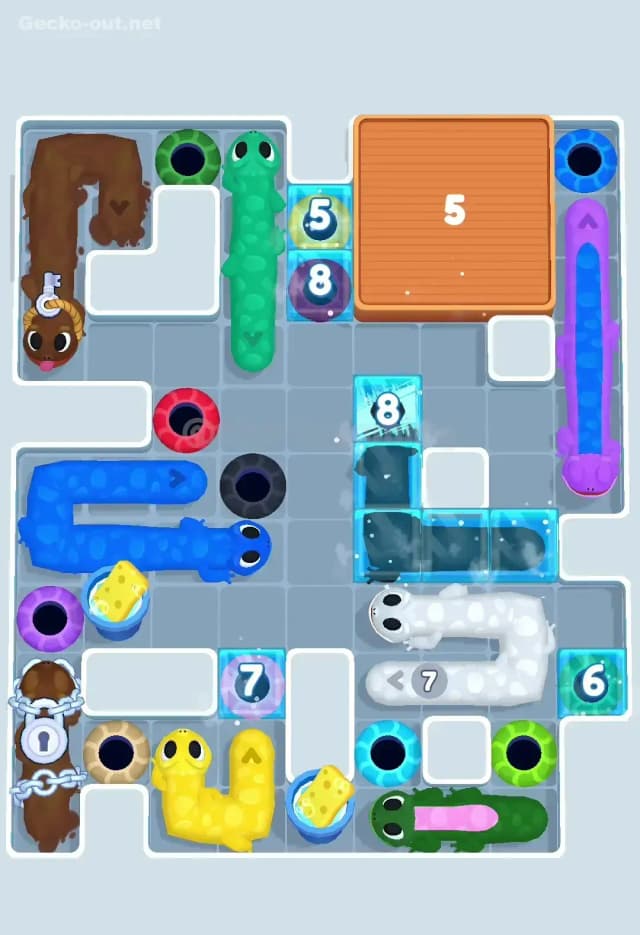
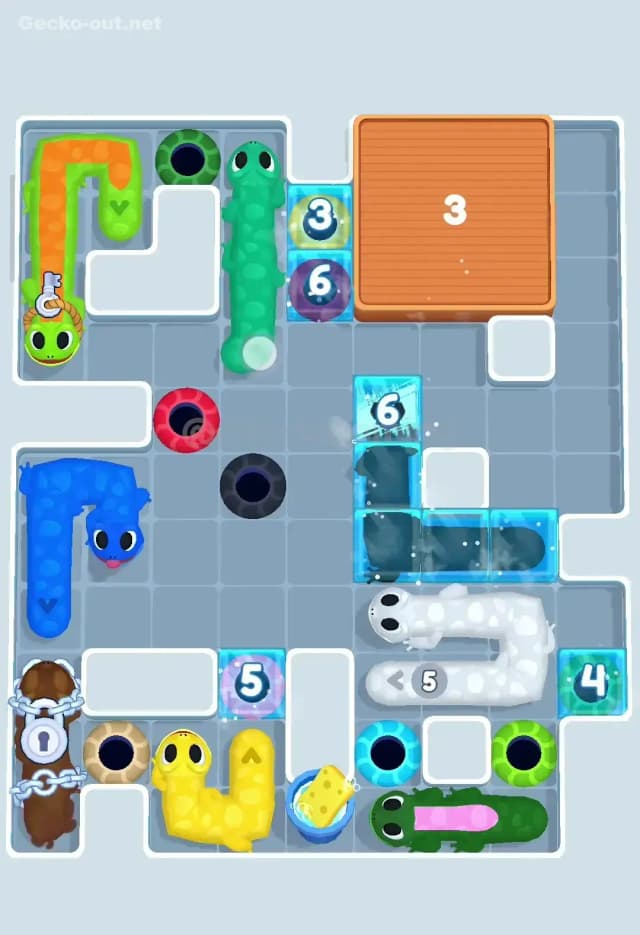
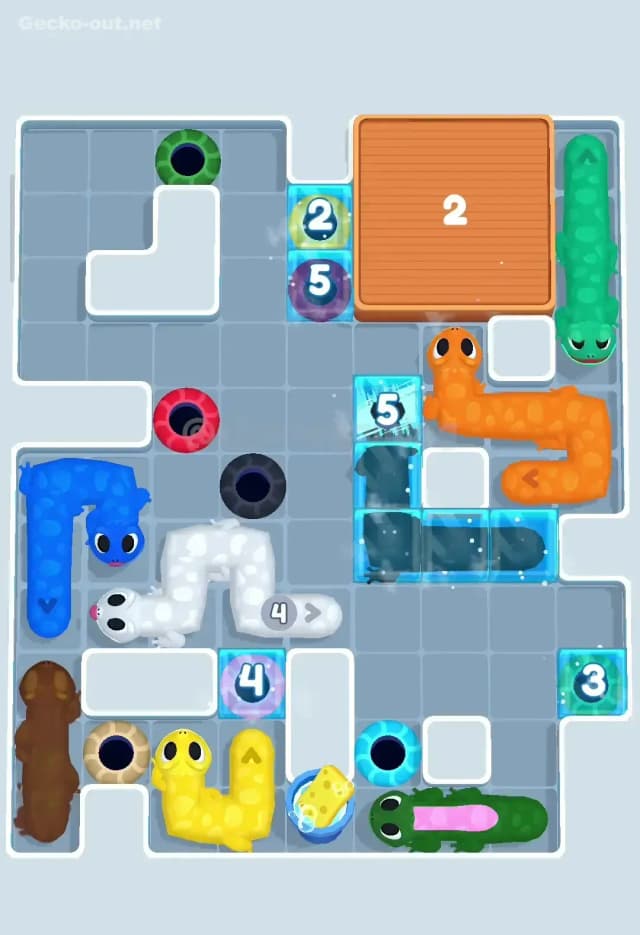
Gecko Out Level 250: Board Layout, Rules, and Win Condition
What You’re Dealing With On This Board
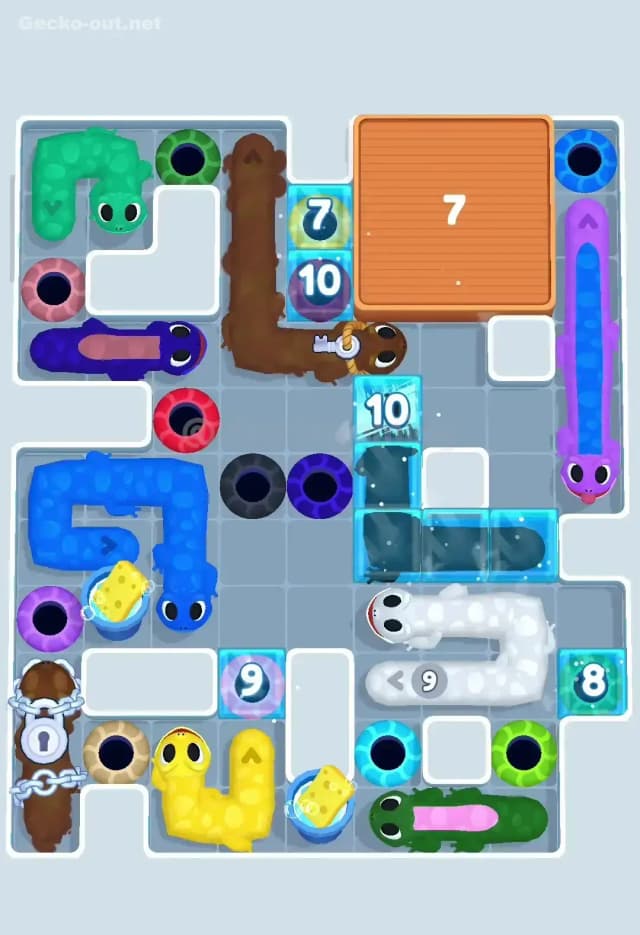
Gecko Out Level 250 throws a lot at you at once. You’ve got a crowded grid with around nine geckos in total, in multiple colors:
- A green gecko curled in the top‑left corner right beside its matching green exit.
- A short purple gecko on the left side near a purple exit and a dangerous red/black warning hole.
- A big blue gecko in the lower‑left/center area, wrapped around a sponge bucket.
- A vertical brown “key” gecko in the center corridor holding the key that unlocks a chained brown gecko at the bottom left.
- That chained brown gecko sitting horizontally at the bottom left, blocking a tan exit.
- A yellow gecko at the lower center pointing upward, again next to a sponge bucket.
- A green gecko at the bottom right near green and blue exits.
- A long white gecko curving around the lower‑right quadrant.
- A tall purple/pink gecko hugging the right wall with its exit near the top right.
On top of the geckos themselves, Gecko Out 250 adds:
- Several exits encased in ice with numbers like 7, 8, 9, and 10 on them.
- Dark ice blocks forming a rigid vertical wall in the right‑center.
- Warning holes in black/red that you can’t accidentally path a gecko into.
- One large wooden crate in the upper‑right that eats up precious space.
The sponge buckets matter because you can drag a gecko through them to “carry” the sponge along its path, clearing icy tiles as you go. The key gecko matters because the chained brown gecko stays locked until that key gecko reaches its exit.
Win Condition And Why The Timer Hurts So Much
To clear Gecko Out Level 250 you must:
- Get every gecko into a hole of its own color.
- Never drive a gecko over walls, other bodies, frozen exits, or warning holes.
- Do it all before the strict timer hits zero.
Movement is path‑based. When you drag a gecko’s head, its body follows exactly through each tile you trace. That’s what makes Gecko Out Level 250 so tricky: a “nice looking” path can leave a giant snake of a body blocking three exits you still need later.
The frozen exits with numbers add a second time axis. Those numbers tick down as you make moves; until they hit zero, that exit is unusable, so you’re forced to spend your early turns re‑parking geckos and clearing ice without accidentally sealing off the parts of the board you’ll need once those exits thaw. If you rush the wrong gecko or draw a long, loopy route, you’ll lose to either the global timer or to your own body traffic jam.
Pathing Bottlenecks and Logical Traps in Gecko Out Level 250
The Main Bottleneck: The Central Brown Key Gecko
The biggest bottleneck in Gecko Out Level 250 is the tall brown key gecko sitting in the center corridor. Its body runs from mid‑top down into the middle of the map, almost perfectly splitting the board into left and right halves.
Why it’s such a problem:
- Until you move it, left‑side geckos (green, purple, big blue) and right‑side geckos (white, tall purple, bottom‑right green) can barely cross paths.
- You also need that brown key gecko to exit, otherwise the chained brown gecko in the bottom‑left stays locked and permanently blocks that corner.
So the level quietly demands: solve the central corridor first. If you ignore that and start by shuffling the big blue or white geckos, you’ll trap yourself.
Subtle Trap 1: Ice‑Gated Exits With High Numbers
Several exits are frozen with high numbers (7, 9, 10). Early on, those exits are unusable, but your geckos can still slither around them. The trap is drawing a “temporary” path that wraps around these iced tiles, then realizing that when the ice melts, the newly opened exit is completely blocked by someone’s tail.
I’ve done this here by parking the big blue gecko around the central area—when the 9‑exit thawed, it was fully walled in by blue segments. You want to keep the tiles adjacent to frozen exits relatively clean, especially near the middle of the board.
Subtle Trap 2: The Right‑Side Vertical Corridor
The right edge of Gecko Out 250 has a long purple gecko and a frozen wall of dark ice in front of the white gecko. It’s very tempting to “solve” that by dragging the purple gecko along the open lane as soon as you can.
Two problems:
- If you send purple out too early, its body can cut across paths you’ll later need for white and green.
- If you weave purple around the frozen wall, you might block the only clean line white has once the ice disappears.
Treat that vertical lane as shared real estate. Don’t let any one gecko own it for too long.
Subtle Trap 3: Buckets And Over‑Cleaning
Those sponge buckets near the blue and yellow geckos look like freebies, but running a long path just to “use up” a sponge wastes time and may over‑clear ice that was actually helping you restrict movement. One of my early failures came from clearing the right‑side ice too soon; suddenly white had too many options and I accidentally parked it over the tiles I wanted as exits later.
Use the sponges surgically—only clean what opens a critical route.
When The Level Starts To Make Sense
I’ll be honest—Gecko Out Level 250 feels like a mess at first glance. It clicked for me once I stopped trying to exit geckos in color order and started thinking in terms of corridors:
- Free the central corridor (brown key gecko).
- Stabilize the left block of geckos without stretching them across the board.
- Unlock and clear the bottom‑left.
- Only then commit to the right‑side geckos when the frozen exits are nearly ready.
Once you think “lanes” instead of “colors”, the level stops feeling chaotic and you can see a clear route.
Turn-by-Turn Path Strategy to Beat Gecko Out Level 250
Opening: What To Solve First And Where To Park
In Gecko Out 250, your opening goal is to unlock space without committing to long exits.
-
Nudge the central brown key gecko:
- Draw a short, efficient path that sends it toward its matching brown hole without wrapping around other exits.
- As soon as it exits, the chained brown gecko in the bottom‑left unlocks.
-
Park the left‑side geckos safely:
- Slide the top‑left green straight into its nearby green hole; it’s quick and doesn’t clutter the board.
- Nudge the small purple on the left just enough so it doesn’t block the big blue gecko’s eventual route, but don’t send it out yet if its exit is still iced or surrounded by other bodies.
-
Prepare the big blue gecko:
- Use blue to grab the nearby sponge, clearing only the ice that directly blocks central paths or a future exit.
- Park blue in a tight “S” or “Γ” shape along the lower‑left edge, leaving the central row open.
You should come out of the opening with the central key gecko gone, the left corner partially cleared, and the timer still healthy.
Mid-game: Keeping Lanes Open And Moving The Long Bodies
Mid‑game in Gecko Out Level 250 is about respecting lanes:
-
Clear the chained brown gecko:
- Now that it’s unlocked, drag it along the very bottom row or along the far left, directly into its tan/brown exit.
- Avoid swinging it through the central rows; its length will block everything.
-
Start shaping the white gecko:
- Even if its exit or surrounding ice isn’t ready, you can pre‑shape white into a compact U near the lower‑right, leaving the center column lanes free.
- Don’t let white drape across the right‑side entrance where purple or green will need to pass.
-
Keep a “spine” down the middle clear:
- When you move any gecko, imagine a vertical spine from top middle to bottom middle; try not to leave long segments permanently in that area.
- This spine is how the last couple of geckos will snake to their exits without backtracking.
-
Use yellow and bottom‑right green as flex pieces:
- Yellow, thanks to its nearby bucket, can act like a little ice‑breaker; clear only the tiles that block your spine or a final exit.
- Park bottom‑right green hugging the right wall or lower boundary, not across central tiles.
By the end of the mid‑game, most frozen exits should be close to thawing, and you want the board to look “vertical” rather than “sprawling”: bodies hugging edges, middle mostly open.
End-game: Exit Order, Avoiding Chokes, And Low-Time Decisions
For the end‑game of Gecko Out 250, you’re playing almost on instinct, so pre‑decide your exit order:
-
First: Short, edge‑hugging geckos
- Send out any remaining small geckos on the edges (left purple, bottom‑right green, yellow) as soon as their exits are free.
- Their paths should be straight lines through already‑open lanes.
-
Second: Tall purple on the right
- Use the right‑side vertical corridor once, efficiently, to guide purple to its exit without weaving.
- Make sure white is curled away so purple doesn’t slice through its planned route.
-
Last: The big bodies (blue and white)
- Blue often goes second‑to‑last, threading up through the now‑empty center.
- White is usually last: once every other gecko is gone, you’ve got full freedom to draw a long, smooth path to its exit without worrying about blocking anyone else.
If you’re low on time:
- Prioritize exits that are one or two drags away over complex re‑parking.
- Don’t re‑optimize a path that “works but isn’t pretty”; as long as it doesn’t cut off another unsolved gecko, commit.
Why This Path Order Works in Gecko Out Level 250
Using Head-Drag Pathing To Untangle Instead Of Knotting
The whole plan for Gecko Out Level 250 is built around how bodies follow the head’s path:
- Early exits (key brown, top‑left green) are short, straight routes that remove bodies from crowded zones.
- Parking moves always curl geckos against walls or in corners so their trailing bodies don’t sprawl across key tiles.
- Leaving a central spine open gives you a guaranteed late‑game highway when other options are gone.
You’re basically tightening each gecko into a compact coil near a wall, then releasing them in a controlled order once exits and ice allow it.
Balancing Reading The Board With Moving Fast
With the strict timer in Gecko Out Level 250, you can’t overthink every move, but you also can’t just drag wildly.
My rhythm here:
- First 5–8 seconds: Don’t move at all; just read the board and mentally mark your lanes (left block, central spine, right corridor).
- Next phase: Make short, deliberate moves (key gecko, green, small parking shifts) where you already know the exact destination.
- Final phase: When only a couple of large geckos are left, you can afford longer drags because nothing else needs the space.
If you catch yourself redrawing the same path more than twice, stop and reevaluate; it usually means you’re ignoring a simpler lane.
Boosters: Optional, Not Required
Gecko Out 250 is beatable without boosters, but a couple can help if you’re stuck:
- Extra time: Best used right before you start exiting the final three geckos (tall purple, blue, white). That’s when long paths matter and mistakes are most punishing.
- Hammer/ice breaker: If you consistently mismanage the frozen exits, using a hammer on one key ice block near the central spine can simplify things—just don’t rely on it, or you won’t learn the lane logic.
- Hint: If you’re completely lost, a single hint early on can confirm that sending the key brown gecko first is correct.
Still, I’d treat boosters as a safety net; the core pathing idea is strong enough to clear Gecko Out Level 250 on its own.
Mistakes, Fixes, and Logic You Can Reuse in Other Gecko Out Levels
Common Mistakes On Gecko Out Level 250 (And Fixes)
-
Exiting the wrong gecko first
- Mistake: Sending out a random small gecko while leaving the key brown gecko in the center.
- Fix: Always clear the key gecko early to unlock its chained twin and open the board.
-
Overusing sponge buckets
- Mistake: Dragging long, looping routes just to clean “all” the ice.
- Fix: Only clear ice that blocks an exit or the central spine; leave the rest alone.
-
Blocking frozen exits before they thaw
- Mistake: Parking big blue or white directly next to high‑number frozen exits.
- Fix: Keep at least one tile clear around important frozen holes so you can reach them instantly later.
-
Filling the central spine with bodies
- Mistake: Curling multiple geckos through the middle because it’s convenient.
- Fix: Hug edges with your parking paths and treat the spine as sacred late‑game space.
-
Panicking when the timer gets low
- Mistake: Redrawing routes repeatedly in the last few seconds.
- Fix: Pre‑decide your final exit order (edges → tall purple → big blue → white) so you can drag confidently.
Reusing This Logic In Other Knot-Heavy Levels
The approach you use on Gecko Out Level 250 works great on other knot‑heavy, gang‑gecko, or frozen‑exit stages:
- Identify the key corridor (like the central spine here) and keep it clear for the late game.
- Exit or reposition unlock geckos (key carriers, gang leaders) before anyone else.
- Use corners and walls as parking bays for big bodies so they don’t sprawl.
- Treat frozen exits with numbers as future goals; don’t block the tiles around them while you wait.
Once you start thinking in terms of lanes, unlocks, and parking spots instead of pure color matching, every complex Gecko Out level gets easier.
Final Encouragement For Gecko Out Level 250
Gecko Out Level 250 looks brutal, and it absolutely can be if you play it reactively. But with a clear plan—key brown first, edges parked tight, central spine reserved for late‑game routes—you’ll see that the level is completely fair and very beatable.
Stick to the lane logic, resist the urge to over‑clean ice, and trust your exit order. After a few attempts, you’ll suddenly have that run where everything lines up and all the geckos dive into their holes with seconds left on the clock.