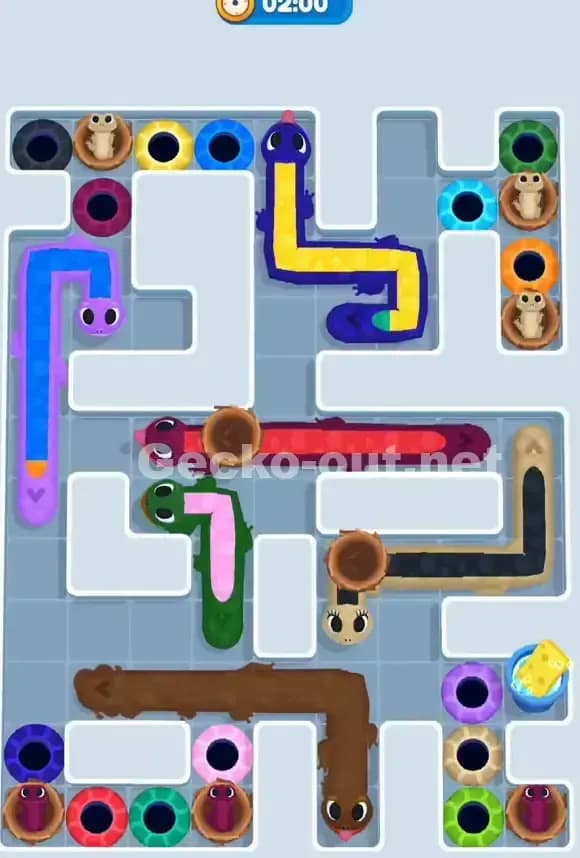
Gecko Out Level 767 Solution Walkthrough | Gecko Out 767 Answer
How to solve Gecko Out level 767? Get step by step solution & cheat for Gecko Out level 767. Solve Gecko Out 767 easily with the answers & video walkthrough.

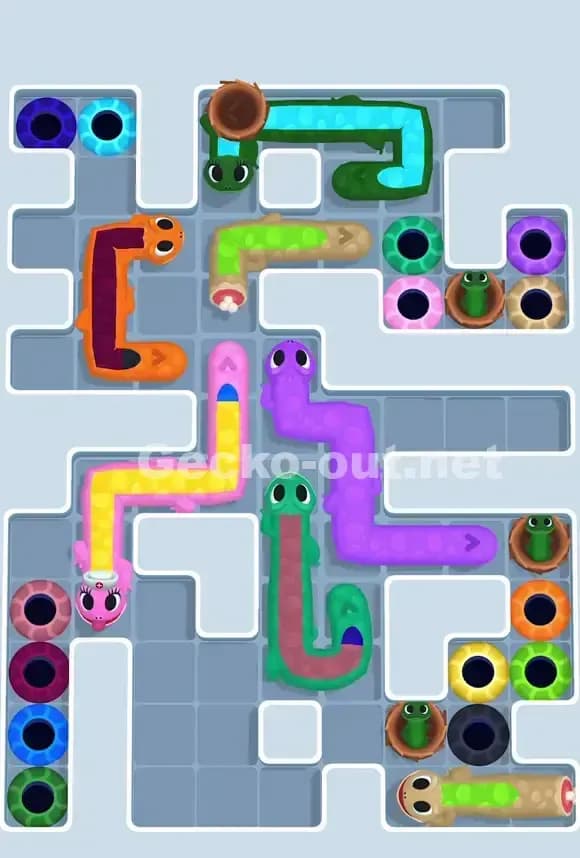
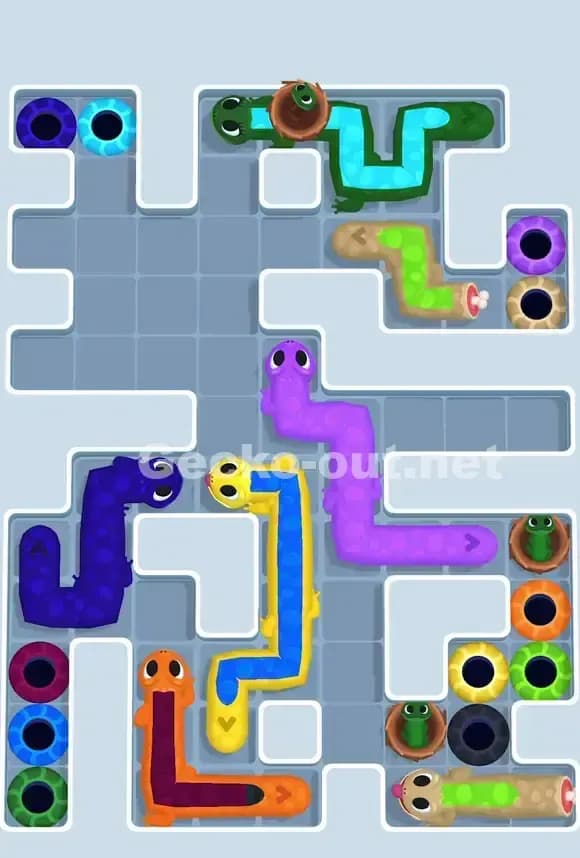

Gecko Out Level 767: Board Layout, Rules, and Win Condition
Starting Board: Geckos, Colors, and Layout Overview
Gecko Out Level 767 is a beast—you're facing eight geckos spread across a maze-like grid with multiple colored holes scattered throughout the playfield. At the top left, you've got a blue gecko and a cyan gecko stacked vertically, with a pink gecko below them forming an L-shaped cluster. On the left side of the board, there's a vertical stack of colored geckos (red, purple, blue, and green) that looks deceptively simple but acts as a major traffic jam. The right side features a green gecko, a brown gecko, and additional geckos in cyan, pink, and orange zones. There are also gang-linked geckos (geckos tethered together) that move as a single unit, which adds serious complexity. Scattered throughout are white walls creating a narrow, winding corridor system that forces long detours. A lime-green booster column sits in the center-bottom area, and colored exit holes match specific gecko colors—but here's the catch: not every hole is accessible from every starting position.
Win Condition and Timer Pressure
You win Gecko Out Level 767 by guiding all eight geckos to their matching-colored exit holes before the timer expires. The timer typically gives you 90–120 seconds, which sounds generous until you realize that dragging long gecko bodies through tight corridors eats time fast. Each head you drag must chart a path that the body will follow precisely—no shortcuts, no overlap with walls or other geckos. If even one gecko doesn't make it to the exit when time runs out, the level resets. This means you can't afford to waste moves on trial-and-error pathing; you need a rock-solid strategy before you start pulling heads.
Pathing Bottlenecks and Logical Traps in Gecko Out Level 767
The Left-Side Stack: Your Primary Bottleneck
The vertical stack of geckos on the left side (red, purple, blue, green) is the critical chokepoint in Gecko Out Level 767. These four geckos are literally stacked on top of each other in a single column, and their exit holes are positioned in completely different zones. The red gecko needs to exit bottom-left, the purple gecko needs to reach a right-side hole, and the blue and green geckos have their own escape routes. Here's what makes this brutal: to free the purple gecko in the middle, you have to move the red gecko first. But to move red without tangling everyone, you need to chart a path that doesn't block purple's exit route. Then purple has to snake all the way across the board to a hole on the right, which means its body is going to occupy prime real estate that other geckos desperately need. The order in which you unstack these four is everything—get it wrong and you'll find the board gridlocked with no valid moves left.
The Center Corridor: A Deceptive Trap
The central area of Gecko Out Level 767 features a narrow, winding corridor around the lime-green booster column. It looks like a natural path for multiple geckos to traverse, but here's the trap: if you route two long-bodied geckos through this corridor in quick succession, they'll cross paths and jam each other. The first gecko's body will still be occupying corridor squares when the second gecko's head is trying to enter. This forces you to either wait for the first gecko to fully exit before moving the second (eating precious time) or find completely different routes for some geckos (forcing them to take longer detours around walls). I found myself repeatedly routing geckos through the center only to realize halfway through that I'd created a deadlock. The "aha" moment came when I realized the solution was to use the center corridor for only one or two geckos and to chart alternative paths along the board's outer edges for the rest.
Gang Geckos and Frozen Exits: Hidden Complexity
Several geckos in Gecko Out Level 767 are linked together as "gang" units—they move as a single entity, which means you're essentially controlling a longer, harder-to-maneuver creature. Additionally, some exit holes appear frozen or locked initially, meaning they won't accept a gecko until a specific condition is met (often freeing another gecko first or hitting the booster). This layered rule set can make it feel like you're missing obvious paths. For example, you might drag a gecko head directly toward what looks like its exit, only to hit an invisible barrier because that exit isn't active yet. The frustration is real, but once you clock which holes are frozen and in what order they unlock, the puzzle snaps into focus.
Turn-by-Turn Path Strategy to Beat Gecko Out Level 767
Opening: Unstacking and Parking
Start by addressing the left-side stack immediately. Your first move should be the red gecko—drag its head downward and leftward along the available corridors toward the bottom-left exit hole. This unblocks the purple gecko above it. Once red is safely parked in its hole, move the blue gecko next. Blue has more freedom now that red is gone, so route it toward its exit on the right side, passing through the upper corridors. This leaves the purple gecko and green gecko with more room to maneuver. Don't move everything at once; each gecko you successfully exit frees up board space for the remaining ones. Park geckos strategically: when you're moving the cyan gecko from the top, for example, drag it along the top edge of the board rather than through the center, keeping the interior lanes open for the longer geckos that follow.
Mid-Game: Maintaining Critical Lanes
Once you've exited the first two or three geckos, the board opens up significantly, but don't get complacent. You still have gang-linked geckos and several tricky long bodies to navigate. For the purple gecko from the left stack, route it across the board using the upper-right path—this keeps the dangerous left-center corridor free for the brown gecko or other remaining creatures. The gang-linked geckos (those tethered pairs or triples) require extra patience: drag their heads slowly and deliberately, checking that their entire linked body can fit through the corridors without clipping walls or other geckos. If you're running low on time at this stage, resist the urge to rush. A badly chosen path that locks up the board will force a restart anyway. Instead, pause for two seconds, trace the route with your eyes, and commit. As you free each gecko, you'll notice certain lanes become highways for the next batch—use them ruthlessly.
End-Game: Final Geckos and Time Management
With three or four geckos remaining, you're probably around the 30–40 second mark on the timer. Prioritize the orange gecko and green gecko from the right side next, as their exit holes are less contested. Then focus on any remaining gang-linked geckos or the brown gecko. The last gecko(es) usually have the most freedom because the board is nearly empty, so use this to your advantage—don't overthink their paths. If you're cutting it very close on time (under 15 seconds), you may need to use the Extra Time booster if you unlocked it, but this should only happen if your first few moves were genuinely optimal and bad luck (like a misclick) cost you time. If you're under 10 seconds with one or two geckos left and no booster, you'll likely fail—and that's a sign to restart and adjust your opening sequence.
Why This Path Order Works in Gecko Out Level 767
Untangling via Sequential Freedom
The strategy works because you're using the body-follow rule to your advantage. By unstacking the left side first, you're not just moving geckos; you're removing obstacles so subsequent geckos have clear lines to their exits. The body of the red gecko follows the exact path you dragged its head through, and once red is gone, that entire path becomes available again for purple or blue. You're essentially creating a cascade of freedom—each exit opens the board for the next gecko. This is fundamentally different from trying to route all geckos at once, which would inevitably create overlaps and deadlocks. Gecko Out Level 767 rewards patience and sequence over speed.
Timing: When to Pause vs. When to Commit
I recommend pausing after every two or three geckos to reassess the board. Look at remaining geckos, identify which exit holes they need to reach, and plan the next two moves in your head. This 5-10 second pause prevents the panicked, rushed drags that lead to mistakes. Conversely, once you've decided on a path, commit to it smoothly—hesitant, jerky drags are slow and can misfire. The timer in Gecko Out Level 767 isn't so tight that you fail if you're methodical, but it is tight enough to punish dithering. Aim for a rhythm: assess (5 sec), execute (15–20 sec per gecko), repeat.
Booster Strategy: Optional but Smart
The Extra Time booster in Gecko Out Level 767 is genuinely optional if you follow this plan. However, if you're new to the level and uncertain, using it after exiting four geckos gives you a comfortable buffer to finish the last four without panic. The Hint booster can also reveal frozen exits that aren't immediately obvious, saving you from wasted moves. I'd recommend trying Gecko Out Level 767 without boosters first to prove you've mastered the logic, then use them only if you're stuck in repeated loops at the same bottleneck.
Mistakes, Fixes, and Logic You Can Reuse in Other Gecko Out Levels
Common Mistakes and Fixes
-
Mistake: Routing multiple geckos through the center corridor in back-to-back moves. Fix: Chart one gecko through the center, then force the next gecko around the outer edge, even if it's a longer path. The time saved by avoiding a deadlock outweighs the extra seconds spent on a detour.
-
Mistake: Moving the cyan gecko from the top-left immediately, thinking it's "in the way." Fix: Leave cyan where it is for now. It's not blocking any critical paths. Instead, unstable the left stack first. Cyan is one of the last geckos you should move in Gecko Out Level 767.
-
Mistake: Dragging a gecko head directly toward its exit without checking if that exit is frozen. Fix: Before you drag, mentally confirm that the exit hole is active (it'll have a glow or be clearly open). If it looks locked or dull, leave that gecko for later. This is especially critical with gang geckos, where a wasted move loses a lot of time.
-
Mistake: Overshooting a path into a dead-end corridor. Fix: Trace the path with your eyes first. If a corridor doesn't lead to a clear exit, don't enter it. Reversing a gecko by dragging it back is possible but slow and demoralizing.
-
Mistake: Panicking and using a booster when you're only five seconds behind schedule. Fix: Boosters are safety nets, not crutches. Use them only if you've made a genuine strategic error and need to recover, not because you're mildly worried.
Reusing This Logic on Similar Levels
The unstacking-then-cascading approach used in Gecko Out Level 767 transfers directly to any level with vertical or horizontal stacks of colored geckos. Whenever you see geckos lined up in a single column or row, your first instinct should be to free the outermost gecko and work inward. For levels with gang-linked geckos or frozen exits, the principle is the same: identify which elements are blocking freedom, clear them first, and trust that the remaining geckos will have easier paths. The "pause and trace" rule also applies universally—it's faster to spend 5 seconds planning than 30 seconds recovering from a bad drag.
Conclusion: Gecko Out Level 767 is Beatable with Clarity
Gecko Out Level 767 looks overwhelming at first glance, with its maze of corridors, stacked geckos, and gang-linked creatures. But it's absolutely beatable once you stop treating it as a chaotic scramble and start viewing it as a logic puzzle with a clear sequence. The left-side stack is your anchor point; unstack it methodically, use the resulting freedom to open lanes for other geckos, and trust that each successful exit makes the remaining puzzle simpler. You've got this. The timer is tight but fair, and the satisfaction of watching all eight geckos reach their colored holes within the deadline is entirely worth the frustration of learning the level the first few times.