Gecko Out Level 670 Solution Walkthrough | Gecko Out 670 Answer
How to solve Gecko Out level 670? Get step by step solution & cheat for Gecko Out level 670. Solve Gecko Out 670 easily with the answers & video walkthrough.
Gecko Out Level 670: Board Layout, Rules, and Win Condition
Starting Board: Geckos, Colors, and Key Obstacles
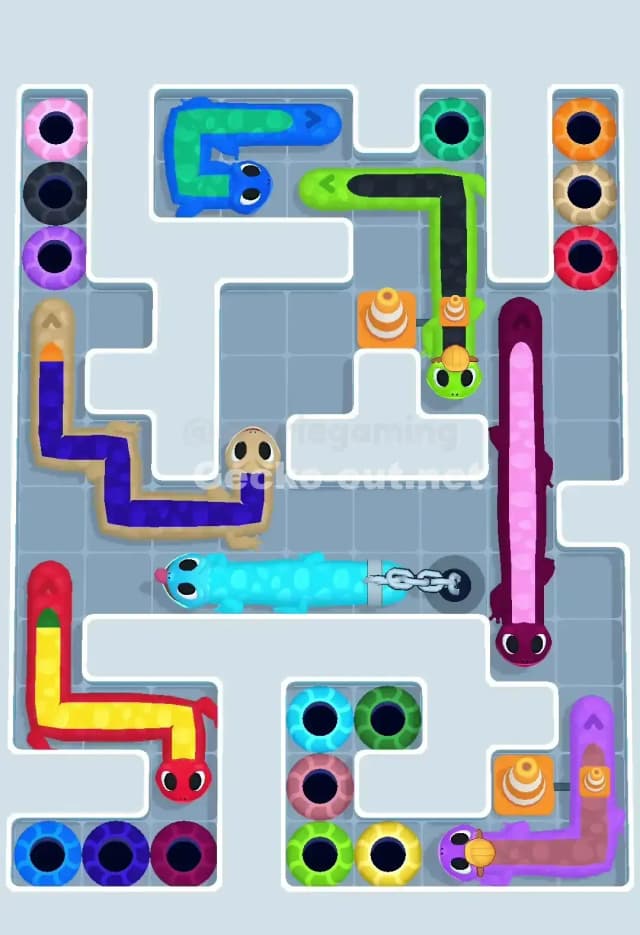
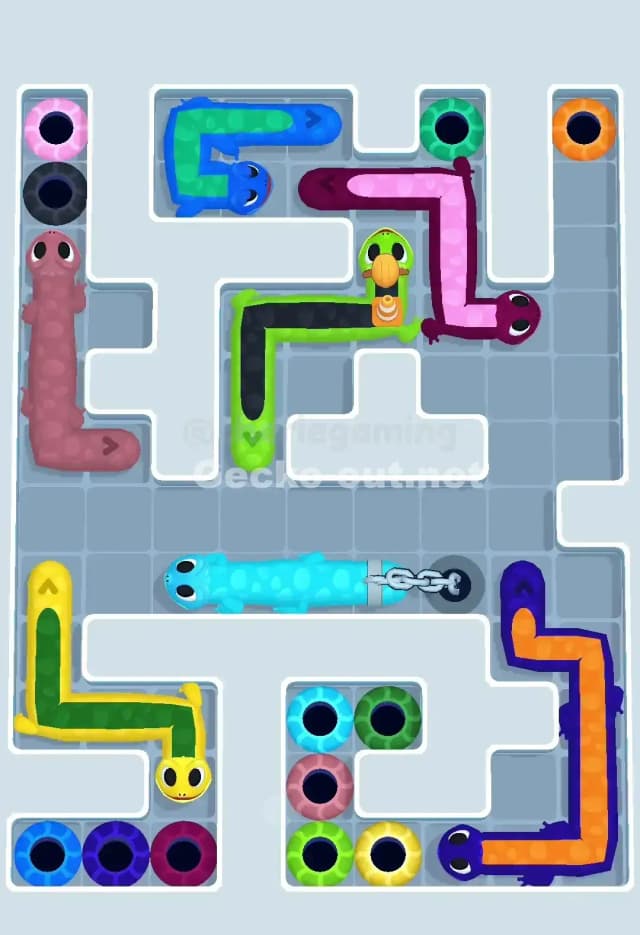
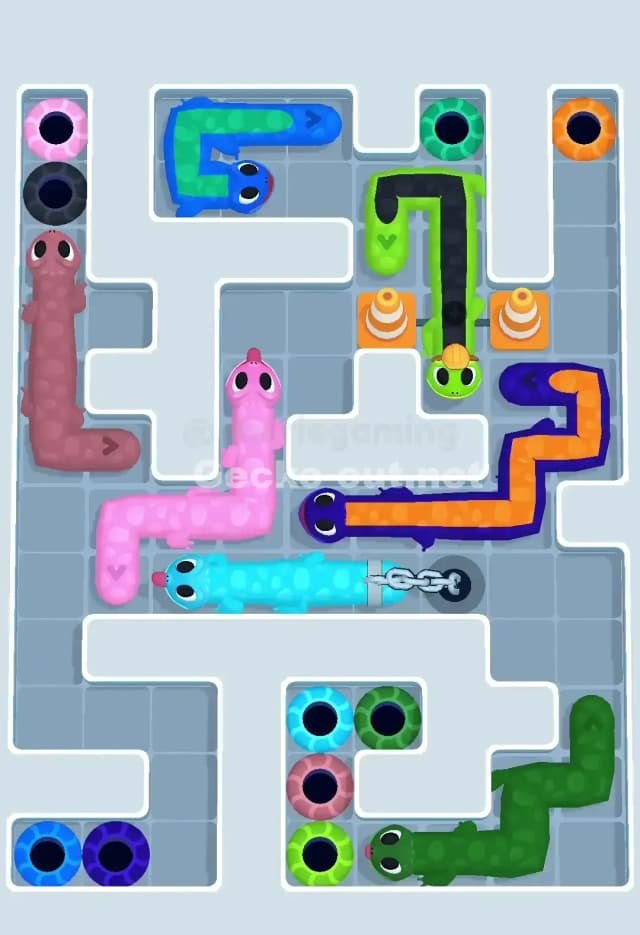
Gecko Out Level 670 is a maze of intersecting long-bodied geckos with a serious spatial constraint problem. You're working with approximately eight geckos spread across the board: a pink-black-magenta vertical stack on the left side, a blue-green L-shaped pair in the upper-left quadrant, a green-black L-shaped duo in the upper-right area, an orange-tan duo on the far right, a cyan chained gecko in the middle-right section, a magenta vertical gecko on the right side, a red-yellow L-shaped gecko in the lower-left corner, and a collection of smaller geckos positioned near the bottom exit holes. Each gecko has a corresponding colored hole—your job is to route each head through the maze so its body follows a clear, unobstructed path to safety. The board features tight corridors, wall-bounded channels, and several geckos that are physically "locked" together or occupy shared pathways, creating the classic Gecko Out Level 670 jam that makes this level notoriously difficult.
Win Condition and Timer Pressure
You win Gecko Out Level 670 when all geckos have successfully exited through their matching-colored holes before the timer reaches zero. Because the timer is finite and the board is densely packed, you can't afford to restart or redo paths—every drag must be purposeful. The drag-path mechanic means the head's route directly determines the body's shape; if you draw a path that later blocks another gecko's escape, you've wasted time and board space. This is why Gecko Out Level 670 demands careful planning: you must mentally "reserve" certain lanes and exit points, then execute the moves in an order that keeps the board uncluttered and lanes open.
Pathing Bottlenecks and Logical Traps in Gecko Out Level 670
The Central Corridor Bottleneck
The single biggest chokepoint in Gecko Out Level 670 is the central horizontal passage that connects the left side of the board to the right. This narrow lane is shared by at least three geckos—the blue-green gang on top, the green-black pair below them, and the cyan chained gecko trying to move from its middle position. If you route any of these geckos carelessly through this corridor first, you'll trap the others behind a motionless body that spans the width of the passage. The solution is to identify which gecko must use this corridor last and deliberately path the shorter geckos through it first, always aiming to clear that space as early as possible.
The Left-Side Stack Entanglement
The pink-black-magenta trio on the left side is stacked vertically in a narrow column, and all three need to exit downward or sideways into different holes. The danger here is that if you drag the top pink gecko too far to the right, its body will block the magenta gecko's path below it. Gecko Out Level 670 punishes hasty decisions on this stack; you must route the middle black gecko or the bottom magenta gecko first—whichever has the clearest direct path—so that the remaining geckos in the stack can move without colliding with their neighbor's body.
The Chained Cyan Gecko and the Toll-Gate Effect
The cyan gecko in the middle-right area has a chain or lock icon, indicating it can't simply exit in any direction. This gecko is often tied to a specific exit hole and may require clearing surrounding geckos first to create access. Many players overlook this gecko entirely during their initial planning, then realize near the end-game that they've painted themselves into a corner with no valid path. The lesson from Gecko Out Level 670 is always scout locked geckos early and reserve their exit route from the start.
Personal Reaction and the "Aha" Moment
I'll be honest—Gecko Out Level 670 was frustrating the first time I attempted it. The board looked like spaghetti, and I spent my first two tries just dragging geckos randomly, watching the timer tick down as the board became more and more tangled. The turning point came when I realized I was approaching it backwards: instead of asking "Where can this gecko go?" I started asking "Which gecko has only one valid path, and which geckos can be flexible?" Once I identified the cyan chained gecko and the central corridor as hard constraints, the rest of the level suddenly made sense. The solution was almost elegant in retrospect—I just needed to map the immovable pieces first.
Turn-by-Turn Path Strategy to Beat Gecko Out Level 670
Opening: Clear the Constraints First
Begin Gecko Out Level 670 by moving the cyan chained gecko to its designated exit hole. Because this gecko has limited options, routing it early ensures you don't accidentally block its path with a longer gecko's body later. Next, tackle the red-yellow L-shaped gecko in the lower-left corner; this gecko has a relatively straightforward downward exit and is far enough from the central corridor that moving it won't jam other geckos. These two moves "anchor" your solution and give you a clearer picture of available board space. Then move either the pink or magenta gecko from the left-side stack—whichever has the most direct path to an exit—so that the remaining geckos in that stack can move without collision risk.
Mid-Game: Keep the Central Corridor Breathing
Once you've cleared two to three geckos, the central horizontal corridor should still be mostly empty. Now route the orange-tan duo from the right side: start with the orange gecko, which can exit upward or rightward depending on the available holes. The tan gecko below it should follow shortly after, but only if the orange gecko's body doesn't block its path. As you clear the right side, you're creating "exhaust space"—room for longer geckos from the top and center to move through without collision. The green-black pair and the blue-green pair in the upper portion of Gecko Out Level 670 should be moved next, one at a time, always routing them through the now-open central corridor toward their respective exit holes on the right or lower sections of the board. The key is never move a long gecko all the way across the board and stop it mid-corridor; always complete its exit in one smooth drag so the corridor clears immediately.
End-Game: Execute the Magenta and Final Geckos with Time Awareness
In the final phase of Gecko Out Level 670, you'll have the magenta vertical gecko on the right side, the blue-green or any remaining top geckos, and possibly one or two geckos from the left-side stack. If you're ahead on the timer (more than 20 seconds remaining), take a second to verify each remaining gecko's path is clear and unobstructed. If time is tight (under 20 seconds), commit decisively: drag each remaining head in a smooth, confident motion straight to its exit hole without hesitation. The magenta gecko on the right side is usually one of the last, and it should slide down into its matching hole with minimal fuss. Watch your timer carefully—if it's counting down below 10 seconds and you still have two or more geckos on the board, increase your drag speed and avoid over-thinking; trust your planning and execute the most direct paths immediately.
Why This Path Order Works in Gecko Out Level 670
Untangling Through Strategic Sequencing
The path order recommended for Gecko Out Level 670 works because it respects the body-follow rule: once a head reaches its exit hole, the body is locked into place and disappears. By moving constrained geckos (the chained cyan one, the red-yellow one, and the left-side stack members) early, you're essentially removing obstacles from the board before they can cause a secondary jam. The remaining geckos have increasingly open space, so their paths become simpler and faster to execute. This is the opposite of a "wrong" approach, where you'd move flexible geckos first and accidentally trap constrained ones, forcing you to restart or waste time finding workarounds.
Balancing Careful Planning with Time Pressure
Gecko Out Level 670 gives you enough time to execute a well-planned solution, but not so much that you can afford to be careless. The recommended strategy is to spend the first 10–15 seconds pausing and reading the board: identify the chained gecko, the central corridor, and the left-side stack. Mark these three mental "zones" as your priority. Once you start moving (which should happen around the 15-second mark), commit to the opening moves—no second-guessing. By the mid-game phase, you should be moving at a steady, confident pace, dragging each gecko in about 2–4 seconds per move. If you find yourself hesitating frequently or restarting, you've planned well but are executing too cautiously; trust your reading and move faster.
Booster Strategy for Gecko Out Level 670
Boosters like extra time, hints, or path-simplification tools are optional for Gecko Out Level 670 if you follow this strategy. However, if you're running low on time during the final three geckos, a time booster is worth using—gaining 15–30 extra seconds can be the difference between a win and a loss. Conversely, don't rely on a hint booster; the logic of Gecko Out Level 670 is solvable through careful observation, and using hints wastes time you could spend moving. If you do want a safety net, grab the time booster before you start, so you know you have a buffer if the execution phase is slower than expected.
Mistakes, Fixes, and Logic You Can Reuse in Other Gecko Out Levels
Five Common Mistakes on Gecko Out Level 670 and How to Fix Them
Mistake 1: Moving long geckos through shared corridors without ensuring they can reach an exit. Many players drag the blue-green or green-black geckos into the central corridor, then realize there's no exit hole immediately available, and the gecko's body gets stuck mid-passage, blocking everything else. Fix: Before dragging any long gecko, mentally trace a complete path from its current head position all the way to an open exit hole. Only drag if the entire route is clear.
Mistake 2: Ignoring the chained cyan gecko until the end-game. This gecko has restricted movement, and by the time players remember it, there's no valid path left. Fix: Scout locked or chained geckos in the first 10 seconds and route them second or third—don't leave them for last.
Mistake 3: Stacking exits incorrectly with the left-side trio. If you move the pink gecko straight down without considering the black and magenta geckos below it, you block those two from exiting downward and force them into convoluted side paths. Fix: Route the middle or bottom gecko of a stack first, so the top gecko can later move freely.
Mistake 4: Dragging geckos too slowly and running out of time. Some players spend 5–7 seconds per move, second-guessing each drag and re-planning mid-move. Fix: Plan for 15 seconds, then execute each move in 2–4 seconds flat. Slow and cautious loses to time; fast and planned wins.
Mistake 5: Assuming all geckos must reach their holes in a particular sequence. This creates artificial constraints. Fix: Remember that any gecko can exit anytime its path is clear; there's no required order except that earlier exits create more space for later geckos.
Reusing This Logic on Similar Levels
The principles from Gecko Out Level 670 apply directly to other complex, multi-gecko levels with bottlenecks. Whenever you encounter a level with a central corridor, a chained gecko, or a vertical stack, use this same approach: (1) identify constraints, (2) clear them early, (3) reserve key pathways, and (4) execute flexible geckos last. Levels with gang geckos (linked pairs) benefit from the same sequencing logic—move the gang member with fewer exit options first. Frozen-exit levels also follow this pattern: the frozen exit is a hard constraint, so route geckos destined for unfrozen exits first, then defrost and use the frozen exit last.
Encouraging Conclusion
Gecko Out Level 670 is tough, genuinely. It's a level that teaches you to think spatially, plan ahead, and trust your preparation when the timer is counting down. But it's absolutely beatable—thousands of players have beaten it, and you will too if you approach it methodically, identify the constraints, and execute with confidence. Don't let a few failed attempts discourage you; each attempt teaches you something new about the board layout. Take your time planning, commit to the moves, and you'll crack Gecko Out Level 670 and move on to the next challenge.