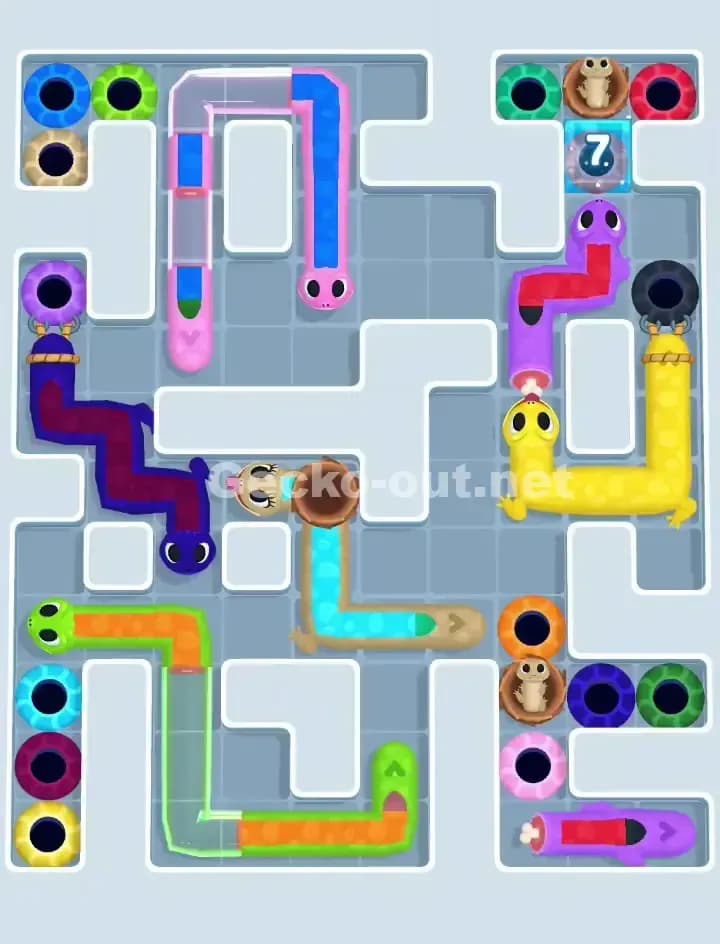
Gecko Out Level 1050 Solution Walkthrough | Gecko Out 1050 Answer
How to solve Gecko Out level 1050? Get step by step solution & cheat for Gecko Out level 1050. Solve Gecko Out 1050 easily with the answers & video walkthrough.
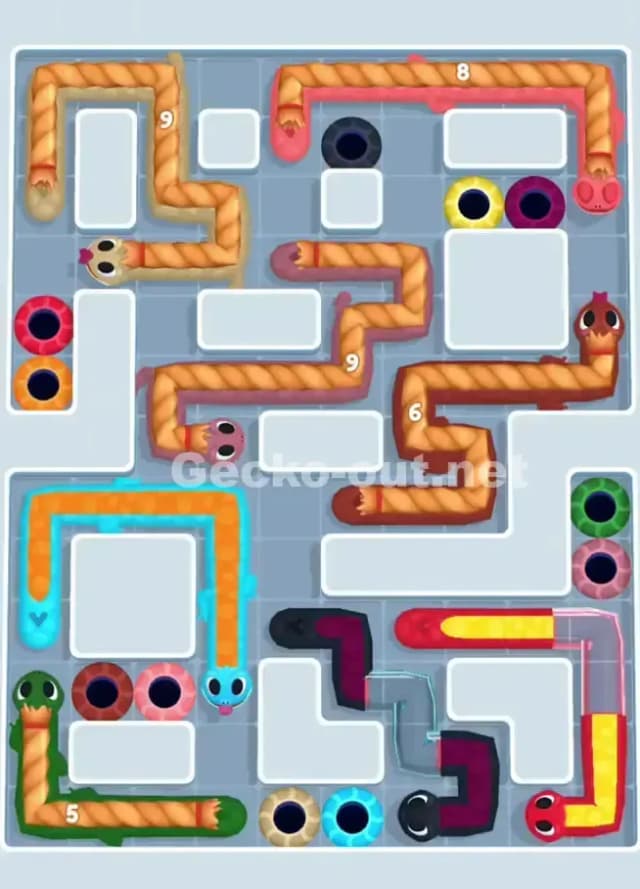
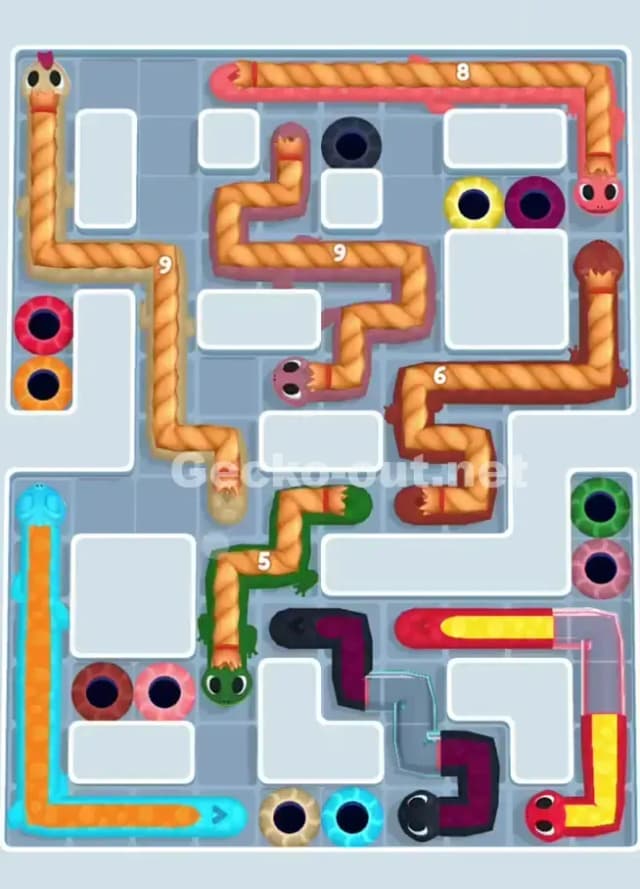
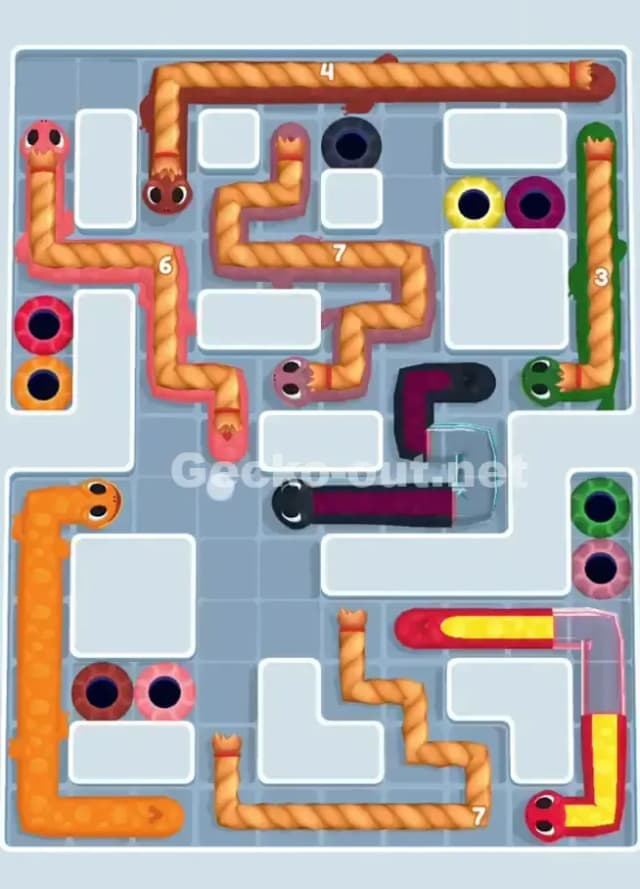
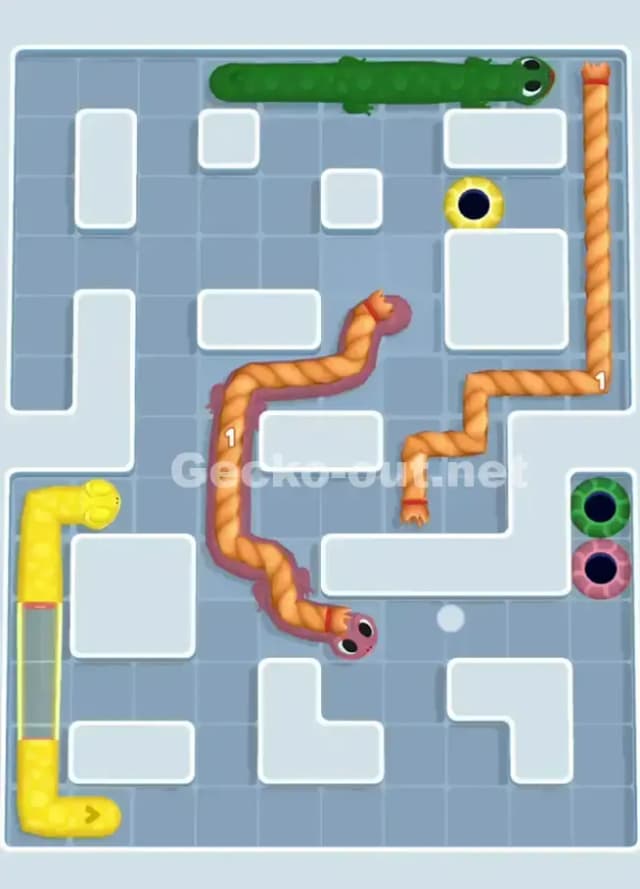
Gecko Out Level 1050: Board Layout, Rules, and Win Condition
Starting Board and Gecko Lineup
Gecko Out Level 1050 is a dense, multi-gecko puzzle with six geckos scattered across the board, each tied to a colored exit hole. You'll find an orange gecko (linked to another orange) on the upper left, a magenta gecko in the upper middle area, a yellow gecko and magenta gecko stacked on the right side, a green gecko on the lower left, and a cyan gecko at the bottom center. The board itself is a maze of braided, winding corridors—those characteristic orange-and-brown snake-like walls that define the visual chaos of Gecko Out Level 1050. White rectangular obstacles block direct paths, and the exit holes are color-matched to each gecko, creating a strict routing puzzle. There's also a warning hole near the top-right that you must avoid, plus a couple of locked or frozen exits scattered strategically to make you think twice about your movement order.
Win Condition and Timer Pressure
You win Gecko Out Level 1050 by guiding all six geckos into their matching colored holes before the timer expires. The timer here is unforgiving—you've got roughly 90–120 seconds depending on the exact difficulty tuning—which means every drag action counts. Because the body of each gecko follows the exact path you drag the head along, a single wrong turn can trap an entire gecko mid-board and block other geckos from reaching their exits. The tight corridors and interlocking wall structures mean that if you don't plan your exit order carefully, you'll create a gridlock where two geckos physically can't pass each other. This is why Gecko Out Level 1050 demands a clear mental map before you start dragging.
Pathing Bottlenecks and Logical Traps in Gecko Out Level 1050
The Central Corridor Knot
The single biggest bottleneck in Gecko Out Level 1050 is the center-right area where the braided walls narrow dramatically. This is the main artery through which at least three geckos must pass to reach their exits. If you're not careful, an orange or magenta gecko will wind through this space and leave its body sprawled across the exit route for the green or cyan gecko, essentially locking you out of victory. The key insight is that this corridor has only one safe path width, and any gecko that traverses it first will partially block the passage for the next one. You need to route your first gecko through the center bottleneck in a way that leaves enough space for a second gecko to squeeze past without overlap.
Subtle Problem Spots
The upper-left corner is a trap for many players. That orange gecko on the left side looks like it should exit quickly through the nearby hole at position 9, but if you drag it directly, its body will coil back on itself and block the adjacent white obstacle, preventing the linked orange gecko from moving at all. You must route the first orange gecko in a wide arc through the top corridor first, establishing clear floor space before attempting the second one.
Another sneaky spot is the warning hole (the dark cavity marked near the top-right). It's easy to accidentally drag a gecko's head into this hole if you're rushing, and that insta-fails your run. The hole sits right along what looks like a natural path for the magenta gecko, so you'll want to steer slightly left and maintain deliberate control as you approach that zone.
Finally, the bottom-center area where the cyan and blue geckos congregate is visually confusing because of the overlapping wall sections and the frozen or partially locked exit. If you try to move the cyan gecko too early, it can wedge itself against the locked structure and become immobile, forcing a restart.
The Frustration and the Breakthrough Moment
I'll be honest—my first five attempts at Gecko Out Level 1050 felt like I was fighting the board rather than solving it. I kept dragging geckos on impulse, and within seconds, two of them would jam against each other or a wall, and I'd watch the timer tick down with no way out. The turning point came when I stopped mid-attempt and actually traced the full body-path of each gecko in my head before dragging. That's when I realized the orange gecko didn't need to be first; the cyan gecko could clear the bottom lane first, and that would open up a domino effect of successful exits. Once I accepted that the solution required forethought rather than speed, Gecko Out Level 1050 stopped feeling impossible.
Turn-by-Turn Path Strategy to Beat Gecko Out Level 1050
Opening: Establish the Escape Lane
Start by moving the cyan gecko at the bottom-center. This gecko has a relatively straightforward path to its exit hole (the cyan square on the lower left), and clearing it first does two crucial things: it removes a large body from the congested bottom area, and it proves to you that the path-following mechanic is working as expected. Drag the cyan gecko's head carefully leftward, then upward around the locked obstacle, and guide it into its matching exit. You should complete this move within 15–20 seconds.
Next, move the green gecko (lower left). Its path to the green exit (upper left) is long but mostly unobstructed if the cyan gecko is already out of the way. Drag the green gecko upward and slightly right, then guide it through the less-congested left corridor. This should take another 15–20 seconds. Now you've cleared two geckos and created breathing room on the lower half of the board.
Mid-Game: Untangle the Braided Center
With the lower lane clear, tackle one of the yellow geckos (upper right). The yellow exit is in the right-side stack area, and the path is relatively direct if you avoid the warning hole. Drag the yellow gecko's head downward and leftward, navigate around the central obstacle, then curve it back right toward its exit hole. This move is tricky because it requires you to loop around the warning zone, but it's doable if you move deliberately. Budget 20–25 seconds for this maneuver and don't rush.
Now for the linked orange geckos. This is where patience matters most. Drag the first orange gecko (upper left) on a long path around the top of the board, down the right side, and then left along the central corridor toward its exit. Because you've already removed the cyan and green geckos, the pathways are much clearer. Once the first orange is out, the second orange gecko will have a direct route to its matching exit. Each orange gecko should take 20–25 seconds.
End-Game: Closing the Magenta Exits
Finally, you'll have the two magenta geckos remaining. At this point, the board is nearly empty, so you can move them with less worry about overlap. Guide the first magenta gecko from the upper-middle area down through the center corridor and into its matching exit hole. Then guide the second magenta gecko (right side) down and around toward its exit. These final two moves should take 15–20 seconds each, and if you've managed your time well, you'll have 10–20 seconds on the clock when the last gecko disappears.
Why This Path Order Works in Gecko Out Level 1050
The Cascading Unblock Strategy
The reason this sequence works is rooted in the body-follow mechanic. Every gecko you successfully exit frees up board real estate for the next ones. By moving the cyan and green geckos first, you eliminate the two geckos that would otherwise create the most physical interference with the center corridor. The order is not about which gecko is fastest or easiest in isolation; it's about which gecko's removal unlocks the path for the next one. This cascading approach transforms Gecko Out Level 1050 from an impossible knot into a series of manageable individual moves.
Timer Management: Read, Commit, Move
Here's a psychological trick that helps with Gecko Out Level 1050: pause for the first 10–15 seconds and visually trace the path for the first gecko. Once you're confident, commit and drag without hesitation. Hesitation mid-drag causes wayward movements and false starts that eat into your clock. For subsequent geckos, pause for only 5 seconds because the board is clearer and your confidence should be higher. The final two geckos can be moved almost instantly because the board is nearly empty. You're essentially investing time early (reading the board) to move faster later (fewer pauses, faster drags).
Booster Strategy
Gecko Out Level 1050 can be beaten without boosters if you follow this strategy carefully. However, if you find yourself with 20+ seconds left and only one gecko remaining, you don't need to panic-buy an extra-time booster. Conversely, if you've made a mistake (e.g., a gecko wedged at the 60-second mark), it's often smarter to restart immediately rather than burn a booster and still fail due to the compounding error. The only booster I'd recommend for Gecko Out Level 1050 is a "hint" on your second or third attempt if you're genuinely stuck, but the strategy above should eliminate that need.
Mistakes, Fixes, and Logic You Can Reuse in Other Gecko Out Levels
Five Common Mistakes and Their Fixes
Mistake 1: Dragging the orange gecko first. Many players assume the leftmost gecko should go first, but the orange gecko's linked nature means its partner can't move until the first one is completely clear. Dragging it first wastes time and creates a two-gecko logjam. Fix: Always move unlinked geckos (cyan, green, yellow) before linked pairs.
Mistake 2: Ignoring the warning hole. A quick drag toward what looks like a shortcut often lands a gecko's head in the warning hole near the top. Fix: Visually mark danger zones on the board in your mind, and steer 1–2 grid squares away from them as a safety buffer.
Mistake 3: Over-complicating the yellow gecko path. Players often try to find the "perfect" arc for the yellow gecko, when a simple loop around the center obstacle works fine. Fix: Don't optimize; just follow a safe, unobstructed route, even if it looks less elegant.
Mistake 4: Dragging geckos while the board is crowded. Attempting to move the magenta gecko when three other geckos are still on the board leads to accidental overlaps. Fix: Use the first half of your timer to aggressively clear the board, and save the magenta geckos for when the space is open.
Mistake 5: Panicking when two geckos touch. If a gecko head touches another gecko's body, the move doesn't complete, and you have to restart the drag. Many players interpret this as a failure and give up. Fix: Treat it as a minor setback, undo the drag, and try again with a slightly different angle.
Reusable Logic for Similar Levels
The "cascade unlock" strategy in Gecko Out Level 1050 applies to any level with multiple geckos and a central bottleneck. Ask yourself: "Which gecko, if removed first, opens the most pathways for others?" Often, it's not the gecko with the easiest individual path, but the one whose body is currently blocking the most real estate. The "read then commit" timer approach also works for any time-pressure puzzle where board clarity improves as you solve it. Finally, the caution around linked geckos is universal in Gecko Out—always move single geckos before paired ones, and always account for how the first gecko in a pair blocks the second.
The Takeaway
Gecko Out Level 1050 is genuinely tough, but it's absolutely beatable with a clear mental map and disciplined execution. The board isn't malicious; it's just intricate. Once you internalize that the solution hinges on removing geckos in the right order rather than finding a magical "best path," the puzzle transforms from frustrating to satisfying. You've got this—map the board, move the cyan gecko first, and trust the cascade.