Gecko Out Level 75 Solution Walkthrough | Gecko Out 75 Answer
How to solve Gecko Out level 75? Get step by step solution & cheat for Gecko Out level 75. Solve Gecko Out 75 easily with the answers & video walkthrough.


Gecko Out Level 75: Board Layout, Rules, and Win Condition
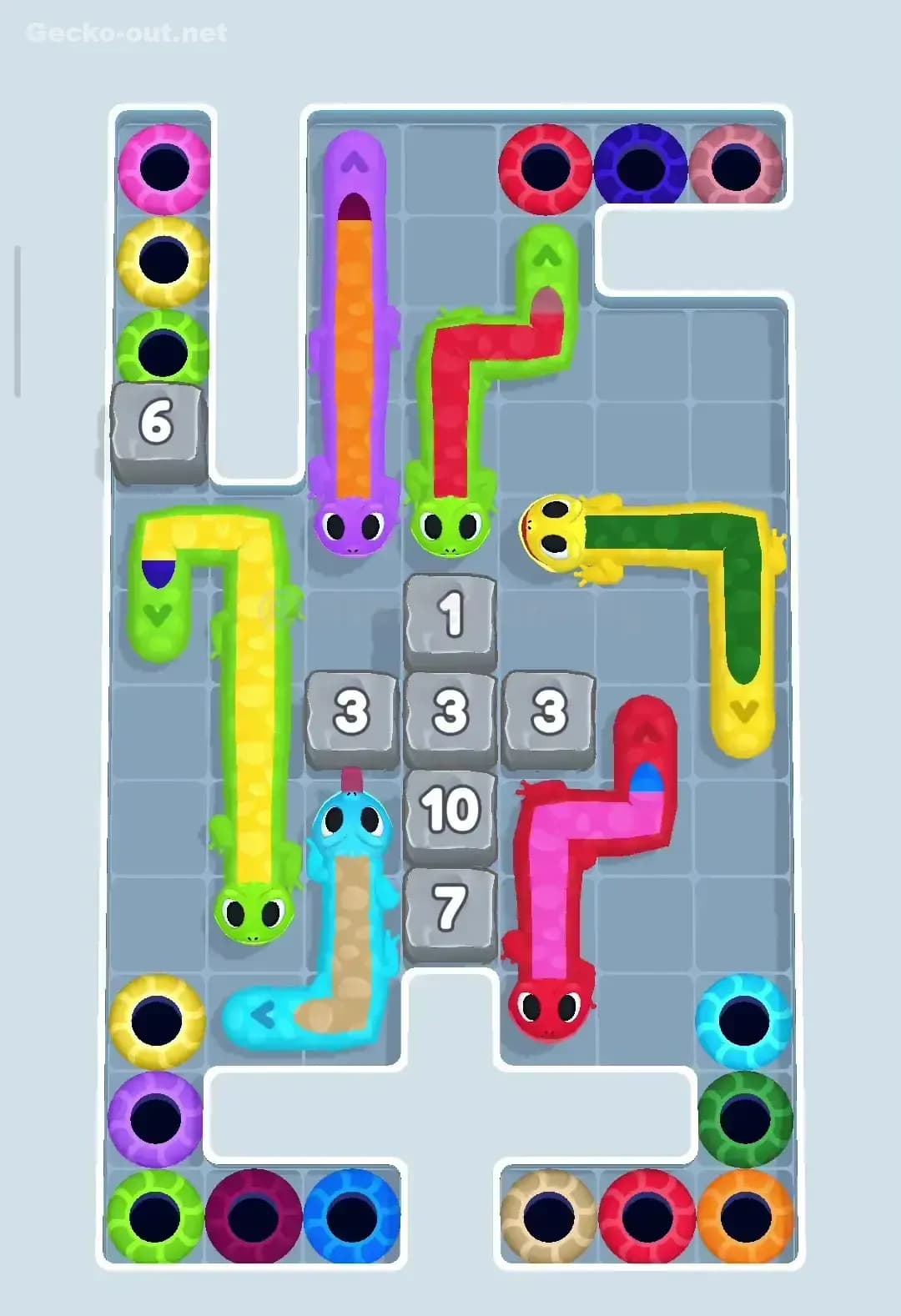
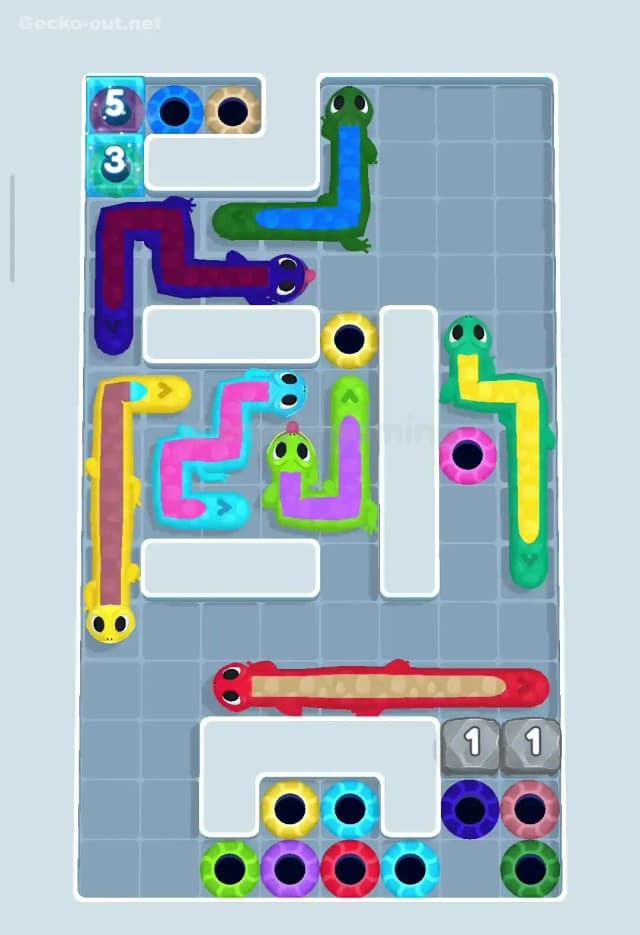
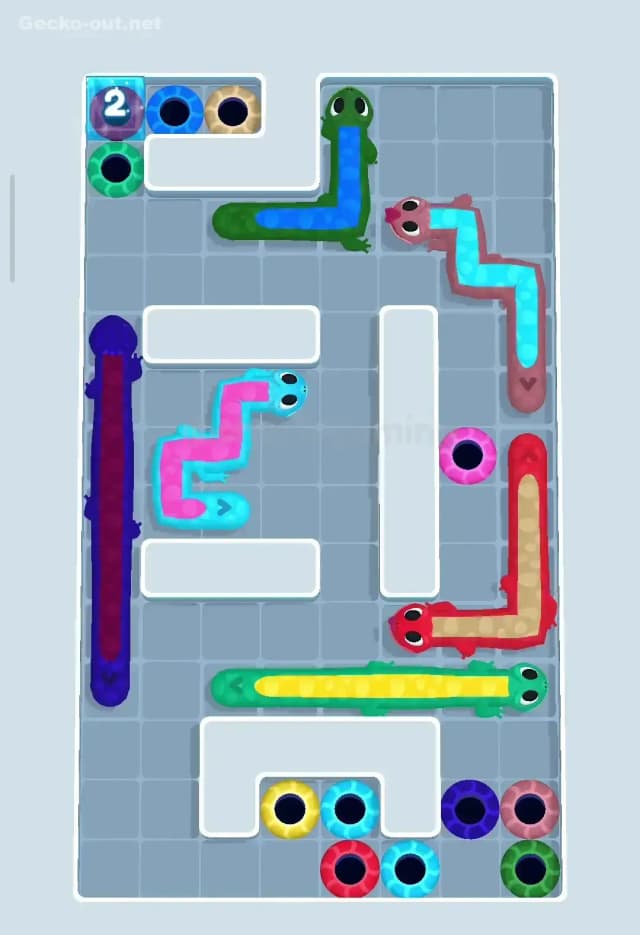
How the Board Starts Out
In Gecko Out Level 75 you’re thrown into a tall, narrow board packed with long geckos and just a few breathing spaces. You’ve got a rainbow of geckos: a tall yellow one hugging the right wall, a long purple one on the left, a big red gecko stretched almost all the way across the lower middle, plus shorter center geckos in cyan, lime/green, and a couple of L‑shaped orange/green mixes. Underneath everything sits a dense row of exits of many colors, with a few extra exits scattered in the middle and top.
White wall blocks carve the board into three main “lanes”:
- a left lane pinned by the purple and orange geckos
- a central lane clogged with the small cyan and lime geckos
- a right lane dominated by the tall yellow gecko and a narrow vertical corridor of exits
Near the bottom right there are numbered stone blocks and a cluster of exits that many geckos need to reach. Those stones and the red gecko form the core traffic jam that makes Gecko Out 75 feel so tight.
Because gecko bodies follow exactly where you drag the head, every path you draw becomes a temporary wall for everyone else. The board is basically a knot of colored hoses in a narrow pipe; pull on the wrong one and everything cinches tighter.
What You Need to Win (and Why the Timer Hurts)
The win condition in Gecko Out Level 75 is standard: every gecko must slither into a hole with the matching colored rim before the timer hits zero. No overlapping bodies, no sliding through other geckos, no sneaking through walls, and you can’t use exits that are still locked or blocked by rocks.
The strict timer matters because:
- you don’t have time to “sketch” a bunch of experimental paths
- undoing a bad drag costs as much time as doing it
- longer geckos (yellow, purple, red) take real-time seconds to trace around corners
So the challenge in Gecko Out 75 is less “can you find any route?” and more “can you move geckos in the right order without redrawing them three times?” Once you see the order, you’ll notice the timer is tight but fair.
Pathing Bottlenecks and Logical Traps in Gecko Out Level 75
The Main Bottleneck: Red and the Bottom Corridor
The single biggest choke point in Gecko Out 75 is the combination of the long red gecko and the bottom corridor of exits. Red stretches across the middle of the board like a barrier. Until red either shifts down or fully exits, the lower lanes stay cramped and several exits are effectively unreachable.
On top of that, the numbered stone blocks on the bottom right crowd the same region. Any clumsy path that brings another gecko across red’s body or through that narrow exit cluster will lock red in place. If you try to exit red too early, you also risk sealing off paths that the orange and purple geckos still need.
Subtle Problem Spots You Might Not Notice
There are a few less obvious traps:
- The central mini‑geckos (cyan and lime) look harmless, but if you park them horizontally they block the pivot space that the green L‑shaped gecko needs to swing around.
- The tall yellow gecko on the right can accidentally “railroad” the right edge. If you run it straight down to its exit too soon, the right lane shrinks and other geckos can’t curve out cleanly.
- The purple gecko on the left can become a solid wall. Dragging it all the way down before the center is cleared turns the left lane into a dead end instead of an escape route.
These aren’t instant fails, but they force you to waste time rewinding paths, which is lethal with Gecko Out Level 75’s timer.
When the Level Clicks
I’ll be honest: the first time I played Gecko Out 75 I spent a couple of runs just tightening the knot. It felt like every move created a new problem. The “aha” moment came when I stopped trying to finish geckos the moment they had a line to their exit.
Once I started treating early moves as “parking” instead of “escaping” — especially for the yellow, purple, and orange geckos — the board opened up. Seeing the central lane as a temporary staging area, not a highway, is what makes Gecko Out Level 75 go from frustrating to satisfying.
Turn-by-Turn Path Strategy to Beat Gecko Out Level 75
Opening: Free the Center Without Blocking Future Routes
In the opening of Gecko Out Level 75, your goal isn’t to cash in exits; it’s to unlock movement.
-
Start with the smallest geckos in the central chamber (cyan and lime/green).
- Drag them in short, tidy paths that hug walls and leave the middle cells empty.
- If they can safely reach their exits near the bottom without crossing red’s body, let them go; otherwise, “park” them vertically along a wall.
-
Use the space you just gained to pivot the green/yellow L‑shaped gecko.
- Rotate it so its body lines up nicely along an inner wall, not across the main vertical lane.
- Don’t send it to its exit yet if that path would cross the future routes of red or orange.
-
Adjust the purple gecko slightly upward or downward just enough to open a clean passage from center to left.
- Keep it mostly flush with the left side of the board so it acts as a boundary, not a plug.
If you finish this opening correctly, you’ll see a more open “S‑shaped” route from the top middle down to the bottom exits, with all long geckos still available to move.
Mid-game: Protect Key Lanes and Prep Red
The mid‑game in Gecko Out 75 is all about setting up red and yellow.
-
Work the orange L‑shaped gecko in the lower left.
- Swing its head around so the tail hugs the left wall and the head faces toward its exit row.
- If its exit is already reachable without crossing red, you can clear it; otherwise, park it neatly.
-
Now carefully reposition yellow on the right.
- Slide yellow down just far enough to free the upper right corridor, then tuck its tail tight against the right wall.
- Avoid any paths that cut diagonally toward the center; those routes will block red’s future turn.
-
With side lanes organized, start maneuvering red.
- Drag red slightly down into the lower corridor but keep its body parallel to the long horizontal passage.
- The idea is to put red where it can later sweep directly into its exit, without having to snake through other geckos.
During this phase, constantly ask yourself: “If I exit this gecko now, will its former path become a wall for someone else?” If the answer is yes, re‑park it instead of finishing.
End-game: Clean Exit Order and Timer Panic Management
End‑game in Gecko Out Level 75 is where the timer gets scary, so you want very few decisions left.
A consistent order that works well is:
- Finish the small central geckos whose exits are in the bottom row or mid‑right.
- Exit the orange and purple geckos once red’s route is clearly open.
- Sweep red into its exit with one clean, mostly straight path.
- Use the freshly opened bottom corridor to run yellow down to its exit and handle any final leftover gecko whose exit was in the right lane or top corner.
If you’re low on time, prioritize long, low‑turn paths. Don’t redraw anything; commit to the plan you’ve already created. In Gecko Out 75 it’s almost always faster to finish a slightly imperfect route than to hunt for a new “perfect” one with seconds left.
Why This Path Order Works in Gecko Out Level 75
Using Body-Follow Pathing to Untangle the Knot
Gecko Out 75 punishes random dragging because every body segment repeats the exact path you draw. The strategy above:
- keeps early paths short and aligned with walls so they don’t become future barricades
- parks long geckos (purple, yellow, red) in positions where their bodies run parallel to key lanes instead of across them
- delays exits that would create “ghost walls” in places other geckos still need
By thinking of each drag as drawing temporary maze walls, you’re basically rewriting the level layout in your favor.
Balancing Thinking Time and Fast Execution
For Gecko Out Level 75 I’d split the run into two mental phases:
- Planning phase (first few seconds): pause, scan the board, and decide which geckos are “park first” (yellow, purple, orange, red) and which are “safe exits” (small central ones). No dragging yet.
- Execution phase: once you see the lane structure, move decisively. Don’t stop mid‑drag to reconsider; that’s how the timer melts.
You actually save time by thinking up front, because you avoid two or three full redraws later.
Boosters: Nice to Have, Not Required
You don’t need boosters to beat Gecko Out 75, but they can bail you out:
- Extra time: most useful if you already understand the order but keep barely timing out. Pop it right before you start the big red–yellow–purple sequence so you can draw clean, slow paths.
- Hammer/rock breaker: if a toll block or stone is ruining your run, breaking a single rock in the bottom right can widen the corridor dramatically.
- Hints: if you’re totally stuck, a hint that highlights the next gecko to move can show you which bottleneck the level expects you to clear first.
Still, I’d treat boosters as backup. The level is absolutely solvable clean with good path discipline.
Mistakes, Fixes, and Logic You Can Reuse in Other Gecko Out Levels
Common Mistakes in Gecko Out Level 75 (and How to Fix Them)
-
Exiting yellow or purple first.
- Fix: only move them enough to free lanes, then park them tight to the edges. Save their exits for the end‑game.
-
Dragging central geckos into wide zigzags.
- Fix: keep central gecko paths straight and minimal so they don’t form new walls.
-
Trying to solve red immediately.
- Fix: clear and park around red first so its final path is a single smooth sweep.
-
Ignoring the bottom corridor shape.
- Fix: always leave a clear “highway” along the bottom row for multiple exits, not just one.
-
Panic‑redrawing with low time.
- Fix: commit to your first proper layout; small imperfections are better than rewinding late.
Reusing This Logic on Other Knot-Heavy Levels
The mindset that cracks Gecko Out 75 carries over nicely:
- Identify the longest geckos as potential walls and park them against actual walls.
- Use small geckos to “scout” and open lanes early.
- Treat every path as part of the board’s architecture, not just a route.
- Plan exits in batches from least disruptive (short, central geckos) to most disruptive (long edge geckos crossing multiple lanes).
Any future Gecko Out level with gang geckos, frozen exits, or dense central knots will bend to the same sequencing and lane‑protection logic.
Final Encouragement for Gecko Out 75
Gecko Out Level 75 looks brutal at first glance, and it absolutely punishes sloppy dragging. But once you see that the real game is about parking and lane management, the solution feels controlled rather than chaotic. Take a few seconds to read the board, park your big geckos smartly, and then run your exits in the planned order. With that approach, Gecko Out 75 stops being a wall and turns into one of those “wow, that was actually elegant” clears.