Gecko Out Level 352 Solution Walkthrough | Gecko Out 352 Answer
How to solve Gecko Out level 352? Get step by step solution & cheat for Gecko Out level 352. Solve Gecko Out 352 easily with the answers & video walkthrough.
Gecko Out Level 352: Board Layout, Rules, and Win Condition
Reading the Starting Board
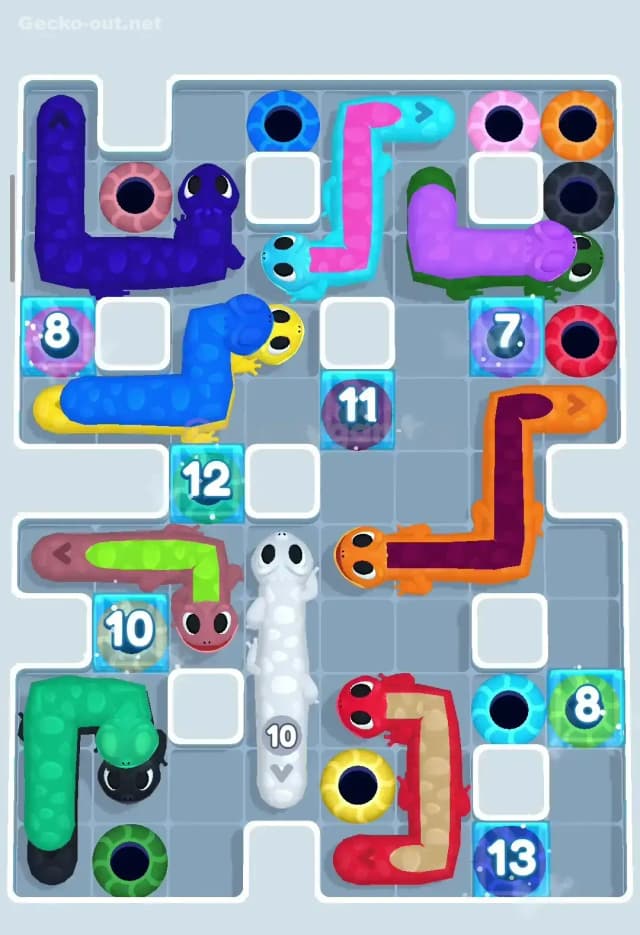
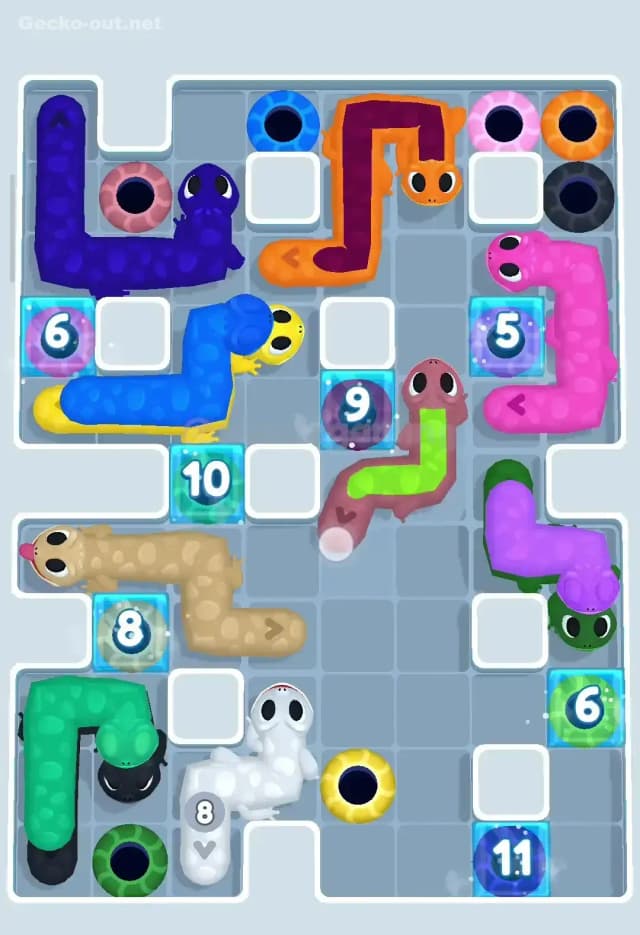
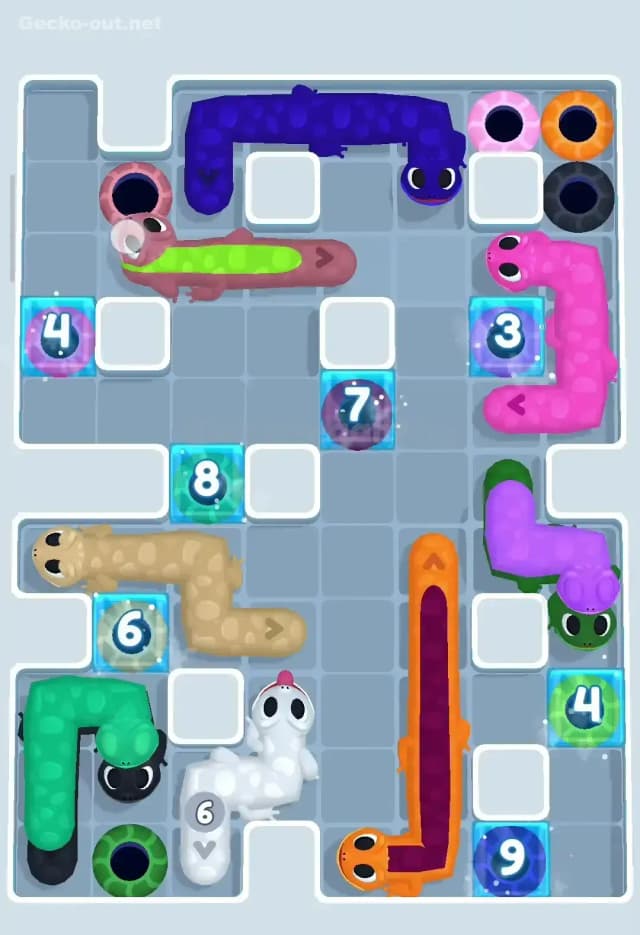
In Gecko Out Level 352 you’re thrown into a very packed grid with a mix of normal geckos, a couple of “gang” pairs, and several frozen/timer tiles. You’ve got a cluster of geckos in the top half and another in the bottom half, separated by a narrow central column.
- Top side: a big dark-purple L‑shaped gang gecko blocks the left, a long pink gecko runs along the upper corridor, and a pale purple gecko sits over a green tail on the right. A short cyan gecko and a chunky blue‑and‑yellow L gecko fill the middle. Their exits are mostly along the top row and the right edge, with a stack of colored holes sharing the same cramped corner.
- Bottom side: a tall white gecko stands almost straight in the middle, and it’s basically wedged between a pink‑and‑lime L on the left and an orange‑and‑maroon L on the right. Below them you’ve got a big green‑and‑black gang pair on the left and a red‑and‑cream gecko on the right. Their exits sit near the bottom corners and just above them.
- Across the board: blue ice/toll tiles with numbers (7, 8, 10, 11, 12, 13) sit in key choke points or directly under exits. Some exits are frozen at the start, so you can’t use them until you’ve cleared or activated the tile. There are also a couple of “warning” holes whose colors don’t match any gecko; they’re basically dead space that can trap bodies if you path badly.
The layout means nearly every gecko in Gecko Out Level 352 is already touching someone else, and moving one usually means at least bumping two more. You don’t have free space; you have to create it by exiting geckos in a smart order.
How the Rules and Timer Shape the Challenge
To win Gecko Out 352 you must drag each gecko’s head so its body follows the path to a same‑colored hole. You fail if you:
- Cross another gecko’s body or head.
- Run into walls, locked exits, or ice/toll tiles you can’t yet pass.
- Or let the strict timer hit zero before every gecko is in its hole.
Because bodies trace the exact path you draw, every wiggle matters. A sloppy curve can wrap a gecko around a future exit lane, turning the whole board into a knot. The timer pushes you to decide quickly, but Gecko Out Level 352 punishes rushing: one bad path near the center, and you’ve locked half the board.
So your real job is to plan a sequence rather than a single clever path: clear the most central blockers first, use each exit to free more space, and only then deal with the long, awkward geckos at the edges.
Pathing Bottlenecks and Logical Traps in Gecko Out Level 352
The Main Bottleneck: The Central White Gecko
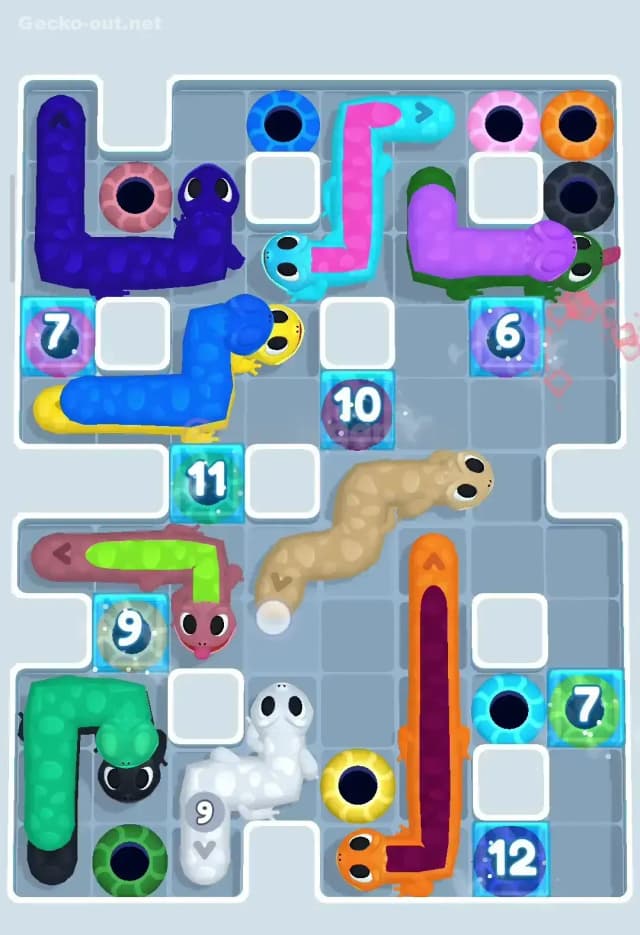
The single biggest bottleneck in Gecko Out Level 352 is the tall white gecko standing in the vertical middle corridor. Until you move it, the board is effectively split into left and right halves. It also sits just in front of several exits and timer tiles, so any attempt to swing big geckos from the top into the bottom (or vice versa) hits that white body.
On top of that, nearby geckos press against it: the pink‑and‑lime L on its left side and the orange‑and‑maroon L on the right. If you move those two without a plan, you thicken the wall around white instead of opening it. The correct early moves are really about “cutting the cage” around that central gecko so it can slide up or down later.
Subtle Problem Spots That Catch You Out
There are a few places in Gecko Out 352 that look safe but quietly ruin the puzzle:
-
Top‑right multi‑exit corner. Several holes are stacked vertically on the right edge near the top. It’s tempting to snake the long pink top gecko down that side early, but its body then blocks the only straight lane for the lavender and cyan geckos. Once you’ve filled that corner, you often can’t get the colors you need to the correct hole.
-
Bottom‑left gang pair (green and black). This gang gecko looks like free early exits: the black head is already near its black hole. But if you pull them through too early, the long green body ends up stretching into the center, sealing off the lane the white gecko needs later. These two should exit only after the white gecko has moved.
-
Central ice/toll tiles. The numbered tiles near the middle and lower‑right look like bonus time or simple gates. The trap is routing long geckos across them in wide loops: you gain a few seconds but lose the clean, straight corridors you’ll need at the end. Use them as you pass naturally, not as destinations.
When the Level Finally “Clicks”
The first time I played Gecko Out Level 352, I kept trying to clear the top cluster first because it looks smaller. Every attempt ended with the bottom half jammed and the white gecko trapped. The moment it clicked was when I flipped that logic: work from the bottom‑right and center outward, using each exit to carve a vertical channel. Once the white gecko moved, the whole board suddenly felt open and manageable instead of impossible.
Turn-by-Turn Path Strategy to Beat Gecko Out Level 352
Opening: Free Space on the Bottom-Right and Center
Your opening on Gecko Out 352 should focus on creating breathing room around the central white gecko.
-
Clear the red gecko first. It sits on the bottom‑right, already pointing toward its yellow or blue‑rimmed exit. Drag it in a tight, mostly straight line into its matching hole, hugging the right wall so its body doesn’t swing left into the center corridor.
-
Nudge the orange‑and‑maroon L. With red gone, pull the orange gecko a little upward and around so it’s aligned more directly with its exit, but don’t finish the exit yet if that would block the white gecko’s future lane. Think of it as parking it against the outer right wall.
-
Loosen the pink‑and‑lime L on the lower left. Move it slightly away from the white gecko, parking it along the left interior wall. Keep its head oriented so it can later curve easily into its green hole without crossing the center.
-
Open a one‑tile gap beside the white gecko. After those small adjustments, you want at least one side of the white gecko free so it can slide either up or down later. Don’t over‑drag; every extra curve is a future body segment that can block something.
At the end of the opening, you haven’t exited many geckos, but the middle of Gecko Out Level 352 is looser. That’s exactly what you want.
Mid-game: Unlock the Center and Protect Key Lanes
The mid‑game is where Gecko Out 352 is won or lost.
-
Exit the orange gecko cleanly. Now that the right side is clearer, path the orange gecko in a tight hook to its hole, sticking close to the outer wall and avoiding any loops into the central column. This frees more space around white.
-
Move the white gecko. With pressure gone, drag the white head either:
- Straight down into its exit if the lane is already open, or
- Upward into the middle region, then curve gently toward its hole, staying as straight as possible.
Your priority is to turn that vertical column into an open road once white is out.
-
Only now deal with the green‑and‑black gang gecko. Rotate the gang pair so the black part slips into its black hole first, then swing the green body around into the nearby green exit. Keep their path hugging the bottom and left edges; don’t send them through the center where they’d re‑create the wall you just removed.
-
Begin clearing the top middle. With the central passage open, start working on the blue‑and‑yellow L and the short cyan gecko. Bring them down through the center to pick up any convenient timer tiles, then curve them into their holes. Again, keep bodies close to outer walls so the center remains a usable highway.
Throughout the mid‑game, mentally reserve one or two vertical “lanes” from top to bottom. If a path would snake across those lanes multiple times, rethink it.
End-game: Exit Order and Handling Low Time
The end‑game of Gecko Out Level 352 is about the long top geckos and the crowded top‑right exit column.
-
Clear the pale purple and green pair on the right first. Use your open middle to pull the purple gecko into position without wrapping it around the stacked holes. If a green tail is linked underneath, send the correct head into its matching hole immediately so the extra body doesn’t linger.
-
Then exit the long top pink gecko. Now that the right corner is mostly free, drag the pink head in a smooth, shallow curve toward its hole, avoiding any deep hooks into the center. You want its final body line to “hug” the outer edge of the board, not cut across it.
-
Finish with the dark‑purple gang gecko. It’s bulky, so leave it for last. Use whatever central space remains to swing both heads in one continuous motion to their holes. Because everyone else is gone, you can afford a wider curve if needed.
If you’re low on time, don’t panic and start scribbling. Commit to one clear path for each of the last two geckos and draw it decisively. The timer punishes hesitation more than a clean, slightly sub‑optimal line.
Why This Path Order Works in Gecko Out Level 352
Using Head-Drag Pathing to Untie the Knot
In Gecko Out 352 the rule that bodies duplicate your exact head path is a double‑edged sword. The plan above uses it in your favor:
- Early moves keep paths short and straight, so exiting geckos leave behind narrow “walls” along the edges instead of messy spirals in the middle.
- Moving the white gecko and gang pairs after you’ve carved safe corridors means their long bodies don’t become new knots.
- Saving the longest top geckos for last avoids having their bodies lying across exits you haven’t used yet.
Instead of tightening the knot by dragging everything at once, you’re peeling layers away from the center outward.
Managing the Timer: When to Think vs. When to Move
For Gecko Out Level 352 I’d break timer management into two phases:
- Planning phase (first few seconds): Pause and scan. Identify where the white gecko will go, and which side (left or right) you’ll clear first. Drawing random test paths wastes both time and mental energy.
- Execution phase: Once you start exiting geckos, move confidently. For the simple early exits (red, orange, blue, cyan) you can drag quickly because their paths are almost straight. Save your slower, more careful drawing for the white gecko and the final purple and pink paths.
Tap timer tiles on the way if it doesn’t force a huge detour, but don’t sacrifice clean geometry just for one extra tile; the lost efficiency often cancels the gain.
Do You Need Boosters on Gecko Out 352?
Boosters in Gecko Out Level 352 are helpful but absolutely optional if you follow a clean path order.
- An extra time booster is nicest right before you start moving the central white gecko and the gang pairs, since that’s where you’ll think the most.
- A hammer‑style unblocker is overkill here; if you feel you “need” it, it usually means you exited the green/black gang or the top pink gecko too early and re‑blocked the center.
- Hints can be useful if you’re repeatedly dying at the same step, but try to use them to confirm your idea of exit order rather than copying the whole solution.
Mistakes, Fixes, and Logic You Can Reuse in Other Gecko Out Levels
Common Mistakes on Gecko Out Level 352 (and How to Fix Them)
-
Clearing the top first. Many players rush the long pink gecko along the top. Fix: Always open the bottom‑right, then the center (white gecko), before committing to any big top exits.
-
Exiting the bottom-left gang too early. Sending green/black out immediately looks efficient but rebuilds a central wall. Fix: Wait until the white gecko has moved and the middle lane is safe, then exit the gang hugging the edges.
-
Over-curving paths. Big loops around timer tiles feel clever but leave twisted bodies in terrible places. Fix: Aim for straight lines and gentle corners; if a path crosses the center more than twice, rethink it.
-
Parking in the wrong place. Players often “park” a gecko in the dead center while working on others. Fix: Always park against outer walls or in corners; treat the center as protected highway space.
-
Panicking on low time. Scrambled last‑second paths usually crash into exits or other bodies. Fix: When you see timer getting low, consciously slow your hand for the final gecko and go for the simplest, straightest route.
Reusing This Logic on Other Knot-Heavy Levels
The strategy you used for Gecko Out Level 352 applies well to other tricky Gecko Out stages:
- Identify the true central blocker (like the white gecko here) and design your whole exit order around freeing and removing it.
- Delay exiting gang geckos and very long bodies until you’ve carved safe paths; they’re great “last pieces” once the board is open.
- Treat timer tiles and frozen exits as secondary; the main problem is geometry, not time. Solve traffic first, time second.
- Always aim to clear from the center outward, not from the edges inward, whenever the middle is heavily stacked.
Final Encouragement for Gecko Out 352
Gecko Out Level 352 looks brutal at first glance—everything is packed, the timer’s strict, and it feels like moving one gecko ruins three others. But once you respect the central white bottleneck, delay the big gang pairs, and keep your paths short and edge‑hugging, the whole level opens up. Stick to that plan, don’t rush the early moves, and you’ll see Gecko Out 352 flip from “impossible knot” to a really satisfying untangle that you can repeat reliably.