Gecko Out Level 680 Solution Walkthrough | Gecko Out 680 Answer
How to solve Gecko Out level 680? Get step by step solution & cheat for Gecko Out level 680. Solve Gecko Out 680 easily with the answers & video walkthrough.
Gecko Out Level 680: Board Layout, Rules, and Win Condition
The Starting Board: A Dense Knot of Colored Geckos and Obstacles
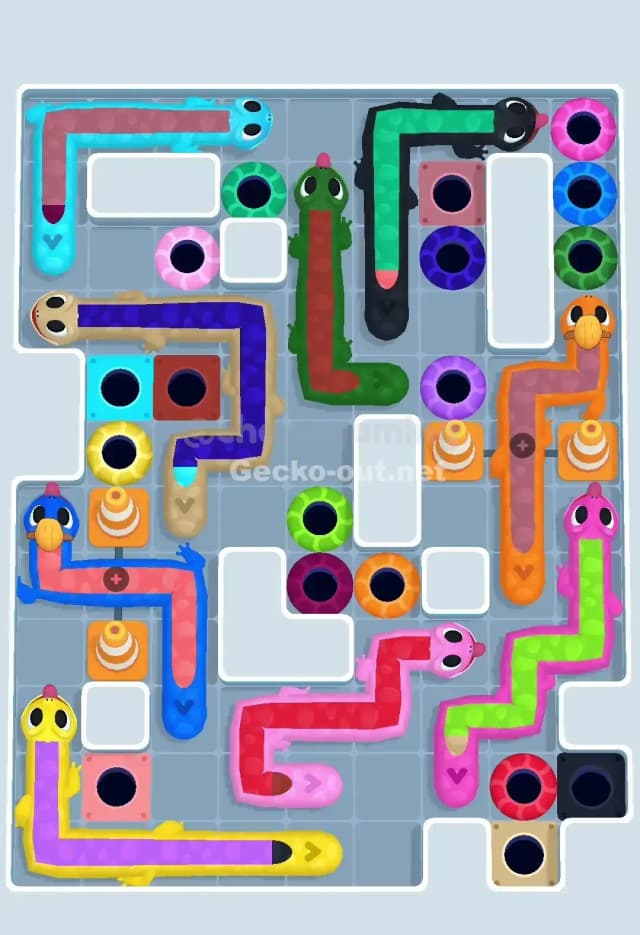
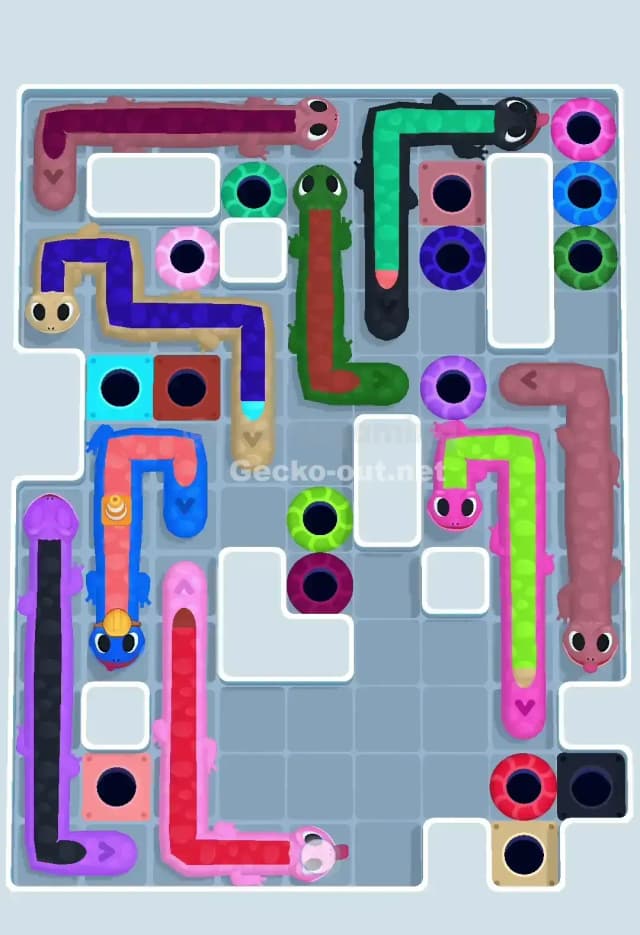
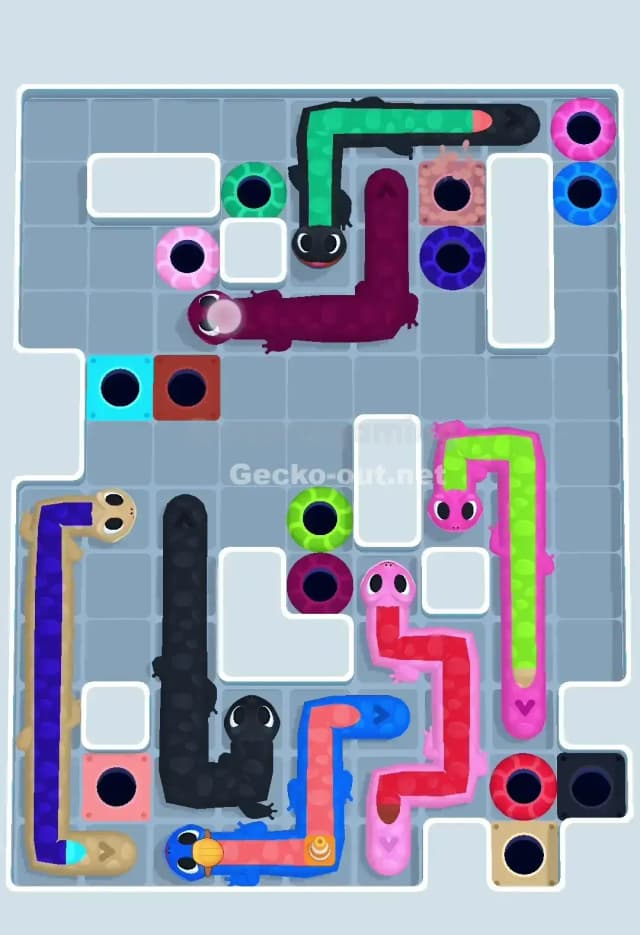
Gecko Out Level 680 is a beast—you're looking at a crowded 10+ gecko puzzle crammed into a tight grid with minimal breathing room. You've got cyan, purple, blue, red, pink, green, orange, and yellow geckos all competing for space, and each one needs to reach its matching-colored hole before the timer runs out. The board is layered with white blocked squares (impassable terrain), which naturally divide the space into isolated corridors and choke points. What makes Gecko Out 680 particularly nasty is that several long geckos are already bent into L-shapes or tight loops on the board—they're not straight lines you can simply slide out. There's a cyan L-shaped gecko in the top-left, a green gang-gecko curving through the center, a purple S-bend taking up the left-middle, a red multi-segment gecko snaking through the lower-middle, and an orange zigzag on the right side. These aren't flexible; they're locked body-shapes, which means you can't rearrange them—only drag their heads along valid paths to guide their rigid bodies toward their exits.
The Win Condition and Why the Timer Is Your Real Enemy
You win Gecko Out Level 680 by getting every single gecko's head into its matching-colored hole. The timer starts generous but ticks down relentlessly, and because each gecko's body must follow the exact path you drag its head through, even a single mistake or hesitation can cost you 10–20 seconds replanning and redoing. If even one gecko hasn't escaped when the timer hits zero, the level fails. This isn't a "get most out" puzzle—it's all-or-nothing, which is why pathing discipline and forward planning separate a clear win from a frustrating reset.
Pathing Bottlenecks and Logical Traps in Gecko Out Level 680
The Central Corridor: Where Everything Wants to Go
The single biggest bottleneck in Gecko Out Level 680 is the middle-right corridor, where the cyan hole, pink holes, and a critical exit lane all funnel together. You'll notice the green gang-gecko is already bent directly through this zone, and the red gecko's lower tail also tries to use this space. If you're not careful, you'll drag the green gecko's head toward its hole and accidentally lock out the pink gecko that needs to pass through the same tight channel. The corridor is maybe three squares wide at its narrowest, so even one gecko sitting in the wrong spot blocks two others. I recommend tackling the green gecko early and parking it in its hole before you even think about moving pink, because once green is out, you've opened that critical lane for the remaining traffic.
The Cyan Trap and the Purple S-Bend Problem
Gecko Out 680 has a second sneaky trap: the cyan gecko in the top-left is already bent into an L-shape, and its hole is at the bottom of that same L. It looks like an easy escape, right? Wrong. If you drag cyan's head too aggressively or without planning the exact path first, its body will wrap around the white blocked squares and jam itself into a corner, making it impossible to reach the hole without overlapping a wall. Worse, cyan's exit sits right next to the purple S-bend gecko's starting position, so if you move purple before cyan is safely out, purple's body becomes a physical barrier that cyan can't pass. The purple gecko itself is another headache: it's a long, winding snake that takes up 8+ squares of real estate. Moving it requires a precise, unobstructed path, and that path doesn't exist until you've cleared cyan and repositioned the blue gecko that's blocking purple's natural exit route.
The Moment the Solution Clicked
I'll be honest: my first three attempts at Gecko Out Level 680 felt chaotic. I was dragging geckos randomly, hoping muscle memory would kick in, and each time I'd get halfway through and hit a total gridlock where two or three geckos were physically tangled and their holes were blocked by my own earlier moves. Then I took a breath, zoomed out, and realized I'd been thinking about the puzzle backward. Instead of asking "where does this gecko want to go?", I asked "what needs to move out of the way first to let everything else flow?" That mental flip changed everything. Suddenly, Gecko Out Level 680 went from frustrating to tactical. Once I committed to a clear evacuation order—cyan first, then green, then purple, then the smaller geckos—the paths opened up like magic, and the whole level came together in under two minutes.
Turn-by-Turn Path Strategy to Beat Gecko Out Level 680
Opening: Clear the Cyan Gecko and Secure the Blue Gecko
Your very first move in Gecko Out Level 680 should be dragging the cyan gecko's head downward and slightly to the right, guiding it along the inside edge of the white blocked squares toward its cyan hole at the bottom-left. Cyan's body is already L-shaped, so the path is mostly predetermined—you just need to ensure you're not overshooting or getting snagged on walls. Once cyan reaches its hole and escapes, you've instantly freed up space around the purple gecko and opened a lane that blue will eventually need. Next, move the blue gecko. Blue is a long, winding gecko on the left side, and its hole is also on the left (lower down). Drag blue's head downward and then rightward, working around the cyan hole you just vacated and the purple S-bend gecko's body. Park blue temporarily in a safe spot near (but not in) its hole—you'll come back to blue once you've cleared the upper-left congestion. Why not finish blue now? Because the yellow gecko in the bottom-left needs a clear path first, and you don't want blue occupying that space.
Mid-Game: Execute the Green-Then-Red Sequence and Keep the Right Side Open
Once cyan and blue are staged, move the green gang-gecko next. Green is bent through the center of the board and needs to reach the green hole on the upper-right side. Drag green's head upward and rightward, carefully threading through the white blocked squares and avoiding overlap with the pink geckos that occupy the center-right. Green's body is long (maybe 10+ segments), so its path needs to be broad and clear—this is where you'll appreciate having already moved cyan, because it removes a collision risk. After green escapes, the middle-right corridor opens dramatically. Now tackle red. Red is a shorter, twisted gecko in the lower-middle area, and its hole is also in the lower-right. Drag red's head rightward, then downward, threading around the pink gecko's starting position and the white blocked squares. Red should exit fairly cleanly once green is gone. With red and green out, you've cleared the entire right side of the board, which is critical because the orange, pink, and magenta geckos all need to exit via that region, and they have very little maneuvering room.
End-Game: Pink, Orange, Magenta, Yellow, and Blue in Rapid Succession
In the final phase of Gecko Out Level 680, you're working with four geckos left and a shrinking timer. Start with the pink gecko (the one with the pink head in the center). Pink is shortish and bent into a simple shape; drag its head toward the pink hole (lower-center area) and let its body follow cleanly. Orange comes next—it's the long zigzag on the right side, and its hole is on the far right. Drag orange's head rightward and downward along the already-cleared right corridor; it should be a straightforward exit. Magenta (the small pink gecko on the lower-right) is tiny and unobstructed by this point, so drag it to its magenta hole (lower-right corner) quickly. Then finish yellow at the bottom-left—you cleared the space earlier, so yellow should slide into its yellow hole without any resistance. Finally, complete blue. Blue has been waiting patiently on the left side; drag its head down into the blue hole, and you're done. The entire sequence, when executed cleanly, takes about 90–120 seconds, leaving you with time to spare.
Why This Path Order Works in Gecko Out Level 680
How the Body-Follow Rule Untangles Instead of Tightens
The genius of this path order for Gecko Out Level 680 is that it respects the body-follow rule and uses it as a planning tool, not a trap. By moving cyan first, you remove a physical blocker that would otherwise force green and purple to overlap walls trying to squeeze past. Each gecko that exits becomes a "free square" that the next gecko can use. If you moved them in the wrong order—say, red first, then green—red's body would still occupy the center corridor when green needs it, and green would jam itself trying to force a path. The drag-and-follow mechanic is deterministic: once you draw a path, the body follows it exactly. There's no flexibility, so planning the evacuation order is 90% of the battle. Gecko Out Level 680 rewards foresight, not quick reflexes.
Managing the Timer: Pause, Read, Commit
The timer in Gecko Out Level 680 is generous enough to allow a few seconds of deliberation, but not so generous that you can afford to second-guess yourself repeatedly. I recommend using this strategy: pause for 10–15 seconds at the start and trace the path for cyan in your head before you drag. Then commit and execute without pause for the next 2–3 geckos. Once you hit the mid-game (green and red exiting), you should be feeling confident enough to move faster—trust your plan and drag fluidly. If you hit unexpected resistance (a gecko's body is overlapping a wall, or you miscalculated a path), don't panic; simply undo or restart that gecko's move immediately. The timer is long enough that a single redo won't kill you, but second-guessing three moves in a row will. Basically, plan hard early, execute fast mid-game, and stay flexible in the end-game.
Boosters: When to Use Them (and When Not To)
Gecko Out Level 680 is absolutely solvable without boosters if you follow the path order above. However, if you're running low on time near the end-game (e.g., only blue and magenta left, and the timer is below 20 seconds), a +30 second time booster is a reasonable safety net. Don't waste a hammer or hint tool on this level—there's no random element or hidden trick. The solution is pure logic, and the path is deterministic. A time booster is insurance, not a crutch. Similarly, if you've already done the puzzle once and know the paths, the second attempt doesn't need any booster at all. Gecko Out 680 is more about confidence and planning than luck.
Mistakes, Fixes, and Logic You Can Reuse in Other Gecko Out Levels
Five Common Mistakes and How to Dodge Them
Mistake 1: Moving long geckos before clearing their escape corridor. Gecko Out Level 680 punishes this hard. Green is 10+ segments long, but you can't move green until cyan and the center-right path are clear. Fix: Always identify long geckos and plan their exits first. Clear blockers in reverse order of gecko length (longest-gecko-first rule).
Mistake 2: Dragging a gecko's head into a corner and assuming its body will follow cleanly. Cyan's L-shaped body can jam if you drag the head too aggressively toward the hole without accounting for the body's angle. Fix: Trace the body's shape mentally before dragging. For bent geckos, drag the head slowly and deliberately, giving the body time to unwind without snagging.
Mistake 3: Parking a gecko too close to another gecko's exit hole. This wastes board space and creates unnecessary collisions. Fix: Park geckos in "dead zones"—empty squares far from critical exit corridors. A gecko waiting safely in the bottom-right corner doesn't interfere with anything happening in the center.
Mistake 4: Ignoring the white blocked squares when planning paths. It's easy to mentally skip over terrain obstacles, but Gecko Out Level 680 is deliberately designed so that the white blocks force specific paths. Fix: Trace the path with your eyes three times before dragging. Ask yourself: "Can the head reach the hole without the body overlapping a wall?"
Mistake 5: Rushing the final three geckos because the timer is running. This is how you fail Gecko Out Level 680 with just seconds left. Time pressure makes you sloppy. Fix: If you're under 30 seconds with three geckos left, pause for three seconds, take a breath, and drag carefully. A slow, correct path beats a fast, wrong one every time.
Reusing This Logic on Gang-Gecko and Frozen-Exit Levels
The strategy you've learned for Gecko Out Level 680 is a template for any level with gang geckos (long, multi-segment, bent-shape geckos) or tight choke points. The key principle is: clear longest geckos first, park extras in safe zones, and open the corridor before the traffic jam. On levels with frozen exits (icy holes that might only unlock after certain moves), apply the same logic but add a dependency check—don't move a gecko toward a frozen hole; instead, clear its surroundings and wait for the hole to unlock. On levels with toll gates (exits that cost one free move per gecko), budget your moves carefully and move your longest gecko last, so you have the most control over final maneuvering.
Gecko Out Level 680 Is Tough, But You've Got This
Gecko Out Level 680 feels overwhelming at first—it's a visual maze of color and body parts, and the timer adds urgency. But once you commit to the cyan-green-red-then-rest evacuation order and you trust that the path will clear as you move geckos out, the level becomes a satisfying puzzle of pure logic. There's no luck, no hidden trick, just careful planning and confident execution. You're now equipped to beat Gecko Out 680, and you've also built a mental framework that'll carry you through every gang-gecko and choke-point level that comes after it. Go clear that board, and enjoy the victory.