Gecko Out Level 513 Solution Walkthrough | Gecko Out 513 Answer
How to solve Gecko Out level 513? Get step by step solution & cheat for Gecko Out level 513. Solve Gecko Out 513 easily with the answers & video walkthrough.
Gecko Out Level 513: Board Layout, Rules, and Win Condition
How the board starts in Gecko Out 513
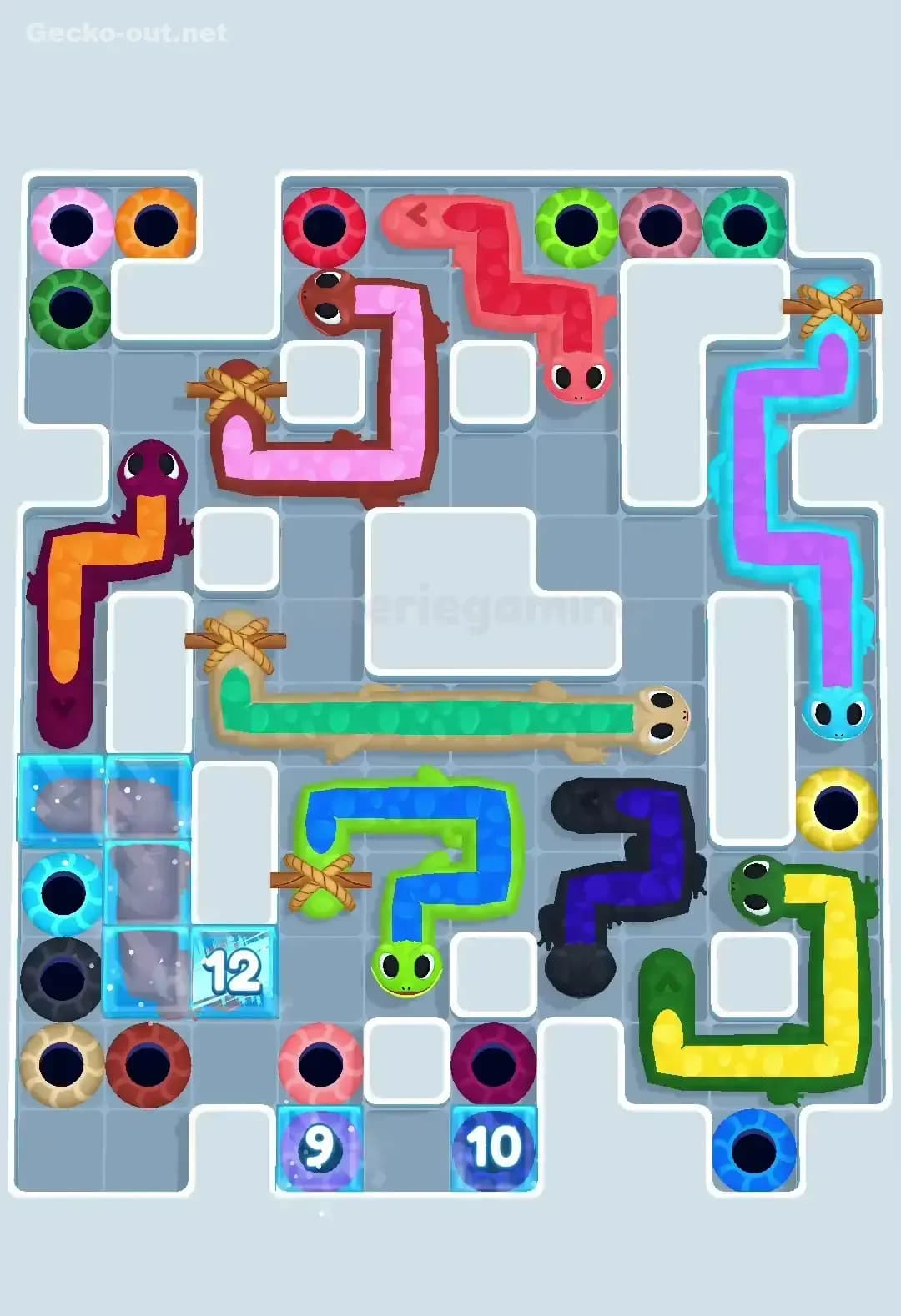
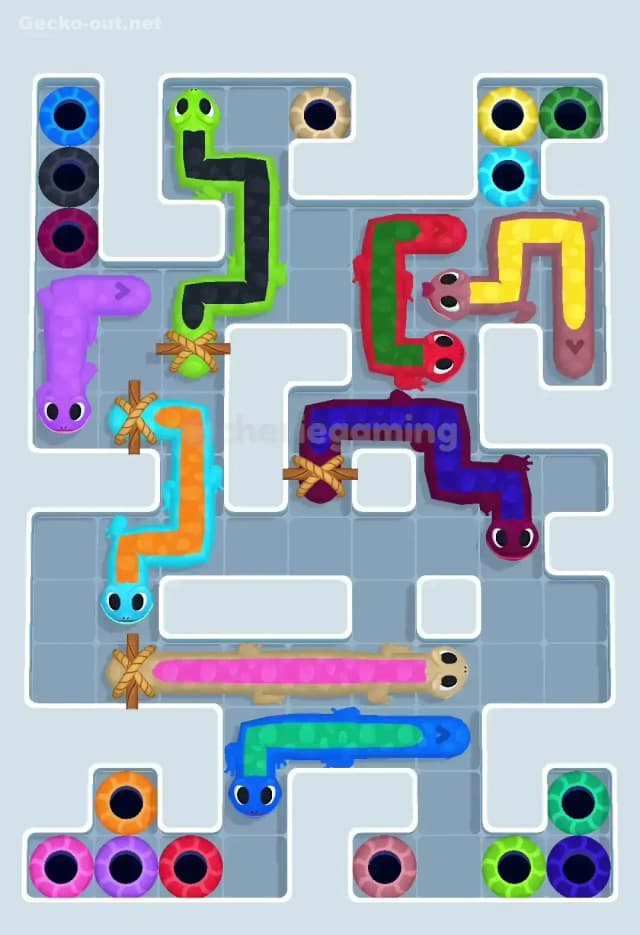
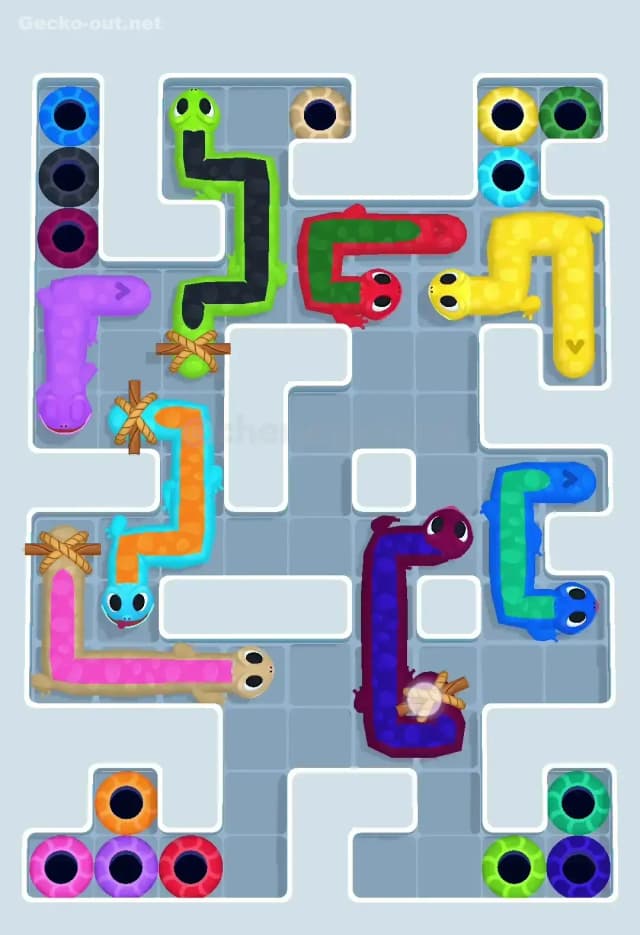
When Gecko Out Level 513 loads, you’re looking at a tall, vertical maze split into three main zones: a crowded top section, a brutally tight middle, and a long horizontal tangle near the bottom. There are multiple geckos in bright colors (green, purple, red, yellow, blue, orange, pink and more), and almost every one of them is already wrapped around a corner or wedged into a corridor. Several exits are grouped in clusters: a stack of holes on the upper left, another set in the upper right, and twin clusters in the bottom corners.
The middle of Gecko Out 513 is where the level really bites. A long pink-ish gecko stretches almost all the way across the board, with another long blue‑green gecko just beneath it. On the left side, an orange‑and‑blue gecko fights for space with a purple one; on the right, a red gecko and a yellow/brown gecko twist around each other near tight right‑hand corridors. A few wooden “toll” obstacles sit in central corridors, forcing you to thread bodies through very specific lanes instead of just drawing big curves.
Because the geckos are long and the corridors are narrow, almost any careless move in Gecko Out Level 513 creates a hard lock. If you send one body through the wrong lane, you’ll block at least one other gecko from ever reaching its color‑matched exit. You essentially start in a partial knot that you must loosen in the correct order rather than just rushing everyone toward the nearest hole.
Win condition and how the timer shapes the puzzle
The win condition in Gecko Out Level 513 is straightforward on paper: drag every gecko’s head so its body slithers into a hole of the same color before the timer hits zero. You can’t pass through walls, other geckos, or any blocked/frozen exits, and you can’t overlap your own body either. The catch is that the path you draw with the head is exactly what the body will trace, so any zigzag or loop you add stays on the board and becomes a permanent corridor blocker.
The strict timer is what turns this from a chill maze into a real pressure puzzle. You don’t have time to experiment with eight different paths for each gecko; you need a plan. In Gecko Out 513 you’re rewarded for taking 10–15 seconds at the start to read the board, then playing confidently once you know who moves first and where they “park” temporarily. If you try to freestyle each gecko as you see it, you’ll usually end up with one color trapped behind a body when the last few seconds tick away.
Pathing Bottlenecks and Logical Traps in Gecko Out Level 513
The main bottleneck: the long middle geckos
The single biggest bottleneck in Gecko Out Level 513 is the horizontal center of the board, dominated by that long pink gecko and the blue‑green one underneath it. Together they act like a sliding gate: whichever direction you move them first determines which half of the board is open. Until you reposition at least one of them, many routes from the top to the bottom corner exits are basically sealed.
Because their bodies are long, they also “echo” your path decisions. If you draw a fancy S‑curve with the pink gecko just to get around something temporarily, that S‑curve stays and will probably slice the level in half later. That’s why the entire strategy for Gecko Out Level 513 revolves around moving shorter, less critical geckos first, then shifting the long central ones with clean, minimal paths once you know every lane you need to keep open.
Subtle problem spots most players miss
There are three big “gotchas” I noticed after a few failed runs of Gecko Out 513:
- The top corridors near the clustered exits look wide, but they funnel into a single cell choke point. If you park a head in that choke – even for a moment – you can block two different colors from ever reaching their slots.
- The left‑side mid corridor where the orange/blue gecko and the purple gecko sit is deceptively tight. If you snake the orange/blue gecko up first with a wide turn, you’ll block the exact corner the purple one needs to escape.
- On the right side, the red and yellow‑brown geckos share a tiny U‑shaped pocket. Drawing a path that loops either of them fully into that pocket makes it impossible for the other to reach the exits at the top‑right and upper clusters.
These aren’t obvious until you’ve “lost” a color and only notice the trap once you’re almost done.
When Gecko Out 513 finally clicks
I’ll be honest: Gecko Out Level 513 feels unfair on the first couple of attempts. It looks like there’s plenty of space, but the moment you move two or three geckos, the board suddenly turns into a brick wall of bodies. The turning point for me was when I stopped trying to solve each gecko one by one and instead thought about lanes: one lane for getting traffic from top to bottom, one for moving left to right, and one protected route to the corner exits.
Once I mentally marked those three lanes and promised myself not to draw paths that cross them, Gecko Out 513 started to make sense. The level becomes less “Which gecko do I move?” and more “How do I move this gecko without closing my lanes?” After that, it’s surprisingly satisfying – like untying a rope knot in exactly the right sequence.
Turn-by-Turn Path Strategy to Beat Gecko Out Level 513
Opening: who to move first and where to park
In Gecko Out Level 513, open by clearing the shortest, least tangled geckos that sit near exits:
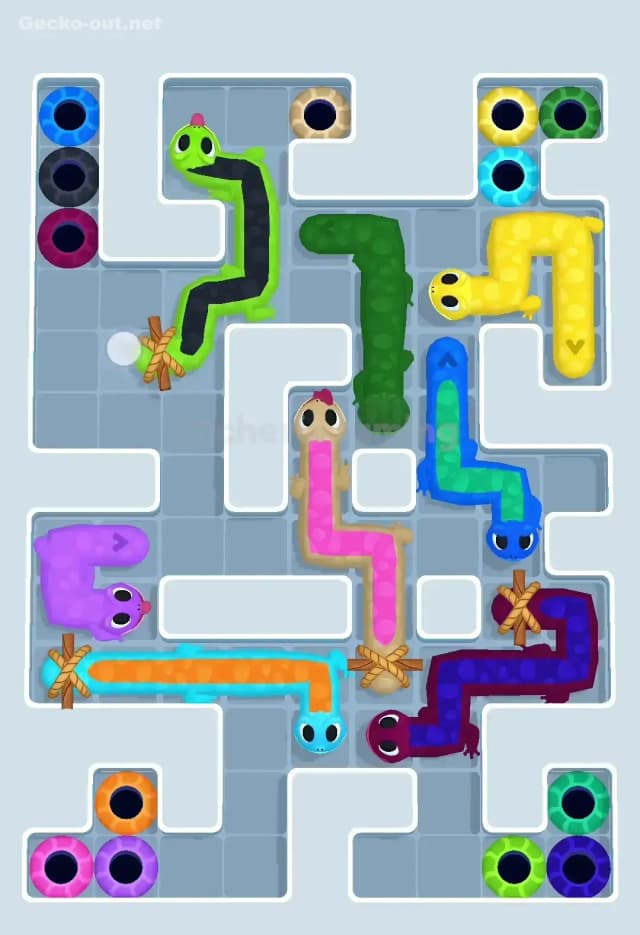
- Take the small gecko near the upper center (the one standing almost vertically) and slide it gently into its matching top exit using as straight a path as possible. Hug the wall so you don’t spill into the central column.
- Next, solve the compact gecko on the left side that can drop down toward the bottom‑left exit cluster. Park its body tight against the left wall and then into its colored hole, keeping that central left corridor open.
- On the right side, resolve the red/yellow pair. Move the one that can reach its exit in the fewest steps first, pulling it up and out without looping deep into the shared U‑pocket. Then nudge the remaining one into the newly opened lane and send it to its hole.
By doing this, you clear the top‑right and left‑side tangles while leaving the middle lane and bottom corridors untouched. You’ve basically removed “clutter” pieces and prepared the board for the big geckos.
Mid‑game: protecting lanes and handling the long bodies
Mid‑game in Gecko Out 513 is where you handle the orange/blue mid‑left gecko and the long central pair:
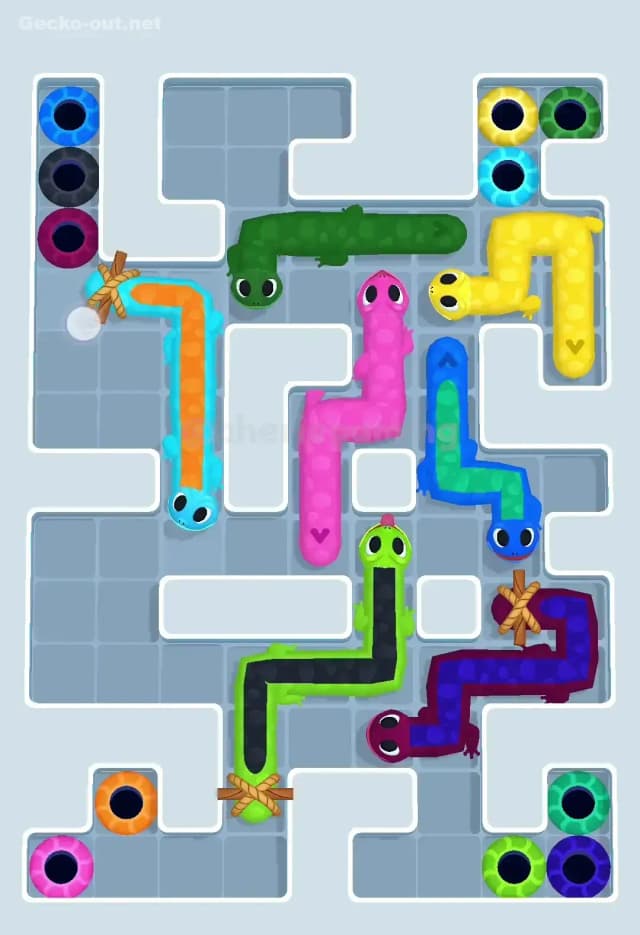
- Move the orange/blue gecko next. Draw a path that runs along the outer edge of its corridor and straight to its exit, avoiding loops around the toll obstacle. You want its body to end up pressed against a wall, not slicing the board in half.
- Now re‑evaluate the central strip. Decide whether you want the long pink gecko to exit left or right; pick whichever side is less crowded after your early moves. Draw a clean, mostly straight line from its head toward that side, dipping only once through any toll gate you must pass.
- With the pink gecko gone or parked along the edge, guide the blue‑green gecko underneath toward its matching bottom‑corner exit. Again, hug walls and avoid S‑curves; you’re preserving one clear vertical lane for any late geckos that still need it.
Throughout this phase, don’t be tempted to “temporarily” loop a body in the center of the board. In Gecko Out Level 513, temporary usually becomes permanent.
End‑game: exit order and low‑time decisions
By the end‑game, you should have only one or two stubborn geckos left, usually one near the bottom cluster and maybe a leftover from the top exits. At this point:
- Prioritize the gecko that still needs to cross the largest distance. If someone at the bottom still has to reach a top cluster, move them first while your main lane is clear.
- Use any remaining toll lanes as straight shortcuts, not as places to curl up. A quick diagonal‑style route through a toll gate is usually faster and cleaner than trying to dodge it.
- If the timer is getting low in Gecko Out 513, commit to the fastest safe path, even if it uses a slightly tighter turn. As long as you don’t cross your own body or slam into another gecko, a slightly messy path is better than timing out.
If you’re down to the final couple of seconds and one gecko is clearly doomed, it can be worth using a time booster; otherwise, stick to your plan and trust that the clean lane you preserved will carry you.
Why This Path Order Works in Gecko Out Level 513
Using head‑drag pathing to untangle, not tighten
The whole plan for Gecko Out Level 513 is built around the body‑follows‑head rule. By resolving short, edge‑hugging geckos first, you “pin” their bodies harmlessly to the walls and keep the central area flexible for longer geckos later. When you finally move the pink and blue‑green middle pair, you guide them in mostly straight lines so they act like zippers that open space instead of tangled ropes that close it.
Because you never draw big loops in the center, every new path either clears space or stays safely out of the way. That’s why Gecko Out 513 feels way easier with this order: you’re always reducing complexity, never adding it.
Managing the timer: when to think and when to move
In Gecko Out Level 513, the best timing rhythm is: read once, then play fast. Spend your first attempt just tracing possible routes with your eyes, identifying your three “lanes” (top, mid, bottom) and the long central bottlenecks. On actual winning runs, you should make the opening moves almost from muscle memory: top center gecko, left side, right pair, mid‑left, then the long ones.
Once you’re into the mid‑game, you don’t have time to re‑plan every move. Trust your lane rules and keep your pen (or finger) moving. The timer is tight, but if your routes are straight and efficient, you’ll usually finish Gecko Out 513 with a small buffer.
Boosters: optional, not required
Boosters in Gecko Out Level 513 are nice but absolutely optional. A time booster can save a sloppy run where you spent too long staring at the board, and a single hammer‑style breaker could theoretically clear a toll obstacle if the game allows it. But the level is designed to be solvable with pure path logic.
If you’re going to use a booster, I’d only consider a time extension, and only after you’ve already practiced the correct move order. Using hints too early here tends to teach you micro‑paths, not the big lane concept that actually wins Gecko Out 513 consistently.
Mistakes, Fixes, and Logic You Can Reuse in Other Gecko Out Levels
Common mistakes in Gecko Out Level 513 (and how to fix them)
- Moving the long central geckos first and filling the board with curves. Fix: always clear the short edge geckos in Gecko Out 513 before touching the big middle ones.
- Parking heads in choke points near exit clusters “just for a second.” Fix: never stop in a 1‑wide intersection; either pass straight through or stay fully outside.
- Drawing decorative loops to feel “safe.” Fix: hug walls, keep paths straight, and remember that every extra bend is future trouble.
- Ignoring the left‑mid lane and blocking it with the orange/blue gecko. Fix: send that gecko out with a tight, wall‑hugging route that doesn’t cut across the corridor.
- Rushing because of the timer and forgetting color matches. Fix: quickly double‑check the target hole color before you commit the last few tiles of a path.
Reusing this logic in other knot‑heavy levels
The approach that beats Gecko Out Level 513 works beautifully on other tough Gecko Out levels too. Whenever you see a knot of long geckos, start by identifying which bodies are “structural” – the ones that span most of the board – and which are small accessories you can clear early. Solve the small ones hugging the walls, then move the long ones in deliberate, straight motions.
On gang‑gecko or frozen‑exit levels, the same lane mentality applies. Mark one safe corridor from top to bottom and one from left to right, and treat those as sacred. Don’t let any early gecko draw across those unless they’re exiting immediately. That habit alone will save you from a ton of late‑game soft locks.
Final encouragement for Gecko Out Level 513
Gecko Out Level 513 looks brutal, but it’s one of those puzzles that feels dramatically easier once you see the structure. You’re not solving eight separate mazes; you’re managing three lanes and a couple of long ropes that can either free the board or strangle it. If you follow the move order, keep your paths straight, and resist the urge to improvise loops under pressure, you’ll see the final gecko slide into its matching hole with time to spare.
Stick with it. After a few tries, Gecko Out 513 goes from “no way” to “oh, I can speedrun this now,” and that’s one of the most satisfying feelings in the whole game.