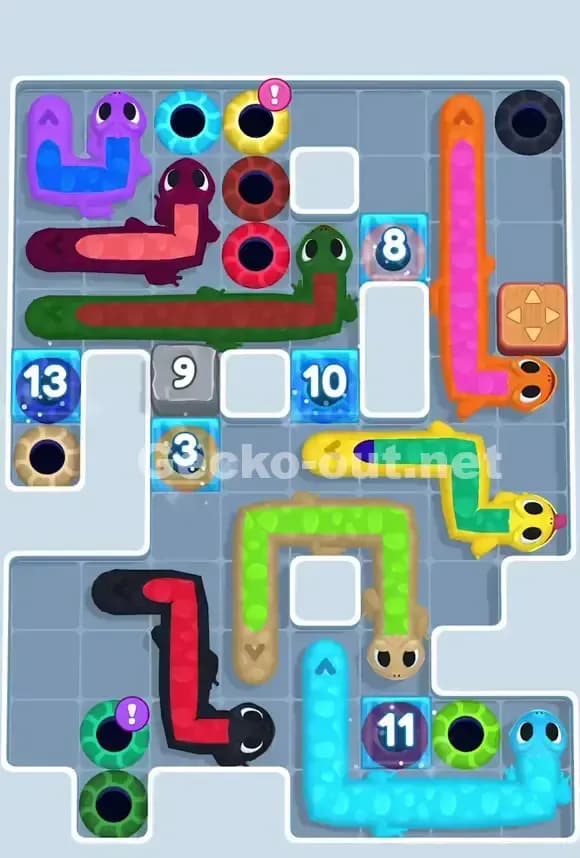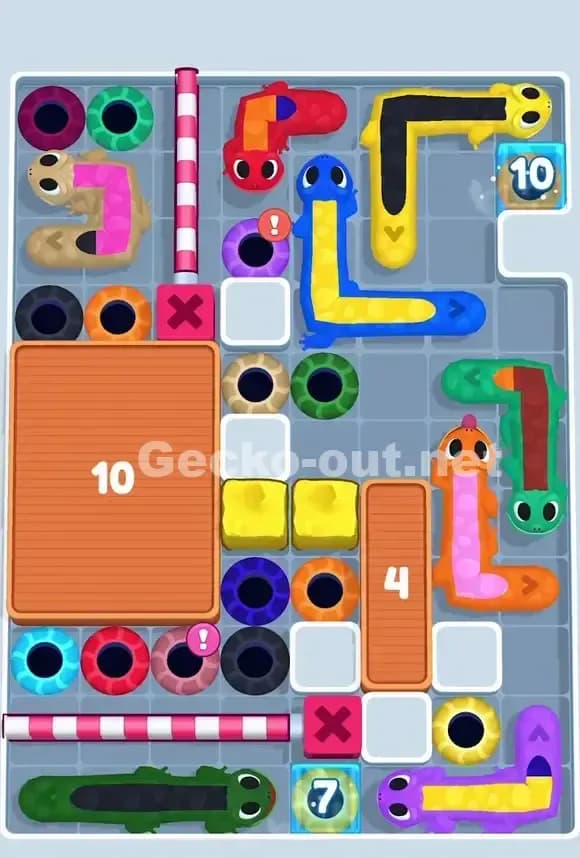
Gecko Out Level 753 Solution Walkthrough | Gecko Out 753 Answer
How to solve Gecko Out level 753? Get step by step solution & cheat for Gecko Out level 753. Solve Gecko Out 753 easily with the answers & video walkthrough.
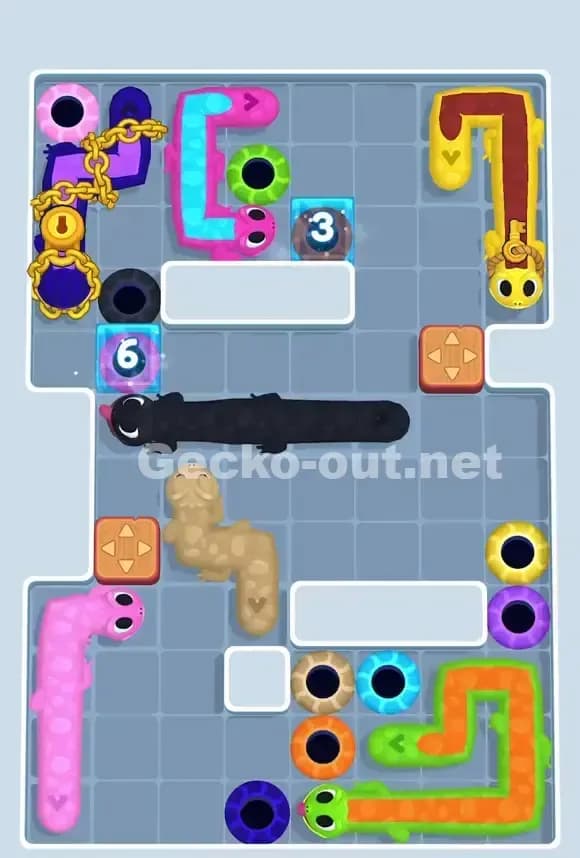

Gecko Out Level 753: Board Layout, Rules, and Win Condition
The Starting Board: A Tangled Web of Geckos and Obstacles
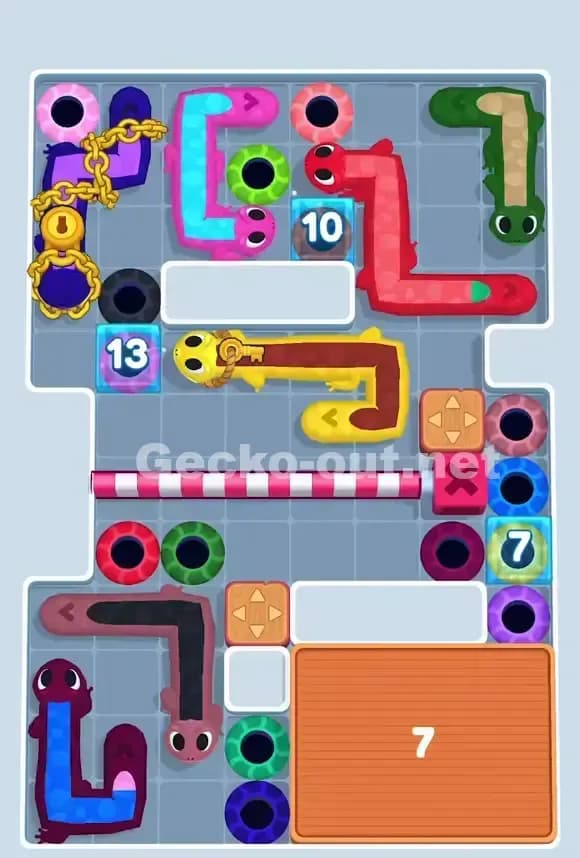
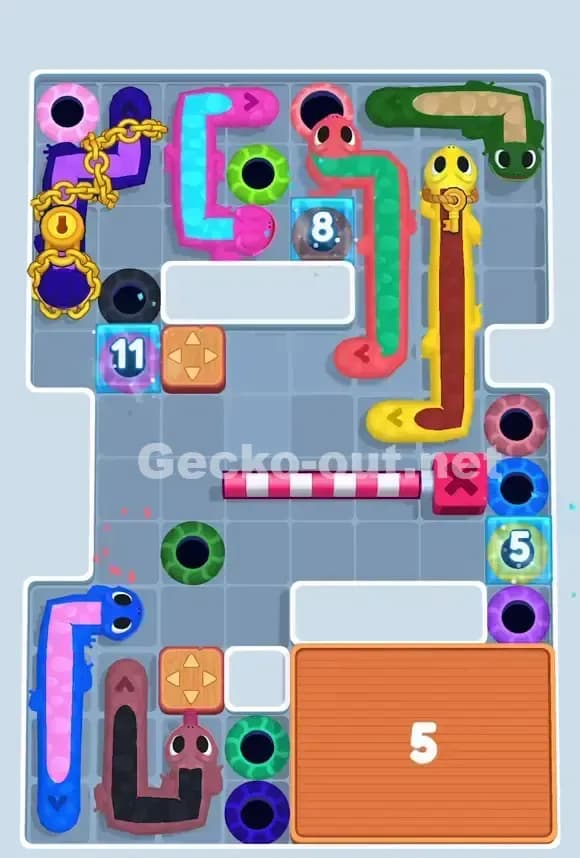
Gecko Out Level 753 throws a lot at you right from the start. You're managing five geckos spread across a grid that's crammed with walls, locked exits, toll gates, and what I'd call "parking lot syndrome"—there's just not enough open space to move freely. The board features a pink gecko (top-left), a magenta "L"-shaped gang gecko taking up serious real estate in the upper-middle section, a red gang gecko forming a twisted knot in the upper-right and center area, a yellow gang gecko curving through the middle-lower portion, and a purple gang gecko coiled in the bottom-left corner. Each gecko has a matching colored hole they need to reach, but here's the catch: several exits are locked behind numbered toll gates (marked 10, 13, and 7), and there are white safe zones scattered across the board that seem helpful but can actually become traps if you're not careful about your pathing order.
The win condition is straightforward but brutal: get all five geckos into their matching holes before the timer runs out. Because you're dragging gecko heads to guide their bodies along a fixed path, every move is permanent until the gecko exits. That means one wrong drag can lock an entire corridor and cascade into failure. The timer pressure is real here—you don't have the luxury of trial-and-error once you start committing geckos to paths.
Why the Layout Is So Punishing
The grid is deliberately congested. Notice how the red gang gecko's body curves directly across potential escape routes, and the magenta gecko's sharp "L" shape means its body occupies multiple zones simultaneously. You can't simply nudge one gecko out and move on; you have to choreograph all five movements in a specific sequence, or you'll end up with overlapping bodies blocking critical corridors. The toll gates add another layer of complexity—you've got to remember which gecko needs to pay which toll and plan your path to hit those gates in the correct order, or you'll waste precious moves repositioning.
Pathing Bottlenecks and Logical Traps in Gecko Out Level 753
The Central Chokepoint: Why the Red Gecko Is Your Biggest Obstacle
The red gang gecko is the primary bottleneck on Gecko Out Level 753. Its twisted, multi-cell body occupies a corridor that other geckos need to pass through to reach their exits. The moment you make any forward move with the red gecko, its long body snakes through the middle of the board, either blocking or opening lanes for everyone else depending on which direction you drag its head. This gecko absolutely must be routed carefully and, frankly, probably needs to be one of your first moves—not because it exits first, but because leaving it in place stalls the entire operation. I've seen players waste half their timer trying to squeeze other geckos around the red one, only to realize too late they've painted themselves into a corner.
Subtle Trap #1: The White Safe Zones Aren't Safe
Here's what trips up most players on Gecko Out Level 753: those white blank spaces look like parking areas where you can stash a gecko body temporarily while you work on others. They're not. They're just empty grid cells. If you drag a gecko through one, its body occupies that space, and if you later need that cell for another gecko's escape path, you've blocked yourself. The urge to "park" a long gecko's tail somewhere quiet is strong, but it's a false sense of security.
Subtle Trap #2: The Numbered Toll Gates and Exit Order
Gecko Out Level 753 has at least three toll gates (10, 13, and 7), and they're positioned such that some geckos must pass through them to reach their holes. The trick is that these gates consume moves and lock in your path sequence. If you route a gecko through toll gate 10 thinking it'll get them closer to their exit, but that exit is actually on the other side of toll gate 13, you've wasted a move and created a dead-end scenario. You need to map the full path to each hole before you start dragging, not as you go.
Subtle Trap #3: Gang Gecko Body Overlap and the Body-Follow Rule
The magenta and yellow geckos are both long gang members, and their bodies are stiff—they follow the exact path you drag the head through. Here's what kills runs on Gecko Out Level 753: you drag one gang gecko's head, forget that its entire body follows that exact route, and when the body snakes around corners or through tight spots, it suddenly blocks the path you needed for a different gecko. The body-follow rule is fundamental, but under timer pressure, it's easy to focus only on the head's destination and forget the trail it leaves behind.
Personal Reaction to the Puzzle's Difficulty
Honestly? Gecko Out Level 753 frustrated me the first couple of times. I'd get three geckos out, run low on time, and then realize the fourth gecko's body was now tangled around exits I hadn't anticipated. But then it clicked—I stopped thinking of this as five separate escape problems and started seeing it as one choreographed sequence. The moment I mapped out all five paths on paper before dragging anything, the level stopped feeling impossible. It's tough, but once you accept that the order and the body trails matter more than speed, Gecko Out Level 753 becomes manageable.
Turn-by-Turn Path Strategy to Beat Gecko Out Level 753
Opening: Triage and Establish the Lane
Start with the red gang gecko. Even though it doesn't exit first, its position is the lynchpin of the entire board. Carefully drag its head toward its exit hole, ensuring its body doesn't collide with walls or other gecko starting positions. This first move opens up the central corridor and removes the biggest geometric obstacle. Once the red gecko is locked into its path, you've essentially freed up space for others.
Next, handle the magenta gecko. Its "L" shape is visually intimidating, but its exit is relatively accessible once the red gecko is out of the way. Drag its head methodically through the upper region, and commit to a path that avoids creating a body trail that'll block future moves. This is where patience pays off—don't rush. Verify the path clears before you drag.
For the third move, tackle the purple gecko in the bottom-left. Its coiled shape means its body occupies several cells, but its exit hole is nearby, and dealing with it early prevents it from becoming a late-game bottleneck. The shorter the gecko's remaining distance, the less its body will interfere with others' escape routes.
Mid-Game: Keep Critical Lanes Open
You should now have three geckos either exiting or locked into safe paths. The remaining two—the pink gecko and the yellow gang gecko—are your mid-game focus. The yellow gecko is tricky because it's long and curved, so you need to drag its head in a way that lets its body follow without looping back into already-cleared spaces. Resist the urge to be efficient; instead, be clear. Choose a path that's slightly longer but guaranteed not to cross other geckos' trails.
The pink gecko, conversely, is short and nimble. Don't move it yet. Use it as a mobile reference point—if you can fit the yellow gecko's body around the pink gecko's current position, you know the path will work. Only move the pink gecko once the yellow gecko is committed to its trajectory.
Throughout this phase, you're managing the timer by making deliberate, well-planned moves rather than quick, reactive ones. Pause. Look at the board. Trace the path with your finger. Then drag.
End-Game: The Final Two Exits and the Timer Crunch
At this point, you've got one or two geckos left and maybe 20–30 seconds remaining (depending on how efficiently you've moved). This is where calm execution matters. If the pink gecko and one other remain, get the longer one out first so its body doesn't block the final exit. The pink gecko, being shorter, can squeeze through tighter final corridors.
Watch for last-second choke points around the remaining holes. If a gecko's exit is partially obscured by walls or toll gates, make sure your drag path actually leads through those gates and doesn't accidentally spiral into a dead-end. Double-check toll gate order: you can't exit through gate 7 if you haven't passed through gate 13 first (or whatever the sequence is).
If you're very low on time and one gecko remains, don't panic-drag. A well-aimed path that takes two seconds of setup and one second to execute beats a frantic drag that overshoots or hits a wall. Gecko Out Level 753 rewards composure.
Why This Path Order Works in Gecko Out Level 753
The Head-Drag and Body-Follow Principle
Gecko Out Level 753's core mechanic is that the gecko's body strictly follows the path you drag the head through. This means you can't "undo" a path once you commit; the body is locked into that trail. The strategy of clearing obstacles early (red, magenta, purple) and parking short geckos late (pink, yellow) works because it eliminates the long, serpentine body trails that could block future moves. By the time you're moving the short gecko, most of the board is already open, and its small body can navigate the remaining space without secondary effects.
The reverse order—moving short geckos first—fails because long geckos' bodies will inevitably overlap with trails you've already marked. You're essentially drawing a web of interlocking paths, and the red gecko is the central spider web thread that every other path must respect.
Timer Management: When to Pause and When to Go
Gecko Out Level 753 gives you a limited timer, but it's not so tight that you have to move without thinking. Use the first 30 seconds to map all five paths mentally. Trace your finger along potential routes for each gecko. Ask yourself: if I drag red here, where does its body end up? Does it block magenta's exit? Once you've answered these questions, you can move with confidence. The difference between a player who runs out of time and one who escapes with seconds left often comes down to 30 seconds of upfront planning.
When you're down to the final gecko, give yourself another five seconds to visually confirm the path is clear. Hitting a wall or toll gate at the last second because you rushed is heartbreaking. Gecko Out Level 753 punishes haste but rewards methodical play.
Booster Strategy: When to Use and When to Skip
Gecko Out Level 753 can be beaten without boosters if you execute the above strategy flawlessly. However, if you've completed three geckos and the timer is under 15 seconds with two geckos remaining, a time booster is justified—it gives you the breathing room to finish without panic-rushing. A "hint" booster isn't necessary once you understand the path-order logic, but if you're genuinely stuck (all paths seem to intersect), a hint will pinpoint the sequence you're missing. The hammer-style tools are overkill for this level unless you accidentally create an unsolvable knot—in which case, restarting is faster than using a tool. Boosters are backup options, not your primary strategy for Gecko Out Level 753.
Mistakes, Fixes, and Logic You Can Reuse in Other Gecko Out Levels
Mistake #1: Dragging Long Geckos Last
Many players move the short geckos early, thinking they're easier and faster. This leaves long geckos for later, and by then, the board is so constrained that the long gecko's body has nowhere to go. Fix: Always route long geckos before short ones. Their bodies take up more space and require more "air" to maneuver.
Mistake #2: Ignoring Body Trails and Focusing Only on the Exit
You drag a gecko's head directly toward its hole without considering that the body will snake through half the board. Fix: Before dragging, mentally trace the full path the body will take, not just where the head ends up. Does that trail cross a wall? Does it block another gecko's route? Trace it completely.
Mistake #3: Moving the Same Gecko Twice
Under timer pressure, players sometimes move a gecko, see it's in a slightly suboptimal position, and try to adjust by dragging it again. This wastes moves and time. Fix: Get the path right before you commit. Use the pause feature (if available) to verify the route is good, then drag once and lock it in.
Mistake #4: Underestimating Toll Gates and Exit Sequences
You route a gecko toward its hole, but the path doesn't account for which toll gate it needs to pay. The gecko reaches a dead-end and you're stuck. Fix: Before you move any gecko, identify which toll gates lie between its starting position and its exit. Plan the path to include those gates in the correct order. Gecko Out Level 753 specifically has this problem because exits are separated by numbered gates.
Mistake #5: Treating White Safe Zones as Parking Spots
You stash a gecko's body in a blank white area, thinking it's out of the way, then later realize you need that cell for another gecko's escape path. Fix: White zones are just empty grid cells; they're not safe havens. Never drag a gecko through a white zone unless that's part of its direct path to the exit.
Reusing This Logic on Similar Levels
This escape-the-long-gecko-first, trace-the-body-trail, map-all-paths-before-moving approach works brilliantly on any level with gang geckos, tight corridors, or multiple exits. If you're facing a level with gang geckos (long, multi-segment bodies), you now know to handle them early and carefully. If there are toll gates, always map the sequence. If the board is congested, prioritize space-freeing moves over quick exits. Gecko Out Level 753 is a masterclass in this type of puzzle, and once you've beaten it, you'll see the same patterns in harder levels and know exactly how to approach them.
Final Encouragement
Gecko Out Level 753 is genuinely tough, but it's not unfair. It's a puzzle that respects the player who takes 30 seconds to think and execute cleanly over the player who panic-drags for speed. You've got this. Map the paths, move the long geckos first, respect the body-follow rule, and trust your plan. The gecko escape is yours to claim.