Gecko Out Level 734 Solution Walkthrough | Gecko Out 734 Answer
How to solve Gecko Out level 734? Get step by step solution & cheat for Gecko Out level 734. Solve Gecko Out 734 easily with the answers & video walkthrough.
Gecko Out Level 734: Board Layout, Rules, and Win Condition
The Starting Board: A Dense Tangle of Geckos and Color-Coded Holes
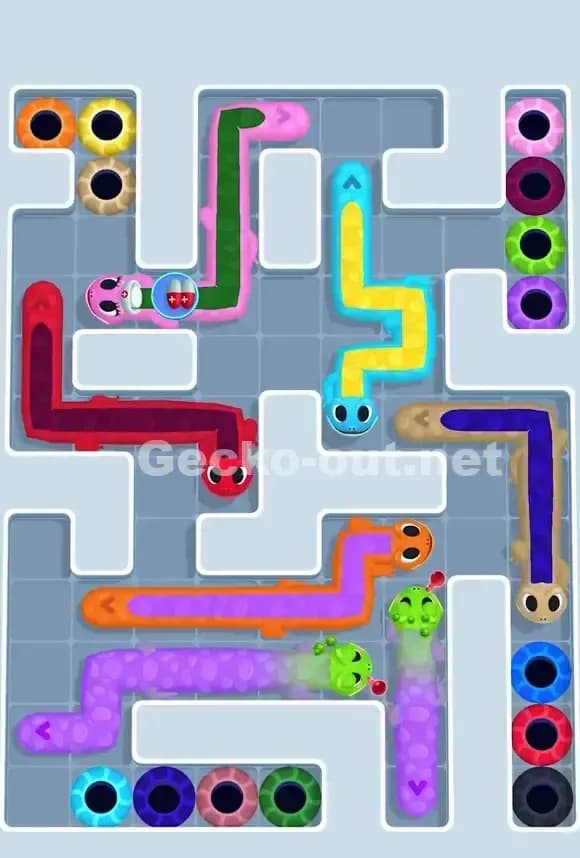
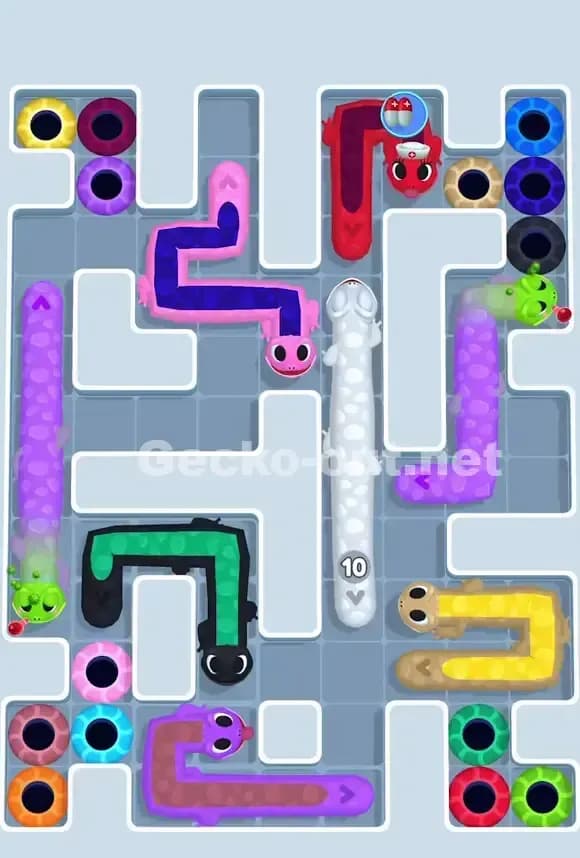
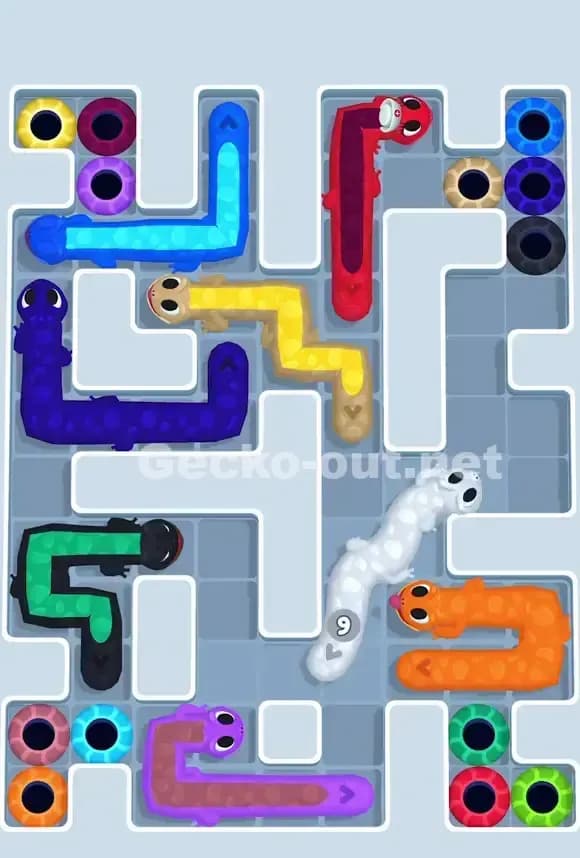
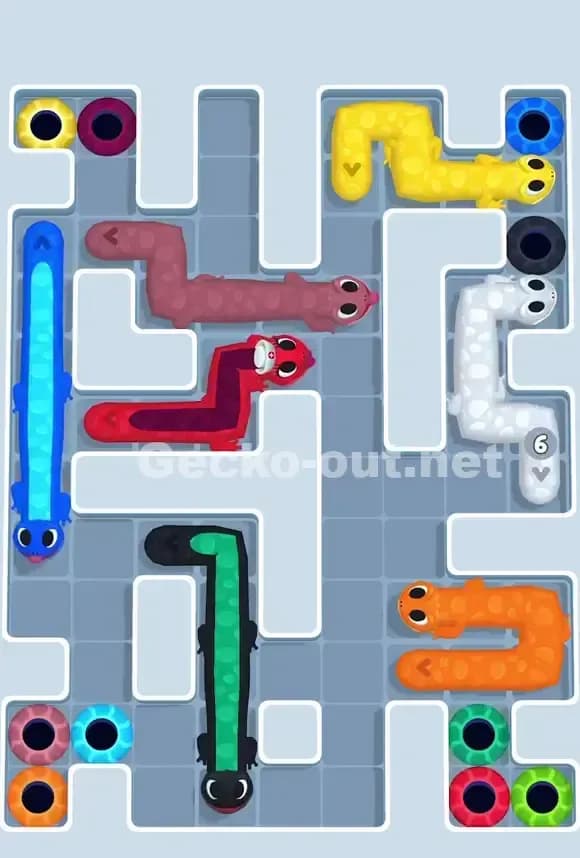
Gecko Out Level 734 is packed. You're looking at roughly eight distinct geckos spread across a maze-like grid, each one a different color: yellow, magenta, purple, red, blue, green, orange, and cyan. The board itself is a cramped labyrinth of white wall corridors cutting through gray tile space, with multiple geckos jammed into tight clusters on the left and right sides. What makes this level immediately tense is that there's very little breathing room—almost every gecko is either touching another gecko or sitting just one or two squares away from a neighbor. The holes (your target exits) are scattered throughout the board in their matching colors, but reaching them isn't straightforward because the paths wind, overlap, and force you to thread bodies through impossibly narrow gaps. You'll also notice a timer counting down from 10 moves or so, which adds real pressure to every drag decision you make.
The Win Condition and Timer Mechanics
To beat Gecko Out Level 734, you need every single gecko to reach its matching-colored hole and escape before that timer runs out. The timer doesn't measure seconds—it measures something more like "action windows," so every path you drag costs time. The body-follow mechanic means that once you drag a gecko's head along a route, its entire elongated body must trace that exact same path without overlapping walls, other geckos' bodies, or any locked/icy exits that might be in the way. This is where Gecko Out Level 734 becomes a spatial chess puzzle: one bad drag can leave a gecko's body blocking the very corridor another gecko needs to use. That's why the timer and the tight layout work together to create real urgency—you can't afford to undo bad moves, and you definitely can't afford to waste time repositioning geckos multiple times.
Pathing Bottlenecks and Logical Traps in Gecko Out Level 734
The Central White Corridor: Your Primary Choke Point
The biggest bottleneck in Gecko Out Level 734 is the vertical white corridor running down the center of the board. This narrow passage is the only route that allows several geckos to move from the upper half to the lower half, and it's only about two squares wide. At least three geckos (including the red and blue ones) need to use this corridor to reach their holes, but you can't send them all at once—their bodies would overlap and jam. This means you'll spend a significant chunk of your planning time deciding which gecko gets to commit to the center corridor first, how to "park" the others so they're not in the way, and in what order the remaining geckos will follow. If you get the sequence wrong, you'll end up with a gecko body blocking the corridor while another gecko's head is still stuck on the wrong side, unable to move forward. That's the moment you'd lose.
Subtle Problem Spot #1: The Purple Gang at the Top-Left
There's a tightly linked cluster of purple geckos in the upper-left section that moves as a unit (gang geckos stay connected). These purple bodies are long and snake around each other, so if you drag the head in the wrong direction, you'll create a knot that becomes nearly impossible to untangle without restarting. The purple hole is actually on the right side of the board, so you'll need to carefully thread this purple chain across the board without it colliding with other geckos or the red gecko above it that also needs to move.
Subtle Problem Spot #2: The Green Gecko's Awkward Entry Point
The bright green gecko is positioned in the bottom-right area, and its exit hole is nearby—but the path to that hole winds through a narrow corner that multiple other geckos' bodies will pass through. If you route the yellow gecko or the orange gecko carelessly, they can block green's final approach to its hole.
Subtle Problem Spot #3: The Cyan and Red Corridor Clash
The cyan gecko (bottom-left) and the red gecko (upper-right) both need to navigate through overlapping corridors. If you move red too early without clearing its path completely, you'll trap cyan's body in a dead-end corridor later, even though cyan's head might reach its hole.
The Moment It Clicked for Me
I'll be honest: the first two attempts at Gecko Out Level 734 felt like pure chaos. I was dragging geckos left and right, watching their bodies snake around in ways I didn't fully anticipate, and within three or four moves, I'd created a complete traffic jam. But on the third attempt, I paused and actually traced each gecko's full path on the board with my eyes before touching anything. That's when I realized the solution wasn't about speed—it was about release order. The geckos that need to cross the board first should be the ones with the longest bodies and the fewest obstacles in their way. The ones with shorter bodies or more direct routes to their holes should go last, so they can weave between the gaps left by the earlier geckos. Once I locked in that logic, Gecko Out Level 734 suddenly became solvable.
Turn-by-Turn Path Strategy to Beat Gecko Out Level 734
Opening: Park the Heavy Hitters First
Start by tackling the purple gang gecko. It's long, visually intimidating, but its route is relatively open if you plan ahead. Drag its head up and around the left side of the board, threading it through the corridor that leads to the purple hole on the right. Don't rush—trace the path carefully before you commit to the drag. The reason you open with purple is that it's a "space hog": once it's committed to its route, it'll occupy a significant part of the board, but at least you'll know exactly where its body is and what corridors are now blocked. This gives you certainty for the next gecko.
Next, move the red gecko from the upper-right. Its hole is accessible via the central white corridor, but you'll need to drag its head downward first, then guide it through the center passage. The trick here is to drag it in one smooth motion without lifting your finger too early—hesitation can make you drop the head partway and mess up your trajectory. Once red is committed to the center corridor, you've now used up that critical pathway, so you know no other gecko can use it while red's body is traversing it.
For your third move, deal with the yellow gecko at the top-left. It's shorter than purple and red, so it'll move faster. Route it via the outer edge of the board, skirting around the right side, and bring it down toward its yellow hole in the middle-right area. By opening with these three geckos, you've "claimed" most of the major corridors and established which parts of the board are now occupied.
Mid-Game: Keep Critical Lanes Open and Reposition Safely
Once your first three geckos are in motion (or ideally, already exited), you now have more flexibility with the remaining geckos because the board is less crowded. The blue gecko, for instance, needs to exit via a hole on the right side. By now, the red gecko should already be out, so the center corridor is partially clear. Drag blue downward and feed it through the center, but do it quickly—you're burning timer ticks with every move.
The orange and cyan geckos in the bottom-left are a pair you need to handle with care. Orange is shorter, so move orange first, routing it upward and to the right, threading it between the gaps created by the previous geckos. Then move cyan. Cyan is also relatively short, and its hole is in the bottom-left, so its route is almost a mirror of orange's path. The key is not to cross their paths: orange should exit before cyan moves, so cyan's corridor is clear.
Throughout mid-game, your mantra should be "one gecko at a time" and "no backseat driving." Once you've dragged a gecko's head and its body is on the move, don't panic if it looks tight. The body-follow mechanic is precise, and the game won't let you collide if you've traced a valid path. Trust your drag.
End-Game: The Last Geckos and the Timer Crunch
By the time you're down to the final two or three geckos, the board should feel much more open. The green gecko and possibly the magenta gecko are your endgame pieces. These are usually shorter and can navigate the remaining gaps quickly. Drag green through its available corridor and directly to its hole—no detours, no second-guessing. Magenta follows the same logic.
If you're running low on time (the timer is at 2 or 3 remaining moves), don't panic. The final gecko should have a clear, direct path because everything else is already out. If it doesn't, you've made a sequencing mistake earlier, and you'll need to restart. But if you've followed the strategy above, you should have enough time to get the last gecko out with one or two moves to spare. The final gecko is almost always the easiest because the board is mostly empty.
Why This Path Order Works in Gecko Out Level 734
Body-Follow Pathing and Untangling Logic
The genius of this strategy is that it respects the body-follow rule instead of fighting it. By moving the longest, most complex geckos first, you're essentially "clearing the board" of obstacles in a controlled way. Each gecko that exits removes a potential collision point for the remaining geckos. The body follows the head's exact drag trajectory, so if you've plotted a clear path before you drag, the body will take that same path without surprises. This is the opposite of the trap many players fall into on Gecko Out Level 734: they move short geckos first, thinking "quicker = better," but then the long geckos get stuck halfway across the board because all the corridors are now occupied by other geckos' bodies. By inverting that logic, you avoid knots altogether.
Timer Management: Pause, Read, Commit
Here's the real secret to Gecko Out Level 734 without burning boosters: spend the first 10–15 seconds just looking at the board. Trace each gecko's hole location, identify the primary corridors, and mentally map out which gecko should go first, second, and third. This pause costs no timer ticks (the timer only starts when you make your first drag), so use it. Once you've got your order locked in, move with confidence. Don't second-guess mid-drag. If you're unsure about a path halfway through dragging, lift your finger early and restart that gecko—the timer ticks will hurt, but less than completing a bad path that jams the board.
The timer pressure in Gecko Out Level 734 is psychological as much as mechanical. If you resist the urge to rush and instead front-load your thinking, you'll execute cleaner drags with fewer corrections, which actually saves time overall.
Are Boosters Necessary?
No, Gecko Out Level 734 doesn't require boosters if you follow this strategy. However, there's one optional booster that can be useful if you find yourself one move away from the timer running out and one gecko still on the board: a time extension or extra move token. If you've got it available and you're at the literal last moment, using it is harmless. But don't rely on it—the level is designed to be beatable without it, and relying on a booster often means you've made an earlier sequencing error. The hint booster is also available, but I'd skip it. The level is logical, not random, so a hint will just show you a path you've probably already considered.
Mistakes, Fixes, and Logic You Can Reuse in Other Gecko Out Levels
Mistake #1: Moving Short Geckos First
Many players assume that faster geckos (shorter bodies) should go first because they're "easier." This backfires on Gecko Out Level 734. The short geckos end up moving through corridors that the long geckos later need, and the long geckos get stuck because there's nowhere to route them. Fix: Always inventory gecko lengths before you move. Move long first, short last.
Mistake #2: Not Tracing the Full Body Path Before Dragging
You see a gecko's head and you see its hole, and you think, "I'll just drag the head toward the hole and see what happens." On Gecko Out Level 734, this is a recipe for disaster. The body is as long as the gecko itself, and if you haven't mentally traced where that body will go, you'll collide with obstacles you didn't see coming. Fix: Before you drag, use your finger to lightly sketch the path in the air (without actually touching the screen), or trace it with your eyes. Make sure the entire body path is clear.
Mistake #3: Dragging the Head Past the Hole
You're excited, the path feels open, and you drag the head right past the hole, overshooting it. Now the gecko's body is spread across the board in a useless configuration, blocking corridors for nothing. Fix: Drag the head directly to the hole, and release exactly when the head reaches the center of the hole. If you undershoot or overshoot, you've wasted a move and timer ticks.
Mistake #4: Ignoring Gang Geckos' Connected Bodies
If you forget that gang geckos (like the purple ones in Gecko Out Level 734) move as a unit, you'll drag one head and be shocked when its connected body refuses to follow the path because a sibling body is already occupying that space. Fix: When you spot gang geckos, treat them as a single organism. Drag the leading head, and trust that the entire chain will follow if the path is clear.
Mistake #5: Creating a Traffic Jam at the Central Corridor
The white corridor in the center of Gecko Out Level 734 is so tempting—it connects the upper and lower halves directly. But players often try to route two geckos through it in quick succession without waiting for the first one to fully exit. The bodies overlap, and both geckos jam. Fix: When you drag a gecko into a tight corridor, drag it all the way through to its hole and exit before you move the next gecko. Single-file is non-negotiable in narrow spaces.
Reusing This Logic on Similar Levels
This strategic thinking applies to any Gecko Out level with a heavy gang-gecko load, frozen exits, or tight central choke points. The principle is universal: inventory obstacles, move long-bodied geckos first, trace paths before committing, and use timer pauses to prevent mistakes rather than to fix them. If you encounter a level with multiple colors, multiple corridors, and a dense starting cluster, apply Gecko Out Level 734's philosophy: ruthlessly prioritize which geckos move first based on body length and path complexity, not cuteness or arbitrary preference.
Final Encouragement
Gecko Out Level 734 is genuinely tough—there's no shame in needing a couple of attempts to crack it. But it's also completely, 100% beatable with a clear head and a solid plan. The moment you stop treating it as a reflex puzzle (fast reflexes don't matter here) and start treating it as a spatial logic puzzle (planning matters a lot), the level opens up. You've got this. Trust your initial read, execute cleanly, and watch that final gecko slide into its hole with time to spare. Gecko Out Level 734 is the kind of level that feels impossible until it suddenly feels obvious—and that shift is incredibly satisfying.