Gecko Out Level 437 Solution Walkthrough | Gecko Out 437 Answer
How to solve Gecko Out level 437? Get step by step solution & cheat for Gecko Out level 437. Solve Gecko Out 437 easily with the answers & video walkthrough.
Gecko Out Level 437: Board Layout, Rules, and Win Condition
Starting Layout: Colors, Knots, and Obstacles
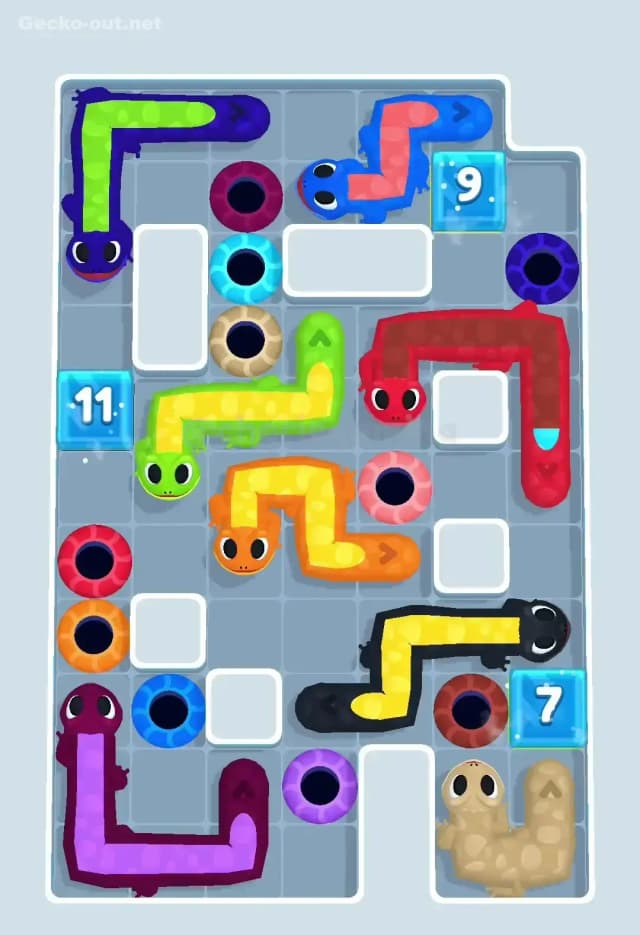
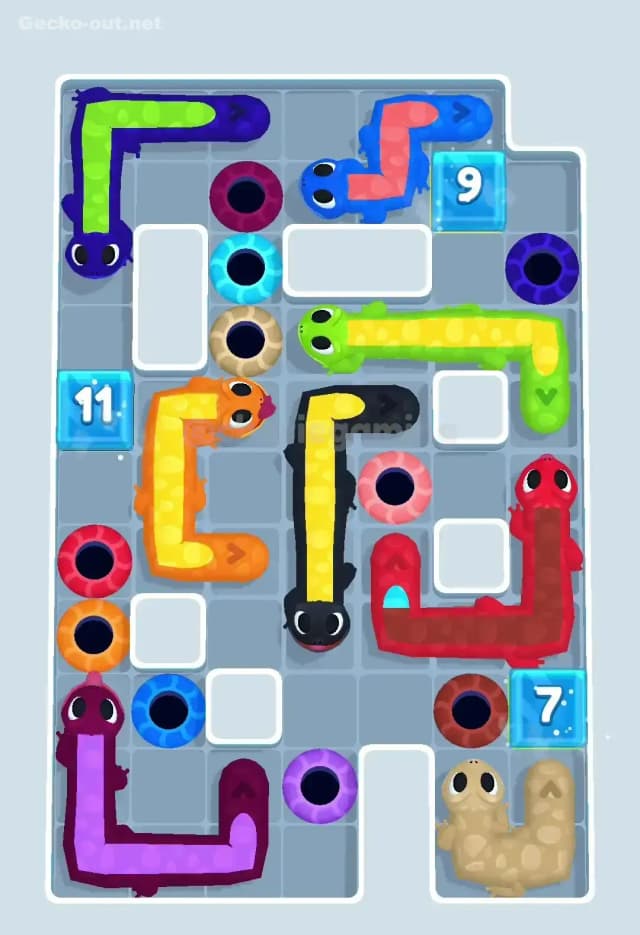
When you load Gecko Out Level 437 you’re dropped onto a tall, narrow board that’s absolutely packed. There are nine geckos in total: green and blue tucked along the top, a red monster hugging the right side, a yellow–orange trio jammed through the middle lanes, a black-and-yellow gecko bridging the lower right, and a purple and a pale beige gecko filling the bottom corners. Every one of them already snakes around at least one wall block, so nothing is “free” from the start.
Each gecko has a matching colored hole: purple, red, yellow, orange, green, blue, black, beige, and one extra bright ring for the second yellow/orange body. Most of the holes sit near the center of the board, which is what creates the knot; the bodies are wrapped around the edges and then turn inward toward those holes. Add in several white wall blocks that carve the grid into thin corridors and you’ve got a level where one wrong move completely seals a lane.
On top of that, Gecko Out 437 uses frozen exits: ice blocks with numbers like 11, 9, and 7. Those tiles behave like walls until their counter runs down, so early on you’re playing inside a smaller maze while some exits and paths are locked away. You’re forced to juggle geckos in tight spaces while keeping future routes open for when those blocks finally thaw.
Win Condition And How Movement Shapes The Challenge
As always, the win condition in Gecko Out Level 437 is simple: every gecko must slither into the hole of the same color before the level timer hits zero. You drag the head to draw a path, and the body follows that exact trail. You can’t cross walls, other geckos, or locked/frozen exits, and bodies can’t overlap or share squares.
Because the movement is path-based, not step-based, the real puzzle is geometry plus timing. A long drag that curls around several corners takes the same “decision time” as a short one, but it fills far more squares with body segments. If you drag carelessly, you leave thick, snaking barriers that other geckos have to navigate around. In Gecko Out 437, where most corridors are only one tile wide, a bad path is basically a temporary wall you built yourself.
The timer tightens everything. You don’t have time to experiment with every crazy idea. You need a clear order of operations, minimal backtracking, and short, direct routes to exits. Think of it like untangling headphones under a countdown: you want calm logic, not frantic swiping.
Pathing Bottlenecks and Logical Traps in Gecko Out Level 437
The Central Bottleneck Corridor
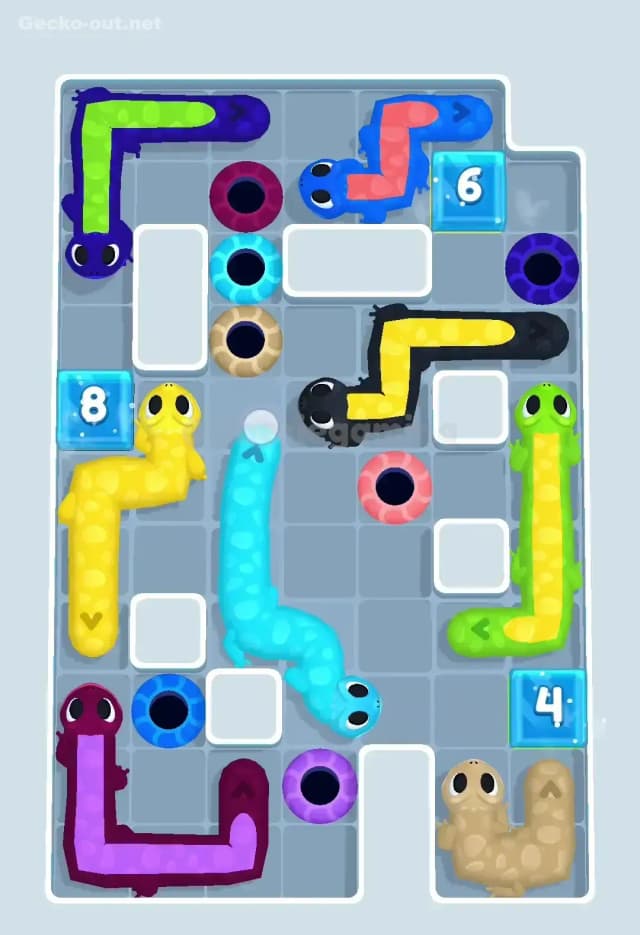
The single biggest bottleneck in Gecko Out Level 437 is the central vertical corridor that connects the bottom half of the board to the top. The orange and yellow geckos twist around this area, the black-and-yellow gecko leans into it from the right, and several holes sit just to the left and right of this lane. If you park any long body across that corridor, you immediately cut the board in two.
The red gecko on the right side is the main bully. Its body runs alongside that bottleneck, and many players instinctively move it first because it’s so prominent. But when you swing the red gecko around too early, its body sweeps across that central lane and makes it impossible for the yellows, green, or purple to reach their holes without a full reset. Treat this corridor as sacred space: you pass through it, you don’t camp on it.
Subtle Problem Spots That Cause Fails
There are a few nasty, less obvious traps in Gecko Out 437. One is the temptation to “park” a gecko head directly on or in front of a frozen exit. While the ice block is active, that seems fine—it looks like a safe dead end. But as soon as the countdown hits zero, the tile becomes a live hole, and now there’s a body segment jammed exactly where another gecko needs to go.
Another subtle trap is drawing big decorative loops when you reposition the central yellows or the purple corner gecko. A looped path looks neat but it makes their bodies sprawl over half the board. Later, when you try to bring the beige or black gecko through, you discover that your earlier loop has turned into a solid wall that costs precious time to unwind.
Finally, the lowest-right pocket where the beige gecko lives is dangerous. If the black-and-yellow gecko or the red gecko lies across that pocket’s mouth, the beige gecko has no escape route at all. It’s very easy to accidentally seal that opening while dealing with the mid-board.
When The Solution Starts To Make Sense
The first time I played Gecko Out Level 437, it felt like everything blocked everything. I’d free one gecko only to realize I’d just locked in two others behind a frozen exit or a wall of my own making. The frustration is real—especially when you run out of timer with a single gecko staring at its hole from two squares away.
The “click” moment came when I stopped thinking in terms of individual geckos and started thinking in lanes. I realized the safe order was: clear the short corner geckos first, keep the central vertical lane empty at all costs, let the frozen exits act as temporary walls, and leave the red and black geckos for last. Once I respected that structure, Gecko Out 437 stopped feeling random and started feeling like a controlled, almost scripted solve.
Turn-by-Turn Path Strategy to Beat Gecko Out Level 437
Opening: Who To Move First And Where To Park
In the opening of Gecko Out Level 437, forget the flashy long red gecko. Start with the short corner geckos: purple in the lower left and beige in the lower right. Their exits are both relatively close, and you can route them by hugging the outer walls so their bodies stay glued to the edges instead of spilling into the middle. Draw short, straight paths that land them in their holes with minimal extra tail.
Next, tidy the top. Slide the green and blue geckos along the top edge toward their own holes, but always end with their bodies lying flat against the upper wall. The goal is to clear room around the frozen exits and central holes while keeping the top row from sagging down into the lanes you’ll need later.
During this phase, “parking” is key. If you must leave a gecko un-exited for a moment, park it lengthwise along an outer wall or tight corner where no one else ever needs to pass. Never park across the vertical center or in front of a numbered ice block.
Mid-game: Keeping Lanes Open And Repositioning Safely
Once the corners and top are mostly sorted, turn to the yellow/orange cluster and the black-and-yellow gecko. For Gecko Out 437, I recommend exiting the orange or brighter yellow gecko next, because its hole is usually only a few turns away if the center is clear. Draw the path so the final body lies either just above or just below the main corridor, not across it.
Then reposition the black-and-yellow gecko. Swing it around so its body runs tight along the right wall, leaving the mouth of the beige pocket open and freeing the central lane. This is a good moment to exit the remaining yellow or the green gecko if their routes are clear; threading them through now prevents traffic later when the red gecko needs space.
The mid-game is where most runs of Gecko Out Level 437 die. Any time you’re about to drag a head, quickly ask: “Will this body end up blocking the vertical center or a thawing exit?” If the answer is yes, redraw the path shorter or along a different edge.
End-game: Final Exit Order And Low-Time Decisions
By the time the numeric ice blocks thaw, you should have only the red gecko, maybe the blue or black, and one leftover mid-board gecko remaining. At this point, prioritize exits whose paths cross others. In Gecko Out 437, that usually means red first, then black, then any final top gecko.
For the red gecko, use the full length of the right wall as a slide. Draw a mostly straight path from its current position to its hole, only dipping into the middle when you’re sure no other gecko still needs that tile. When the red body is gone, the board suddenly opens and the remaining routes are almost trivial.
If you’re low on time, commit to direct lines. Don’t redraw for “pretty” routes; as long as a path doesn’t block a remaining gecko’s only corridor, take the shortest path to the hole. Even messy-looking solves are wins in Gecko Out 437 as long as the timer hasn’t hit zero.
Why This Path Order Works in Gecko Out Level 437
Using Body-Follow To Untangle Instead Of Tighten
Gecko Out Level 437 is all about abusing the body-follow rule to your advantage. By moving short geckos first and hugging walls, you turn their bodies into harmless decorations along the edges instead of bulky barriers in the middle. The suggested order keeps long bodies like red and black for last, when there are fewer other geckos left to tangle with them.
Parking and exiting in this order means bodies mostly sweep in one direction—outward toward walls, then inward toward holes—rather than crisscrossing. That’s why you feel the knot loosening with each correct move instead of tightening into an impossible mess.
Balancing Planning Time And Fast Execution
On Gecko Out 437, you actually want to “waste” a few seconds at the very start just reading the board and committing to the plan. Once you know your rough order—corners, top, center yellows, then right-side long geckos—you can drag confidently without pausing before every move.
The ideal rhythm is: pause briefly whenever a frozen exit is about to thaw or you’re about to enter the central corridor; otherwise, move quickly with short, decisive drags. Overthinking every tile is how you lose to the timer. Underthinking the bottlenecks is how you soft-lock the board.
Boosters: Needed Or Optional?
Boosters in Gecko Out Level 437 are optional, not mandatory. The level is tight but fair once you respect the lane logic. If you absolutely need help, an extra-time booster is the most useful; it gives you room to redraw a path or fix a mid-game mistake without panicking.
I’d avoid using hammer-style tools on frozen exits here. Those icy blocks are actually helping you early on by acting as temporary walls that keep you from accidentally routing through future exits too soon. Only consider a hammer if you consistently reach the end with all routes clear but one exit still frozen.
Mistakes, Fixes, and Logic You Can Reuse in Other Gecko Out Levels
Common Mistakes On Gecko Out Level 437
Players usually trip over the same patterns on Gecko Out 437. Moving the red gecko first almost always ends in disaster; its long body sprawls through the center and strands smaller geckos behind it. Instead, leave red for later and focus on clearing space.
Another frequent mistake is looping paths unnecessarily. If your gecko could reach its hole with a clean “L” shape, don’t draw a spiral. Extra turns mean extra body segments in the way. People also love parking geckos directly in front of frozen exits; remember that those tiles will open, so that “safe” parking spot is actually a future choke point.
Finally, many runs die because players forget they can undo a single move quickly. If you see a path starting to block the center, cancel and redraw immediately instead of trying to fix it three geckos later.
Reusing This Logic On Other Knot-Heavy Levels
The mindset that solves Gecko Out Level 437 works on a lot of other tricky stages. On gang-gecko or frozen-exit levels, identify your main bottleneck lane first and mentally mark it as “no parking.” Exit short corner geckos early so their bodies hug the border and stop mattering.
Treat frozen exits as temporary walls when planning early-game routes. Ask which exits will open last and avoid drawing bodies through those areas until the board is thinner. On knot-heavy layouts, always think in terms of lanes rather than individual geckos: who owns the left wall, who owns the right, and who must pass through the middle only once.
Tough But Totally Beatable
Gecko Out Level 437 looks overwhelming, and it absolutely punishes random swiping. But with a calm lane-based plan—corners and top first, careful mid-board clean-up, long right-side geckos last—you’ll feel the whole puzzle unlock. Once you beat it a couple of times, you’ll start recognizing the same patterns in later levels and breeze through those too. Stick with the strategy, respect the bottlenecks, and Gecko Out 437 goes from “impossible” to “satisfyingly tight” in just a few runs.