Gecko Out Level 441 Solution Walkthrough | Gecko Out 441 Answer
How to solve Gecko Out level 441? Get step by step solution & cheat for Gecko Out level 441. Solve Gecko Out 441 easily with the answers & video walkthrough.
Gecko Out Level 441: Board Layout, Rules, and Win Condition
Starting Board Breakdown
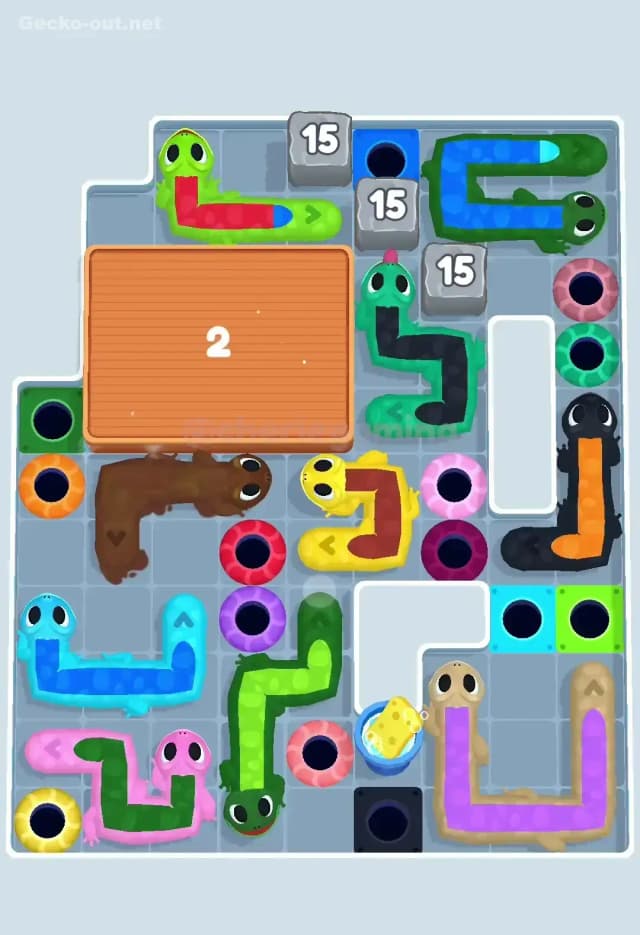
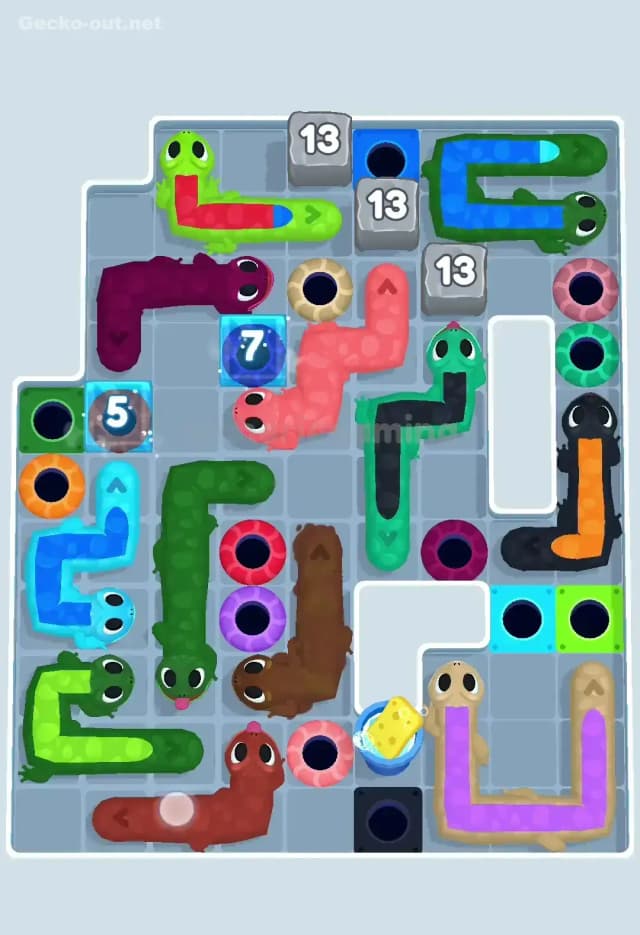
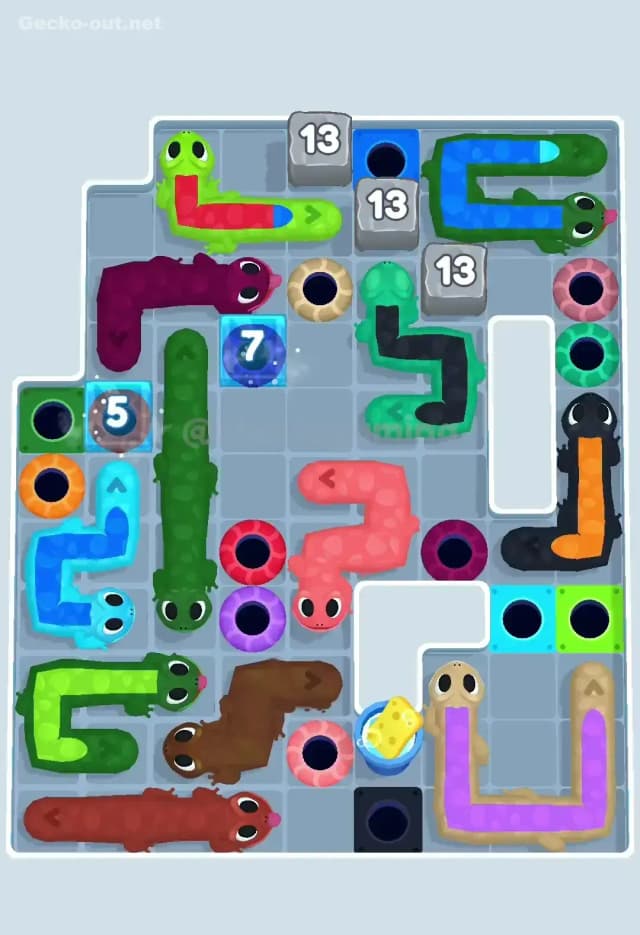
In Gecko Out Level 441 you drop straight into a very cramped board with lots of long bodies and barely any open floor. You’ve got a big mix of colors: a short green gecko tucked into the upper‑left corner, a long blue one wrapped around the upper‑right, a tall black‑and‑orange gecko on the right side, a chunky brown gecko sprawled across the center, and several shorter geckos packed along the bottom (light blue, pink, bright green, yellow, and a pale tan‑and‑purple one).
Colored holes ring the edges: orange and green on the left, blue and pink on the right, red and purple around the middle, plus a black exit near the lower center. Matching each gecko to its color hole is straightforward; the hard part is actually getting them there without sealing yourself in.
Obstacles in Gecko Out 441 are what make it nasty. There are two grey tiles marked with 15 near the top, acting as time‑bonus toll gates. A big wooden timer tile sits in the upper middle with a tiny starting value, plus solid white walls that carve the board into tight L‑shaped corridors. There’s also a soapy bucket next to the tan‑and‑purple gecko at the bottom right, meaning you have to route that gecko through it to fully “thaw” before it squeezes out.
Win Condition, Timer, and Pathing Pressure
Your win condition is the usual for Gecko Out Level 441: every gecko has to slither into its matching colored hole before the timer hits zero. The twist is that the visible timer is incredibly low at the start, so if you play slowly you lose before even clearing space.
Because bodies follow the exact path the head takes, every drag you make leaves a permanent trail. You can’t cross walls, other geckos, or exits, and you also can’t casually “undo” a loop without consuming even more time. In Gecko Out 441 the paths are so tight that one sloppy curve with the brown or black‑and‑orange gecko can choke off half the board. The pressure is to think in “lanes”: where can each gecko pass once, cleanly, without forcing everyone else to detour?
Pathing Bottlenecks and Logical Traps in Gecko Out Level 441
The Main Bottleneck Corridor
The single biggest bottleneck in Gecko Out Level 441 is the vertical and central space around the big brown gecko. That brown body sits under the timer, stretching from the left side toward the middle, with multiple exits and geckos trying to cross that same region. Until you move and park it somewhere sensible, the bottom cluster can’t really access their exits, and the tall black‑and‑orange gecko on the right can’t slide past cleanly either.
The top‑right lane around the long blue gecko is the second major choke. That blue body hugs the outer wall and sits next to the blue exit and one of the +15 tiles. If you move it in the wrong direction, it becomes a locked ring that nobody else can pass.
Subtle Problem Spots You Might Miss
-
The timer tiles (
15blocks) are deceptively placed. If the green gecko in the upper left hits its+15then coils back into the corner, you’ve burned your bonus on a move that still leaves the lane blocked. You want to hit the bonus while moving it toward a parking spot, not as a dead‑end lap. -
At the bottom right, the tan‑and‑purple gecko and the soap bucket look optional, but they’re not. If you try to send that gecko to the purple exit without first threading through the bucket, you’ll end up double‑pathing and stealing precious seconds.
-
The little knot of short geckos in the lower left (light blue, pink, and bright green) shares space with several exits. If you pull any one of them out in a big looping arc, you trap the others inside an “L” of your own body. It feels open, but one wrong curve there completely freezes the cluster.
How the Level Feels and When It Clicks
Gecko Out Level 441 feels brutal on the first attempts. I remember dragging the brown gecko back and forth in the middle, watching the timer crater while nothing actually escaped. It’s that classic puzzle frustration where every move seems to make the knot tighter.
The “aha” moment came when I flipped my priorities: instead of trying to free a gecko immediately, I treated the first few seconds as a race to secure time by hitting both +15 tiles and then park the long bodies along the edges. Once the brown gecko was shifted to the left side and the blue and black‑and‑orange geckos were straightened out, the board went from impossible to surprisingly manageable.
Turn-by-Turn Path Strategy to Beat Gecko Out Level 441
Opening: Secure Time and Park the Long Geckos
-
Use the upper‑left green gecko to grab the left
+15. Drag its head out toward the center, across the bonus, then down so its body ends up lying horizontally just under the timer rather than curling back into the corner. You’re both buying time and opening that upper corner. -
Next, move the green‑and‑black gang gecko on the right side through the other
+15tile. Pull its head up and left to touch the bonus, then guide it down along the right wall and park it low, near the bottom‑right white wall, leaving the blue exit area clear. -
Now tackle the big brown gecko. Drag it down and left so it lies mostly along the lower left edge, just outside the immediate exit cluster. The goal is to free the center lane and avoid letting the brown body weave between multiple exits.
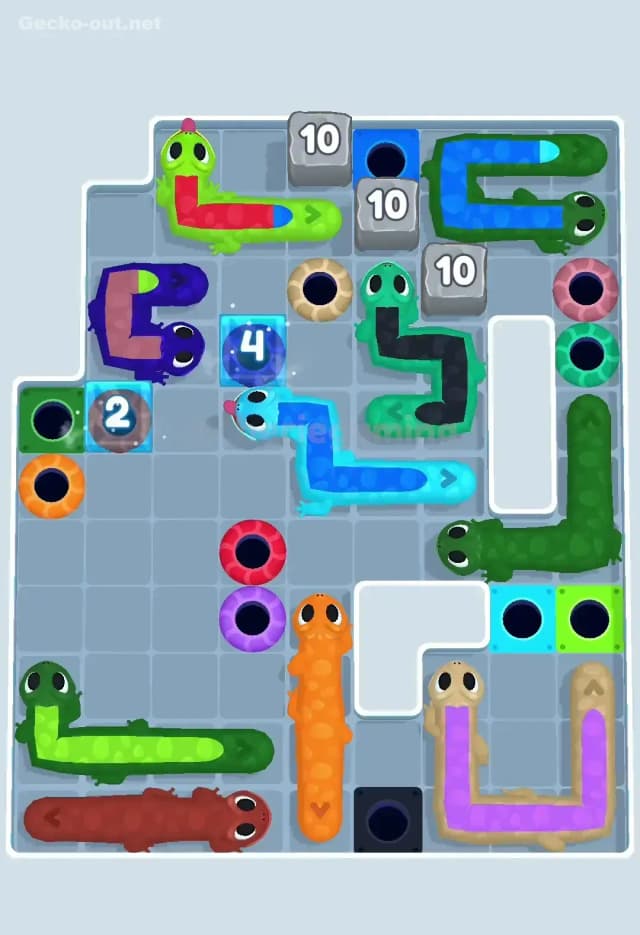
By the end of this opening, you should have more time on the clock, the top row relatively clean, and the middle vertical corridor open.
Mid-game: Keep Lanes Open and Untangle the Bottom Cluster
Now that Gecko Out Level 441 has some breathing room, focus on the bottom geckos:
-
Start with the light blue and pink geckos in the lower left. Route each one in a short, direct path to its matching exit (left edge for the light blue, lower exits for pink/green), drawing the smallest possible arc. While doing this, keep their bodies pressed against edges or holes so they don’t jut into the central lane.
-
Next, straighten and move the tall bright‑green gecko in the lower center. Pull it either straight up into the cleared middle and then out toward its green exit, or down and along the bottom first, but avoid zig‑zags. That gecko’s length can easily form a cage if you over‑curve it.
-
Use this clearer bottom area to reposition the black‑and‑orange gecko on the right. Drag it slightly left and down, hugging the right wall, so its body is vertical and neat. Don’t send it into the exit yet; you still need that lane as a highway for the tan‑and‑purple gecko.
Also, route the long blue gecko on the top right to its blue hole while the middle remains open. Keep its path hugging the outer walls, avoiding swipes across the central region.
End-game: Exit Order and Handling Low Time
Once most of the short geckos are out and the long ones are parked neatly, you should have only a few left: the tan‑and‑purple gecko near the bucket, possibly the brown one, and the black‑and‑orange on the right.
-
For the tan‑and‑purple gecko, drag its head through the soap bucket first to “clean” it, then thread it up through the central gap and into the purple exit. Use a simple L‑shape path; don’t spiral around any existing bodies.
-
After that, escort the black‑and‑orange gecko straight into the black exit in the lower middle. Since its body is already vertical along the right wall, this should be a short move.
-
Finally, exit the brown gecko (if it isn’t already out) by sweeping it along the left side and then into its matching hole with a clean curve.
If you’re low on time near the end, prioritize the geckos closest to their exits and draw only straight or single‑turn paths. Because their bodies mirror your swipe exactly, every decorative bend is wasted time and future blockage.
Why This Path Order Works in Gecko Out Level 441
Using Body-Follow Pathing to Untangle, Not Tighten
The reason this sequence works in Gecko Out 441 is that it respects how bodies follow heads. Parking the longest geckos (brown, blue, black‑and‑orange, bright green) along the outer edges early means their bodies become walls you can rely on, not random spaghetti that slices the board into unusable pockets.
By hitting the +15 tiles during useful moves, you expand the timer while also repositioning. Moving the bottom cluster after the center lane is open turns those tiny geckos into quick wins instead of awkward obstacles, and delaying the tan‑and‑purple one until the end lets you route it through the bucket once, cleanly, instead of multiple passes.
Timer Management: When to Think vs. When to Swipe
In Gecko Out Level 441, you actually want to pause mentally before your very first move: scan for both +15 tiles and decide which gecko will touch which one. After that, play the opening fairly quickly; those first three geckos don’t require perfect precision, just clear lanes.
Once the timer is padded, you can afford a brief pause before the mid‑game to plan the exact order for the bottom cluster. In the end‑game, speed matters again. If your plan is solid, you’re just executing simple L‑shapes, so trust it and swipe.
Boosters: Optional, Not Required
You can absolutely beat Gecko Out Level 441 without boosters. I’d treat them as insurance, not the default plan:
- A time booster is only worth using if you consistently reach the end with the last one or two geckos nearly home.
- A hammer‑style blocker remover is overkill here; the board is solvable without breaking walls.
- Hints can be helpful if you keep trapping the bottom cluster, but they often show very specific paths that don’t teach the lane logic.
If you follow the parking‑and‑lane strategy, boosters should stay unused.
Mistakes, Fixes, and Logic You Can Reuse in Other Gecko Out Levels
Common Mistakes on Gecko Out Level 441
-
Moving the brown gecko first without a plan, letting it sprawl through the middle. Fix: always park it along the left edge early so it stops cutting the board in half.
-
Ignoring the
+15tiles until mid‑game. By then the timer’s already dead. Fix: your first two real moves in Gecko Out 441 should grab both bonuses while repositioning the upper geckos. -
Drawing big loops with the short geckos in the lower left. Fix: aim for the smallest possible L‑shape from each head to its exit, hugging the walls, not the middle.
-
Trying to exit the tan‑and‑purple gecko before running it through the bucket. Fix: route it through the soap once, near the end, then send it directly to the purple hole.
-
Finishing the black‑and‑orange gecko too early. Fix: keep it vertical on the right and use that lane for other geckos, then drop it into the black exit when everything else has passed.
Reusing This Logic on Other Knot-Heavy Levels
The mindset you build on Gecko Out Level 441 carries over really well:
- Identify the longest geckos first and assign them edge‑parking spots so they form predictable borders.
- Treat timer tiles or toll gates as part of efficient paths, not as detours.
- Decide on a “main highway” (in this case, the central vertical lane) and avoid letting any body snake across it more than once.
- Handle special rules (frozen exits, buckets, gang bodies) as late as possible, with clean, single‑pass routes.
Whenever you see a level with multiple gang geckos or frozen exits, ask yourself: “Which long body can I turn into a wall, and which single lane do I absolutely need to keep open?”
Final Encouragement
Gecko Out Level 441 looks overwhelming, but it’s one of those puzzles that goes from chaos to clarity once you respect the lanes and the timer. If you focus on grabbing time early, parking the long geckos along the edges, and keeping that central corridor open, the exits fall into place much faster than you’d expect. Stick with this plan, and you’ll have Gecko Out 441 under control—and you’ll be better prepared for every tight, knot‑heavy level that comes after it.