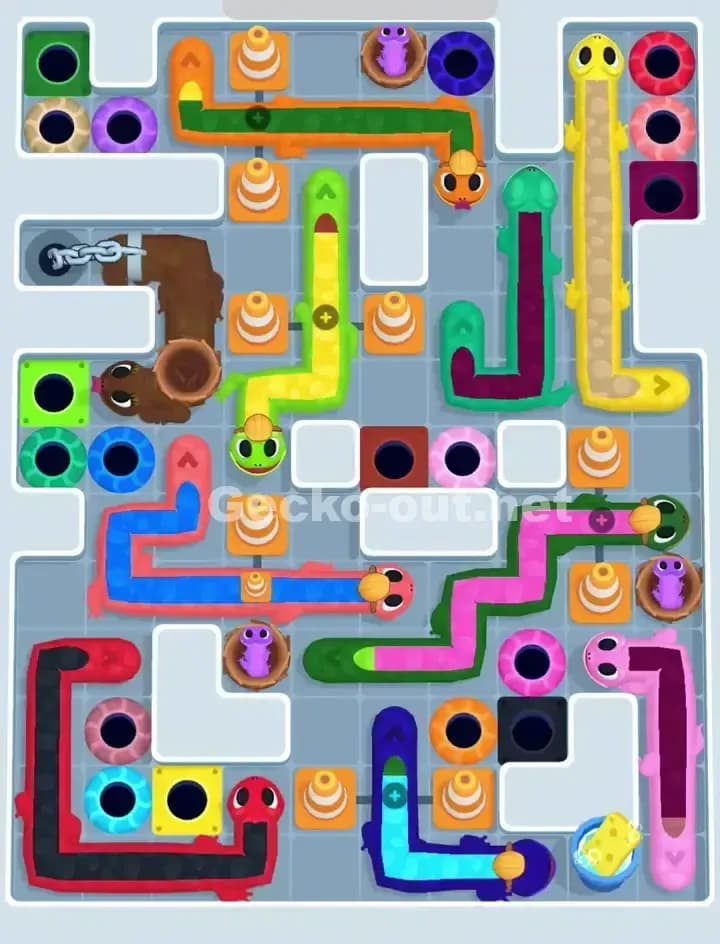
Gecko Out Level 1101 Solution Walkthrough | Gecko Out 1101 Answer
How to solve Gecko Out level 1101? Get step by step solution & cheat for Gecko Out level 1101. Solve Gecko Out 1101 easily with the answers & video walkthrough.
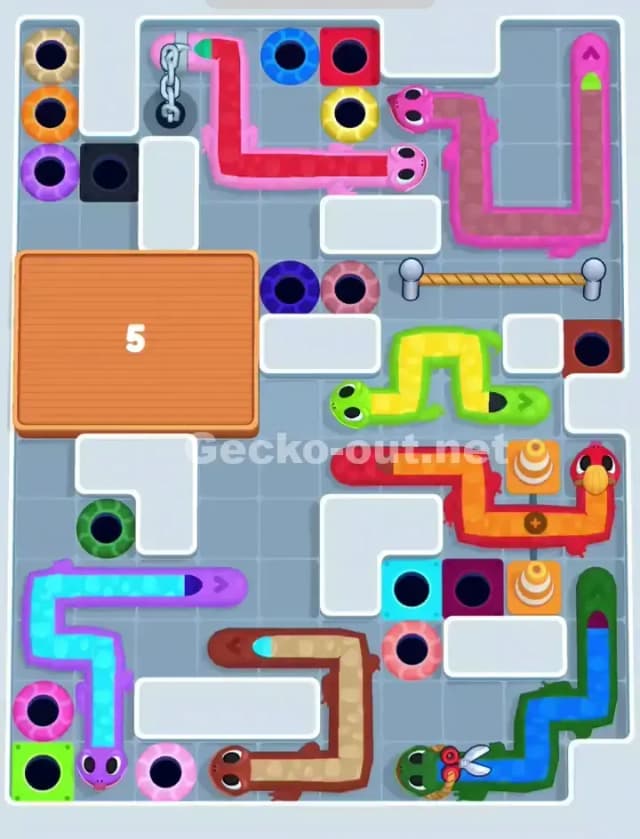
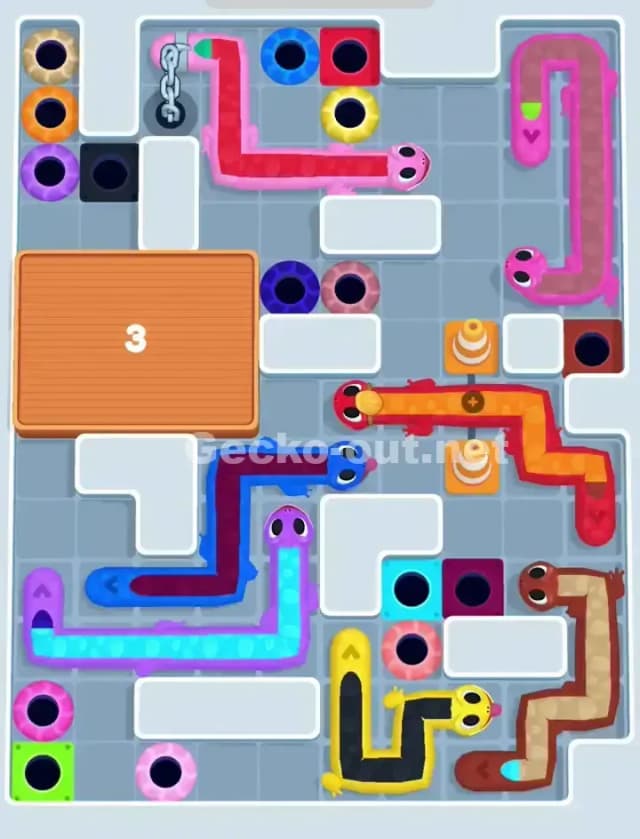
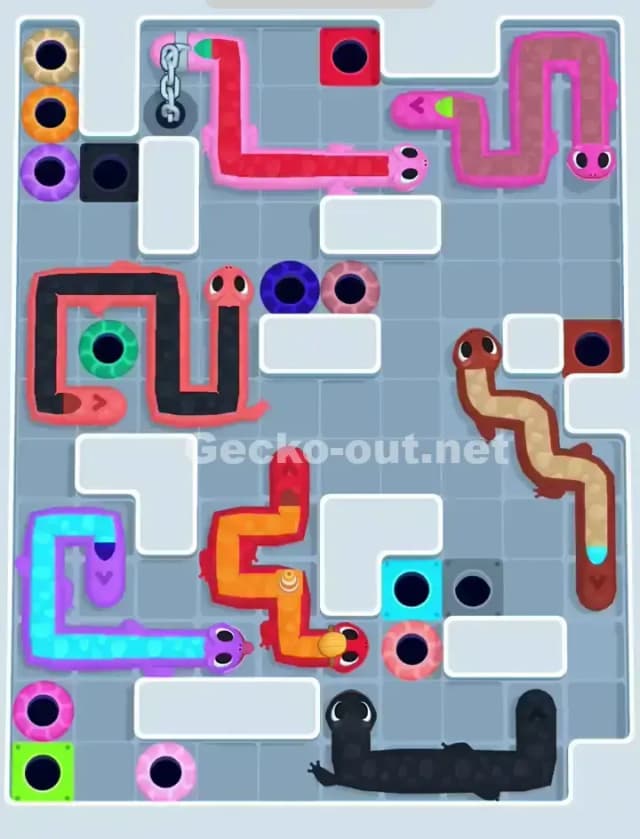

Gecko Out Level 1101: Board Layout, Rules, and Win Condition
Gecko Out Level 1101 is a dense, multi-gecko puzzle that tests both your spatial reasoning and your ability to plan under pressure. You're looking at a board packed with roughly a dozen geckos in various colors—orange, purple, pink, blue, yellow, cyan, red, and green—scattered across a compact grid with numerous walls, blocked spaces, and tight corridors. The starting configuration is deliberately tangled: several geckos are stacked near the left and bottom edges, while others are tucked into the nooks of L-shaped and rectangular paths on the right side. Each gecko has a matching hole (also called an exit) somewhere on the board, and your job is to drag each gecko's head through the available spaces so its body follows a safe, unobstructed path to that exit.
The win condition is straightforward but unforgiving: every single gecko must reach its matching-colored hole before the timer runs out. There's no partial credit in Gecko Out Level 1101. One gecko left behind means a failed run. The timer is your constant pressure—it's not generous, so you can't afford to waste moves or second-guess your paths once you've committed to dragging a gecko head. The board's layout forces you to choreograph your exits carefully, because once a gecko's body occupies a corridor, no other gecko can use that space. This creates a cascading dependency: moving one gecko wrong doesn't just trap that gecko, it can lock three others in place and make the puzzle unsolvable before you even realize it.
Starting Setup and Key Obstacles
When you first load Gecko Out Level 1101, you'll see a vertical stack of three geckos on the left (orange, purple, and pink), plus a black gecko nearby in a small chamber. The orange gecko is particularly bulky and will become your first bottleneck because it controls access to a critical lower corridor. Scattered across the right and center zones are more geckos: a pink one forming an L-shape, a blue and red pair at the top, a yellow gecko, a cyan mega-gecko forming a large S-curve at the bottom-left, and several smaller geckos near the exits. There are also a few locked or frozen exit markers, gang-linked geckos that move as units, and narrow choke points where only one gecko body can fit at a time. The orange marked box labeled "5" is a visual puzzle note—possibly indicating five steps to a sub-goal or a hint about sequencing.
Understanding the Timer and Path-Based Movement
In Gecko Out Level 1101, every action you take consumes time. Dragging a gecko head from its starting position to its exit traces a path that the body must follow exactly—you can't redirect mid-drag, and if your path clips a wall or another gecko's body, the move fails and you waste precious seconds recovering. The timer doesn't pause while you're thinking, so you need to balance careful planning with decisive action. If you're analyzing the board for more than 15–20 seconds without moving, you're burning time you might need later. The challenge of Gecko Out Level 1101 is partly mechanical (drawing the right path) and partly strategic (choosing the right order so earlier moves don't sabotage later ones).
Pathing Bottlenecks and Logical Traps in Gecko Out Level 1101
The Critical Orange Gecko Bottleneck
The orange gecko on the left is your single biggest headache in Gecko Out Level 1101. It's a long, multi-segment gecko that starts vertically and needs to exit through a lower-left passage. Here's why it's the bottleneck: every gecko below it or to its left cannot move freely until the orange gecko gets out of the way. If you try to move the orange gecko too late, you'll have painted yourself into a corner where five other geckos are jammed together waiting for a corridor that's still blocked. Conversely, if you move it too early without thinking through the path, you might drag it into a wall or overlap it with the purple gecko above it, forcing a restart. The lesson here is that Gecko Out Level 1101 demands you identify the mega-bottleneck early and plan its exit route before you move anything else.
Subtle Problem Spots: The Cyan S-Curve and the Right-Side Nest
The cyan gecko at the bottom-left is a second structural trap. It's stretched in a long S-shape, and its exit is at the far right side of the board. To drag this gecko's head across the entire board, you have to trace a path that threads through the center lanes—the same lanes that other geckos also need to use. If you move the cyan gecko too early, its body will occupy half the board and strangle every other gecko's mobility. Move it too late, and you won't have time to clear it out before the timer expires. The right-side nest (the magenta L-shaped gecko and the stacked blue, red, and yellow geckos) looks self-contained, but their exits are interleaved with each other and with the central corridor. It's easy to assume they'll escape cleanly, but one wrong path order will have them blocking each other's exits.
The Frozen Exit Trap
There are one or two exits in Gecko Out Level 1101 that appear slightly faded or marked with frost, suggesting they're frozen or locked. These exits won't accept a gecko until you've unlocked them, often by completing another task first. If you drag a gecko head toward what looks like an exit but it's actually frozen, the gecko's body will pile up against that frozen barrier and refuse to enter. You'll lose time, and you might accidentally jam other geckos behind it. Always scan the board before you start and mark which exits are active and which are locked. In Gecko Out Level 1101, this one mistake can cascade into a full restart.
Personal Reaction: The Moment It Clicked
I'll be honest—my first three attempts at Gecko Out Level 1101 were frustrating. I kept moving the orange gecko first (which seemed logical), but then the cyan gecko had nowhere to go, and the purple one got stuck above a wall. On the fourth attempt, I stopped dragging things and spent a full 30 seconds just staring at the board, tracing imaginary paths with my eyes. That's when I realized: I had to move the top-right geckos (blue, red, yellow) out first because they were the only ones not blocking or blocked by anyone. Only after they were gone did the cyan gecko have a clear lane to its exit. Only after that could I safely move orange. Once I saw that dependency chain, the solution stopped feeling chaotic and started feeling inevitable. Gecko Out Level 1101 isn't actually harder than other levels—it's just teaching you to think backward from the exits.
Turn-by-Turn Path Strategy to Beat Gecko Out Level 1101
Opening: Clearing the Top-Right Pressure Valve
Start by moving the blue gecko in the top-right quadrant. Its exit appears to be directly to its right or slightly down and right. Drag its head carefully so the body follows a tight, straight path without overlapping the red gecko beside it. Blue gecko out—that's one down and one less obstacle. Next, move the red gecko. Its exit is also nearby, probably sharing the same general zone. With blue out of the way, red should have a clearer path. Then yellow: you'll notice yellow is tucked below or beside red, and its exit is somewhere in the mid-right area. By clearing these three geckos first, you accomplish two things: you reduce the clutter in the upper-right corridor, and you free up the central lanes that the larger, longer geckos will need later. Think of this as opening a pressure valve—you're letting the small geckos escape so the big ones have room to maneuver.
Park the small geckos near their exits as you move them; don't drag them all over the board. In Gecko Out Level 1101, unnecessary detours waste time and risk unexpected overlaps.
Mid-Game: The Cyan Maneuver and the Orange Extraction
Once the top-right is clear, you have a choice: move the cyan S-curve gecko or the orange gecko. I recommend the cyan gecko next because its path is long and needs the most open real estate. Trace a path for cyan that hugs the center lanes, curves around the central white-box obstacles, and reaches its exit (likely on the far right or bottom-right) without cutting back over its own body. This is delicate—cyan is long, so you have almost no margin for error. If you mess up here, you'll lose 20+ seconds waiting for the fail animation and repositioning. Once cyan is out, the board suddenly feels spacious. Now you can move the orange gecko. Its path should be more straightforward: straight down or down-and-left toward its exit in the lower-left area. By removing orange now, you unblock the purple and pink geckos that were stacked above or beside it.
Continue with the purple gecko (directly above or adjacent to where orange was). It's smaller and should exit quickly to the left or lower-left. Then pink: pinkhas at least two variants on the board (one in a stack, one as an L-shape on the right), so make sure you're moving the correct one. Check the color of its exit and drag the matching gecko toward it.
End-Game: The Final Sprint and Timing Precision
By now, you should have six or seven geckos out and maybe four to six remaining on the board. The remaining geckos are often the awkward ones: the black gecko, the gang-linked geckos (if any), and any multi-segment geckos trapped in corners. Move these deliberately. Check the timer—if you have fewer than 15 seconds left, stop being cautious and commit to paths immediately. A slow, certain exit is better than a fast, failed one, but a fast, certain exit is the best outcome. If you're really tight on time and there's one last gecko, and if boosters are available, a time-extension booster is justified here. Otherwise, trust your paths. Exit the remaining geckos in order of smallest-to-largest or by whichever gecko is closest to its exit. The last gecko out should be the one with the most direct route—this minimizes the risk of a timeout right at the finish line. In Gecko Out Level 1101, the last 10 seconds are nerve-wracking, but if you've been efficient, you'll have seconds to spare.
Why This Path Order Works in Gecko Out Level 1101
Head-Drag Pathing and the Body-Follow Rule
The strategy I've outlined above respects the fundamental mechanic of Gecko Out Level 1101: when you drag a gecko's head, the body follows that exact trajectory. This means you can't "squeeze" a gecko through a gap smaller than its body length, and you can't teleport it. Every path you draw is permanent until the gecko exits. The genius of starting with the top-right geckos is that they're geographically isolated; their exits are close, and they don't block anyone's critical paths. Once they're gone, the remaining board is simpler to navigate. The cyan gecko is moved next precisely because it's long and needs early access to the open lanes before other geckos crowd them. Orange is moved after cyan, not before, because moving orange first would still block the left-side escape routes. This sequencing works with the body-follow mechanic instead of against it—you're essentially untangling the knot by removing the smallest tangles first, leaving the middle of the rope accessible for the bigger knots to pass through.
Pause vs. Commit: Timer Management
Gecko Out Level 1101 rewards decisiveness but punishes recklessness. Your timer-management strategy should be: spend the first 30–40 seconds carefully reading the board and mentally mapping at least the first five gecko exits. Then, commit to those moves and execute them quickly—no more than 3–5 seconds per gecko. If you're unsure about a path halfway through your drag, release and reset; don't force a bad path. Around the halfway mark of the timer (when you have maybe 30 seconds left), pause one more time for 10 seconds and assess how many geckos remain and how much time you have per gecko. If you're on pace, keep the same rhythm. If you're behind, you might need to take riskier paths or accept that a booster is necessary. The trick is to never panic; panic in Gecko Out Level 1101 leads to sloppy drags and failed paths, which waste time faster than anything else.
Booster Strategy: Optional but Situational
In Gecko Out Level 1101, boosters—such as extra time, a "hammer" to smash obstacles, or a hint system—are completely optional for a skilled player. However, if you find yourself with two geckos left and only 8 seconds remaining, an extra-time booster could be the difference between a win and a fail. I'd avoid using hint boosters on Gecko Out Level 1101 unless you're truly stuck; the level is solvable with clear planning, and hints tend to waste time if they're vague. A hammer booster is useful only if there's a frozen exit or a locked corridor blocking your path—use it immediately and then proceed. Time extensions are the most universally helpful booster; spend one if you're in the final seconds and can see a clear path to victory but just need a few more seconds to execute it. Don't use boosters early or speculatively in Gecko Out Level 1101; reserve them as a clutch safety net for the endgame.
Mistakes, Fixes, and Logic You Can Reuse in Other Gecko Out Levels
Common Mistakes and Fixes
Mistake 1: Moving the Largest Gecko First Many players tackle Gecko Out Level 1101 by moving the biggest, most visible gecko (orange or cyan) first, thinking "get the hard one out of the way." This backfires because the largest geckos often occupy the central corridors that everyone else needs. Fix: Always clear the periphery first. Move small, isolated geckos at the edges, then open up the central lanes.
Mistake 2: Dragging Without Checking Exits You start dragging a gecko's head without confirming where its exit is. Halfway through, you realize the exit is frozen or in a different zone entirely. Fix: Before you start any drag, visually trace a line from the gecko to its exit. Confirm the exit color matches. Mentally plan the path. Only then drag.
Mistake 3: Overlapping Gecko Bodies Unnecessarily You drag one gecko's body across a corridor, and its tail overlaps with the starting position of another gecko. When you try to move the second gecko, it can't fit because there's a body in the way. Fix: Move geckos out of each other's starting zones early. Don't leave a gecko's body lingering near another gecko's spawn point.
Mistake 4: Ignoring Frozen Exits There's a faded exit on the board, and you send a gecko toward it, only to have the gecko get stuck at an invisible barrier. You waste 15 seconds trying to troubleshoot. Fix: Before you start, mark all frozen or locked exits mentally. If an exit looks slightly different in color or texture, assume it's locked and don't target it until you've completed a prerequisite task.
Mistake 5: Running Out of Time on the Last Gecko You've cleared 11 of 12 geckos flawlessly, but with 3 seconds left, the final gecko is only halfway to its exit. You watch the timer hit zero and fail. Fix: Keep a mental tally of geckos remaining and time left. If you're behind, move faster (even if paths are slightly riskier) or use a time-extension booster. Never let yourself get into a position where the final gecko is a time crunch.
Reusable Logic for Similar Puzzles
The approach you use to solve Gecko Out Level 1101 transfers directly to other knot-heavy, multi-gecko levels in the game. Any level with a gang-gecko (two or more geckos linked together that move as one unit) should be tackled using the same peripheral-first mentality: clear out the isolates, then maneuver the gang through the now-spacious board. Frozen-exit levels also respond to the same "read the board thoroughly before moving" discipline. And any level with tight choke points benefits from the same sequencing logic: identify which gecko controls access to which corridor, then move in reverse dependency order (move the gecko that's blocking others, then move the geckos that were blocked, and so on).
The timer-management mindset also scales across the entire game. Gecko Out levels are about foresight and decisiveness—not about reflexes. If you can master the planning discipline on Gecko Out Level 1101, you'll find similar levels much less stressful because you'll already be thinking three moves ahead.
Final Encouragement
Gecko Out Level 1101 is tough, no question. It's one of those levels that feels impossible the first time you see it and laughably simple once you've cracked the sequence. But that's the magic of it—you're not fighting poor game design or unfair timing. You're solving a puzzle, and the solution is there waiting for you. Spend a minute reading the board. Move the small geckos first. Clear the corridors. Then move the big ones. Trust your paths. You've got this.