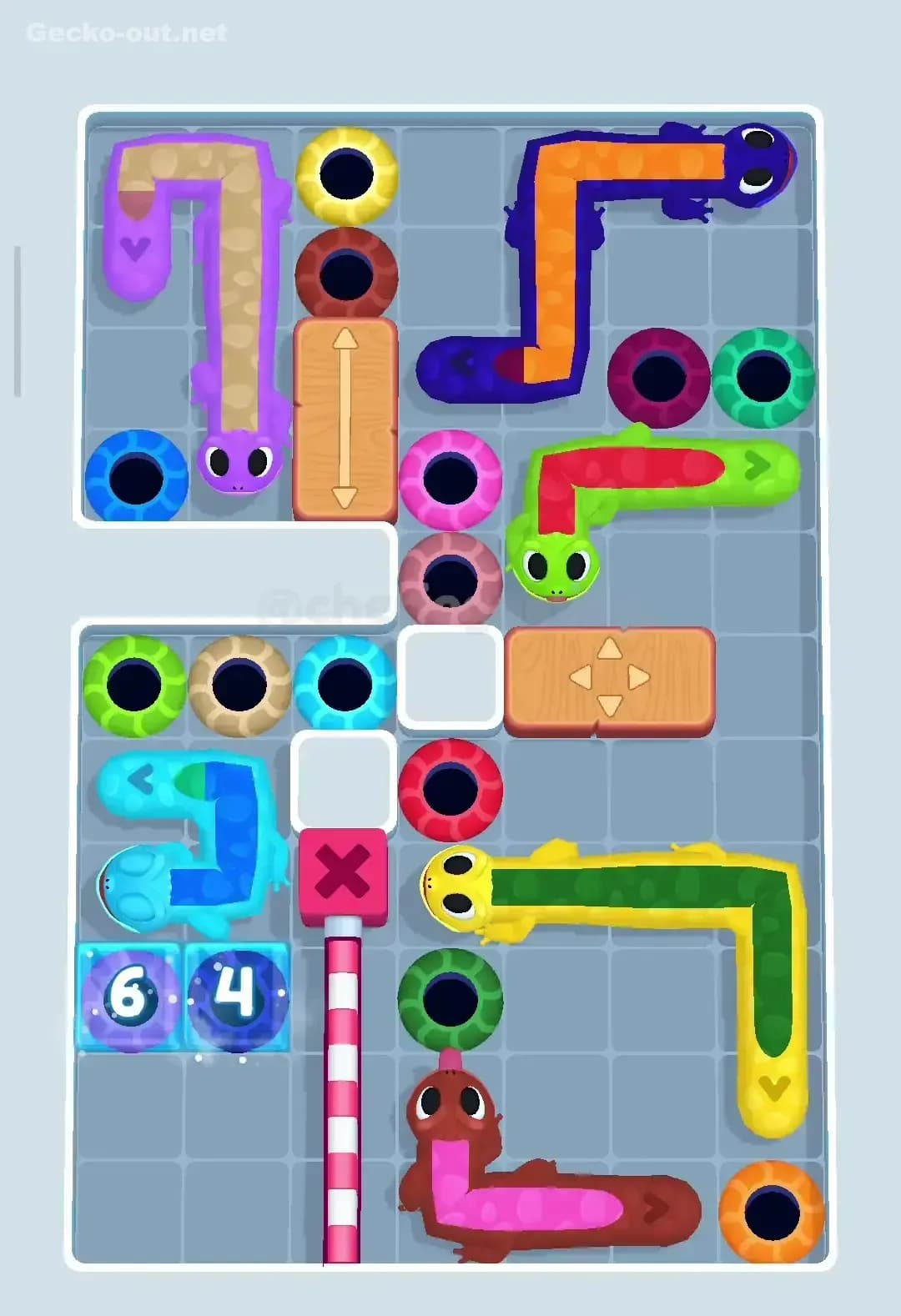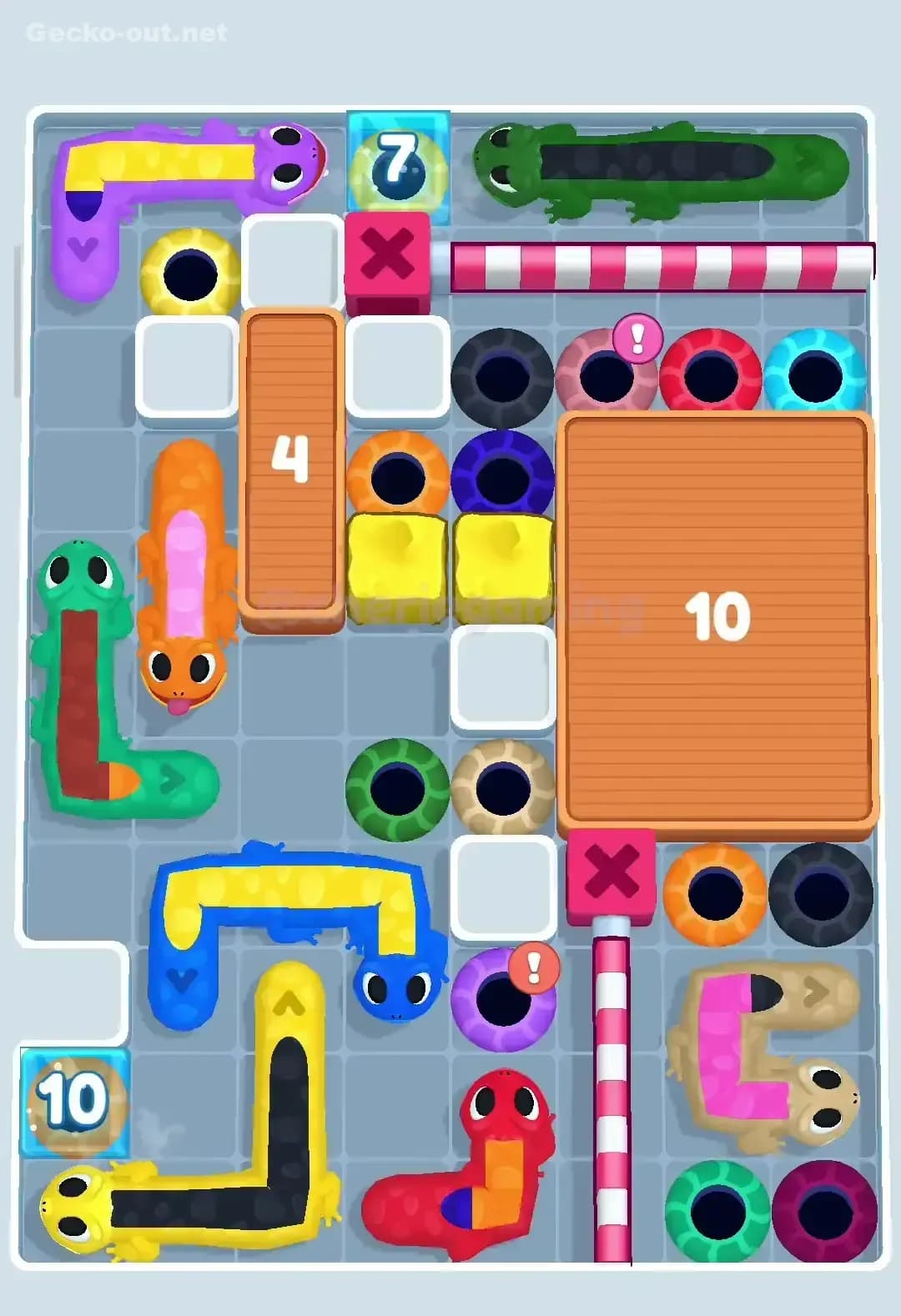
Gecko Out Level 160 Solution Walkthrough | Gecko Out 160 Answer
How to solve Gecko Out level 160? Get step by step solution & cheat for Gecko Out level 160. Solve Gecko Out 160 easily with the answers & video walkthrough.
Gecko Out Level 160: Board Layout, Rules, and Win Condition
The Starting Board: Who’s Where
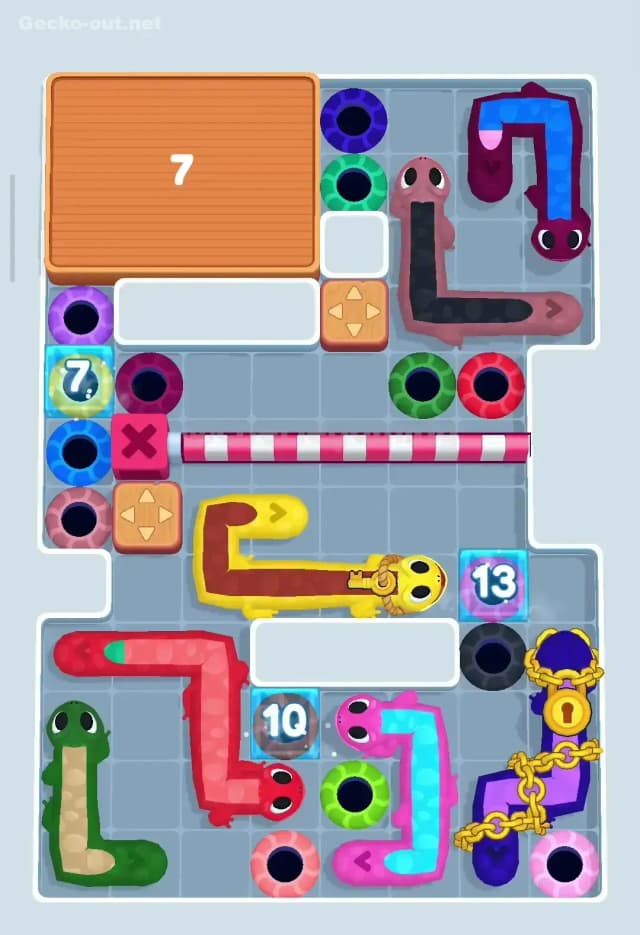
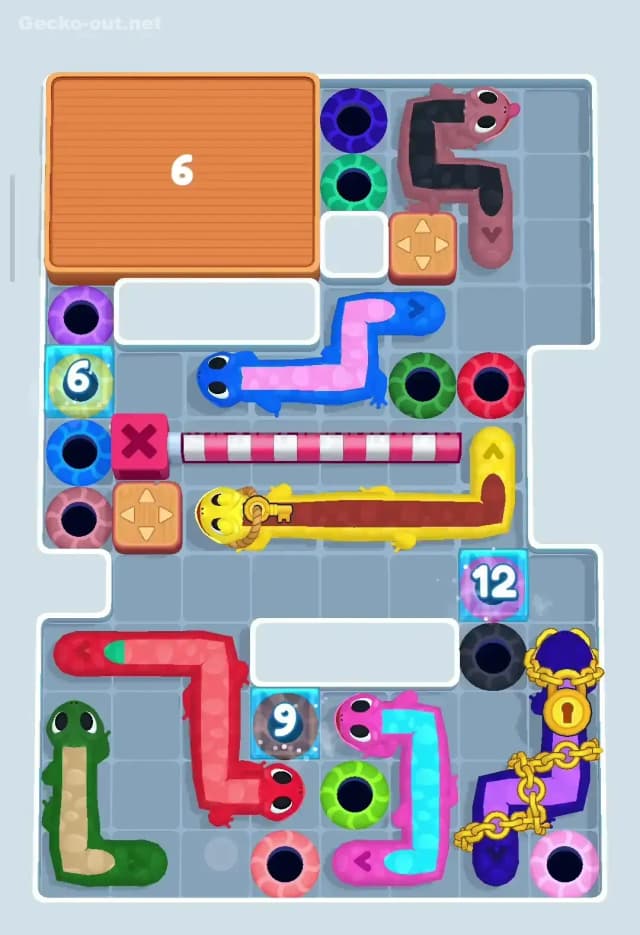
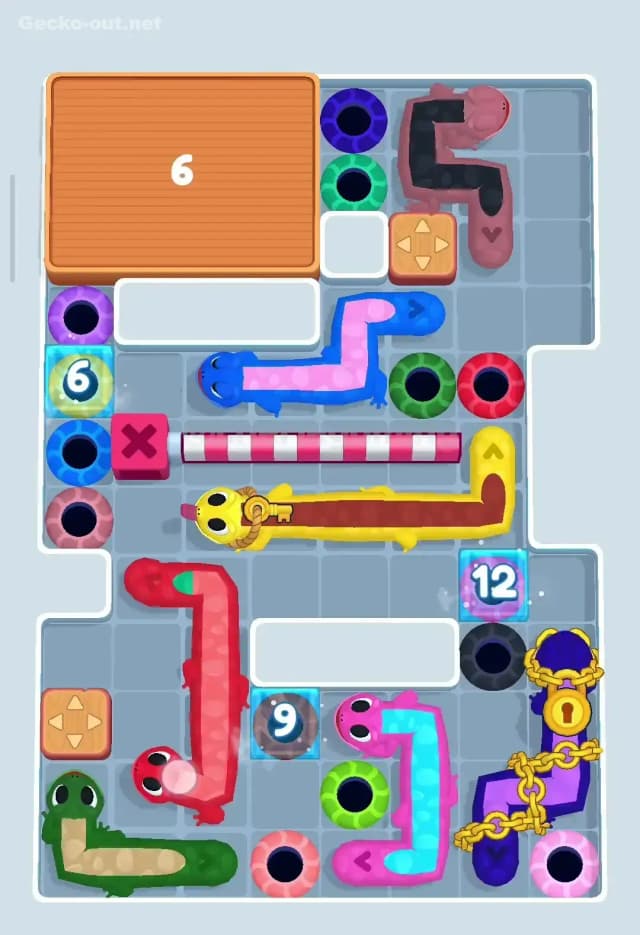
In Gecko Out Level 160 you start with a packed board. The bottom half holds a long red gecko and a short green gecko on the left, a cyan‑pink gecko near the center, and a chained purple gecko on the right. Across the middle sits a yellow gecko carrying the key that unlocks those chains. Up top, a brown gecko and a dark purple/blue gecko share a cramped upper-right corner. Colored holes ring the edges, there’s a candy‑striped barrier across the middle, a red “X” warning hole on the left, and three blue time cubes marked 7, 10, and 13.
Win Condition and Why This Level Feels Tight
You still win Gecko Out 160 the classic way: every gecko has to slither into a hole of its own color before the timer hits zero. The twist is that you start with very little time, so you’re almost forced to route one or two early geckos through the time cubes. Because movement is “draw the head, the body follows exactly,” any sloppy loop you draw in this cramped layout quickly turns into a permanent knot. The real challenge isn’t just freeing each gecko, it’s doing it in an order that keeps lanes open while you’re racing the clock.
Pathing Bottlenecks and Logical Traps in Gecko Out Level 160
The Main Bottleneck Corridor
The biggest bottleneck in Gecko Out Level 160 is the middle lane around the candy‑striped barrier and the yellow key gecko. That yellow body sprawls across the central row, and almost everyone depends on that space either to reach a time cube or to line up with their exit. If you park the yellow gecko badly—even for a moment—it blocks both the lower geckos and the top-right pair, and you end up restarting. Treat that central strip like a highway you’re trying to keep as empty as possible.
Subtle Problem Spots That Sneak Up On You
There are a few less obvious traps. First, the red “X” hole on the left is easy to forget about when you’re drawing fast under the timer; if you clip it with the wrong gecko, you waste a path and lock yourself in. Second, the time cubes sit in awkward spots: the bottom one is just above the red gecko’s tail, and the top-left one is squeezed between holes, so careless curves can block those bonuses for later geckos. Finally, the chained purple gecko has exits very close to where it’s locked; if you unlock it without planning a safe parking spot, it can clog the right side instantly.
When The Level Finally Clicks
The first time I played Gecko Out 160, I kept freeing the purple gecko too early and then watching it ruin the board. Once I realized the level is really about staging—moving some bodies just far enough, then pausing—the solution started to make sense. I stopped trying to rush everyone out and instead focused on: 1) use one bottom gecko to grab time, 2) park the yellow key gecko neatly, 3) only then unlock and route the purple and top geckos. After that mindset shift, the layout went from “impossible” to “tight but fair.”
Turn-by-Turn Path Strategy to Beat Gecko Out Level 160
Opening: First Moves and Safe Parking
In the opening of Gecko Out Level 160, immediately use a bottom gecko to stabilize the timer. The easiest is usually the red or cyan‑pink gecko: drag its head through the nearby 10‑second cube while curving it toward its own exit, but don’t overdraw loops. Next, nudge the green gecko into a corner along the left wall where it’s not touching any key corridors. Then focus on the yellow key gecko: drag it into a compact “C” or “L” shape along the bottom edge so the central row stays as straight and open as possible. Resist the urge to unlock the chained purple gecko just yet.
Mid-game: Keeping Lanes Open and Repositioning Safely
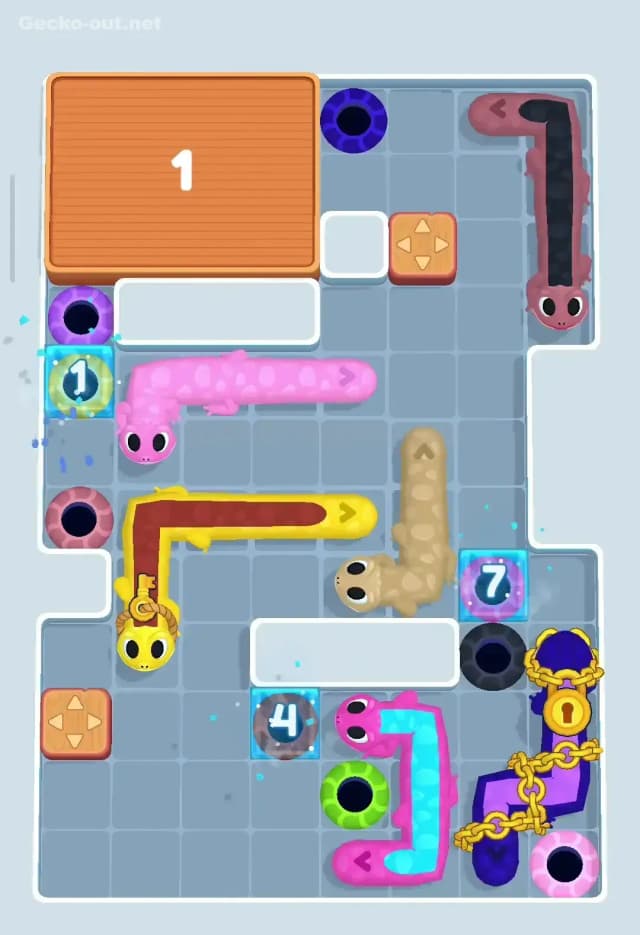
Mid-game in Gecko Out 160 is all about traffic control. Once you’ve grabbed at least one time cube and cleared one or two bottom geckos, use the extra space to unlock the purple gecko: route the yellow key gecko cleanly to the lock on the right, then tuck its body against the bottom or right boundary so it’s basically out of play. As soon as the purple gecko is free, don’t send it straight to an exit. Instead, park it in a loose shape that hugs the right wall and leaves the central lane and bottom-center tiles clear. With the bottom side decongested, you can now start rotating the top-right brown and dark purple/blue geckos: slide them down one at a time through the middle lane, keeping your paths as straight as possible so they don’t form blocking spirals.
End-game: Exit Order and Panic Management
The cleanest end-game order in Gecko Out Level 160 is usually: finish any remaining top-right gecko first, then the purple gecko, and finally whichever small gecko is parked nearest a spare hole. By this stage your central lane should be mostly clear, so each path can be one smooth sweep to an exit. Watch out for last-second choke points around the red “X” hole and the tight left-side holes—draw close but not through them. If time is low, commit to simple, short routes instead of trying to grab more bonus seconds; the extra thinking time you’d spend on a fancy path is often more than the time you’d gain.
Why This Path Order Works in Gecko Out Level 160
Using Head-Drag Pathing To Untangle, Not Tighten
This plan works in Gecko Out Level 160 because it respects how bodies trace the exact head path. Early on, you only draw short, purposeful curves for the bottom geckos so their bodies line the edges and free up interior tiles. Parking the yellow key gecko and purple gecko flush against the borders keeps their long bodies from cutting the board in half. When you finally move the top-right geckos, you guide them through clear, straight corridors, which avoids wrapping another gecko in a loop. In other words, every head drag is either “get out” or “hug the wall,” never “wander in the middle.”
Managing the Timer: When To Think vs. When To Move
Gecko Out 160 feels super rushed, but you actually have two tempo phases. At the very start, you have to move quickly just to touch a time cube—there’s no luxury of a long stare. Once you’ve secured one bonus (two if you’re neat), the pressure eases enough to pause for a couple of seconds and read the board. That’s when you plan the unlocking of the purple gecko and the top-right rotations. After you’ve mentally rehearsed those last few paths, the end-game becomes a quick execution sprint again. Switching consciously between “plan” and “go” is the difference between calm clears and frantic resets.
Boosters: Optional, Not Mandatory
Boosters in Gecko Out Level 160 are very much backup tools. The built‑in time cubes are already generous if you route one or two geckos through them, so you shouldn’t need an extra-time booster unless you’re learning the level and want a safety net. A hammer-style remover could theoretically break a wall or obstacle to simplify a lane, but it’s overkill here; polishing your parking positions does the same job for free. I’d only consider a hint booster if you’re completely stuck on the order of operations—once you see that yellow key → unlock purple → rotate top-right is the core flow, you can win without any power-ups.
Mistakes, Fixes, and Logic You Can Reuse in Other Gecko Out Levels
Common Mistakes and How To Fix Them
Players usually trip over the same issues in Gecko Out Level 160. One, unlocking the purple gecko immediately so it clogs the right side; fix this by unlocking only after clearing at least one bottom gecko and planning a wall-hugging parking spot. Two, drawing big decorative loops with early geckos, which turns their bodies into permanent fences; fix it by keeping routes minimal and edge-focused. Three, ignoring the time cubes and trying to brute-force perfect paths under the base timer; instead, deliberately route one gecko through a cube as part of its exit. Four, accidentally clipping the red “X” hole while rushing; slow your finger slightly whenever you path near it.
Reusing This Logic On Other Knot-Heavy Levels
The logic you practice on Gecko Out 160 carries nicely into other hard Gecko Out levels, especially those with gang geckos, keys, or chained bodies. The key habits are: prioritize freeing space rather than specific geckos, park long bodies tight against walls, and never unlock extra complexity (like chained geckos) before you’ve made room for them. Treat time pickups as part of your route design, not as last-second detours. Any time you see a narrow central lane and big bodies, think, “Which one can I safely line up along the edges first?”—that mindset alone solves a ton of future puzzles.
Final Encouragement for Gecko Out Level 160
Gecko Out Level 160 looks brutal at first glance: tiny timer, chains, keys, and a board full of tails. But once you understand that the level is a traffic puzzle—stabilize the timer, park the long bodies neatly, then run a clean exit order—it becomes completely manageable. Don’t worry if you need a few restarts to internalize the layout; each attempt makes the board feel less chaotic. Stick with the plan, keep your paths tidy, and you’ll watch every last gecko wriggle out in style.