Gecko Out Level 9 Solution Walkthrough | Gecko Out 9 Answer
How to solve Gecko Out level 9? Get step by step solution & cheat for Gecko Out level 9. Solve Gecko Out 9 easily with the answers & video walkthrough.

Gecko Out Level 9: Board Layout, Rules, and Win Condition
Understanding the Starting Configuration
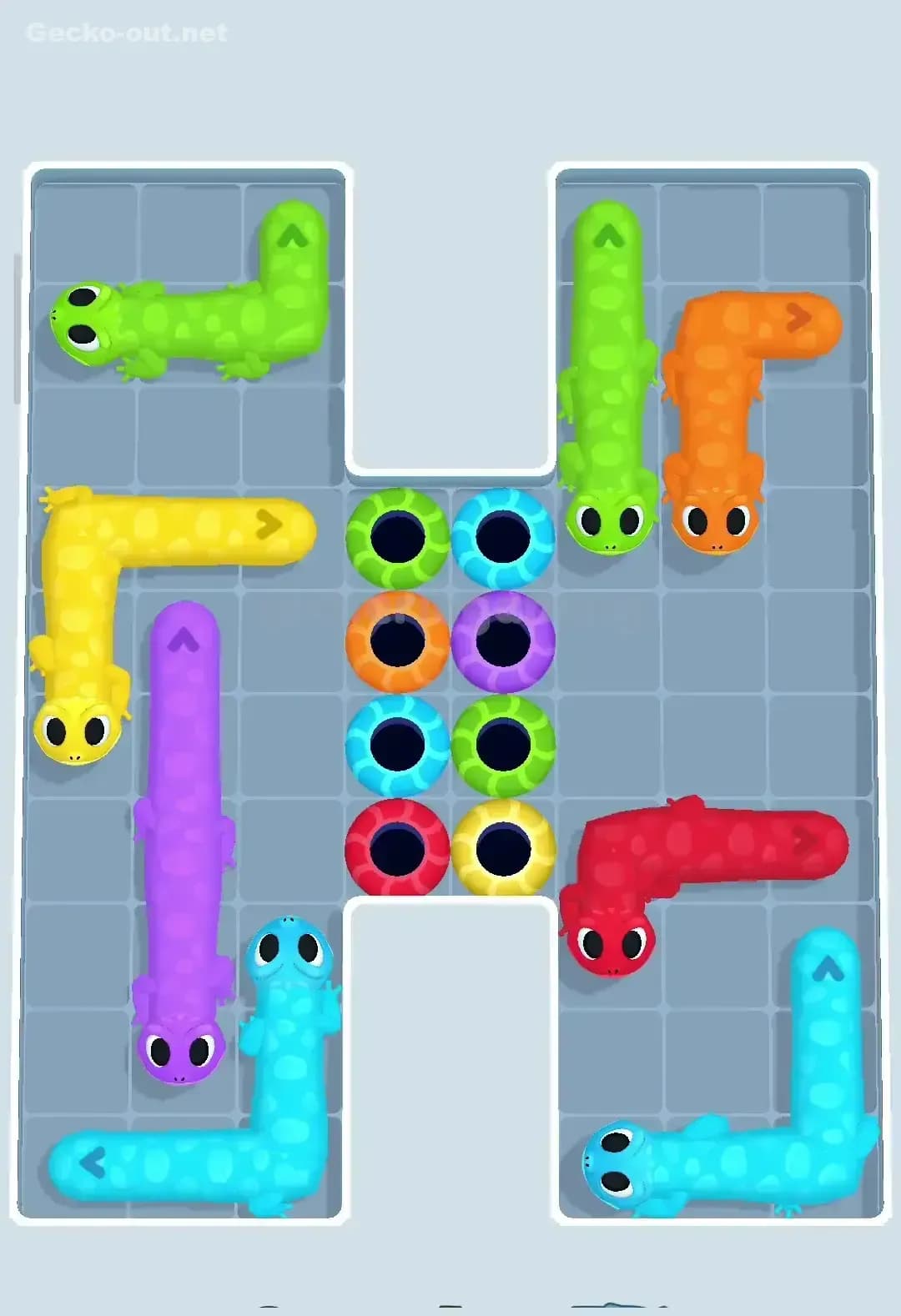
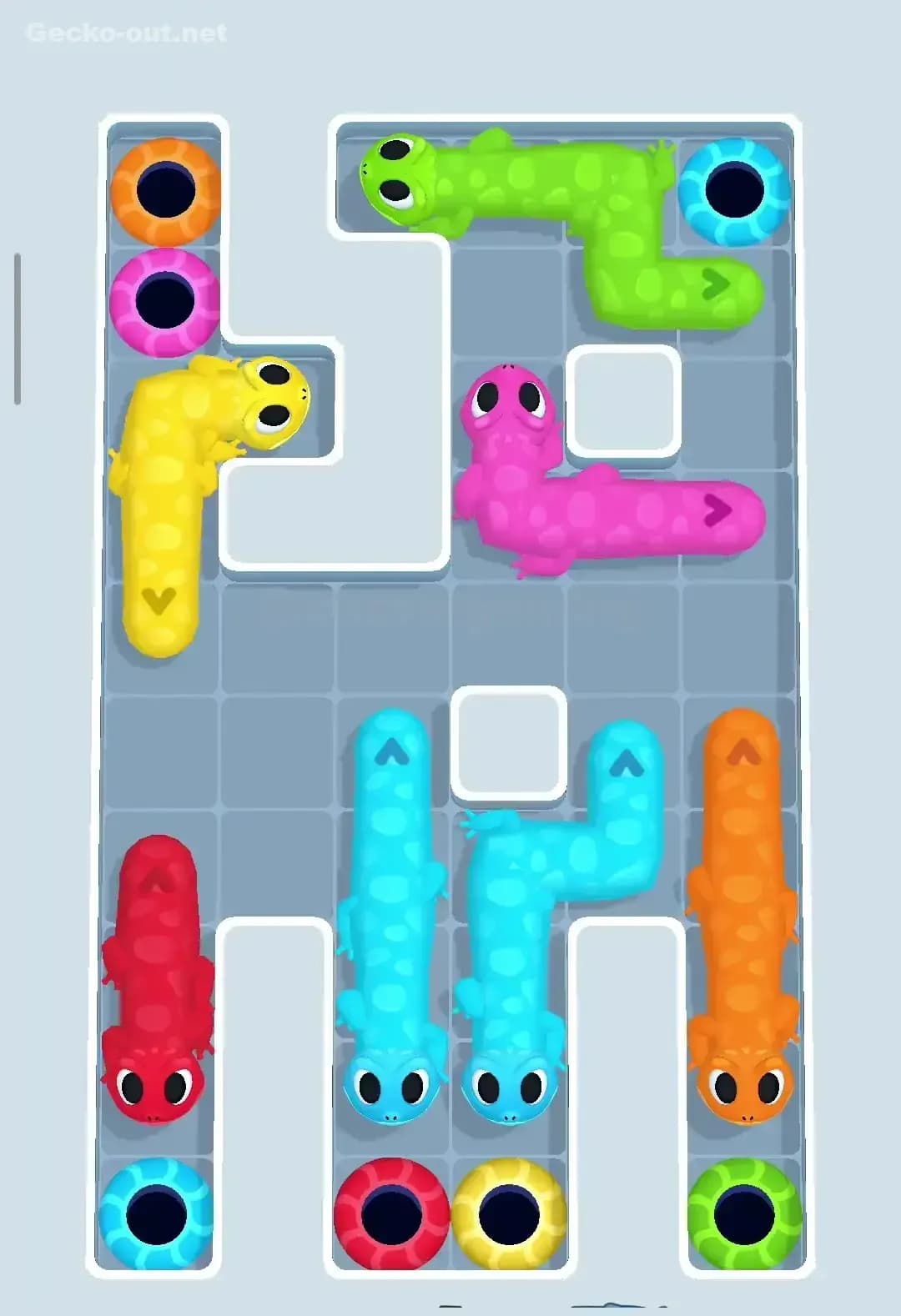
Gecko Out Level 9 presents you with a complex two-board setup that immediately signals this won't be a straightforward puzzle. The top board holds five circular exit holes (red, yellow, green, and two purple) plus a red T-shaped gecko already stretched across multiple cells. Below, the main playing field is packed with seven geckos of varying lengths and colors: red, purple, green, orange, yellow, and cyan. Each gecko needs to reach its color-matched hole, but the bodies are intertwined in ways that create multiple dependency chains. The orange gecko forms an L-shape in the center-right area, while the yellow and cyan geckos curve through the lower portion. Purple geckos occupy both vertical and angular positions, and the green gecko stands vertically in the middle column. The sheer density of gecko bodies means almost every move you make will affect the available space for other geckos.
The Win Condition and Movement Mechanics
To beat Gecko Out Level 9, you must guide every gecko head to its matching colored hole before the timer expires. The timer adds constant pressure—you can't afford to experiment endlessly with different paths. The drag-path movement system is the key mechanic here: when you drag a gecko's head, its entire body follows that exact route cell by cell. This means you're not just moving a piece from point A to point B; you're choreographing a specific path that must avoid all walls, other gecko bodies, and obstacles. If you draw a path that later blocks a critical exit or creates an impossible knot, you'll have to undo moves and waste precious seconds. The two-board layout compounds the challenge because you need to clear geckos from the lower board up through the connecting pathways to the top board's exit holes.
Pathing Bottlenecks and Logical Traps in Gecko Out Level 9
The Central Corridor Chokepoint
The biggest bottleneck in Gecko Out Level 9 is the narrow connecting pathway between the lower main board and the upper exit board. Only one or two cells wide at certain points, this corridor forces you to think carefully about the order in which geckos travel upward. If you send a long gecko through first and it curves or bends in that passage, it can completely block other geckos from reaching their exits. The red T-shaped gecko at the top is particularly problematic because it already occupies space near several exit holes, meaning you might need to move or reposition it before other geckos can escape. I've seen players rush the orange gecko upward only to discover they've accidentally locked the purple and cyan geckos below with no viable path.
Hidden Problem Spots That Ruin Runs
Beyond the obvious corridor jam, Gecko Out Level 9 has several subtle traps. First, the L-shaped orange gecko in the center-right creates a barrier that divides the board—if you don't clear it at the right time, it blocks both vertical and horizontal movement for multiple other geckos. Second, the two purple geckos have overlapping path requirements; moving one can inadvertently create a wall for the other. Third, the lower exit holes (red, purple, and orange circles at the bottom) can trick you into thinking you should clear bottom geckos first, but those holes might actually be meant for geckos that need to loop around from elsewhere on the board. I found myself repeatedly trying to force the yellow gecko directly downward to its hole, only to realize that path blocked the cyan gecko's only viable route.
The Moment It Clicks
I'll be honest—Gecko Out Level 9 frustrated me for a solid dozen attempts. I kept treating it like a "clear from outside in" puzzle, but that approach created impossible tangles in the middle. The breakthrough came when I stopped focusing on individual geckos and started visualizing the entire board as a sequence of space-clearing operations. Once I understood that certain geckos are "key removals" that unlock space for everyone else, the solution snapped into focus. It's not about speed; it's about precision and order.
Turn-by-Turn Path Strategy to Beat Gecko Out Level 9
Opening Moves: Creating Space and Parking Geckos
Start Gecko Out Level 9 by addressing the geckos that free up the most board space with minimal risk. The red gecko on the left side of the lower board should be one of your first targets—it's relatively short and has a clear path to the top board's red hole. Drag its head carefully upward through the left corridor, ensuring the body doesn't sweep through cells you'll need for other geckos. Next, focus on the green gecko in the center column. It occupies a critical vertical lane that multiple other geckos need to cross. Guide the green gecko's head upward to the green exit hole on the top board, taking care to route it so the body doesn't block the central connecting passage. These two moves "park" or remove obstacles that would otherwise make mid-game maneuvering impossible.
Mid-Game: Maintaining Critical Lanes and Repositioning
With the red and green geckos cleared, Gecko Out Level 9 opens up considerably. Now tackle the purple geckos, but here's where order matters: the shorter purple gecko (the one positioned more vertically) should exit before the longer, more angular one. Drag the shorter purple gecko's head to one of the purple holes on the top board, routing it through whichever corridor is least congested. Once that's done, the longer purple gecko has room to curve through the board. The orange gecko is your next priority—its L-shape makes it a blocking hazard, but once you have space, you can drag its head in a wide arc toward the orange exit hole. Watch your path carefully here; if the orange gecko's body sweeps through the lower-left area, it can trap the yellow gecko. Keep checking that you're leaving at least a two-cell-wide lane for the remaining geckos.
End-Game: Final Exit Order and Timer Management
The yellow and cyan geckos are typically your last evacuations in Gecko Out Level 9. By this point, you should have cleared enough space that their paths are relatively straightforward, but don't get complacent—the timer is ticking down. The yellow gecko usually needs to curve from the lower-left toward its yellow hole on the top board. Draw a smooth path that doesn't create unnecessary bends, because every extra cell the body occupies is a potential block. Finally, guide the cyan gecko to its cyan hole. This one often has the most freedom since it's moving into a mostly empty board, but double-check that you didn't accidentally leave a body segment from a previous gecko blocking the exit. If you're running low on time (under 10 seconds), commit to your paths quickly—hesitation costs more than a slightly imperfect route.
Why This Path Order Works in Gecko Out Level 9
Exploiting the Body-Follow Rule to Untangle Knots
The recommended sequence for Gecko Out Level 9 works because it leverages the body-follow mechanic to systematically dismantle the knot rather than tighten it. By removing the red and green geckos first, you're eliminating the two pieces that divide the board into cramped quadrants. Each subsequent move is designed to free up the next gecko in line—the purple geckos clear the middle, the orange gecko opens the right side, and the yellow and cyan geckos have clear runs once the others are gone. If you reverse this order (say, trying to move the orange gecko before the green), you'll find that the orange gecko's body sweeps through cells the green gecko needs, creating a deadlock. The logic here is about dependency: identify which geckos block the most space and remove them in descending order of obstruction.
Timer Management: When to Pause and When to Commit
Gecko Out Level 9 gives you enough time to solve the puzzle if you don't waste seconds on failed paths. I recommend pausing for a full two or three seconds at the start to mentally map your first three moves. Once you commit to the red and green geckos, you can move faster because the board state becomes more predictable. The mid-game (purple and orange geckos) is where you want to slow down slightly—rushing here often leads to path errors that cost you 10+ seconds in undo time. In the end-game, trust your plan and execute quickly. If you followed the order correctly, the yellow and cyan geckos should have obvious paths, and you can drag them to their exits without overthinking.
Do You Need Boosters?
For most players, Gecko Out Level 9 is solvable without boosters if you follow the path order outlined above. However, if you've attempted the level multiple times and keep running out of time in the final 5-10 seconds, consider using an extra-time booster. Activate it right before you start moving the yellow gecko—this gives you breathing room for the last two evacuations without wasting the booster on the easier opening moves. A hammer-style tool (if your version of the game has one) can remove a blocking gecko body segment, but I've found it's unnecessary here; careful pathing solves the puzzle cleanly. Hints can help if you're stuck on which gecko to move next, but they won't teach you the underlying logic, so use them sparingly.
Mistakes, Fixes, and Logic You Can Reuse in Other Gecko Out Levels
Common Errors and How to Correct Them
First mistake: moving the orange gecko too early. Players see its central position and assume it's a priority, but relocating it before clearing the green gecko creates a body-block nightmare. Fix this by always clearing vertical blockers (like the green gecko) before horizontal or L-shaped ones. Second mistake: dragging gecko heads in straight lines when curves would be more efficient. The body-follow rule means a curved path can sometimes hug the edges of the board and avoid collisions that a straight path would cause. Third mistake: ignoring the top board's red T-shaped gecko until late in the puzzle. If you wait too long, it can block multiple exit holes simultaneously. Address it early, even if it means making a minor repositioning move to shift it out of the way.
Fourth mistake: underestimating the timer and spending too much time on the first gecko. The opening moves (red and green) should take no more than 10-15 seconds combined if you've planned them correctly. Fifth mistake: forgetting that undo moves cost time. Some players repeatedly try a path, undo it, try a slightly different version, and burn 20+ seconds on a single gecko. Instead, visualize the full path before you drag, commit to it, and adjust your next move if it doesn't work perfectly.
Reusing This Approach on Similar Levels
The logic you've learned in Gecko Out Level 9—identify bottleneck geckos, clear them in dependency order, maintain critical lanes, and manage the timer—applies directly to other high-difficulty Gecko Out levels, especially those with multi-board layouts or gang-gecko mechanics. When you encounter a level with linked geckos (where moving one forces another to move), use the same principle: determine which gecko in the gang is the primary blocker and plan your path to minimize the secondary gecko's interference. For frozen-exit levels, you'll need to add an extra step (thawing the exit, usually by clearing nearby geckos first), but the core path-planning strategy remains identical. Tight-corridor levels like this one reward players who think two or three moves ahead rather than reacting to immediate obstacles.
Final Encouragement
Gecko Out Level 9 is legitimately challenging, and if you've struggled with it, you're in good company—this level has stumped plenty of experienced players. But it's absolutely beatable once you internalize the path order and understand why each move matters. The satisfaction of finally clearing this level, watching all those geckos slide into their holes with seconds to spare, makes the effort worthwhile. Take your time on the first few attempts to learn the board, then execute the plan with confidence. You've got this.