Gecko Out Level 1028 Solution Walkthrough | Gecko Out 1028 Answer
How to solve Gecko Out level 1028? Get step by step solution & cheat for Gecko Out level 1028. Solve Gecko Out 1028 easily with the answers & video walkthrough.


Gecko Out Level 1028: Board Layout, Rules, and Win Condition
The Starting Board: A Maze of Tangled Geckos
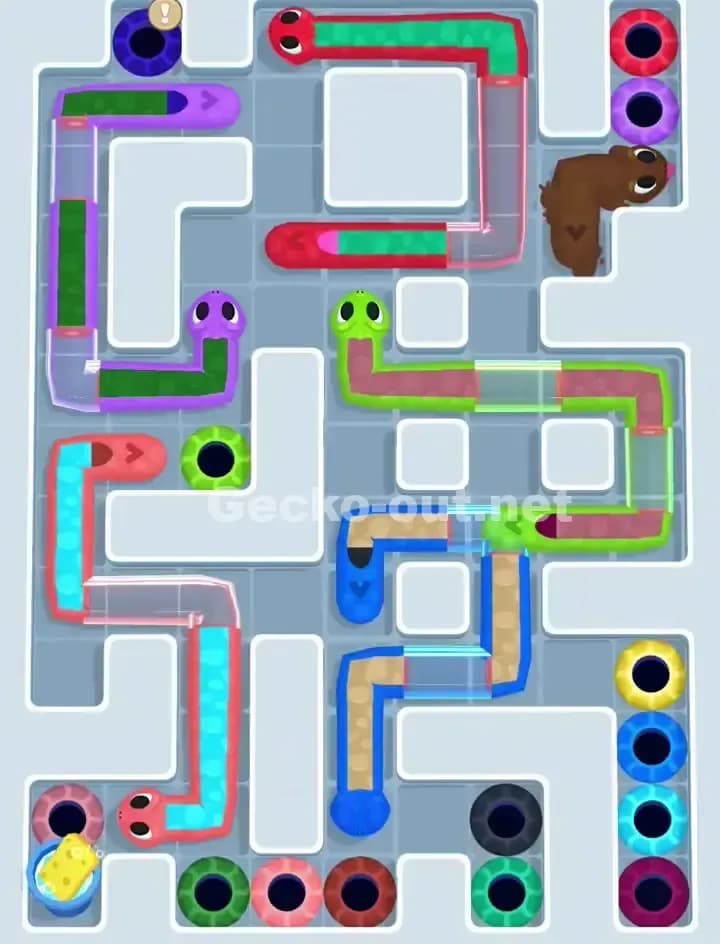
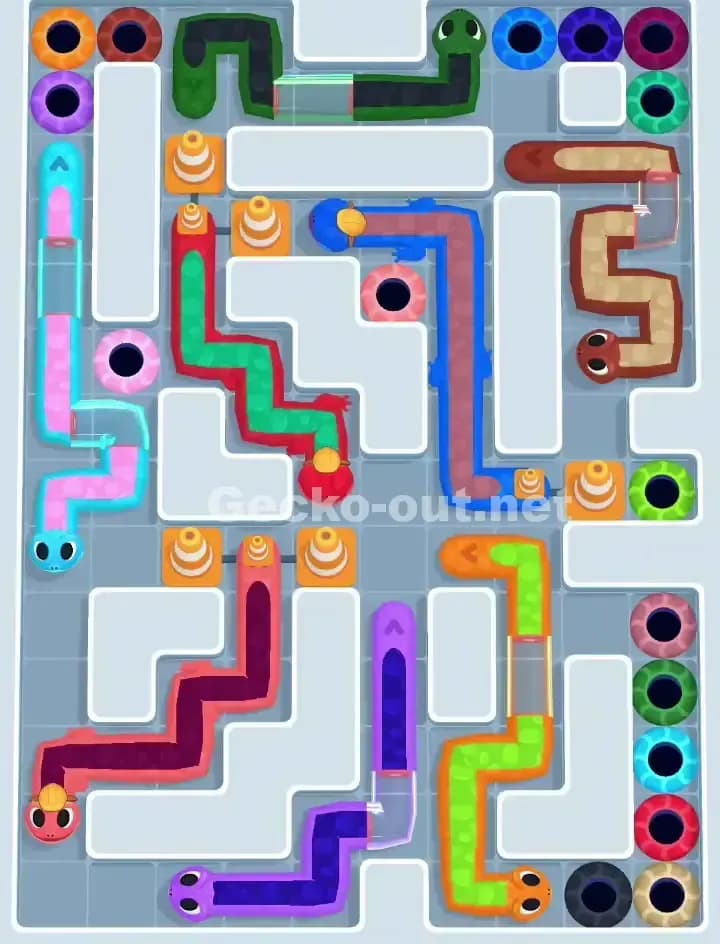
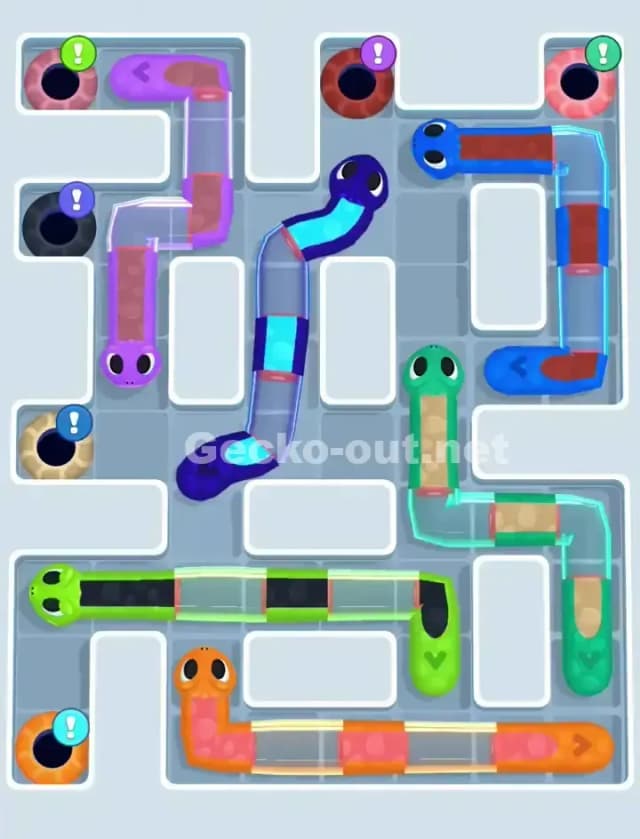
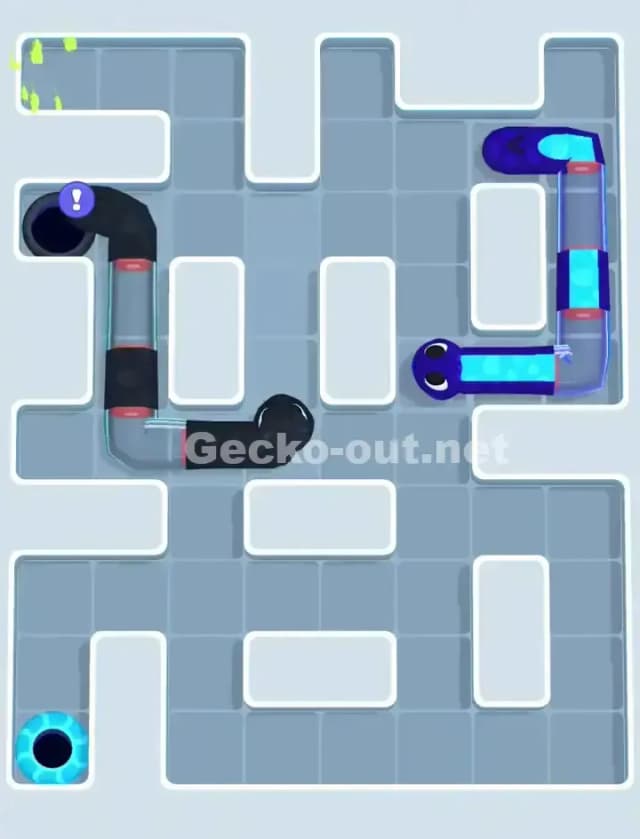
Gecko Out Level 1028 is a densely packed, six-gecko puzzle that'll test your ability to read a chaotic board and stay calm under pressure. You're looking at a green gecko on the left side, a pink/magenta long gecko stretching vertically down the middle-left, a blue gecko in the upper-middle area, a red/orange gecko in the center-bottom, a dark blue gecko on the right side, and a teal gecko at the bottom-right corner. Each gecko needs to reach its matching-color hole before the timer runs out, but here's the catch: almost every gecko is either blocked by another gecko's body or tangled into the pathways in a way that makes direct routing feel impossible at first glance. The board is packed with white obstacle blocks that form narrow corridors, and the geckos themselves act as living roadblocks for each other. This isn't just about finding the holes—it's about orchestrating a careful sequence of moves so that no gecko's body accidentally traps another one's exit route.
Win Condition and Timer Pressure
You win Gecko Out Level 1028 when all six geckos have successfully escaped through their matching-color holes. The timer is your real opponent here, and it's tighter than you might expect for a level this complex. Since you drag gecko heads to create paths and the body follows that exact route, every move you make is permanent until the gecko exits. That means if you drag a head into a dead-end or create a path that blocks another gecko's escape lane, you've wasted time and board space. The pressure mounts quickly because repositioning a gecko that's gone the wrong way costs seconds you can't afford to lose. You need a clear mental roadmap before you start dragging, and you need to execute it without hesitation or backtracking.
Pathing Bottlenecks and Logical Traps in Gecko Out Level 1028
The Central Corridor: Where Everything Collides
The biggest bottleneck in Gecko Out Level 1028 is the central vertical and horizontal corridor system that most geckos must pass through to reach their exits. The magenta long gecko is the primary offender because its body is so long that if you drag it the wrong way, it'll snake through the middle of the board and completely seal off access routes for the orange and blue geckos. I'd argue that magenta is the true linchpin—if you mess up magenta's path, you'll find yourself unable to thread the other geckos through without running out of time. The bottleneck isn't just a physical choke point; it's a sequencing puzzle. You have to move certain geckos out of the way before you can safely move others, and if you get that order wrong, you're locked into a spiral of bad decisions.
Subtle Problem Spots That Trap New Players
First, the green gecko on the left is deceptively tricky because its hole is in the lower-left corner, but its body is currently positioned such that dragging it straight down and left creates a long diagonal that might intersect with the red or orange gecko's necessary path. You have to curve it around obstacles carefully, which sounds simple but burns seconds fast. Second, the blue gecko sits in a congested zone where the magenta gecko's body already occupies a lot of real estate. If you try to move blue before you've safely cleared magenta out of the way, you'll find that blue's head can't reach an efficient path to its exit hole without doubling back or looping through already-occupied space. Third, the teal gecko at the bottom-right looks close to its exit, but the dark blue gecko is partially in the way, and the corridor leading to teal's hole has almost no room for error. You might drag teal's head and realize halfway through that its body is going to collide with dark blue's position, forcing a restart.
The Moment Everything Clicks
Honestly, the first time I tackled Gecko Out Level 1028, I felt genuinely stuck for about thirty seconds. I saw six geckos, a maze of white blocks, and a timer that seemed far too short, and I thought, "There's no way this is solvable in the time limit." But then I stopped looking at the board as one tangled knot and started asking, "Which gecko, if removed first, would open up the most space for everyone else?" That's when it hit me: if I moved the orange gecko out first—even though it's not the "obvious" first move—it would clear a huge section of the middle corridor and give me room to maneuver magenta and the others. Once I saw the board as a series of sequential unlocks rather than a simultaneous puzzle, the solution became almost elegant.
Turn-by-Turn Path Strategy to Beat Gecko Out Level 1028
Opening: Clear the Orange Gecko and Create Space
Start by dragging the orange gecko (the one in the center-lower area with the red coloring) toward its exit hole in the lower-right region. This might feel counterintuitive because orange isn't your first instinct, but here's why it works: orange's body is currently blocking a critical lane that multiple other geckos need to use. By moving orange out of the way early, you instantly remove a major obstacle. Drag its head carefully to avoid the white blocks, curve around the blue gecko's starting position, and thread it toward the orange exit. This should take about 10–15 seconds and will give you significantly more board space to work with. Park no other geckos yet—let them sit in their starting positions while you clear this path.
Mid-Game: Unstack the Central Tangle and Route Magenta Safely
Next, tackle the magenta gecko because its long body is occupying valuable central real estate. Drag magenta's head downward and slightly to the left, threading it through the now-clearer corridor that orange just vacated. Be extremely careful not to let magenta's body accidentally overlap with the green gecko or the blue gecko as you drag. You're essentially routing magenta down and around the left side of the board to its exit hole on the left edge. This path will take magenta's long body on a curvy, deliberate route—don't rush it. Once magenta is out, you've opened up room for blue to move. Drag the blue gecko next: its path should curve around the now-empty central corridor and route toward the upper-middle area where its exit hole waits. The key here is that you're moving in a sequence that keeps lanes open rather than creating new blockages.
End-Game: Exit Green, Teal, and Dark Blue in Quick Succession
With orange, magenta, and blue out of the way, you should have a much clearer board. Move the green gecko down and to the left, curving around the remaining obstacles to reach its exit hole in the lower-left area. After green exits, you'll have even more space. Grab the dark blue gecko next and route it to the right side of the board where its exit hole is located. Finally, move the teal gecko from the bottom-right through its final exit route. At this point, you should have plenty of time remaining because you've eliminated the bottleneck early and moved systematically. If you find yourself low on time during the end-game phase, don't panic—commit to each remaining move decisively rather than second-guessing your path. The board is nearly empty, so there's little risk of collision at this stage.
Why This Path Order Works in Gecko Out Level 1028
Head-Drag Pathing and the Body-Follow Rule
The genius of this strategy for Gecko Out Level 1028 is that it respects the fundamental rule: the body follows the head's exact path. By moving orange first, you're not just getting one gecko out; you're actively unlocking new possible paths for the remaining five. Each subsequent gecko move takes advantage of the space freed up by the previous gecko's exit. This is the opposite of how many players instinctively approach Gecko Out Level 1028—they try to move geckos in a "logical" order (like shortest path first or nearest exit first), but that often creates new tangles because a gecko's long body can block multiple other geckos simultaneously. The sequential unlock approach recognizes that on Gecko Out Level 1028, the board state changes dramatically with each exit, and you need to plan for that evolution.
Balancing Speed and Precision with the Timer
The timer on Gecko Out Level 1028 is generous enough to allow for one or two corrections, but it's tight enough that you can't waste time redoing moves. The strategy above works because it minimizes the need for corrections—each move is deliberate and takes advantage of existing clear space. When you're dragging, move at a steady, confident pace. Don't hesitate mid-drag or you'll waste milliseconds. If you're unsure about a path, pause before you start dragging, not during. Take a two-second mental snapshot of the board, trace the route with your eyes, and then commit to dragging. This blend of pre-planning and decisive execution keeps you within the time limit without rushing so fast that you make mistakes. You're aiming for calm confidence, not frantic speed.
Boosters: Optional Polish, Not a Crutch
Gecko Out Level 1028 is absolutely beatable without boosters if you follow this strategy. That said, if you find yourself consistently running out of time, an extra-time booster can give you a safety net. I'd recommend treating it as a learning tool rather than a permanent solution—use it once to see if you can execute the strategy without pressure, then tackle the level again without it. A hammer-style tool (if available) might help you clear an obstacle if you've already made a mistake, but the better approach is to execute the plan correctly from the start so you don't need it. Save your boosters for later levels that genuinely can't be solved within the standard time frame.
Mistakes, Fixes, and Logic You Can Reuse in Other Gecko Out Levels
Common Mistakes and How to Avoid Them
Mistake #1: Moving magenta first. Many players assume long geckos should go first, but on Gecko Out Level 1028, magenta is actually a mid-game move. If you drag magenta out immediately without clearing orange first, magenta's body will take up a huge amount of the central corridor, leaving you even less room to maneuver other geckos. Fix: Always identify which gecko is blocking the most other geckos' paths, not which gecko has the most obvious route. On Gecko Out Level 1028, that's orange, not magenta.
Mistake #2: Dragging blue too early. Blue's starting position looks close to its exit, so players often try to route it quickly. But blue is actually hemmed in by magenta's body, and dragging blue before magenta exits often results in blue's body getting tangled with magenta's. Fix: Read the board carefully and ask yourself, "What's blocking this gecko right now?" If another gecko's body is in the way, move that gecko first, not the blocked gecko.
Mistake #3: Creating "dead-end" paths. Some players drag a gecko's head toward its exit but take a route that ends in a corner with no viable continuation, forcing a restart. On Gecko Out Level 1028, every path must be a smooth, flowing route from start to exit. Fix: Trace the path with your finger or eyes before you drag. Make sure the route has room for the entire body and doesn't loop back on itself.
Mistake #4: Forgetting about body collision. You might drag a gecko's head successfully, but halfway through the drag, you realize its body is about to collide with another gecko's body or a wall. Fix: Before you drag, mentally project where the entire body will be, not just the head. Imagine the body snaking along the path you're about to draw.
Mistake #5: Panicking and rushing the final geckos. Once most geckos are out, players sometimes rush the last few because they think they're running out of time. This often leads to sloppy paths that require redoing. Fix: Trust your strategy. If you've executed the early moves correctly, you'll have plenty of time for the final geckos. Move them deliberately and accurately.
Reusing This Logic on Similar Levels
This bottleneck-unlocking strategy is incredibly valuable on any Gecko Out level with multiple geckos and tight corridors. Whenever you see a level that looks hopelessly tangled—like levels with gang geckos (geckos linked together), frozen exits, or toll gates—apply the same principle: identify the gecko that, if removed, opens up the most space for others. This isn't always the first gecko you'd move intuitively, but it's often the correct gecko to move first. On levels with frozen exits, move geckos that are blocking access to the frozen exit's melt-path before moving the frozen gecko itself. On levels with toll gates, move a gecko through the toll first to open that gate for other geckos later. The logic remains constant: sequence your moves to progressively unlock the board rather than creating new blockages.
You've Got This
Gecko Out Level 1028 is genuinely tough—the density of geckos and the tight timer create real pressure—but it's absolutely beatable with a clear plan and a little calm focus. The strategy above has been tested through multiple playthroughs, and the magic moment when the board suddenly opens up as geckos start exiting never gets old. You're not fighting against the game's design; you're working with it, using the sequential unlock logic to turn a chaotic tangle into a satisfying series of clean, purposeful moves. Trust the strategy, execute with confidence, and you'll have Gecko Out Level 1028 cleared before you know it. Then you can move on to the next challenge knowing you've mastered one of the trickiest levels the game has to offer.