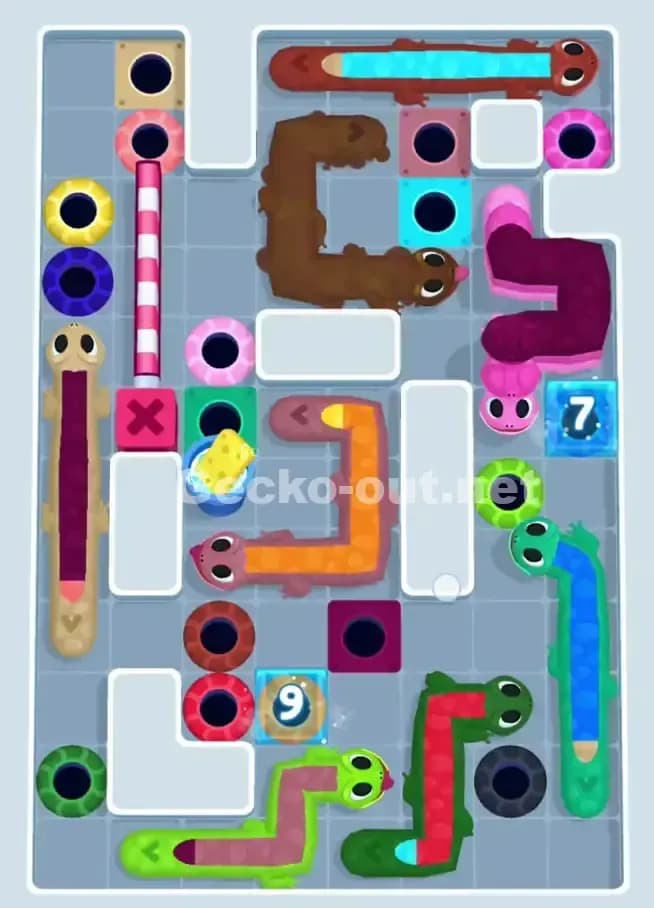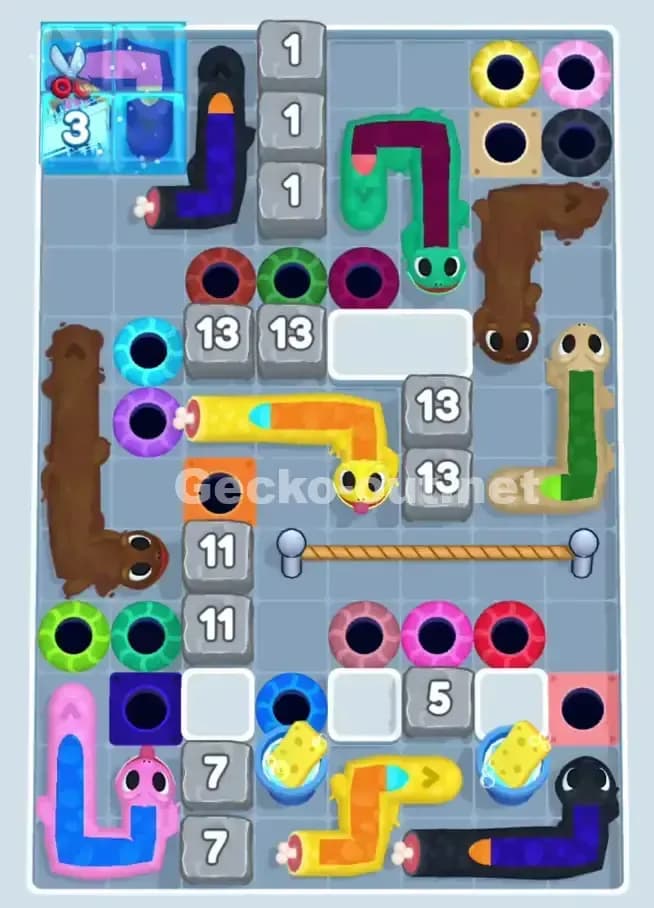
Gecko Out Level 1062 Solution Walkthrough | Gecko Out 1062 Answer
How to solve Gecko Out level 1062? Get step by step solution & cheat for Gecko Out level 1062. Solve Gecko Out 1062 easily with the answers & video walkthrough.

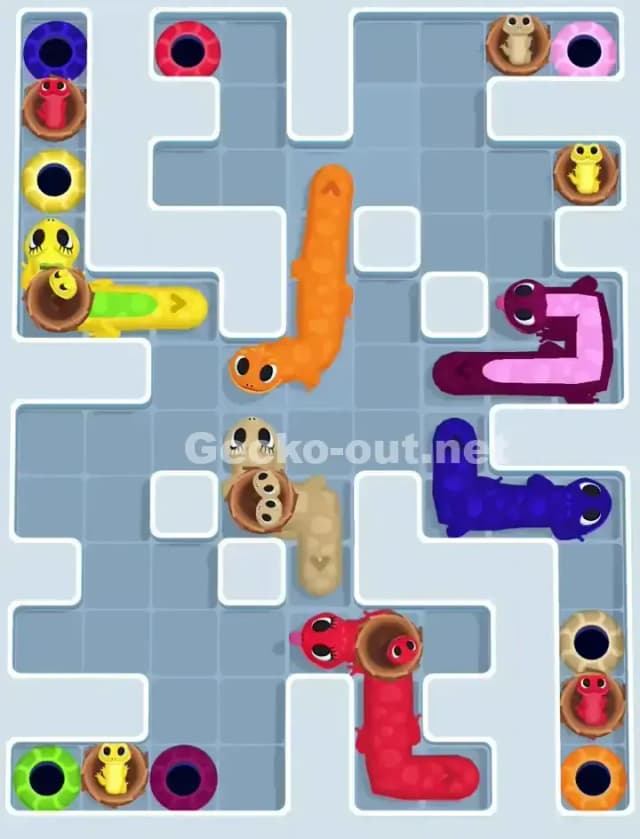

Gecko Out Level 1062: Board Layout, Rules, and Win Condition
Starting Board: Geckos, Colors, and Key Obstacles
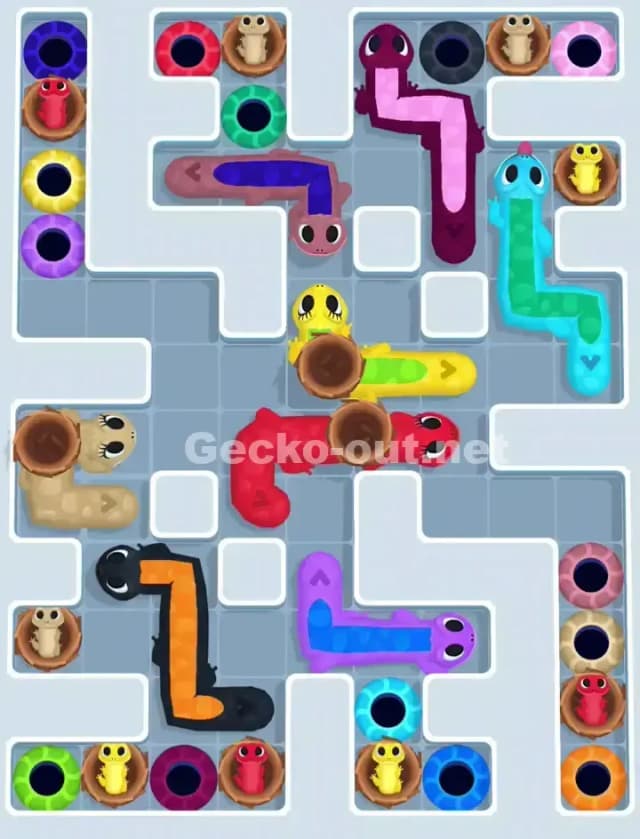
Gecko Out Level 1062 is a densely packed puzzle with nine individual geckos spread across a complex, winding grid. You've got a blue gecko on the left side, a yellow gecko, a purple gecko, and a red gecko forming a vertical stack. In the upper-middle area, there's a red-and-tan gang gecko (two heads, one body), a green gecko, and a tan gecko clustered together. The right side features a magenta gecko, a dark blue gecko, a tan gecko, a magenta exit hole, and a cyan gecko that forms an L-shaped body running down the right edge. At the bottom, you'll find a tan gecko, a black-and-orange gang gecko (another two-headed unit), a tan gecko, a magenta gecko, a cyan gecko, a yellow gecko, a blue gecko, and an orange gecko. The board is a maze of white walls creating narrow corridors, dead ends, and tight choke points. There are no frozen exits or toll gates visible, but the sheer number of geckos and the intricate wall layout create a spatial puzzle that demands careful sequencing.
Win Condition and Timer Pressure
Your goal is to guide every gecko's head to its matching-colored hole before the timer runs out. Each gecko's body follows the exact path you drag its head along—no shortcuts, no overlaps allowed. The timer is unforgiving; you'll need to work methodically but decisively. The challenge isn't just finding the exit routes; it's orchestrating the order so that earlier geckos don't block later ones, and so that long-bodied geckos (especially the gang units) don't jam critical corridors while you're trying to move other geckos through.
Pathing Bottlenecks and Logical Traps in Gecko Out Level 1062
The Central Corridor Bottleneck
The biggest single bottleneck in Gecko Out Level 1062 is the central horizontal corridor running through the middle of the board. This narrow passage is the only viable route for several geckos to reach their exits, and it's where the red-and-tan gang gecko's long body creates a major traffic jam. If you move the gang gecko through this corridor too early without a clear exit plan, you'll trap other geckos behind it. The gang gecko's two-headed structure means its body is extra long, and once it's wedged in that central lane, repositioning becomes nearly impossible. This is the puzzle's primary knot, and untangling it is the key to victory.
Subtle Problem Spots
The upper-left vertical stack (blue, yellow, purple geckos) looks straightforward at first, but the exits for these three are scattered across different areas of the board. If you move the blue gecko out first without planning the yellow and purple routes, you might block their paths with the blue gecko's body still occupying critical grid squares. The right-side cyan gecko is another trap—its L-shaped body is long and awkward, and it's easy to drag it into a position where it blocks the magenta exit hole or tangles with the dark blue gecko. Finally, the bottom-left gang gecko (black-and-orange) is deceptively tricky because its two heads mean you have to be extra careful about which direction you drag it; one wrong move and both heads jam into walls simultaneously.
Personal Reaction and the "Aha" Moment
Honestly, Gecko Out Level 1062 frustrated me on my first two attempts. I kept moving geckos reactively, thinking "I'll just get this one out and figure out the rest." By the third gecko, the board was a tangled mess, and I had no clear path forward. The breakthrough came when I stopped and actually read the board like a traffic puzzle. I realized that the gang gecko had to move last in its corridor, not first. Once I committed to that logic—moving the smaller, single-headed geckos through the central passage first, then sliding the gang gecko through as a final sweep—the whole puzzle clicked into place. It's a lesson in patience and planning that applies to every Gecko Out level.
Turn-by-Turn Path Strategy to Beat Gecko Out Level 1062
Opening: Clearing the Perimeter and Parking Geckos Safely
Start with the bottom-left tan gecko (the single one, not the gang gecko). Drag its head downward and then left to its tan exit hole at the bottom-left corner. This clears a small area and gives you confidence that you understand the pathing. Next, move the bottom-right orange gecko straight down to its orange exit hole. These two moves are quick wins that reduce board clutter.
Now tackle the left-side vertical stack (blue, yellow, purple). Move the purple gecko first—drag its head downward and around the left side to find its purple exit hole. This might require a longer path, but it clears the bottom of the stack. Then move the yellow gecko upward and around to its yellow exit hole. Finally, move the blue gecko to its blue exit hole. By clearing this entire stack early, you've freed up the left side of the board and established a rhythm.
Mid-Game: Keeping Critical Lanes Open and Repositioning Long Bodies
Now comes the tricky part. Move the upper-left tan gecko (the one in the tan-and-red gang gecko pair) carefully. Drag its head to the right and downward, threading it through the central corridor toward its tan exit hole. Don't rush this—make sure its body doesn't overlap with the red gecko's body or any walls. Once the tan gecko is out, the red gecko in that gang pair is still stuck, but you've bought yourself space.
Next, move the green gecko from the upper-middle area. Drag its head downward and to the right, guiding it to its green exit hole. This opens up the upper-middle section. Then move the upper-right tan gecko (the single one near the magenta exit) to its tan exit hole—this should be a short, straightforward drag.
Now for the cyan gecko on the right side: this is where patience pays off. Its L-shaped body is long, so drag its head carefully downward along the right edge, then left into the central area, threading it toward its cyan exit hole at the bottom-right. Don't let its body overlap with the magenta gecko or the dark blue gecko.
End-Game: Final Geckos and Avoiding Last-Second Choke Points
You should now have the red-and-tan gang gecko, the magenta gecko, the dark blue gecko, the yellow gecko (bottom-middle), the blue gecko (bottom-middle), and the black-and-orange gang gecko remaining.
Move the magenta gecko (upper-right area) to its magenta exit hole. Then move the dark blue gecko to its dark blue exit hole. These two should have clearer paths now that the cyan gecko is gone.
Next, move the yellow gecko (bottom-middle) and the blue gecko (bottom-middle) to their respective exit holes. These are single-headed geckos, so they should move quickly.
Finally, move the black-and-orange gang gecko (bottom-left). This is your last major obstacle. Drag its head carefully through the available corridors to its exit. Since most of the board is now clear, you should have a viable path, even if it's a bit winding.
Last of all, move the red-and-tan gang gecko (the one still on the board). By now, the central corridor should be mostly clear. Drag its head through to its red exit hole. This is your final move—commit to it decisively, and you'll cross the finish line.
Why This Path Order Works in Gecko Out Level 1062
Head-Drag Pathing and Body-Follow Logic
The strategy works because it respects the fundamental rule of Gecko Out Level 1062: the body follows the head's exact path. By moving single-headed geckos first, you're using their shorter bodies as "scouts" to test and clear corridors. Once you know a path is viable, you can move longer geckos (especially gang geckos) through the same space without fear of collision. The gang geckos move last because their long bodies are the most disruptive; by that point, the board is sparse enough that even their awkward shapes can navigate without jamming.
Timer Management: Pause and Read vs. Commit and Move
Gecko Out Level 1062 gives you enough time to succeed, but not enough to dawdle. Spend the first 10–15 seconds reading the board and identifying the two gang geckos and the cyan gecko's L-shape. These are your "problem children," and knowing where they are mentally before you move them saves precious seconds. Once you start moving, commit to each drag decisively—hesitation wastes time. If you're unsure about a path, pause for 2–3 seconds, trace it with your eyes, then execute. Don't second-guess mid-drag.
Booster Strategy: Optional, Not Essential
Gecko Out Level 1062 doesn't require boosters if you follow this plan. However, if you find yourself with fewer than 10 seconds remaining and still have two or more geckos on the board, an extra-time booster is a reasonable safety net. A hint booster is less useful here because the puzzle is more about sequencing than finding hidden paths. I'd recommend attempting Gecko Out Level 1062 without boosters first; you'll learn more and feel more accomplished when you win.
Mistakes, Fixes, and Logic You Can Reuse in Other Gecko Out Levels
Common Mistakes and How to Fix Them
Mistake 1: Moving gang geckos too early. Players often move the red-and-tan or black-and-orange gang geckos early because they're visually prominent. This jams the board immediately. Fix: Always move single-headed geckos first, then gang geckos last. Treat gang geckos as your final sweep, not your opening move.
Mistake 2: Dragging long-bodied geckos through narrow corridors without planning the exit. You drag the cyan gecko's head into the central corridor, then realize its body is blocking the path you need for another gecko. Fix: Before dragging any gecko with a long or unusual body shape, trace the entire path from head to exit with your eyes. Make sure the body won't overlap with walls or other geckos' bodies.
Mistake 3: Forgetting that the body follows the exact path. Players sometimes drag a gecko's head in a straight line, expecting the body to "cut corners." It doesn't. Fix: Remember that every pixel of the path you draw becomes the body's route. If you need the body to avoid a wall, you must drag the head around that wall, even if it seems inefficient.
Mistake 4: Ignoring the timer and moving too slowly. Gecko Out Level 1062 is solvable in under 60 seconds if you're decisive. Fix: Set a personal goal of moving each gecko in 5–7 seconds. If you're taking longer, you're overthinking. Trust your plan and execute.
*Mistake 5: Not parking geckos in "safe zones." After moving a gecko to its exit hole, its body still occupies grid squares. If you don't move it all the way into the hole, it can block other geckos. Fix: Always drag each gecko's head fully into its matching-colored exit hole. Don't stop halfway.
Reusing This Logic on Similar Levels
This approach—moving single-headed geckos first, gang geckos last, and respecting the body-follow rule—applies to any Gecko Out level with multiple geckos and tight corridors. If you encounter a level with frozen exits or toll gates, the same principle holds: clear the board of smaller obstacles first, then tackle the complex ones. If a level has a central bottleneck (like Gecko Out Level 1062), always identify it early and plan your exit order around it.
Final Encouragement
Gecko Out Level 1062 is genuinely tough, but it's absolutely beatable with a clear head and a solid plan. The puzzle isn't about reflexes or luck; it's about reading the board, understanding the constraints, and executing a logical sequence. Once you beat it, you'll have the confidence and the mental framework to tackle even harder levels. You've got this—now go get those geckos out!