Gecko Out Level 645 Solution Walkthrough | Gecko Out 645 Answer
How to solve Gecko Out level 645? Get step by step solution & cheat for Gecko Out level 645. Solve Gecko Out 645 easily with the answers & video walkthrough.


Gecko Out Level 645: Board Layout, Rules, and Win Condition
Understanding the Starting Configuration
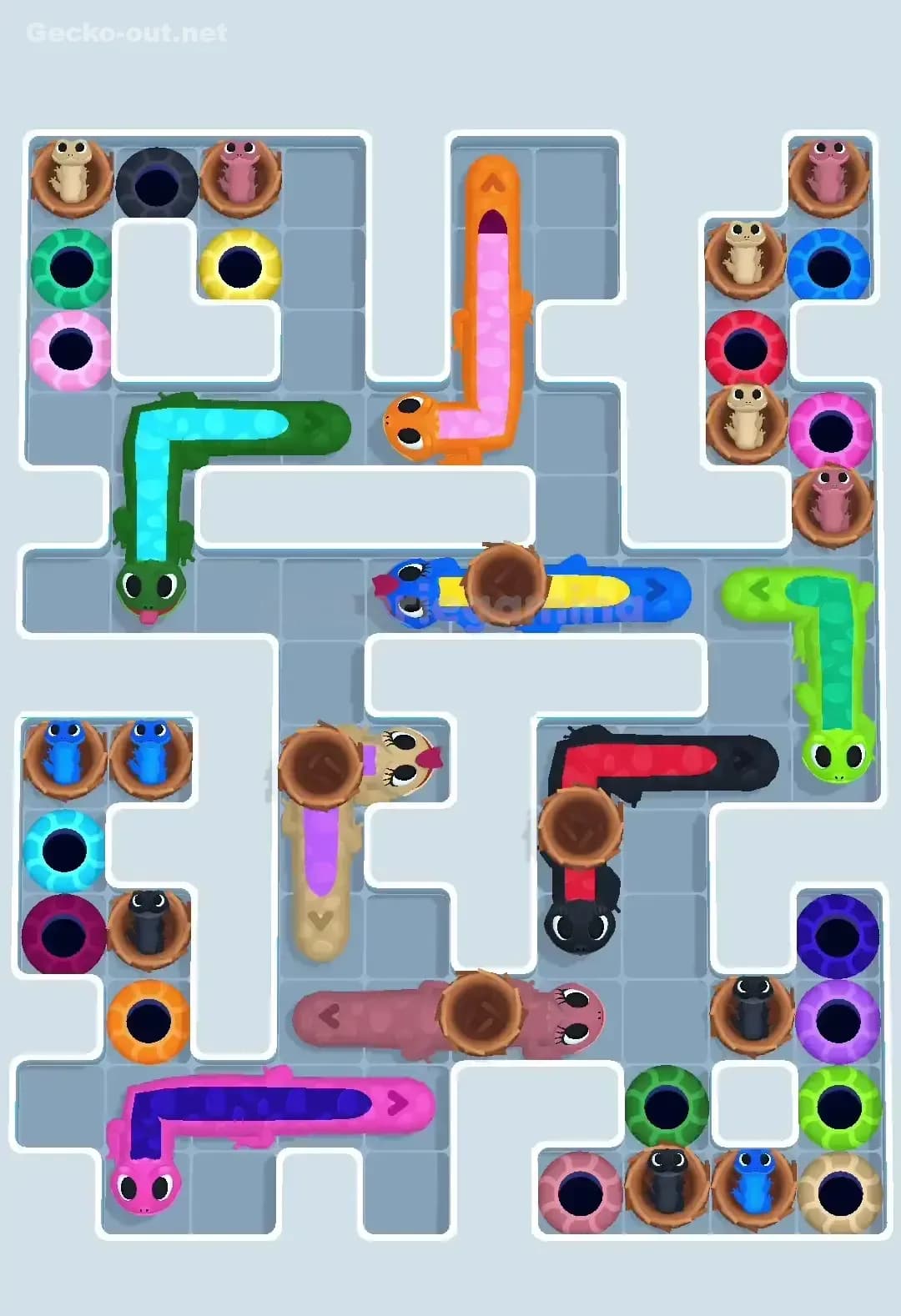
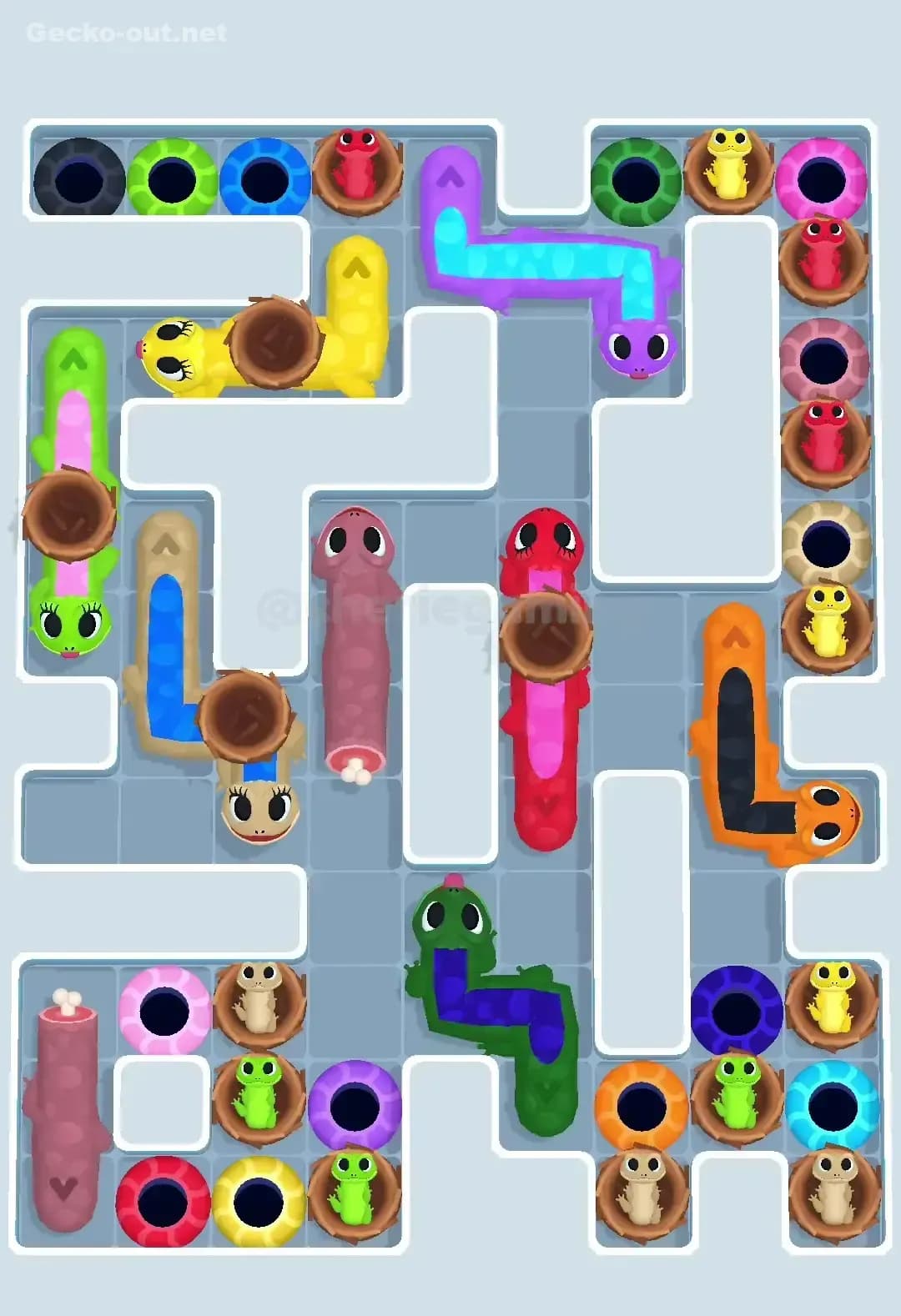
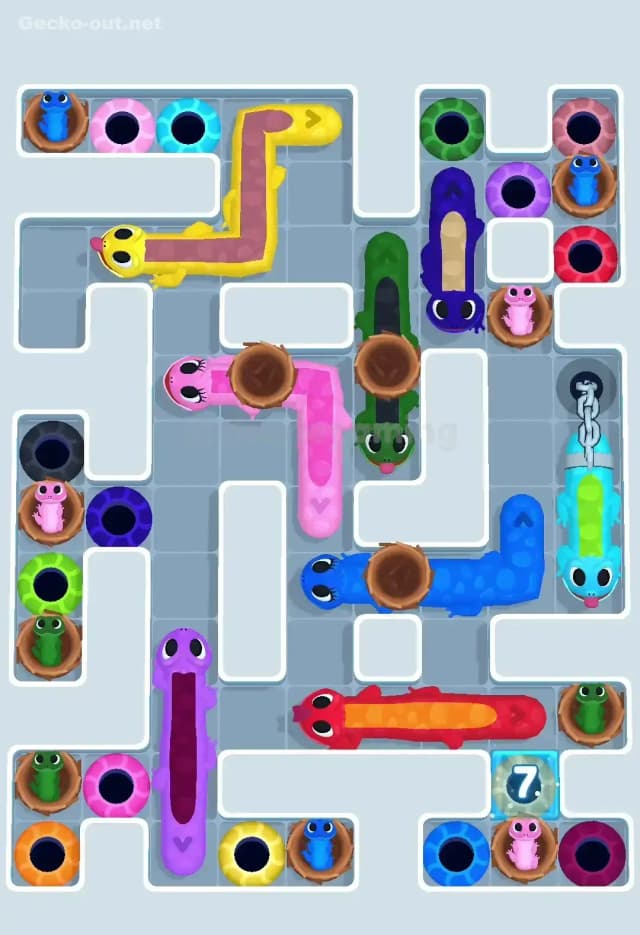
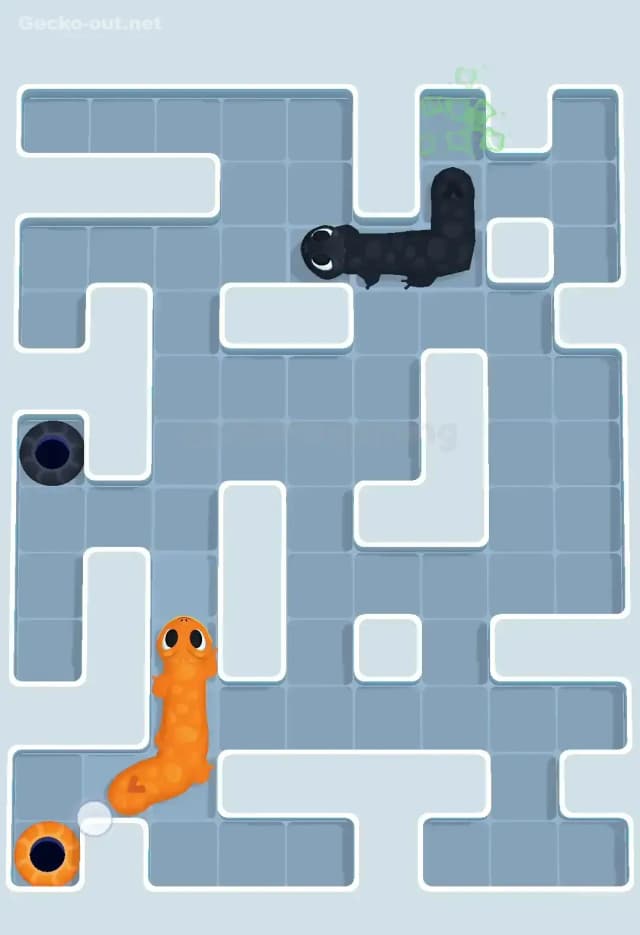
Gecko Out Level 645 hits you with one of those boards that looks chaotic at first glance. You've got eight geckos sprawling across a complex grid with narrow corridors, multiple right-angle turns, and several brown "blocker" holes that sit exactly where you'd want to path through. The color distribution is fairly balanced—you'll spot yellow, pink, green, blue, red, purple, and a couple of cyan geckos—but the real problem isn't the number of pieces. It's how they're woven together. Long geckos snake through the center and right portions of the board, creating overlapping body segments that turn simple moves into cascading problems. The yellow gecko at the top stretches down and right, blocking access to at least two other escape routes. Meanwhile, the pink gecko in the middle-left has positioned itself right across a critical junction that three other geckos need to cross.
The exits are scattered around the perimeter, which sounds helpful until you realize several of them are positioned so that reaching them requires threading through gaps that are currently occupied by other gecko bodies. White obstacle blocks further restrict your options, creating a maze-like environment where every move needs to account for not just where the head goes, but where the entire body will trail behind it. This is Gecko Out Level 645 showing its teeth—it's not about individual gecko difficulty, it's about the interdependencies.
The Win Condition and Timer Pressure
To beat Gecko Out Level 645, you need to guide every single gecko to its matching color hole before the timer runs out. The clock doesn't pause while you're thinking, which means indecision costs you just as much as wrong moves. The drag-path movement system is the core mechanic here: when you drag a gecko's head, its body follows exactly along the route you trace. This means you can't just think "I need the blue gecko over there"—you have to visualize the entire path the body will occupy, because that path will temporarily block other geckos from moving through those squares. Miss this detail in Gecko Out Level 645, and you'll watch helplessly as one gecko's exit route permanently blocks another's.
The timer is generous enough that you won't feel rushed on every single move, but tight enough that you can't afford to make more than one or two major mistakes. If you solve geckos in a random order, you'll likely find yourself with 30 seconds left and three geckos hopelessly tangled, their bodies forming a knot you can't unravel without undoing moves you've already committed. That's the punishment for not planning ahead in Gecko Out Level 645.
Pathing Bottlenecks and Logical Traps in Gecko Out Level 645
The Yellow Gecko Chokepoint
The single biggest bottleneck in Gecko Out Level 645 is the yellow gecko occupying the upper-center area. Its body forms an L-shape that cuts through two major traffic corridors. Multiple other geckos—specifically the pink, blue, and one of the green geckos—need to move through spaces that are currently underneath the yellow gecko's body. If you don't move the yellow gecko early and position it correctly, you create a scenario where extracting it later becomes impossible without first moving three other geckos out of the way, which requires moving the yellow gecko first—a classic circular dependency trap. I've seen players lose Gecko Out Level 645 specifically because they saved the yellow gecko for last, assuming its exit was easy to reach, only to discover they'd painted themselves into a corner.
Subtle Problem Spots You'll Miss on First Attempt
Beyond the yellow chokepoint, there are three subtle traps. First, the pink gecko in the middle-left looks like it has a short, direct path to its exit, but that path crosses through a junction that the green and blue geckos also need to use later. If you rush the pink gecko out first using the "obvious" route, you'll block your own ability to reposition the green gecko when its turn comes. Second, there's a brown blocker hole on the right side that sits exactly one square away from where you'd naturally want to stage the blue gecko. Players instinctively path around it, creating unnecessarily long routes that waste time and occupy more board space. Third, the red gecko at the bottom has an exit that's easy to reach, but the natural path to it crosses through a zone where the purple gecko's body will eventually need to extend. Clear the red gecko too early, and you help yourself; clear it at the wrong moment, and you've just deleted a critical staging area.
When the Solution Clicks
I'll be honest—my first three attempts at Gecko Out Level 645 ended in frustration. I kept treating it like a sequential puzzle, clearing one gecko at a time in isolation. The breakthrough came when I stopped thinking about individual geckos and started thinking about zones of the board. Once I realized the yellow gecko was the "keystone" that unlocked access to the entire upper-right quadrant, and that I needed to create a temporary "parking lot" in the lower-left for geckos waiting their turn, the solution snapped into focus. Gecko Out Level 645 isn't a sequence problem—it's a space management problem.
Turn-by-Turn Path Strategy to Beat Gecko Out Level 645
Opening Moves: Establishing Control
Your first priority in Gecko Out Level 645 is creating breathing room. Start by identifying which gecko has the most "free" exit—meaning an exit you can reach without crossing through spaces occupied by other gecko bodies. In this layout, one of the green geckos positioned near the edges usually qualifies. Move it out first, but here's the key: don't take the shortest path. Take the path that clears a corridor you'll need later. I typically start by moving the green gecko in the upper-right first, threading it through the top edge and exiting via its hole. This clears the entire top-right corner and gives you a staging area for repositioning other heads.
Next, address the yellow gecko immediately. Don't wait. Drag its head down and around the board's perimeter, giving it a long, looping path that pulls its body completely out of the center corridors. Your goal isn't to exit the yellow gecko yet—it's to park its body along the bottom or left edge where it won't interfere with the mid-game moves. Think of this as "stashing" the yellow gecko so you can deal with the geckos it was blocking.
Mid-Game: Sequencing the Center Cluster
With the yellow gecko repositioned, you can now focus on the center cluster—the pink, blue, and remaining green geckos. The correct order here is critical for Gecko Out Level 645. Move the green gecko in the center-left next, but path it through the upper corridors rather than cutting straight across the middle. This keeps the central junction clear for the blue gecko. Now tackle the blue gecko: drag its head toward the lower-right, creating a path that curves around the brown blocker hole rather than fighting against it. You'll notice the blue gecko's body naturally clears a lane that the pink gecko will need.
Only after the blue gecko is staged should you move the pink gecko. This is counterintuitive because the pink gecko looks like it should go early, but in Gecko Out Level 645, early pink moves create jams. Path the pink gecko through the space the blue gecko just vacated, and exit it via its hole. You're now past the hardest part of the puzzle.
End-Game: Closing Without Choking
You should have roughly 45-60 seconds left when you reach the end-game phase. The remaining geckos—typically the purple, red, and cyan—have clearer paths now, but you can still fail here if you move carelessly. The purple gecko in the right area needs to exit before the red gecko, even though the red gecko's exit is closer. Why? Because the red gecko's body, if positioned too early, blocks the final approach angle for the purple gecko. Move the purple gecko first, threading it through the newly cleared right corridor.
The red gecko can now move freely—drag it straight to its exit in the bottom-right. Finally, handle the cyan gecko, which should have a completely clear path at this point. If you're running low on time (under 20 seconds), skip the optimal path and just drag heads directly to exits—perfection doesn't matter if you run out of time. But if you've followed this sequence correctly in Gecko Out Level 645, you should finish with 15-30 seconds to spare.
Why This Path Order Works in Gecko Out Level 645
Leveraging Body-Follow Mechanics
The entire strategy for Gecko Out Level 645 exploits the body-follow rule. By moving the yellow gecko first and giving it a long perimeter path, we're essentially "pulling" its body segments out of the center like unspooling thread. This is the opposite of what inexperienced players do—they try to move the yellow gecko directly to its exit, which requires a short path, which means the body stays in the center, which means everything else stays blocked. The longer path actually solves the puzzle faster because it clears more space per move.
Similarly, the mid-game sequence works because we're moving geckos in an order that turns their body paths into temporary corridors for the next gecko. When you move the green gecko through the upper area in Gecko Out Level 645, its body briefly occupies that space, but by the time you need that space for the pink gecko, the green gecko's body has already exited. It's like a conveyor belt—each gecko's exit motion creates the opening the next gecko needs.
Timer Management and Commitment Timing
The timer in Gecko Out Level 645 punishes hesitation more than wrong moves. You'll notice the strategy I outlined involves very few "pause and reconsider" moments—once you commit to moving the yellow gecko, you keep the momentum going through the green, blue, and pink geckos without stopping. This isn't recklessness; it's confidence built on understanding the board logic. The time to pause is before you start—spend the first 10-15 seconds reading the board and identifying the yellow chokepoint. Once you've confirmed your mental plan, execute it quickly.
That said, if you do make a mistake mid-sequence, don't panic-restart immediately. In Gecko Out Level 645, you can often recover from one wrong move if you adapt the sequence on the fly. Stuck geckos can sometimes be pulled backward and re-pathed. It's only when you make 2-3 mistakes that the board becomes unsolvable.
Are Boosters Necessary?
For Gecko Out Level 645, boosters are optional if you execute the core strategy correctly. However, if you're struggling, the "extra time" booster is the most helpful—it directly addresses the clock pressure without changing the puzzle logic. I don't recommend using the hammer-style boosters that remove obstacles, because Gecko Out Level 645 doesn't have obstacles that need breaking—it has sequencing problems that need solving. The hint booster can show you which gecko to move next, but it won't teach you why that order works, which means you'll still struggle on similar levels later. Save your boosters for levels with frozen exits or toll gates. Gecko Out Level 645 is solvable with pure logic.
Mistakes, Fixes, and Logic You Can Reuse in Other Gecko Out Levels
Five Common Mistakes and Their Fixes
First mistake: moving the pink gecko first because it "looks ready." Fix: Always check if a gecko's natural path crosses a future bottleneck. In Gecko Out Level 645, the pink gecko's obvious path blocks critical center space. Move it fourth or fifth instead.
Second mistake: taking the shortest path for every gecko. Fix: Longer perimeter paths often clear more board space and create better staging for subsequent moves. The yellow gecko proves this—its long edge-hug path solves the entire puzzle's central conflict.
Third mistake: ignoring the brown blocker holes and pathing around them inefficiently. Fix: Those holes are positioned deliberately to guide your thinking. In Gecko Out Level 645, the brown hole on the right is actually telling you "don't use this square," which means you should stage the blue gecko one square higher than you initially planned.
Fourth mistake: running the timer down while trying to find the "perfect" solution. Fix: Gecko Out Level 645 doesn't require perfection—it requires a working sequence executed with confidence. If you're past 60 seconds and still planning, you've already lost. Commit to your best guess and adjust as you go.
Fifth mistake: restarting after one wrong move. Fix: Unless you've completely blocked an exit or created an irreversible knot, you can usually recover by reversing the last gecko's path and trying a different route. I've beaten Gecko Out Level 645 with "ugly" solutions that involved backtracking twice mid-game.
Reusing This Approach on Similar Levels
The keystone-gecko identification technique you learned in Gecko Out Level 645 applies to any level with overlapping long geckos in tight quarters. Look for the gecko whose body occupies the most board "real estate"—that's your keystone. Move it first, even if its exit seems far away, because moving it clears exponentially more options for everyone else.
The staging-area concept also transfers beautifully. When you encounter crowded boards in future Gecko Out levels, identify a "parking lot" zone—usually an edge or corner—where you can temporarily position gecko bodies without blocking exits. This turns chaotic boards into manageable ones.
Finally, the timer-versus-planning balance is universal. Gecko Out Level 645 taught you that 10-15 seconds of upfront planning saves 90+ seconds of mid-game confusion. Apply this to every level: read the board, identify the keystone, visualize the first three moves, then execute quickly. You'll beat levels faster and conserve boosters for genuinely unfair puzzles.
Final Encouragement
Gecko Out Level 645 is absolutely beatable without boosters, without luck, and without superhuman reflexes. It's a pure logic puzzle wrapped in a timer, and once you see the yellow gecko as the keystone that unlocks the entire board, the solution becomes almost obvious. Yes, you'll probably need 2-3 attempts to internalize the sequence, and yes, the timer will feel tight the first time through. But this is one of those levels where the "aha" moment is incredibly satisfying—you'll finish it and immediately understand why the designer built it this way. Trust the strategy, move with confidence, and you'll clear Gecko Out Level 645 on your next try.