Gecko Out Level 106 Solution Walkthrough | Gecko Out 106 Answer
How to solve Gecko Out level 106? Get step by step solution & cheat for Gecko Out level 106. Solve Gecko Out 106 easily with the answers & video walkthrough.
Gecko Out Level 106: Board Layout, Rules, and Win Condition
Starting Board: Who’s Where
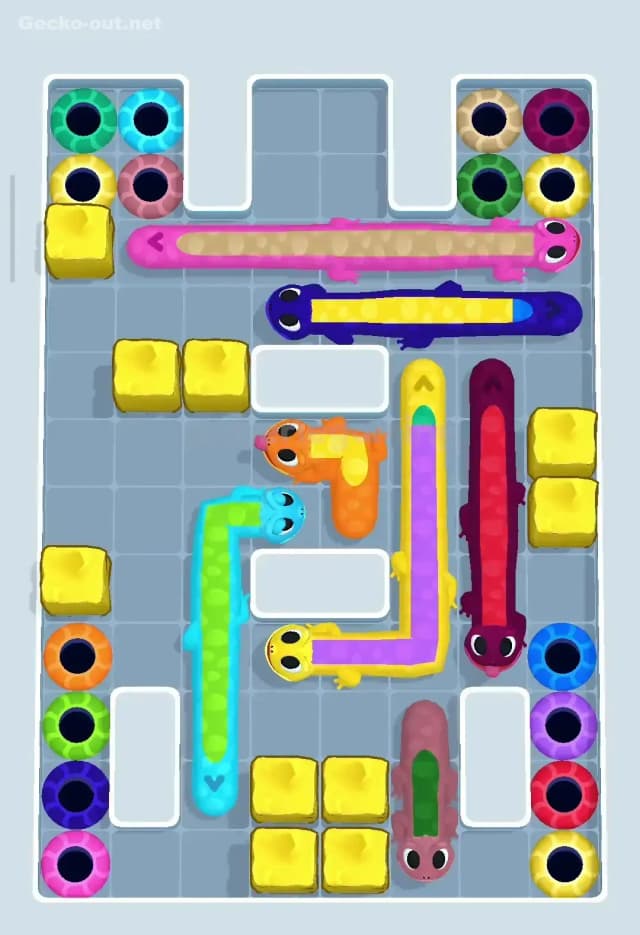
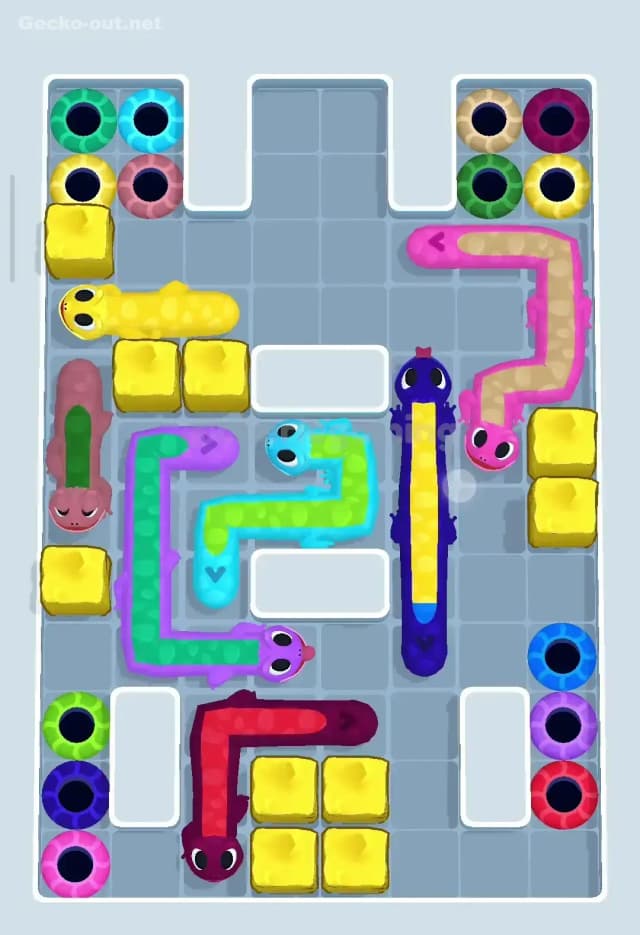
In Gecko Out Level 106 you’re staring at a tall, narrow board packed with seven geckos and a ring of exits around the edges.
Here’s how the layout breaks down:
- At the very top there’s a long pink gecko stretched almost all the way from left to right, just under the top exits.
- Directly under it sits a medium-long dark blue gecko, also horizontal, forming a second “bar” across the upper third.
- In the central pocket you’ve got a short orange gecko turned sideways between those upper geckos and the ones below.
- On the left-center, a tall turquoise/green gecko runs vertically, hooked near the middle so it leans toward the center.
- On the right side, a tall red gecko stands vertically from mid-board downward, hugging the right wall and blocking the right exits.
- Lower down, a yellow gecko forms an L-shape, turning from vertical to horizontal near the middle-right.
- At the bottom, a brown/green gecko sits vertically between the yellow-block cluster and the right exits.
Yellow blocks form chunky “rocks” around the top-left, bottom-left, and bottom-middle, and white rectangular tiles act as solid platforms in the center lanes. The colored holes (exits) sit in clusters in all four corners plus the upper-right and lower-right edges, matching the head color of each gecko.
Nothing can overlap: geckos can’t cross rocks, each other, or exits that don’t match their color. When you drag a head, the body follows the exact path, like a snake tracing your line.
Win Condition and Why the Timer Hurts
To clear Gecko Out 106, every gecko has to slither into a hole of its own color before the timer runs out. Because movement is path-based, you’re not just sliding them around like blocks—you’re drawing roads. Every time you “overdraw” a path you don’t really need, you’re wasting time and potentially building a tighter knot.
The timer changes the puzzle in two big ways:
- You can’t brute-force by random dragging; if you improvise every move, the paths get tangled and the clock kills your run.
- You need a fixed order in your head: which gecko leaves first, which lanes must stay open, and where you’re allowed to park bodies temporarily.
Gecko Out Level 106 looks chaotic, but once you see it as a couple of critical corridors and a few sacrificial parking spots, it becomes a lot more manageable.
Pathing Bottlenecks and Logical Traps in Gecko Out Level 106
The Main Choke Lane
The single biggest bottleneck in Gecko Out 106 is the central vertical lane that runs from the top cluster of exits down past the white platforms toward the bottom exit clusters.
That lane is:
- Blocked on the right by the long red vertical gecko and the L-shaped yellow gecko.
- Partly blocked on the left by the tall turquoise gecko and the yellow-rock stacks.
- Narrowed further by the white platforms in the middle, which you can’t occupy or pass through.
If you move the wrong gecko into that lane early—especially the red or turquoise one—you effectively build a solid wall and nothing else can reposition. The trick is to keep this lane open as a highway for several exits in a row.
Subtle Problem Spots You Don’t Notice at First
A few nasty details in Gecko Out Level 106 catch people off guard:
- The top bar combo (pink above, blue below) looks like free moves, but if you send the dark blue one first, its path often blocks the exact line the pink gecko needs to wrap into its exit.
- The orange gecko in the middle seems “small and easy,” but if you exit it too early, its route can cut off the turning radius the turquoise and yellow geckos need later.
- The bottom-right cluster with the brown/green gecko and red gecko is deceptive: grabbing the red exit line immediately tends to lock the brown gecko and makes it impossible to thread the yellow one out cleanly.
These aren’t instant failures, but they force you into ugly detours that burn time and tighten the knot.
When the Level Starts to Make Sense
I’ll be honest: the first few attempts at Gecko Out 106 feel like you’re just rearranging spaghetti. For me, it clicked when I realized two things:
- The upper pair (pink and blue) are essentially a removable “ceiling” for the whole puzzle. Once they’re gone, the center opens up.
- The tall red gecko on the right should be treated as a late-game piece. As soon as you move it early, half the board turns into a dead end.
Once I started treating the top row as Phase 1, the central geckos as Phase 2, and the right-side verticals as Phase 3, my paths got cleaner, and the timer stopped feeling so brutal.
Turn-by-Turn Path Strategy to Beat Gecko Out Level 106
Opening: Clear the Ceiling and Set Up Parking
In Gecko Out 106, start by cleaning the top:
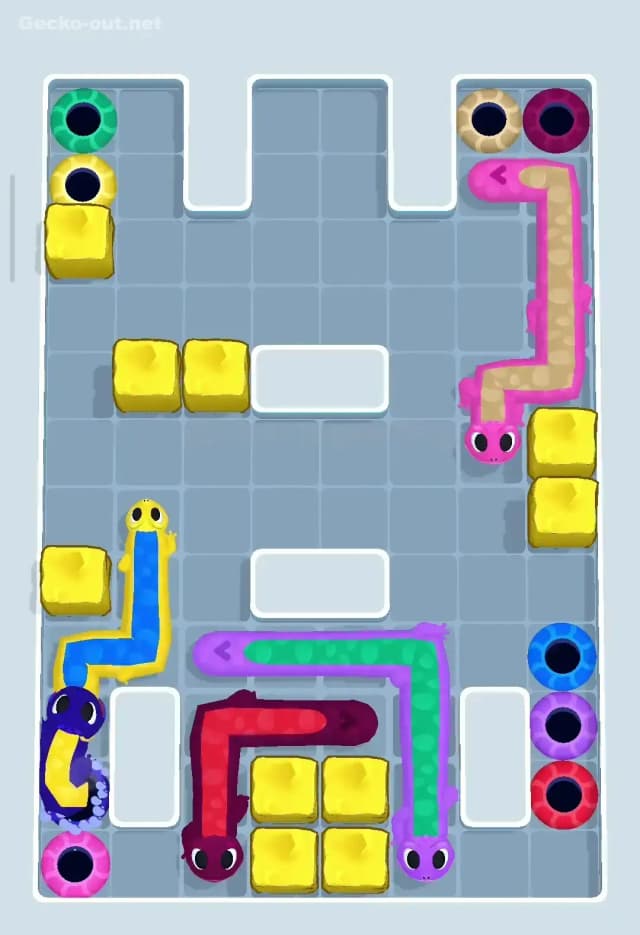
- First move: guide the long pink gecko from the top row into its matching exit in the top corner. Drag its head along its current body toward the matching hole so you’re mostly retracing existing squares, then peel it into the correct hole cluster. This frees a full horizontal lane.
- Second move: use the open space to move the dark blue horizontal gecko to its top-side exit. Again, try to skim along its own body and the newly freed top lane, then hook into its matching hole.
- With the top cleared, gently nudge the short orange gecko into a temporary parking spot in the center, away from the main vertical lane. Aim to tuck it above or beside a white platform so it isn’t guarding any corridor you’ll need later.
By the end of the opening, the top two geckos should be out, and the orange one should be sitting somewhere that doesn’t touch the central vertical strip.
Mid-game: Protect the Central Lane and Reposition Safely
Mid-game in Gecko Out 106 is all about using the space you just created:
- Use the open center to route the turquoise/green vertical gecko down to its matching exit (usually in the left or lower cluster). You want a mostly straight path down the left side of the board, turning only once or twice to line up with the correct hole.
- While doing that, avoid moving the red vertical gecko on the right more than a square or two. Keep it roughly aligned with the right wall so it doesn’t jut into the middle.
- After turquoise is out, reposition the yellow L-shaped gecko. Pull its head along the central lane, then bend it toward its matching exit without letting its body sprawl sideways across the board. Think of it as drawing a neat “hook” rather than a big spiral.
- Once yellow is gone, you can either exit the orange gecko if its route is now obvious, or leave it parked if you still need that lane for the brown/green one.
The key mid-game rule: every time you draw a path, imagine how other geckos will use that same corridor later. If you see your line wrapping around rocks for no reason, cancel and redraw.
End-game: Right-side Vertical Cleanup Under Time Pressure
The end-game of Gecko Out Level 106 is the right half:
- Use the central lane to free the brown/green gecko at the bottom. Pull its head up just enough to clear the yellow rocks, then swing it right into its exit cluster.
- Now the red vertical gecko should be almost alone on the right. Draw a clean, mostly straight line from its head to its matching right-side exit, using any space freed by the brown and yellow geckos.
- Finally, if you parked the orange gecko for very late, give it a quick, direct route into its hole. At this point, you should have wide open lanes around the middle.
If you’re low on time in Gecko Out 106, prioritize the longest remaining gecko. Long bodies take the most dragging and are easiest to mess up if you rush.
Why This Path Order Works in Gecko Out Level 106
Using Head-Drag Pathing to Loosen the Knot
This plan works in Gecko Out 106 because it respects the body-follow rule:
- You remove the biggest horizontal “bars” first (pink and blue), which stops them from acting as permanent ceilings.
- You route mid-game geckos (turquoise and yellow) along edges and existing paths, so they don’t add new twists to the knot.
- You save the tall red gecko for last so you can draw a simple, straight route instead of threading it through a maze of bodies.
Each move either deletes a long obstacle entirely or turns a complicated area into a clean corridor for the next gecko.
Timer Management: When to Think vs. When to Drag
On Gecko Out Level 106, you want to:
- Pause before your very first move and mentally group geckos into phases: top pair, middle trio, right-side duo.
- During the opening, think carefully and redraw your paths if they feel convoluted; there’s still time.
- During the end-game, stop second-guessing and commit. By then, the board is relatively open, and overthinking just wastes seconds.
I like to treat the first few failed attempts as free planning: watch where you consistently jam up, then adjust the order.
Boosters: Optional, but Where They Help
You can absolutely beat Gecko Out 106 without boosters. If you’re stuck, these are the most useful:
- Extra time: best used when you’ve already learned the order but keep running out of seconds on the last one or two geckos.
- Hammer-style remover (if available): save it for a long gecko that consistently causes jams—usually the red one—so you can skip its trickiest path.
- Hint: useful once, early on, to confirm whether the game wants you to clear the top pair or the center first.
Don’t rely on boosters to brute-force the whole level; use them to polish a strategy you almost have.
Mistakes, Fixes, and Logic You Can Reuse in Other Gecko Out Levels
Common Mistakes on Gecko Out Level 106 (and How to Fix Them)
-
Exiting the dark blue gecko before the pink one
Fix: Always clear the pink “ceiling” first so the blue gecko has room to turn without blocking future routes. -
Dragging the red vertical gecko early
Fix: Treat red as a late-game piece. Keep it hugged to the wall, and only send it out once most central geckos are gone. -
Over-wrapping paths around rocks
Fix: Redraw lines to be as straight as possible. In Gecko Out 106, extra loops don’t help—they just eat time and create barriers. -
Exiting the orange gecko too soon
Fix: Park orange in a neutral corner and leave it. Exit it only after turquoise and yellow are clear, when you know exactly which lane is safe. -
Ignoring the central vertical highway
Fix: Before every move, ask: “Does this block the main vertical lane?” If yes, reroute.
Reusing the Logic in Other Tough Gecko Out Levels
The approach you use on Gecko Out 106 carries over nicely:
- Identify “bars” and “pillars” (very long geckos) and plan to remove them in a specific order.
- Keep at least one major corridor open as a shared highway; don’t let any one gecko own it permanently.
- Use small geckos as parking pieces, not early exits, if their position helps keep lanes clear.
- Draw minimal, edge-hugging paths for long geckos so they act like temporary walls that you later delete.
Any knot-heavy, gang-gecko, or frozen-exit level in Gecko Out will feel easier if you first decide which corridor you’re protecting and which three geckos are “late-game only.”
Final Thoughts: Tough but Totally Beatable
Gecko Out Level 106 looks brutal at first glance, but once you respect the central lane and follow a clean order—top pair, center geckos, then the right-side verticals—it becomes a satisfying, fast-flowing puzzle. Take a couple of runs just to watch where you jam, adjust your path order, and you’ll see the whole board suddenly open up. Stick with that plan, and Gecko Out 106 goes from frustrating roadblock to one of those levels you can beat in a smooth, almost rhythmic sequence.