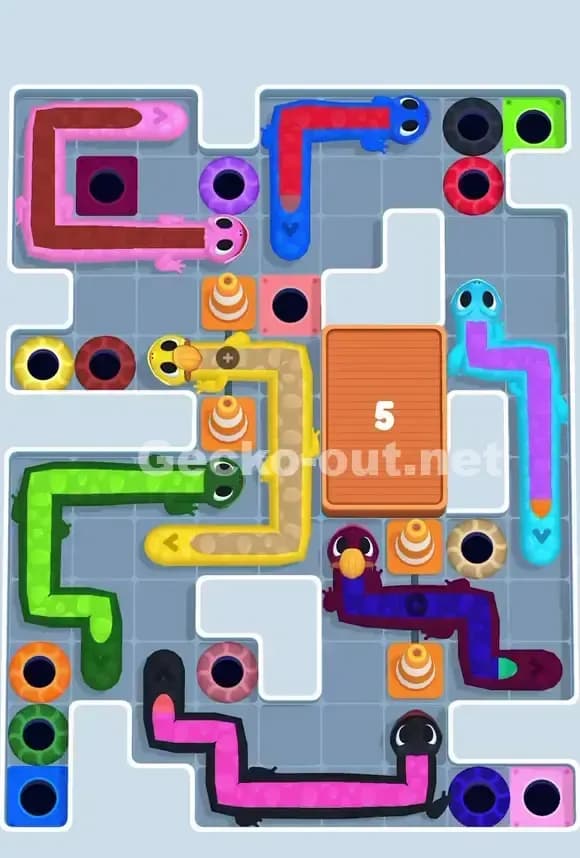
Gecko Out Level 687 Solution Walkthrough | Gecko Out 687 Answer
How to solve Gecko Out level 687? Get step by step solution & cheat for Gecko Out level 687. Solve Gecko Out 687 easily with the answers & video walkthrough.

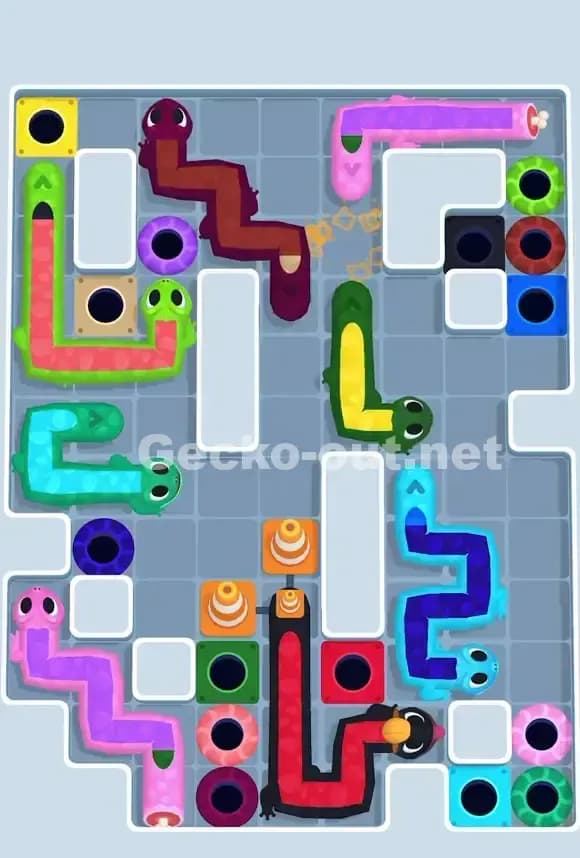


Gecko Out Level 687: Board Layout, Rules, and Win Condition
Understanding the Starting Board
Gecko Out Level 687 is a crowded, multi-color puzzle that'll test your patience and spatial reasoning. You're looking at eight geckos spread across the grid—yellow, red, blue, pink, orange, green, purple, and cyan—each needing to reach their matching colored hole to escape. The board is packed with white wall obstacles creating a tight maze-like structure, and there are several gang-linked geckos (you'll spot the golden chain connections) that move together as a single unit. This interconnection is crucial because moving one linked gecko means repositioning all its partners simultaneously, which creates major cascading complications if you're not careful. The timer is strict here, so you've got roughly two to three minutes to thread all eight geckos through this puzzle box without anyone getting stuck or overlapping.
Recognizing the Win Condition and Timer Pressure
To win Gecko Out Level 687, every single gecko must reach its matching colored hole before the timer hits zero. There's no partial credit—if even one gecko is still on the board when time runs out, you fail the entire level. The head-drag mechanic means you're physically drawing the path each gecko's head will follow, and the body trails behind like a rope, so any path you create becomes permanent terrain for other geckos to navigate around. This is where Gecko Out 687 gets tricky: you can't just move randomly and hope for the best. Every drag is binding, and poor sequencing early on will absolutely trap you late in the puzzle.
Pathing Bottlenecks and Logical Traps in Gecko Out Level 687
The Central Corridor Chokepoint
The biggest bottleneck in Gecko Out Level 687 is the central vertical corridor running down the middle of the board. This narrow passage is the only practical route for multiple geckos to exit, and it's flanked by white walls on both sides. If you don't plan the order carefully, you'll have two or three gecko bodies clogging this lane simultaneously, and the trailing portions will block newer geckos from entering. The red gang-linked geckos in particular create a domino effect here—when you move the red head, all three linked red bodies shift as one unit, taking up enormous space. Getting the gang geckos through this corridor first is essential because if you leave them for last, you'll never fit them through alongside the other escapees.
Subtle Traps: The Left-Side Knot and Gang Overlap Issues
The left side of Gecko Out Level 687 features a dense knot of geckos clustered near the golden chain links. If you drag any gecko head through this area without proper foresight, you'll create a body path that permanently blocks the escape route for its partners. I actually got stuck here on my first attempt because I tried to pull the purple gecko out early without realizing it would cross the space where the chained geckos needed to move. Another hidden trap is the orange striped obstacles scattered throughout the board—they're not walls, but they do take up grid space, so your paths have to route carefully around them. Finally, the bottom-left corner features a pink gecko that looks like it has a direct exit, but its initial position makes it impossible to drag without first clearing space around it.
The "Aha Moment"
I'll be honest—Gecko Out Level 687 felt overwhelming at first glance. There are so many geckos, so many walls, and the gang mechanic seemed like pure chaos. But then it clicked: instead of thinking about each gecko individually, I started viewing them as a puzzle where the gang-linked units had to move first, clearing the board and opening lanes for the solo geckos. Once I reframed the problem that way, the solution became logical rather than random, and I realized the timer pressure was actually a helpful constraint that forced me to commit to a sequence rather than second-guessing every move.
Turn-by-Turn Path Strategy to Beat Gecko Out Level 687
Opening: Clear the Gang Geckos First
Your first move in Gecko Out Level 687 should be to extract the red gang-linked geckos. These three connected bodies take up the most space on the board, and every second they remain in play, they're blocking potential exit routes for other geckos. Drag the red head upward and then right toward its matching red hole in the upper-right area. The body will follow the exact path you've drawn, and because the three units are chained together, they'll move as one long snake. Park the secondary geckos (yellow, purple, and pink) in neutral holding zones—corners or dead-end areas where they won't interfere with your next moves. The goal here is simple: reduce the number of active geckos on the board as quickly as possible.
Mid-Game: Reposition Long Bodies and Maintain Lane Access
Once the gang is gone, Gecko Out Level 687 opens up slightly. Next, move the yellow gecko in the top-left corner. Its path is relatively straightforward—drag it right and down toward the yellow hole on the right side. Be very intentional about the route you choose; avoid cutting across the central corridor if you haven't already decided whether other geckos will need that space. The blue gecko positioned in the lower-middle area should be next. Its hole is directly accessible if you route it downward and then left, but only if you haven't blocked the path with another gecko's body. This is where timing and planning intersect; pause for a few seconds before each drag to mentally trace the path and confirm it won't trap anyone else. The purple gecko in the middle section can wait a bit longer, but start thinking about its exit route (upward and left toward the purple hole) now so you can mentally reserve that lane.
End-Game: Exit Order for the Final Four
As Gecko Out Level 687 approaches the final countdown, prioritize the geckos with the longest escape routes. The pink gecko on the left side needs to navigate a winding path downward and right; get it out now while you have room to maneuver. Next, move the cyan and green geckos from the bottom-right area—they have relatively short, direct paths, so they're perfect for padding your timer buffer. Save the blue and purple geckos for near the very end because their holes are closest to their current positions, so even if you're running low on time, you can still execute quick, simple drags. If you're down to the final ten seconds and still have one gecko left, don't panic—take a deep breath, identify the shortest possible path to its hole, and commit to a single confident drag. Hesitation and second-guessing will waste precious time.
Why This Path Order Works in Gecko Out Level 687
Head-Drag Pathing and Body-Follow Mechanics
The reason this sequence works is fundamental to how Gecko Out Level 687's physics operate. When you drag a gecko's head, its body doesn't teleport; it follows the exact trace of your finger, pixel by pixel. This means that once a gecko is on the board, it's occupying space permanently until it reaches its hole and exits. By moving the largest obstacles (the gang-linked geckos) first, you're opening the board proactively instead of reactively. Early gecko bodies won't be in the way of mid-game moves, and mid-game positioning won't trap your final geckos. The head-drag mechanic also rewards planning because you can visually trace your finger along a path before you commit, giving you a chance to spot potential conflicts before they happen.
Timer Management: Pause vs. Commit
Here's the key insight for Gecko Out Level 687: there's a balance between careful analysis and decisive action. Spend your first 20–30 seconds carefully reading the board, identifying which geckos are gang-linked, and mentally mapping the two or three most critical paths (gang geckos, then long-route geckos). Then commit. Stop pausing after every gecko and start executing moves with confidence. If you overthink, you'll burn timer without making progress. Once you've mapped the first half, move into a rhythm—drag, confirm the gecko is heading toward its hole, move to the next gecko. This tempo will keep you ahead of the clock while still maintaining enough control to avoid catastrophic mistakes.
Booster Strategy: Optional, Not Essential
Gecko Out Level 687 can be beaten without boosters if you execute the strategy cleanly, but if you find yourself stalling (say, 40 seconds left with three geckos still on the board), an extra time booster is a reasonable safety net. A hint booster isn't worth it here because the level's solution is logical rather than random; you don't need to guess the answer, you just need to execute the order. The hammer tool could help if you accidentally block a critical path, but again, careful planning makes it unnecessary. Treat boosters as a backup cushion, not a primary strategy.
Mistakes, Fixes, and Logic You Can Reuse in Other Gecko Out Levels
Common Mistakes on Gecko Out Level 687
Mistake 1: Moving gang-linked geckos last. Players often focus on "easier" solo geckos first, thinking they'll save the gang for later. This is backwards. Fix: Always identify linked geckos and prioritize them for early removal.
Mistake 2: Not leaving space for long gecko bodies. A gecko can be four or five grid units long, and many players forget to account for the full body length when planning paths. Fix: Trace the path with your eyes (or your finger) from head to tail and confirm every grid unit is clear.
Mistake 3: Cutting through high-traffic corridors unnecessarily. The central lane in Gecko Out Level 687 is tempting because it's open, but using it for multiple geckos creates bottlenecks. Fix: Use side routes and corners as much as possible; reserve the central corridor for geckos that have no alternatives.
Mistake 4: Panicking when the timer drops below 30 seconds. Rushing leads to sloppy drags that trap geckos or send them toward the wrong holes. Fix: Trust your plan. If you've executed the first 70% correctly, the final 30% should be quick and clean.
Mistake 5: Forgetting that obstacles take up space. The orange striped tiles and golden chain links aren't walls, but they do block gecko bodies. Fix: Route around them, not through them.
Reusing This Logic on Similar Levels
Any Gecko Out level with gang-linked geckos should follow this same prioritization strategy: gang first, then long-route solos, then short-route solos. Similarly, if you encounter a level with a central bottleneck corridor (common in levels 600+), always reserve it for the geckos that absolutely need it and find alternative routes for everyone else. The timer-pressure mechanic you'll face in future levels responds well to this "plan then execute" rhythm as well. Spend 25% of your time analyzing and 75% moving decisively.
The Encouraging Truth About Gecko Out 687
Gecko Out Level 687 is genuinely challenging, but it's not impossible or random. It's a puzzle that rewards clear thinking and logical sequencing over luck or reflexes. Once you understand that the gang geckos are your priority, that the central corridor is a shared resource to be managed carefully, and that every drag is permanent, the level becomes solvable. You've got this.