Gecko Out Level 709 Solution Walkthrough | Gecko Out 709 Answer
How to solve Gecko Out level 709? Get step by step solution & cheat for Gecko Out level 709. Solve Gecko Out 709 easily with the answers & video walkthrough.
Gecko Out Level 709: Board Layout, Rules, and Win Condition
Understanding the Starting Board
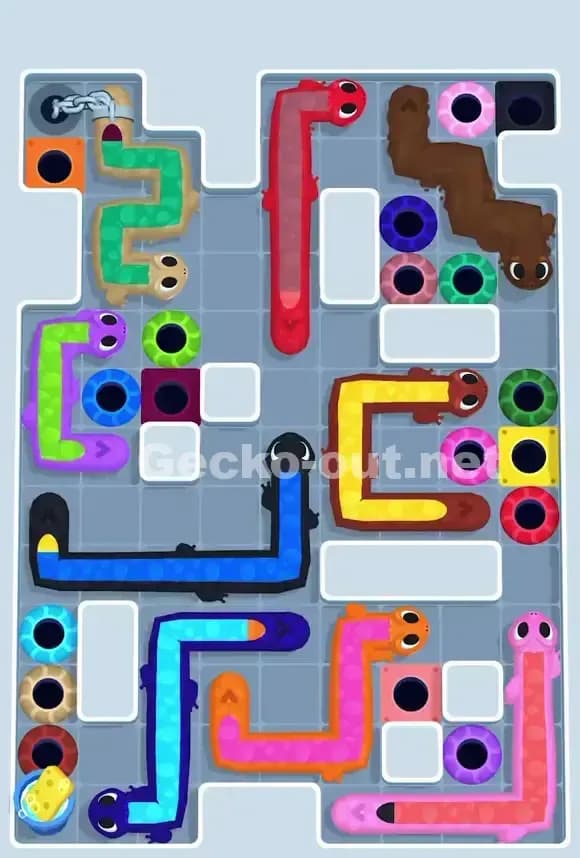
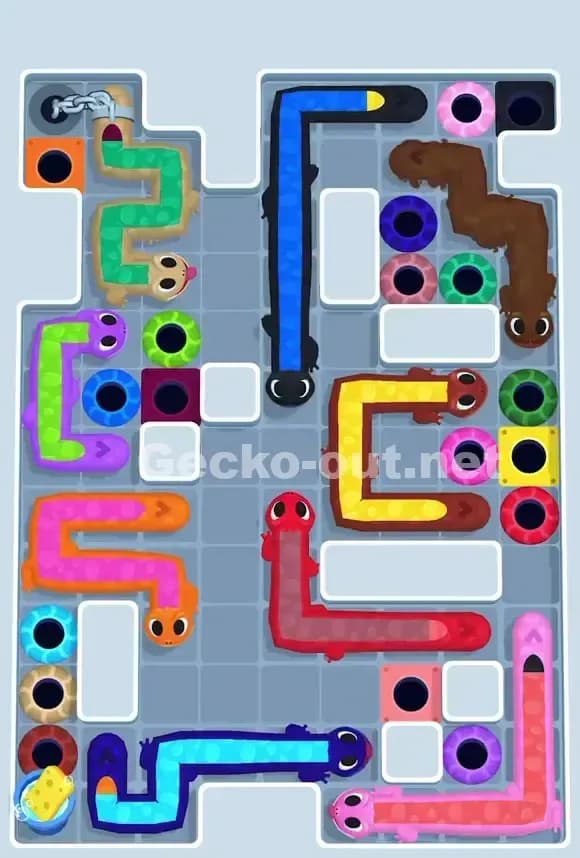
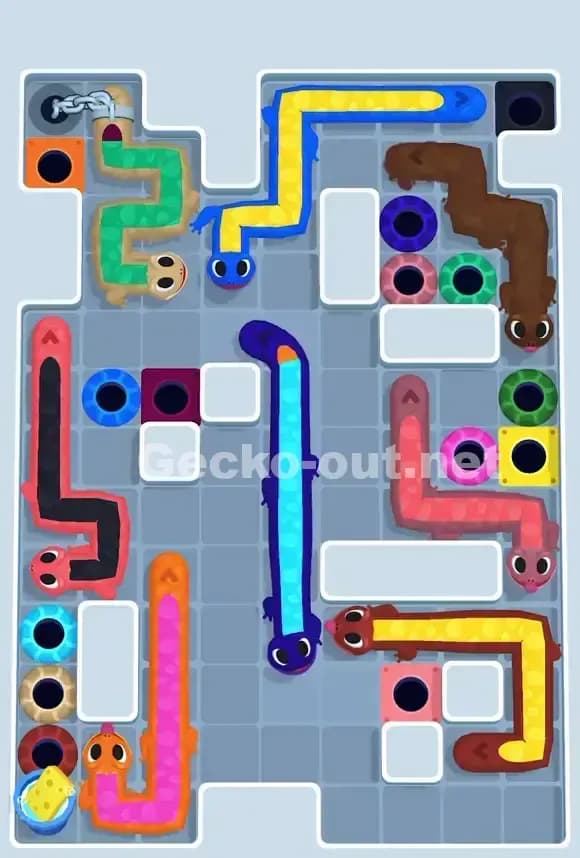
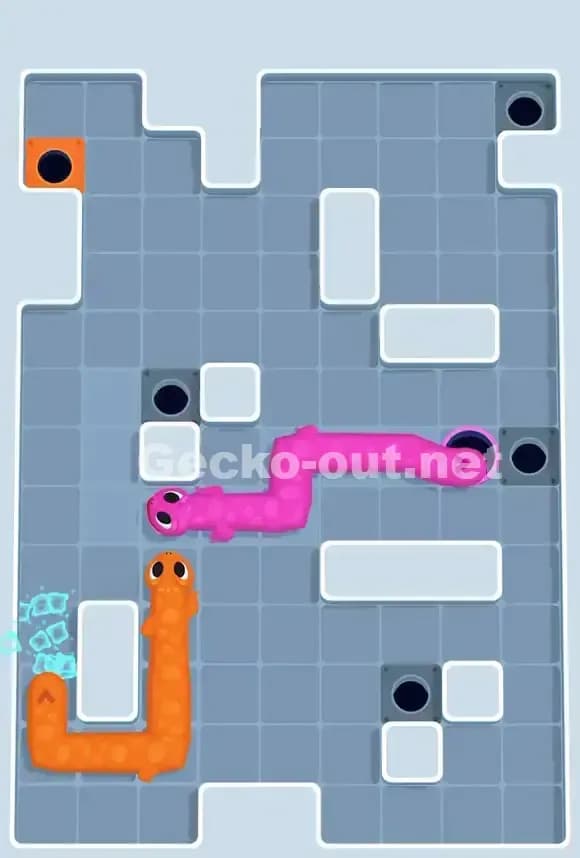
Gecko Out Level 709 is a densely packed puzzle with seven distinct geckos, each color-coded to a matching exit hole. You've got a red gecko in the upper-middle area, a green gecko twisting through the left-center corridor, a blue gecko anchoring the lower-left section, a cyan gecko on the far left, a purple gecko nested in the bottom-left quadrant, an orange gecko in the lower-right zone, and a pink gecko holding the bottom-right corner. The board is split by white walls (safe zones where bodies can rest) and a grid of interconnected passages. What makes Gecko Out Level 709 particularly tricky is that several geckos are tangled together in their starting positions, meaning you can't just drag one gecko to its hole without first repositioning others—or you'll create immediate collisions.
The Win Condition and Timer Pressure
Your goal in Gecko Out Level 709 is straightforward: guide all seven geckos to their matching colored exit holes before the timer runs out. Here's the catch—the timer is tight, and because movement is path-based (the body always follows the exact route you drag the head), a single misstep doesn't just waste time, it can jam multiple geckos into a dead end. You can't undo a drag once you've committed, so you have to visualize the entire path before you touch the screen. The timer adds psychological pressure: you need to move fast enough to escape, but slow enough to avoid collision disasters.
Pathing Bottlenecks and Logical Traps in Gecko Out Level 709
The Red Gecko Chokepoint
The red gecko in the upper-middle area is the single biggest bottleneck in Gecko Out Level 709. It's long, it's positioned right in the horizontal flow of the board, and its exit hole is on the far right. If you try to rush the red gecko out early without clearing the space below it, you'll wedge it against other geckos (especially the brown gecko that sits near the center-right area). The red gecko's body needs a clear, unobstructed path downward and to the right, which means you must first move at least two other geckos completely off the board or park them safely in a white-wall zone. This gecko forces you to think three moves ahead.
Hidden Trap: The Green Gecko's Spiral
The green gecko on the left side looks straightforward at first—it's a simple L-shape that should fit through the left corridor. But here's where Gecko Out Level 709 gets devious: if you drag the green gecko's head too aggressively toward its exit, its body will snake back and collide with the cyan gecko (which sits just below it on the left edge). You have to guide the green gecko in a very specific arc, giving the cyan gecko room to move first. Many players drag the green gecko directly down and lose 5–10 seconds to collision detection, then panic.
The Brown Gecko Parking Problem
The brown gecko on the right side is a mid-length gecko that doesn't have a direct, obvious route to its exit. Its hole is positioned such that you need to thread it through a narrow gap that the yellow, pink, and red geckos might already be claiming. If you don't park one of these competing geckos in a white-wall safe zone early, the brown gecko becomes a traffic jam that cascades into failure. I'll admit, the first time I hit Gecko Out Level 709, I completely underestimated this gecko and watched my run crumble in the final 20 seconds.
The Moment It Clicked
Once I realized that Gecko Out Level 709 isn't about "fast"—it's about "planned"—everything changed. I started mapping out which gecko blocks which exit, then working backward from the most constrained geckos (like the brown gecko and red gecko) to identify which geckos had to leave first. That's when I went from frustrated to confident, and beat Gecko Out Level 709 on my next attempt.
Turn-by-Turn Path Strategy to Beat Gecko Out Level 709
Opening: Clear the Left Corridor First
Start with the cyan gecko on the far left. Drag its head straight down and slightly to the right, into its cyan-colored exit hole at the bottom-left corner. This takes about 3–4 seconds and immediately frees up left-edge real estate. Next, move the blue gecko (the long one anchoring the lower-left section). Guide its head along the bottom-left passage, curving it upward and into its blue exit hole. These two moves open the entire left side of the board, which is your buffer zone for repositioning other geckos if you need to pause and recalculate.
Once the left is clear, tackle the purple gecko. Its path is a gentle curve from the bottom-left inward; drag its head slightly upward and to the right into its purple exit hole. At this point, you've removed three geckos and bought yourself breathing room. The timer should still show 40+ seconds remaining—you're in good shape.
Mid-Game: Reposition the Center and Right Geckos
Now focus on the green gecko. Drag its head carefully to the right, then downward in a wide arc that avoids the path where the cyan gecko already exited. The green gecko's body is long and will occupy several grid spaces; make sure your arc has a generous radius so the body doesn't clip any walls or overlap with other geckos. Once the green gecko reaches its exit hole, you've cleared the left-center zone.
Next, handle the red gecko—the big bottleneck. Before you move it, pause for two seconds and visually trace the path: head down from its current position, then curve right, then down again toward its red exit hole on the right side. You'll need to make sure the brown gecko and orange gecko are not in that path. If they are, nudge them into a white-wall safe zone first. I typically move the orange gecko slightly to the right to create space, then drag the red gecko in a smooth S-curve to its exit. This is where precise dragging matters; don't jab the screen, use smooth, deliberate motions.
End-Game: Final Two Geckos with Zero Room for Error
You should now have four geckos exited and two remaining: the brown gecko and pink gecko. These are positioned close together on the right side, and their exit holes are adjacent. The key here is order. Move the brown gecko first—drag its head right, then down into its brown exit hole. Don't rush; take a clean path. Once the brown gecko is out, the pink gecko's route opens up. Drag the pink gecko's head down and to the right, into the pink exit hole at the bottom-right corner.
If you're running low on time at this stage (less than 15 seconds), resist the urge to panic-drag. A sloppy path that causes a collision will cost you far more time than a careful 3-second move. Commit to your drag, smooth and intentional.
Why This Path Order Works in Gecko Out Level 709
Head-Drag Pathing and the Body-Follow Rule
The strategy I've outlined for Gecko Out Level 709 exploits the body-follow rule to your advantage. By removing geckos from the left side first, you're not just clearing exits—you're clearing pathways that other geckos can later use without collision risk. When you drag the cyan gecko straight out, you've permanently removed a body from the board, so the blue gecko's path won't accidentally overlap it. This is the opposite of many players' instinct, which is to tackle the most obvious gecko first (usually the one closest to you visually). In Gecko Out Level 709, you have to prioritize constraint and dependency: which gecko, if removed, frees up the most options for the others?
The body-follow rule also means that every drag is a commitment. You can't "test" a path partway and then undo it. So before you drag a head in Gecko Out Level 709, you mentally trace the entire body route. This is slower at first, but it prevents disasters.
Timer Management: Pause and Commit
In Gecko Out Level 709, you should pause briefly between each gecko—maybe 2–3 seconds—to visually scan the board and confirm your next target. These micro-pauses seem like they'd waste time, but they actually save 20+ seconds because they prevent collision blunders that force restarts. The timer in Gecko Out Level 709 is designed to be tight but beatable if you're efficient. You're not trying to beat your personal speed record; you're trying to avoid mistakes. Speed comes naturally once you've solved Gecko Out Level 709 a few times.
Booster Strategy for Gecko Out Level 709
For most players, Gecko Out Level 709 is solvable without boosters if you use the path order I've described. However, if you're struggling with timing or keep colliding geckos in the center-right zone, an "extra time" booster (usually +15 seconds) is worth using at the moment you feel the panic starting. A +15-second booster gives you a comfortable buffer to slow down and make clean moves on the remaining 2–3 geckos. Don't save boosters "for later"—if you need one in Gecko Out Level 709, use it before you make a desperate mistake.
Mistakes, Fixes, and Logic You Can Reuse in Other Gecko Out Levels
Common Mistakes on Gecko Out Level 709
Mistake 1: Moving the red gecko too early. Players often grab the largest, most visible gecko and try to drag it straight to its hole, only to realize three other geckos are blocking the way. The fix is simple: identify bottleneck geckos first (like the red gecko in Gecko Out Level 709), then work backward to clear dependencies.
Mistake 2: Dragging the green gecko downward instead of in an arc. A straight-down drag causes the green gecko's body to collide with the cyan gecko. The fix is to always trace the body path, not just the head destination. Ask yourself: "Will the body clip anything?"
Mistake 3: Ignoring white-wall safe zones. Many players forget that white walls are parking spots, not obstacles. In Gecko Out Level 709, you can safely position a gecko against a white wall to get it out of the way temporarily. The fix is to use white-wall zones as your "staging areas" for geckos that need to wait their turn.
Mistake 4: Rushing the final geckos. When the timer hits 20 seconds and you've still got two geckos left, panic sets in. Players start jabbing the screen, creating sloppy paths and causing collisions. The fix is to breathe and commit to deliberate, clean drags. A 4-second move executed well beats a 2-second move that causes a collision.
Mistake 5: Not recognizing that Gecko Out Level 709 is a puzzle, not a reflex challenge. This is the meta-mistake. Gecko Out Level 709 requires planning, not speed. The fix is to shift your mindset: spend 10 seconds reading the board, then spend 30 seconds executing clean moves.
Reusable Logic for Similar Levels
This strategy applies directly to other Gecko Out levels with tight boards, gang geckos, or frozen exits. Whenever you see a level where multiple geckos are tangled together:
- Map the dependencies. Which gecko blocks which exit?
- Identify bottlenecks. Which gecko, if not moved carefully, will jam everything else?
- Work backward. Move the least-constrained geckos first to clear space for the bottleneck geckos.
- Use safe zones. Park geckos strategically against walls, not randomly.
- Trace the body path. Never drag a head without visualizing the full body route.
These principles will carry you through dozens of similar Gecko Out levels, and you'll find that the timer pressure feels much less acute once you're confident in your planning.
Final Encouragement
Gecko Out Level 709 is genuinely one of the trickier mid-game levels, and if you've been stuck on it, that's completely normal. The combination of seven geckos, a congested board, and a tight timer creates a perfect storm of complexity. But here's the truth: Gecko Out Level 709 is absolutely beatable with the strategy and mindset I've outlined. Once you clear it, you'll have unlocked a crucial skill—the ability to see a tangled puzzle and calmly untangle it one gecko at a time. You've got this.