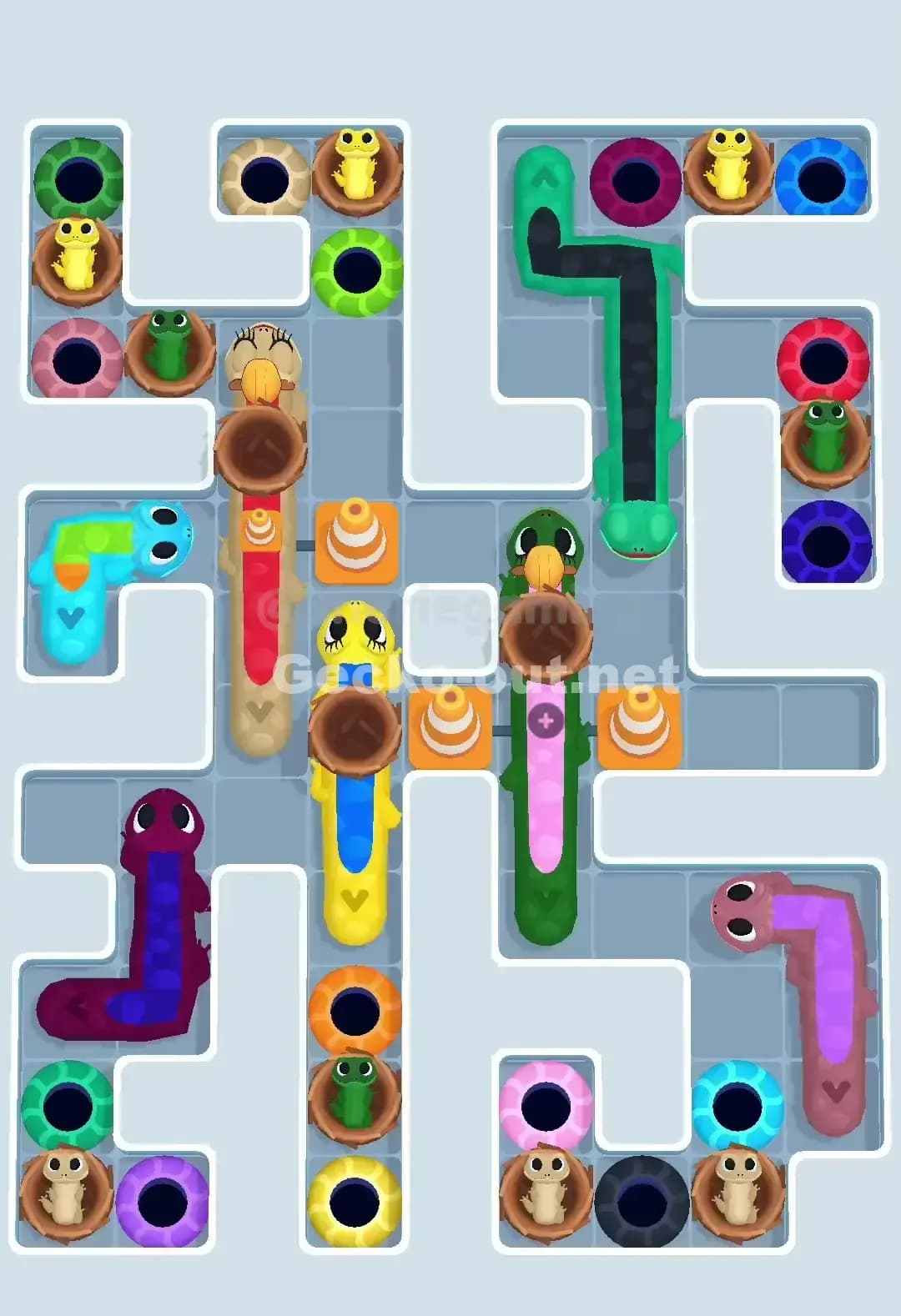
Gecko Out Level 672 Solution Walkthrough | Gecko Out 672 Answer
How to solve Gecko Out level 672? Get step by step solution & cheat for Gecko Out level 672. Solve Gecko Out 672 easily with the answers & video walkthrough.
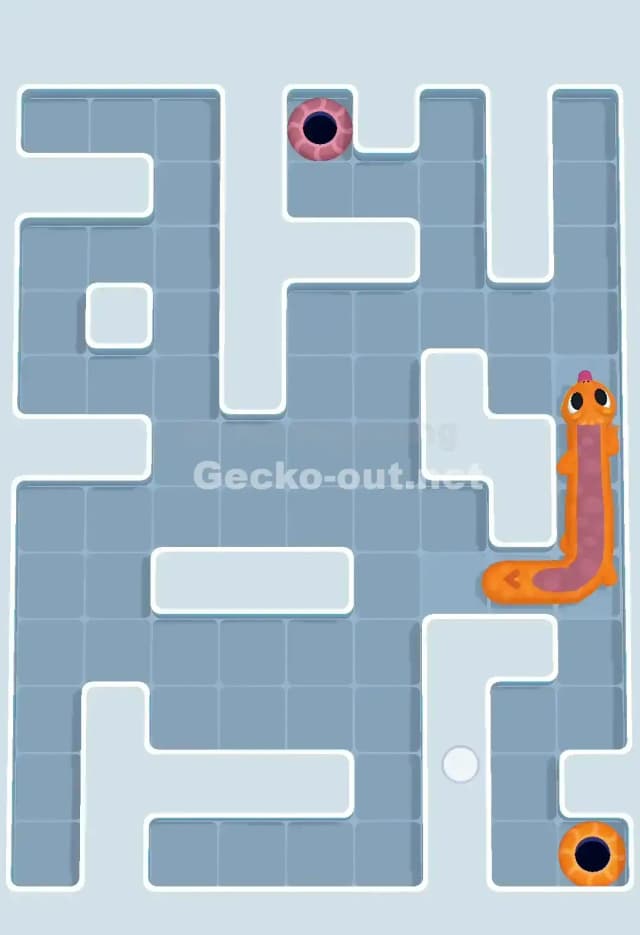
Gecko Out Level 672: Board Layout, Rules, and Win Condition
Starting Setup and Obstacle Overview
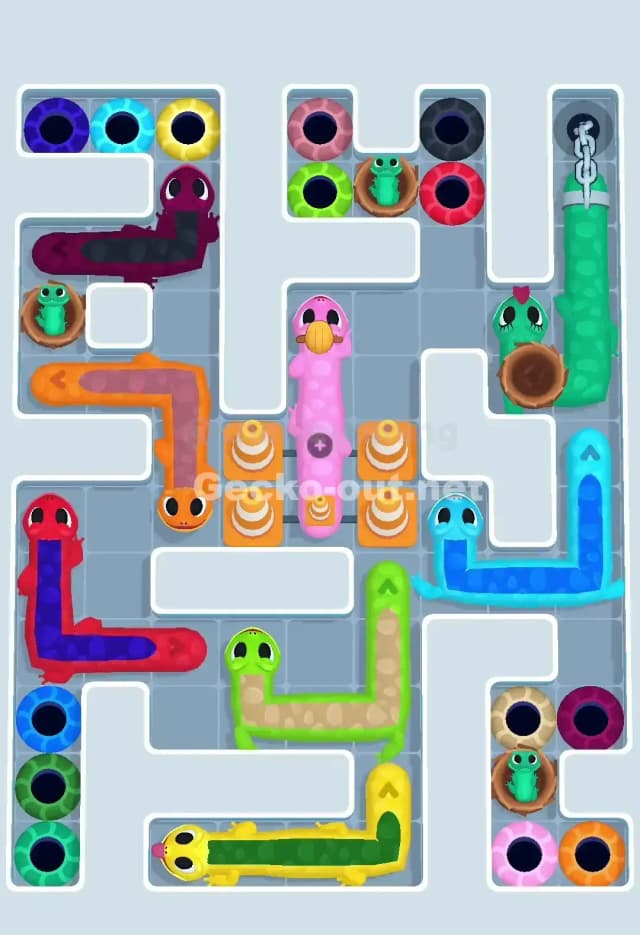
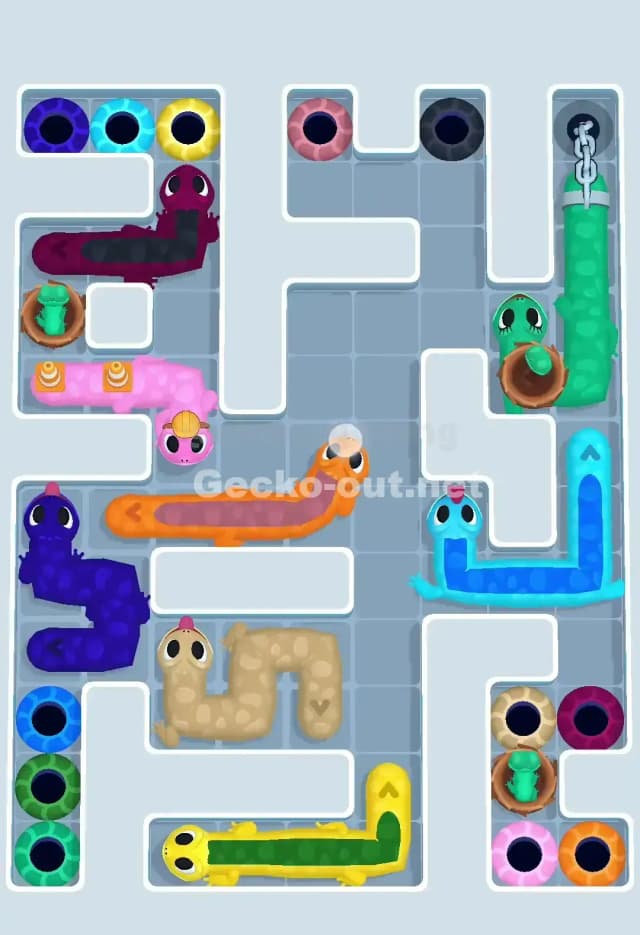
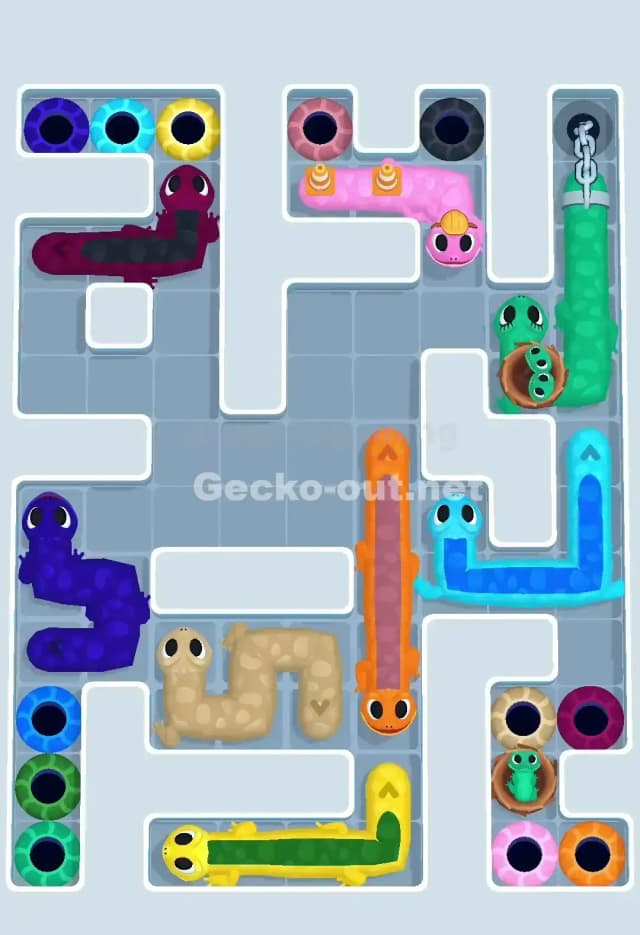
Gecko Out Level 672 is a dense, multi-level puzzle that'll test your patience and planning. You're looking at nine geckos spread across the board in various colors: blue, cyan, yellow, purple, orange, pink, red, green, and brown. Each one needs to reach its matching colored hole to escape. The board itself is a maze of white walls creating tight corridors, and there's absolutely no room for casual dragging—every path you draw affects what comes next.
What makes Gecko Out Level 672 particularly tricky is the gang-gecko setup. You've got several long, linked geckos whose bodies are bound together (like the purple-headed gecko with its orange body, or the red gecko whose tail extends far down the board). These aren't just obstacles; they're spatial anchors that completely govern what moves you can make early on. You also have several stationary colored holes positioned at different regions of the board, and the narrow corridors mean that if one gecko's body blocks a path, it cascades into failure for everyone else downstream.
Win Condition and Timer Pressure
You win when all nine geckos are in their matching holes before the timer runs out. The timer is typically generous for a puzzle this size, but only if you move decisively and don't waste turns repositioning geckos unnecessarily. The path-following mechanic means every drag-and-release counts: the gecko's body will trace your exact route, so a sloppy curve can eat up board space and trap another gecko. Gecko Out Level 672 demands respect for spatial efficiency and a clear mental model of exit order before you start dragging.
Pathing Bottlenecks and Logical Traps in Gecko Out Level 672
The Critical Bottleneck: The Lower-Middle Corridor
The single biggest chokepoint in Gecko Out Level 672 is the lower-middle section of the board, where multiple geckos must funnel through a narrow horizontal passage to reach their holes. The yellow gecko at the bottom and the green geckos on the left side all need to route through or around this area, but if the red or purple gang geckos occupy that space, you're gridlocked. This bottleneck is the reason you can't just move geckos at random—you have to clear the big, long-bodied geckos first so the smaller or simpler ones can slip through behind them.
Subtle Problem Spot #1: The Pink Gecko's Vertical Trap
The pink gecko in the middle-left area has a long body that snakes downward. If you're not careful with your path, you'll drag its head left or right too early, and its body will block access to the yellow hole at the bottom. The temptation is to send it quickly, but Gecko Out Level 672 punishes speed without forethought. You need to commit to a clear vertical descent first, then curve only when you're past the danger zone.
Subtle Problem Spot #2: The Blue and Green Exit Stacking
On the far right side, the blue exit and green exit are vertically aligned but separated by walls. New players often try to route both geckos to that area simultaneously, forgetting that the body of one gecko will block the path to the other's hole. You must process these in strict order, and the body of the first gecko must retract fully into its hole before the second can safely approach.
Subtle Problem Spot #3: The Orange Gang Complexity
The orange gecko at the top-left has a compact head but a medium-length body. Because it shares the upper-left chamber with the blue, cyan, and yellow geckos, there's massive overlap potential. If you send orange before blue or cyan, you risk pinning one of the others against the wall. Gecko Out Level 672 teaches you that position and color don't always correlate with exit order—spatial arrangement does.
Personal Reflection on the Challenge
Honestly, when I first looked at Gecko Out Level 672, I felt that familiar knot of frustration. Nine geckos, narrow corridors, gang bodies everywhere—it screamed "impossible" for about thirty seconds. But then I paused, zoomed in on the board, and traced the exit paths with my eyes alone (no dragging). The moment I realized that the red and purple geckos had to leave first to open the middle corridor, everything clicked. That's when Gecko Out Level 672 shifted from terrifying to solvable.
Turn-by-Turn Path Strategy to Beat Gecko Out Level 672
Opening: Clear the Gang Geckos First
Your first move in Gecko Out Level 672 should be to identify and extract the longest, most entangled geckos. Start with the purple gecko (with the orange body) at the top-middle. Drag its head upward and route it to its matching purple hole in the upper-right area. This move immediately frees up the central horizontal corridor. Next, send the red gecko (bottom-left) straight down and to the left, into its red hole. These two moves are your "unlocking" phase and should happen before you touch any of the simpler, single-cell-body geckos.
Park the remaining geckos mentally in zones. The blue, cyan, and yellow geckos in the top-left corner should stay put for now—they're compact and won't block anything yet. The green geckos on the far left are tall but narrow; they can wait. The goal is to move only the geckos that have long, winding bodies and high blocking potential.
Mid-Game: Reposition and Open Secondary Routes
Once the purple and red geckos are home, pivot to the pink gecko in the middle-left. Drag its head downward in a clean vertical line until you clear the lower-middle corridor, then curve left into its pink hole. This clears the vertical axis for the green geckos. Next, address the orange gang gecko at the bottom—it has a moderate length, and it needs to reach the orange hole in the lower-middle area. Drag it carefully, avoiding collision with the path you just used for pink. Gecko Out Level 672 at this stage is all about not overwriting your own pathways.
The brown gecko on the right side is relatively isolated; move it early if you haven't already, since it's self-contained and frees up that corner. Now the board is thinning out, and the simple geckos (single round heads) have clear lanes opening up.
End-Game: Exit Order for the Final Geckos
The last four or five geckos should exit in this order: green geckos (both of them) down the left side into their green holes, blue and cyan into their holes on the top-left, yellow into its hole at the bottom. Time isn't usually a problem here—if you've managed the first half cleanly, you'll have forty-plus seconds remaining. The key is to drag each gecko head cleanly along the now-open corridors and avoid the beginner mistake of over-curving and hitting a wall at the last second.
If you do find yourself low on time, don't panic. Most of the board is now empty, so movement is fast. Draw straight, confident lines and commit to each drag. Gecko Out Level 672 rewards decisiveness in the endgame.
Why This Path Order Works in Gecko Out Level 672
Head-Drag Mechanics and Body-Follow Logic
The strategy for Gecko Out Level 672 works because it respects the body-follow rule: every cell your gecko head passes through, the body must also occupy in sequence. By removing the long geckos first, you prevent their bodies from permanently blocking corridors. When you drag the purple gecko's head upward and out, its body retracts from the central lane, leaving it open for smaller geckos later. This is the opposite of the mistake many players make—dragging a small gecko through the middle, then realizing the big gecko can't pass anymore.
The path order also minimizes intersections. By moving red and purple early, you "claim" the main arteries before the secondary geckos need them. The pink gecko, which also has a long body, goes third precisely because it doesn't interfere with red and purple's planned routes. Gecko Out Level 672 is ultimately a puzzle about sequence and spatial priority, not speed.
Reading the Board vs. Committing to Motion
Early in Gecko Out Level 672, spend about 10–15 seconds pausing and reading the board. Trace potential paths with your eyes. Once you identify the two or three geckos that must go first, commit to them without hesitation—dragging slowly or redoing paths eats timer. The mid-game phase (geckos 3–6) is where you can afford to be slightly more cautious, since the board is opening up and mistakes become harder. By the endgame, you should move quickly; the lanes are clear, and every second counts toward a higher score or comfort margin.
Booster Strategy for Gecko Out Level 672
In most playthroughs of Gecko Out Level 672, you won't need boosters. The puzzle is tight but fair, and a clear path order solves it within the time limit. However, if you find yourself stuck on a mid-game move (say, you've trapped a gecko and can't see the exit), the Hint booster can show you the intended next move. Alternatively, if you're consistently finishing with only 5–10 seconds left, the Extra Time booster gives you a comfortable safety net. The Hammer tool (if available) isn't necessary here, as there are no locked exits to break. Boosters should be treated as optional helpers, not crutches—Gecko Out Level 672 can absolutely be beaten without them.
Mistakes, Fixes, and Logic You Can Reuse in Other Gecko Out Levels
Five Common Mistakes on Gecko Out Level 672
Mistake 1: Sending Small Geckos Before Big Ones
Many players naturally go for the "easy" small geckos first, thinking they're clearing the board. In Gecko Out Level 672, this traps the long geckos because their bodies have nowhere to go. Fix: Always remove the longest geckos first, regardless of perceived difficulty.
Mistake 2: Over-Curving Paths Too Early
Dragging the purple gecko's head in a smooth S-curve through the upper area looks elegant but wastes board real estate. Fix: Use straight lines and right angles. Only curve when absolutely necessary to avoid walls or other geckos.
Mistake 3: Forgetting About the Body
You drag the head and focus on reaching the hole, then forget that the body is trailing behind and has now blocked another gecko's path. Fix: Before every drag, mentally trace the body's path from head to current position, imagining where it'll land.
Mistake 4: Not Parking Geckos Efficiently
Leaving geckos scattered around the board after they're done leaves no room for latecomers. Fix: Once a gecko is in its hole, it's out; don't worry about it. Focus on moving the remaining ones into clear spaces or out entirely.
Mistake 5: Panicking in the End-Game
Running low on time can make you drag carelessly, hitting walls and restarting paths. Fix: Even if the timer is tight, draw slowly and deliberately. The open board at the end means you can afford precision over speed.
Reusing This Logic on Similar Levels
Gecko Out Level 672 is a prototype for gang-gecko and bottleneck puzzles. Whenever you encounter a level with multiple long, linked geckos and narrow corridors, apply the same philosophy: identify the bottlenecks, remove the longest geckos first, and keep secondary lanes clear for smaller ones. Levels with frozen exits or toll gates benefit from the same patience-and-planning approach—read the board, commit to a sequence, and execute cleanly.
The path-tracing and spatial-priority thinking from Gecko Out Level 672 also applies to more complex levels. If a puzzle feels impossible, don't assume it's unfair; instead, assume your move order is wrong. Gecko Out Level 672 reinforces this lesson: the right sequence makes the puzzle trivial; the wrong sequence makes it impossible.
Final Encouragement
Gecko Out Level 672 is tough, no question. The nine-gecko count, the gang-body complexity, and the tight corridors all conspire to frustrate. But it's absolutely beatable with a clear head and a deliberate plan. Once you've solved it once, you'll recognize the pattern in future levels, and that's when Gecko Out puzzles stop feeling like chaos and start feeling like elegant logic. You've got this.