Gecko Out Level 425 Solution Walkthrough | Gecko Out 425 Answer
How to solve Gecko Out level 425? Get step by step solution & cheat for Gecko Out level 425. Solve Gecko Out 425 easily with the answers & video walkthrough.




Gecko Out Level 425: Board Layout, Rules, and Win Condition
Starting Board Overview
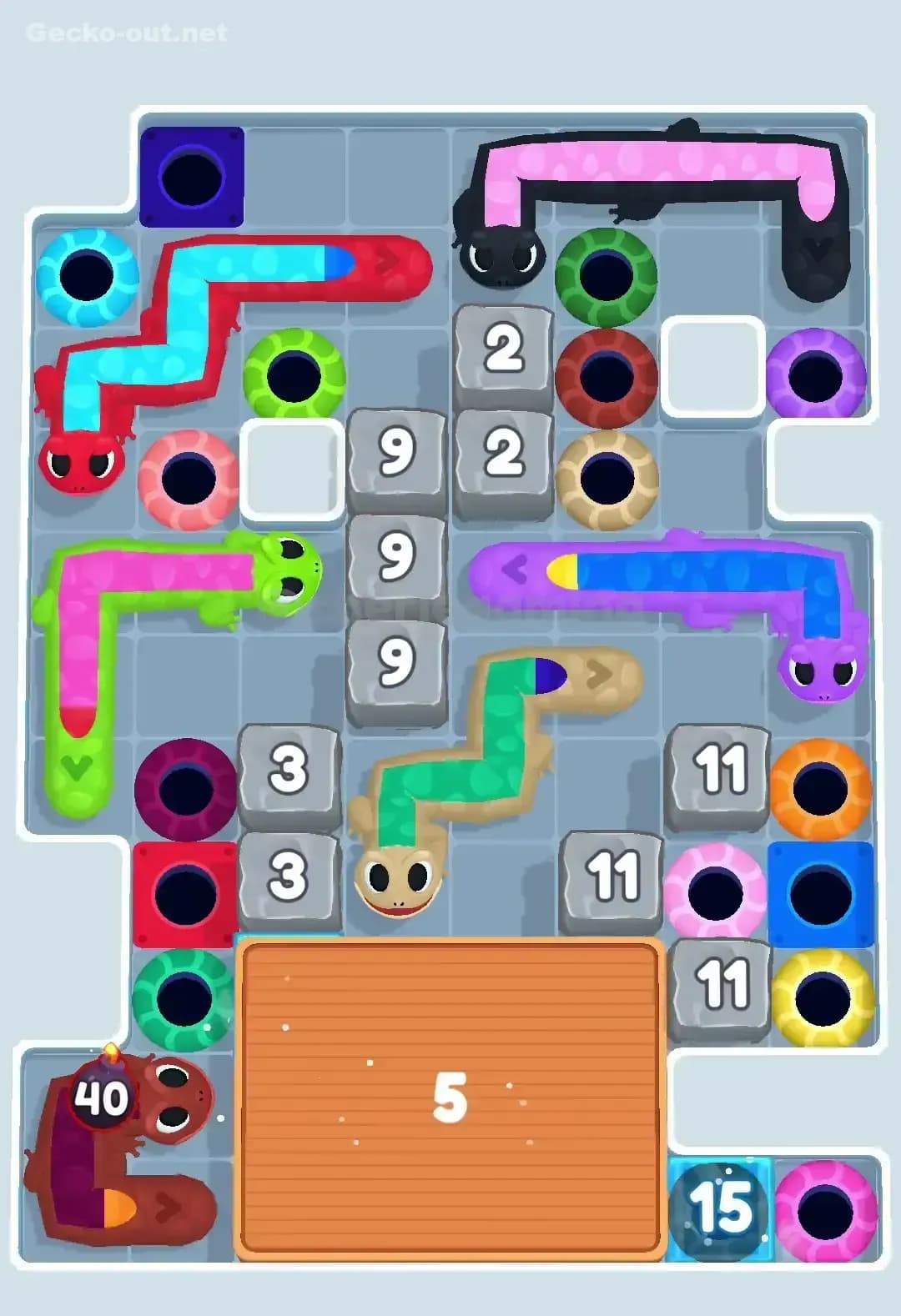
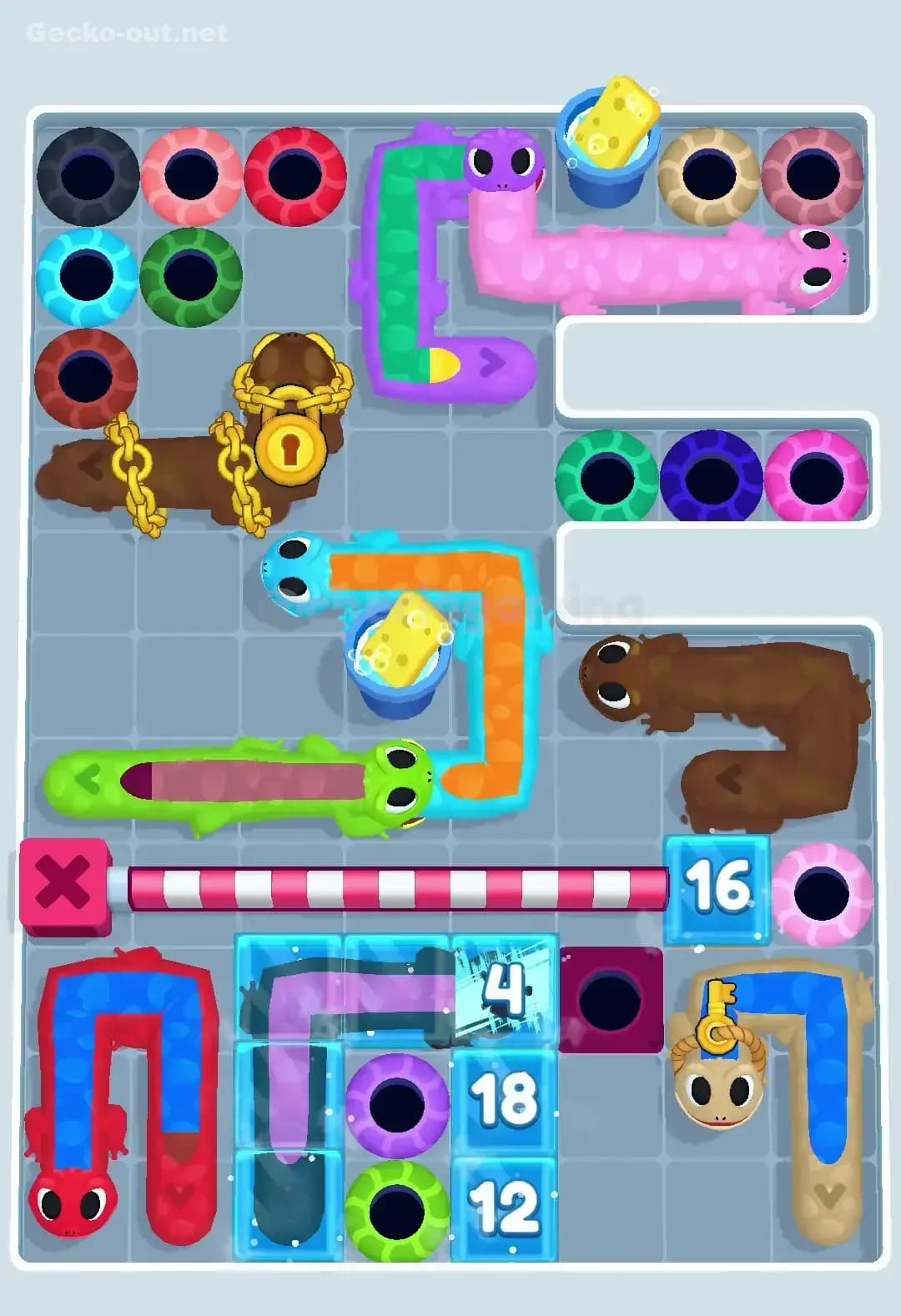
Gecko Out Level 425 drops you into a packed vertical board with almost no free squares. You’ve got a full rainbow of geckos: a long orange one on the left, a tall yellow one on the right, a chained turquoise “gang” gecko in the middle wrapped around a pink partner, a big black-and-orange gecko at the bottom, plus blue, magenta, green, and beige bodies weaving through everything. Several exits are already visible, but many are buried behind other geckos or squeezed against walls.
On top of the geckos themselves, you’re dealing with several special tiles. There are black “dead” holes that can’t be used, warning holes with exclamation marks, a coin-style toll gate wrapped in chains, and chunky white blocks that act as permanent walls. The central region is especially scary: a chained turquoise path, the pink gang gecko, and the tall yellow gecko compete for the same tiny corridor.
Why The Timer And Pathing Are So Brutal
The win condition in Gecko Out 425 is simple on paper: drag each gecko’s head so its body follows a path to a hole with the matching color ring. No overlaps with walls, other geckos, frozen or locked exits, and no letting the timer hit zero. The reality is that the board is so dense that a bad drag tightens the knot instead of loosening it.
Because the body traces the exact route of the head, every wiggle matters. If you draw big loops “just to move something,” you fill every free square and trap yourself. The timer punishes that kind of experimentation. Gecko Out Level 425 forces you to think in terms of lanes: you clear a corridor, move a specific gecko through it once, then immediately reuse that space for another color instead of leaving bodies sprawled all over.
Pathing Bottlenecks and Logical Traps in Gecko Out Level 425
The Main Central Bottleneck
The biggest bottleneck in Gecko Out Level 425 is the vertical corridor on the right side, where the tall yellow gecko runs up and down alongside the chained turquoise and green/beige geckos. Most of the upper exits and several mid-board holes are effectively behind that yellow body. If you leave the yellow gecko parked in the middle, you’ll constantly find that “just one more square” is missing to complete a path.
A close second bottleneck is the lower-right corner where the long black gecko curls around the warning holes and a white block. That U-shaped body can either be a perfect temporary parking spot or a solid wall, depending on how you redraw it. A lot of runs die because you move that black gecko too early or too lazily and end up sealing off both warning exits.
Sneaky Trouble Spots
There are a few subtle hazards that make Gecko Out 425 feel unfair at first:
- The gang-chained turquoise and pink geckos in the middle look like they want to exit immediately, but moving them first often locks the yellow and green/beige geckos into a corner.
- The colored exits near the black dead holes on the lower left are easy to misuse; if you send the wrong gecko through a warning exit early, the ring locks and blocks the correct one later.
- The fat orange gecko near the upper left can look “free,” but if you drag it too far into the center you block the space you desperately need for rotating the turquoise and green bodies.
Once you see those as shared lanes instead of personal playgrounds for each gecko, the level starts to make sense.
When The Level Finally Clicks
I’ll be honest: Gecko Out Level 425 feels like chaos the first few times. I kept rushing, drawing big sweeping paths and then realizing I’d created an unbreakable wall of tails. The turning point was when I stopped trying to solve everything at once and instead picked one corridor at a time: clear it, use it, then repurpose it.
The “aha” moment for me was realizing that the yellow gecko isn’t an early exit; it’s a sliding door. As soon as I started treating it as a movable divider—shifting it just enough to let other geckos slip past—my success rate shot up. The gang geckos became tools rather than problems once I stopped dragging them in big circles and only nudged them through precise, pre-planned routes.
Turn-by-Turn Path Strategy to Beat Gecko Out Level 425
Opening: Creating Breathing Room
For the opening of Gecko Out 425, your goal is simple: carve out a little space on the left and bottom so you can rotate the central knot.
- Use the blue and magenta geckos on the lower left to clear their nearest exits first. Drag them in tight, efficient L-shapes, hugging the board edge so their bodies don’t sprawl into the middle.
- Next, gently reposition the big orange gecko on the upper left. Don’t send it to its exit yet; just pull its head down or inward enough to open a lane along the wall for future passes.
- With that done, you can give the black gecko at the bottom a compact loop that tucks it against the right wall, freeing a central bottom lane without actually exiting it yet (unless its exit is already perfectly lined up).
If you finish the opening with a clearer left side and an open strip across the bottom, you’ve set yourself up well.
Mid-game: Rotating The Knot Without Tightening It
Mid-game is where most runs of Gecko Out Level 425 fail. You’re now focused on the central gang geckos and the yellow and green/beige bodies on the right.
- Slide the yellow gecko just enough up or down to open a two-square-wide vertical lane beside it. Think of it as opening a sliding door, not moving house.
- Use that lane to reposition the green/beige gecko. Route its head through the center so it lines up with its exit, but keep its body running parallel to the walls whenever possible. Long zigzags will strangle the board.
- Once the green/beige gecko is out (or at least parked in a harmless edge position), turn to the turquoise and pink gang geckos in the middle. Move them one at a time through the space freed by the green gecko. Keep each path short and purposeful—no idle loops.
The key mid-game rule: every time you free a lane, immediately run a gecko through it that won’t have to come back, then reclaim the space.
End-game: Clean Exits Under Pressure
By the end-game of Gecko Out 425, only a handful of colors should be left: usually the yellow gecko, the orange one, and the long black gecko plus maybe one last gang member.
- Decide which remaining exit is hardest to reach and solve that one first while you still have time. Often this is the one behind a warning hole or tucked behind a white block.
- Use the yellow gecko as the last true “door.” Slide it up or down to let the last two geckos take turns reaching their exits, then either park it harmlessly or exit it last.
- If the timer’s low, prioritize straight-line, low-turn paths even if they’re not perfectly elegant. As long as geckos don’t collide or block the remaining path, speed wins over neatness.
If you’re under ten seconds, stop planning and just commit to the path order you’ve already visualized; last-second dithering is how you lose Gecko Out Level 425.
Why This Path Order Works in Gecko Out Level 425
Using Head-Drag Pathing To Your Advantage
This plan works because it respects the head-drag body-follow rule instead of fighting it. In Gecko Out Level 425, every extra bend is another square you’re stealing from future moves. By opening with short, edge-hugging paths for the left-side geckos, you keep the center hollow. The mid-game strategy of using the yellow gecko as a moving divider lets you reuse the same tiny corridor for multiple exits instead of drawing new ones.
Treating the black gecko and the gang geckos as flexible, compact shapes instead of snakes that must stretch everywhere is the difference between a win and a stalemate. You’re basically “rotating” the knot around the same central space, handing the lane from one color to the next.
Playing Around The Timer
The timer in Gecko Out 425 punishes blind experimentation but leaves enough room for a quick mental count before each phase. I like to pause at three key moments: before moving anything (scan the board), before dealing with the central gang geckos, and before the final two exits. Outside of those mini-pauses, you should be dragging confidently.
Think of it as alternating between planning mode and execution mode. Plan in short bursts, then commit. Half-finished moves waste more time than fully committing to a “good enough” route.
Boosters: If You Really Get Stuck
Boosters are optional in Gecko Out Level 425, but they can bail you out if you’re consistently close. An extra-time booster is the safest: use it right before you start the mid-game knot rotation so you can experiment with the gang geckos without panicking.
Hammer-style tools that remove a tile or freeze a gecko are overkill here; they’re better saved for levels where exits are permanently blocked. I’d only use them if you’ve tried the lane-based approach several times and still can’t clear the central corridor.
Mistakes, Fixes, and Logic You Can Reuse in Other Gecko Out Levels
Common Errors On Gecko Out Level 425
Here are the big mistakes I see (and made myself):
- Moving the yellow gecko all the way out early, which removes your sliding door and makes later rotations impossible.
- Dragging huge, curvy paths “just to move something,” which fills every free square and leaves no way to reposition the gang geckos.
- Using a warning hole too early for the wrong color, locking a ring that a later gecko actually needs.
- Exiting the black gecko at the bottom immediately, even though its body can temporarily wall off the right side in a helpful way.
Fix all of these by sticking to the ideas of short paths, temporary parking, and treating big geckos as movable walls, not immediate exits.
Reusing This Logic On Other Levels
The logic you learn beating Gecko Out 425 is gold for other knot-heavy stages:
- Identify your “door” geckos—long bodies that control key corridors—and move them minimally.
- Clear edge geckos first with tight paths to free the middle.
- Use shared lanes for multiple exits, one after another, instead of carving new routes each time.
- Respect warning holes and toll gates; treat them as limited resources, not generic exits.
Whenever you see chains, gangs, or frozen exits in other Gecko Out levels, ask yourself: which piece is actually a tool that can open a lane for others?
Final Thoughts: Yes, Gecko Out 425 Is Beatable
Gecko Out Level 425 looks like a mess, but it’s a structured mess. Once you recognize the central bottleneck, use the yellow gecko as a sliding door, and rotate geckos through the same corridor instead of drawing big loops, the level suddenly feels fair. Stick to short, efficient paths, plan your mid-game carefully, and don’t panic about the timer. With that approach, Gecko Out 425 goes from “impossible” to one of the most satisfying clears in the game.