Gecko Out Level 678 Solution Walkthrough | Gecko Out 678 Answer
How to solve Gecko Out level 678? Get step by step solution & cheat for Gecko Out level 678. Solve Gecko Out 678 easily with the answers & video walkthrough.

Gecko Out Level 678: Board Layout, Rules, and Win Condition
Starting Board and Gecko Distribution
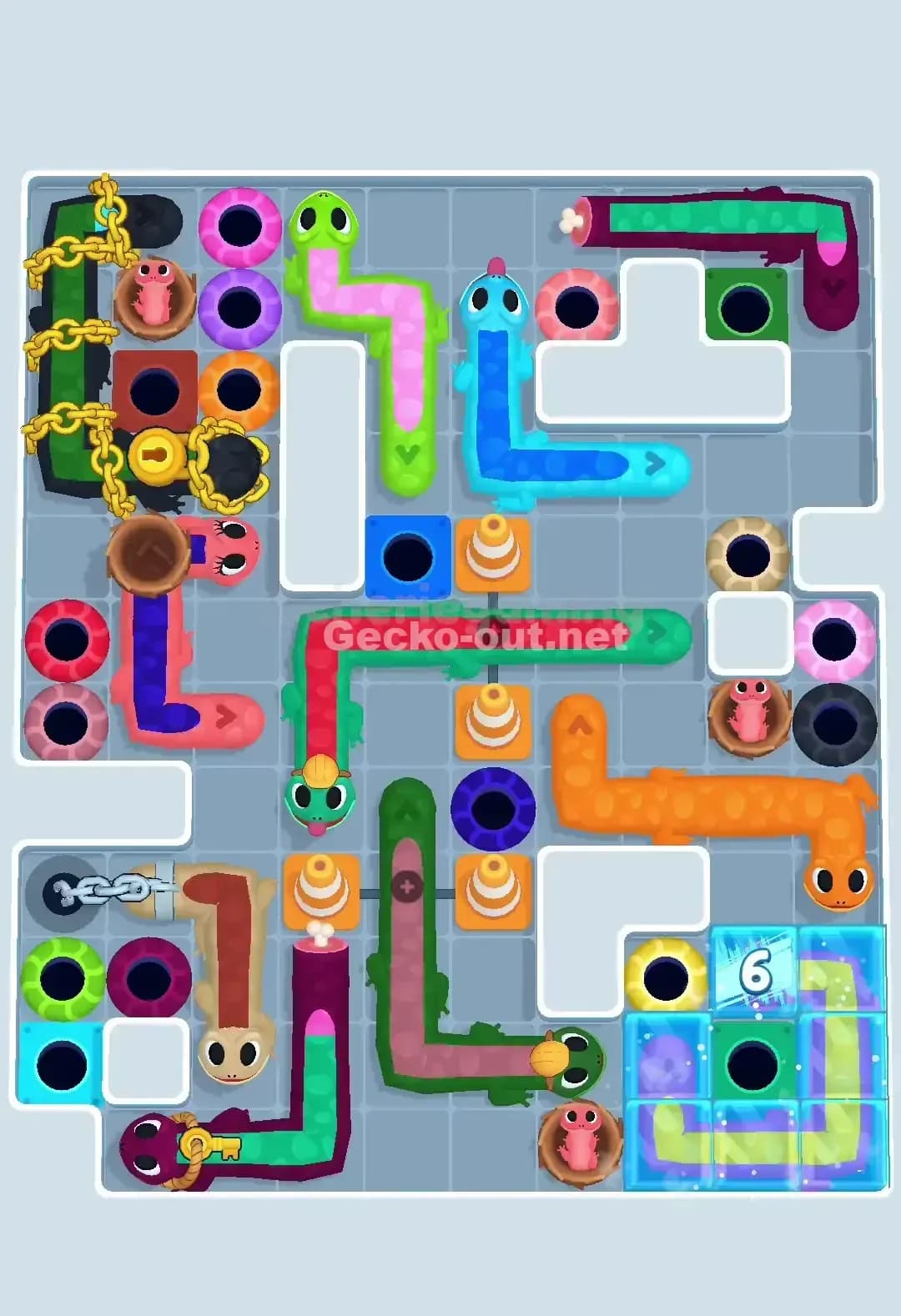
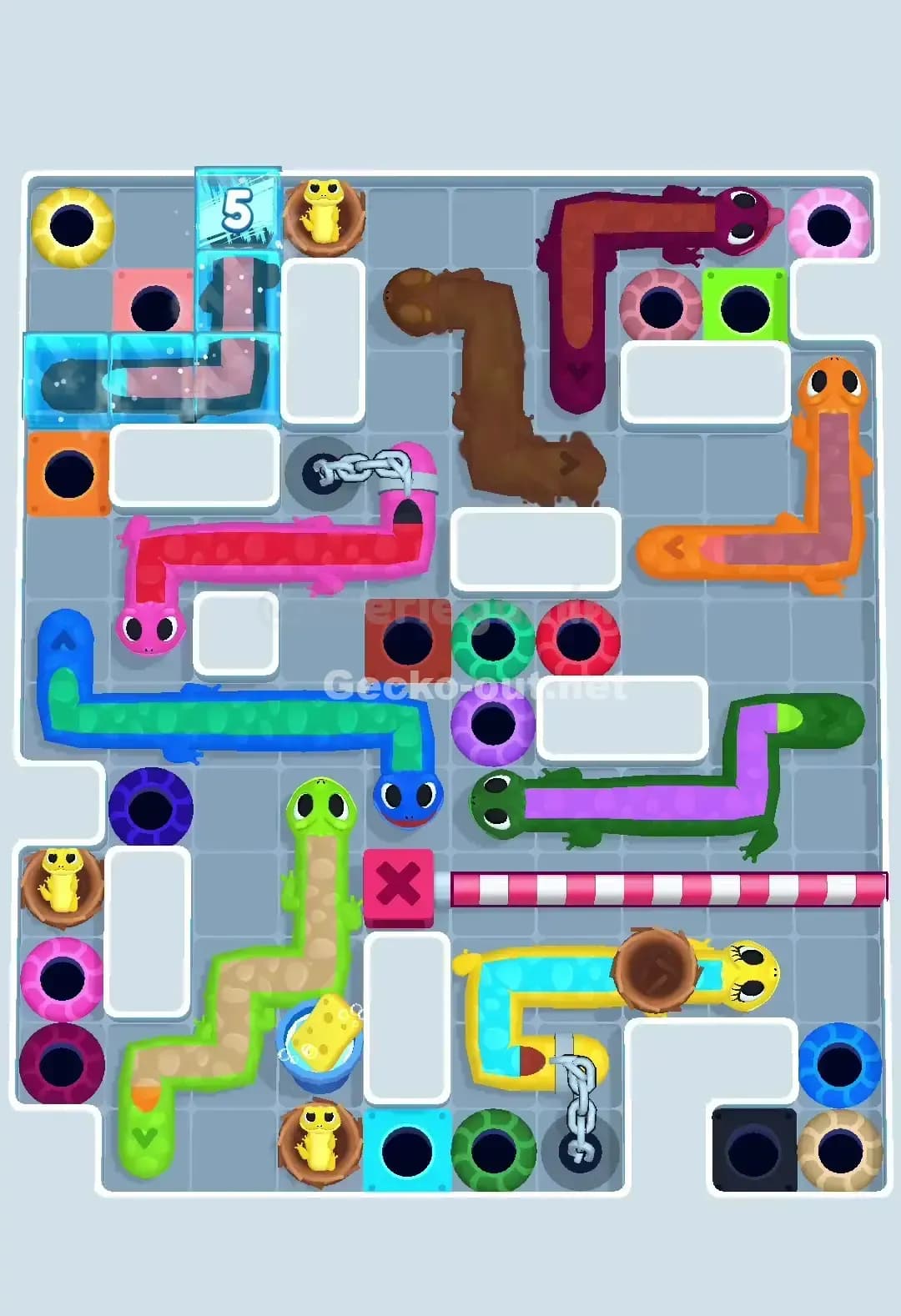
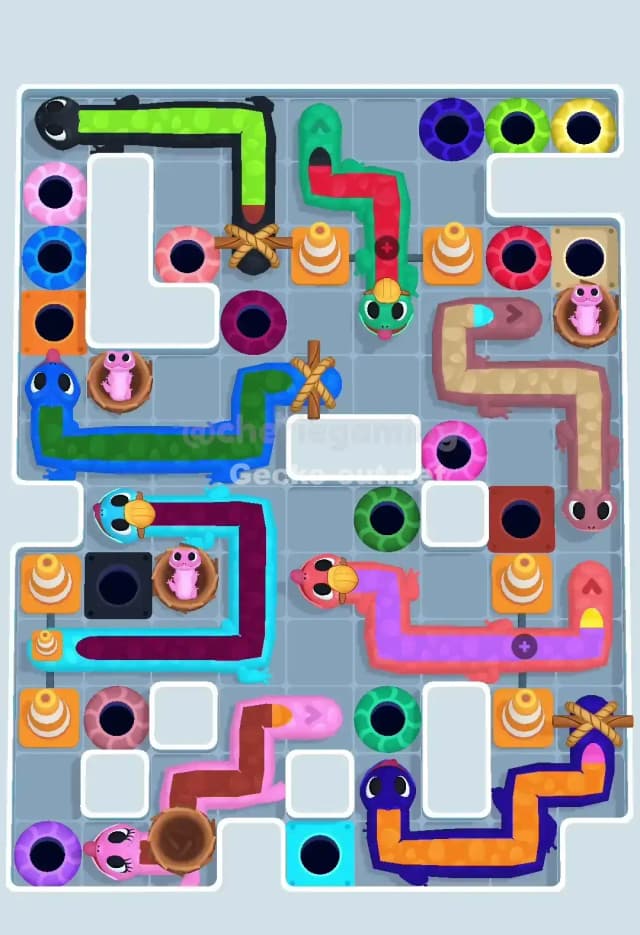
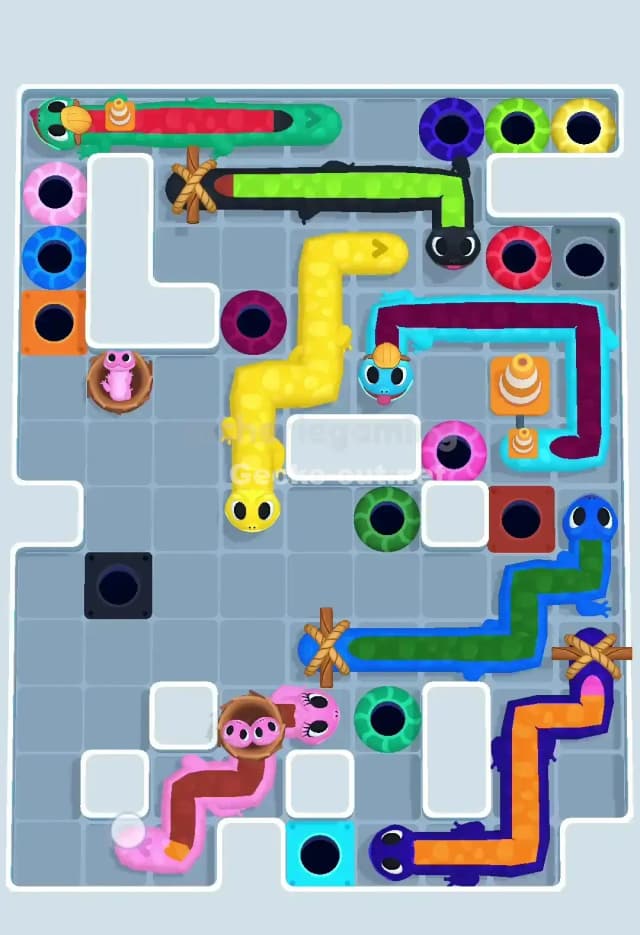
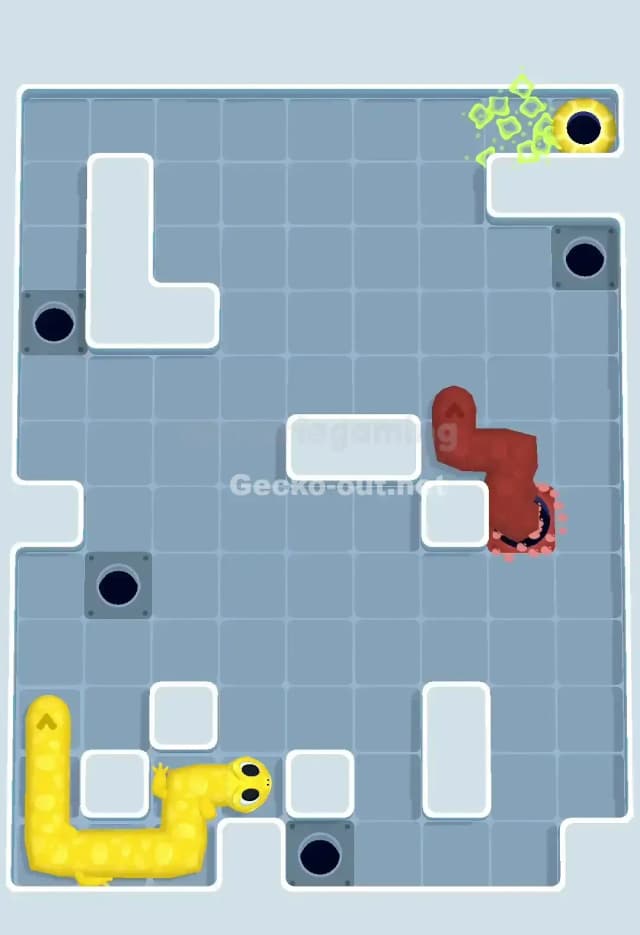
Gecko Out Level 678 is a densely packed puzzle with nine geckos distributed across the board in multiple colors: pink, blue, orange, green, purple, red, yellow, cyan, and magenta. Each gecko is matched to a corresponding hole of the same color, and your job is to drag each gecko head carefully through the grid to guide its body to the exit. The starting positions are spread across all four quadrants, which immediately signals that this level will demand serious multitasking and tight spatial planning. You'll notice several geckos are already positioned in long chains or curves on the board itself—these aren't just decorative; they're gang geckos that move as one unit when you drag their heads, and they take up valuable real estate while you're trying to route everyone else.
The board is packed with white walls, toll gates (marked by golden circular barriers), and multiple choke points that funnel movement into narrow corridors. Some exits are frozen or locked temporarily, which means certain geckos can't leave until others have cleared the way. This isn't a level where you can rush; you need to understand which gecko blocks which path before you make your first move.
Win Condition and Timer Pressure
Your goal is straightforward: get all nine geckos into their matching-colored holes before the timer expires. The timer ticks down relentlessly, so every second counts. What makes Gecko Out Level 678 genuinely tough is the interaction between the timer and the drag-path mechanic. When you drag a gecko head, its body follows the exact route you trace—if you accidentally brush past a wall or another gecko, the whole path breaks and you waste precious seconds rerouting. The pressure isn't just about finding the exit; it's about executing flawlessly under time constraints while keeping the board from becoming a tangled, unsolvable knot.
Pathing Bottlenecks and Logical Traps in Gecko Out Level 678
The Central Corridor Bottleneck
The biggest traffic jam in Gecko Out Level 678 is the central corridor running horizontally through the middle of the board. This narrow passage is the only efficient route for multiple geckos to reach their exits on the right side, and if you send two long-bodied geckos through it without proper sequencing, you'll create a deadlock where neither can move forward or backward. The cyan gecko and the purple gecko both need to traverse this corridor, and they're long enough that they can't pass each other. You absolutely must exit one completely before committing the other to this path, or you'll find yourself stuck with seconds remaining and no way forward.
Subtle Problem Spots
The first trap is the green gecko's initial position at the top-center of the board. It's tempting to route it directly downward toward what looks like an obvious exit, but that path crosses directly through the flow of the blue gecko's exit route. If you're not careful, the green gecko's body will block the blue gecko's head from reaching its hole, and you'll need to restart the entire sequence. The second problem spot involves the orange and yellow geckos on the upper right; they're positioned so close together that dragging one without carefully clearing space for the other results in immediate collision. Third, watch out for the toll gates—they're not walls, but they're visually deceiving, and it's easy to think a path is blocked when it actually leads through a toll gate that you can pass.
The Moment It Clicked
I'll be honest: my first two attempts at Gecko Out Level 678 were frustrating disasters. I was dragging geckos willy-nilly, trying to get as many out as possible before the timer ran down, and every time I'd get five or six out, I'd hit a jam with the remaining geckos and watch the timer drain away. The breakthrough came when I stopped playing reactively and started mapping out the board mentally. Once I realized that the central corridor was the lynchpin and that I had to empty it completely before using it for the next gecko, everything fell into place. Gecko Out Level 678 transformed from chaotic to methodical, and suddenly I could see the winning sequence.
Turn-by-Turn Path Strategy to Beat Gecko Out Level 678
Opening: Clear the Long Geckos First
Start with the black gecko at the top-left corner. It's a long chain, and it's in the way of almost everything else on the upper half of the board. Drag its head directly downward and then curve it to the left toward the black hole on the far left side. This clears a major artery and gives you breathing room. Next, tackle the blue gecko at the left side. It's positioned vertically and needs to travel rightward across the board. Drag its head carefully through the central corridor and around the white wall obstacles until it reaches the blue hole on the upper right. Don't rush this—every pixel of precision saves you from restarting. Once these two are out, the board suddenly feels less claustrophobic.
Mid-Game: Keeping Critical Lanes Open
Now that you've opened up space, address the cyan gecko and magenta gecko on the lower half. These are both long, and they both want to use the central corridor. Drag the cyan gecko first through a path that hugs the bottom edge of the board, routing it down and around to reach the cyan hole at the bottom-left. This keeps the central corridor clear for the magenta gecko's approach. The magenta gecko should come next—trace its head carefully through the central passage and guide it to the magenta hole at the bottom-right. You're now halfway home, and you've still got time on the clock.
At this point, address the green gecko with extreme care. Route its head downward from the top-center position, but angle it to the right side of the board to avoid crossing the blue gecko's path. The green gecko needs to curve around several white walls, so take your time and trace a wide, arcing path rather than trying to cut corners. Once green is out, move on to the purple gecko. It's in the middle area and needs to curve around obstacles to reach the purple hole. The tricky part is that its initial path shares space with where you've just moved other geckos, so you need to route it through a gap between the white walls that doesn't re-cross any completed paths.
End-Game: The Final Three and Avoiding Last-Second Crashes
With six geckos down, you've got the red gecko, yellow gecko, and pink gecko left. These are positioned around the edges and don't have as many interdependencies, but you're running low on time. Exit the red gecko next—it's on the right side and has a relatively clear path to the red hole, so drag its head straight and confidently without second-guessing. The yellow gecko is next; route it upward from the upper-right area and guide it to the yellow hole at the top-right corner. Finally, drag the pink gecko leftward from the right side to the pink hole on the left. If you're running very low on time (less than ten seconds), commit to straight-line paths even if they're not perfect—a slightly inefficient but completed path beats a restart. If you've still got thirty seconds or more, take one extra moment to trace each path cleanly and avoid any last-second collisions.
Why This Path Order Works in Gecko Out Level 678
Head-Drag Pathing and Body-Follow Logic
The reason this sequence works is rooted in how the drag-path mechanic functions in Gecko Out Level 678. When you drag a gecko's head, the body doesn't teleport; it follows that exact path, occupying every grid cell you traced. This means that once a gecko is out, it's no longer taking up space on the board, and you've freed up those cells for the remaining geckos. By prioritizing the longest, most spatially demanding geckos first (black and blue), you remove the biggest obstacles early. The mid-game geckos (cyan, magenta, green, purple) are then able to navigate more freely because the board is less crowded. The end-game geckos (red, yellow, pink) are naturally shorter or positioned at the board's edges, so they slide out with minimal fuss once the central congestion is cleared.
Timing Your Moves: Pausing vs. Committing
Gecko Out Level 678 rewards deliberate thinking over panic clicking. In the opening and early mid-game, take one or two seconds to trace your finger or cursor along the path you're about to drag before you commit. This mental dry-run catches potential collisions before they happen. If you spot a problem, pause the timer (many versions of Gecko Out allow this), reassess the board, and identify an alternative route. However, once you're in the final third of the level and you've got fewer than three geckos remaining, stop pausing and commit to moves decisively. Hesitation at that stage burns time without adding clarity, because the board is now so open that there's usually only one or two viable paths anyway.
Booster Strategy for Gecko Out Level 678
Boosters like the Time Extender or Hint Tool are optional on Gecko Out Level 678 if you follow this strategy. The Time Extender is tempting, but it's unnecessary if you execute cleanly—you'll have time to spare. The Hint Tool can be useful if you get stuck mid-game and genuinely can't see a path forward, but it's not required. The Hammer Tool (used to remove obstacles) might help in some variations of Gecko Out Level 678, but the standard version doesn't need it. Save your boosters for harder levels; this one is absolutely beatable with the right order and clean execution.
Mistakes, Fixes, and Logic You Can Reuse in Other Gecko Out Levels
Common Pitfalls and Solutions
Mistake 1: Dragging the green gecko straight down without deflecting around the blue gecko's path. This creates an immediate collision and forces a restart. Fix: Always scan for body-to-body overlaps before dragging. Mentally trace the path of the gecko you're about to move against the positions of geckos still on the board.
Mistake 2: Trying to send both the cyan and magenta geckos through the central corridor in quick succession without fully clearing the first gecko. They'll collide mid-path, and you'll burn ten seconds undoing the mess. Fix: Only drag the next gecko once the previous gecko's tail has fully exited the hole. Watch for the "pop" effect that indicates a gecko is completely gone.
Mistake 3: Overthinking the toll gates and treating them as walls. Gecko Out Level 678 includes several toll gates that don't actually block movement—they're just visual markers. Avoid them if you can, but don't assume they're impassable. Fix: Experiment in early practice attempts to learn which elements are hard walls and which are cosmetic. Treat golden circular markers as passable unless the level explicitly warns otherwise.
Mistake 4: Dragging the red gecko before clearing the magenta gecko from its immediate area. They're positioned close together on the right side, and an early drag of red gets tangled with magenta's body still on the board. Fix: Stick to the exit order suggested above. The order isn't arbitrary; it's designed so that each exit is completely clear before the next gecko enters that zone.
Mistake 5: Running out of time in the final seconds because you've been dragging every gecko with exaggerated curves and long detours. Sometimes the most direct path, even if it grazes near a wall, is better than a safe, winding path when the timer is critical. Fix: Develop a feel for how much detour is actually necessary versus how much is just overcautious. In Gecko Out Level 678, the second-to-last gecko should always be exited cleanly with at least fifteen seconds remaining.
Reusing This Logic for Similar Levels
Gecko Out Level 678's lesson applies directly to any level featuring multiple gang geckos, tight corridors, or shared bottlenecks. The core principle is: identify the most spatially demanding gecko, exit it first, then work downward to the smallest geckos. This inverse-size-order approach prevents deadlocks and keeps the board progressively simpler as time pressure increases. If you encounter frozen exits or locked geckos in other Gecko Out levels, adapt this strategy by noting which exit is locked and planning other geckos' routes to avoid standing on that exit cell. The patience-before-execution mindset—pause, scan, trace, commit—is universally applicable. Gecko Out Level 678 isn't unique in difficulty; it's unique in teaching you to think like an organizer before you act like a player.
Final Encouragement
Gecko Out Level 678 is tough, but it's absolutely not impossible. The first time you beat it, you'll realize that the difficulty came mostly from not knowing the sequence, not from the puzzle being fundamentally broken. Every gecko has a path. Every path is clear once you remove the right obstacles in the right order. You've got this. Trust the strategy, execute with precision, and Gecko Out Level 678 will fall.