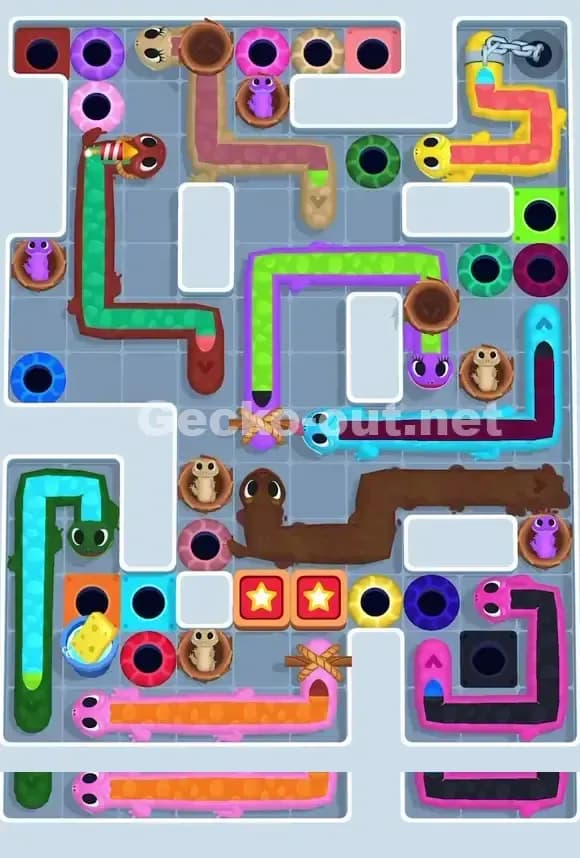
Gecko Out Level 707 Solution Walkthrough | Gecko Out 707 Answer
How to solve Gecko Out level 707? Get step by step solution & cheat for Gecko Out level 707. Solve Gecko Out 707 easily with the answers & video walkthrough.


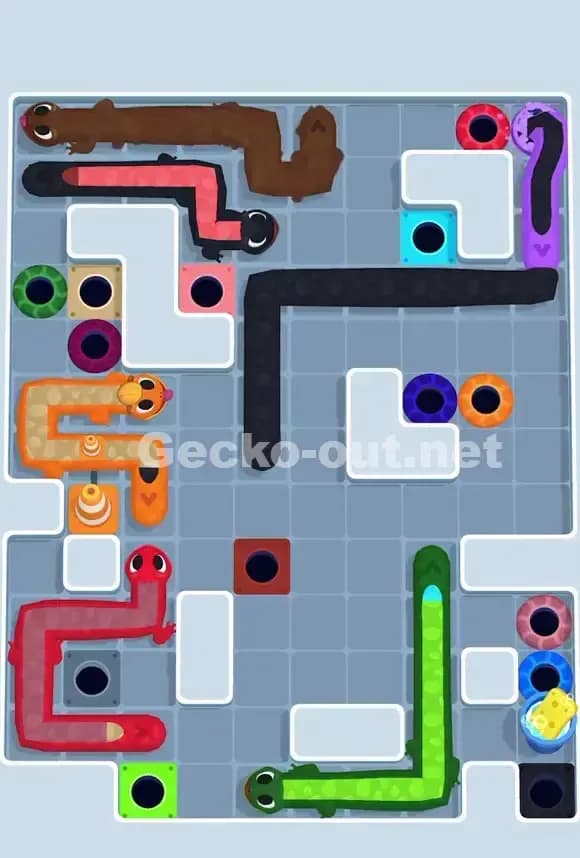

Gecko Out Level 707: Board Layout, Rules, and Win Condition
Starting Board: Geckos, Colors, and Layout
Gecko Out Level 707 is a dense, multi-colored puzzle with nine geckos scattered across a moderately complex grid. You're working with brown, orange, pink, cyan, purple, yellow, green, red, and blue geckos—each one needs to reach its matching colored hole to escape. The board is crammed with white walls that create a labyrinth-like structure, and several geckos are already positioned in tight corners or wrapped around obstacles. What makes Gecko Out 707 particularly tricky is that multiple geckos are chained together as "gangs," meaning they move as a single unit when you drag one head. This interconnection creates cascading bottlenecks: moving one gecko can block or unblock paths for several others simultaneously.
The layout features walls forming a winding corridor system that forces you to be strategic about pathing. Some geckos are already long and sprawling across the board, while others are coiled up in corners. The holes themselves are positioned at various edges and pockets, some easily accessible and others tucked behind walls that require precise navigation to reach.
Win Condition and Timer Pressure
Your goal in Gecko Out Level 707 is straightforward: guide all nine geckos to their matching colored holes before the timer runs out. The timer is generous enough that you're not racing against the clock if you plan ahead, but it does punish hesitation and trial-and-error. When you drag a gecko's head, its body follows the exact path you trace—every corner, every detour, every backward step gets "recorded" into the body's movement. This means drawing inefficient paths not only wastes time but also eats up precious grid space that other geckos might need. If even one gecko is still on the board when the timer hits zero, you fail the entire level. The combination of gang geckos, tight corridors, and the path-following mechanic makes Gecko Out 707 a lesson in planning and sequencing.
Pathing Bottlenecks and Logical Traps in Gecko Out Level 707
The Central Corridor Knot
The biggest bottleneck in Gecko Out Level 707 is the central vertical corridor that nearly every gecko needs to pass through or around. Multiple geckos converge on this space, and if you're not careful about which gecko you move first, you'll create a traffic jam where longer geckos block shorter ones from escaping. The brown gang gecko at the top of the board is particularly problematic because it's long and horizontally oriented; if you move it too early without a clear exit path, its body will snake across the middle of the board and block access to several holes. This is the single greatest source of failure on Gecko Out 707.
Subtle Traps: Frozen Exits and Wall Reversals
Beyond the central corridor, there are two or three sneaky traps that catch most players on their first attempt. The first is underestimating how much space a gecko's body occupies as it follows your drag path. If you draw a path that seems to fit but includes too many sharp turns or backtracks, the body can collide with walls you didn't anticipate. The second trap is reversing direction mid-path: dragging a gecko head toward its hole, then pulling back to avoid a wall—this creates a bloated path that wastes space. The third trap is ignoring gang connections. If two geckos are linked and you drag one without accounting for the other's position, you'll create a pretzel that jams the board.
Personal Reaction and Breakthrough Moment
Honestly, Gecko Out Level 707 frustrated me on the first two attempts. I kept trying to move the longest geckos first, thinking I'd "clear space," but all I did was create immovable walls of body that locked everyone else in place. The moment everything clicked was when I realized I should move the shortest, most strategically positioned geckos first, creating pathways for the big gang geckos to follow. That mental flip—prioritizing by position rather than size—turned the level from chaotic to solvable.
Turn-by-Turn Path Strategy to Beat Gecko Out Level 707
Opening: Secure the Short Geckos and Side Passages
Start Gecko Out Level 707 by moving the shortest, unlinked geckos to their holes first. The yellow, cyan, and green geckos in the upper-right and left corners are your opening targets. These moves accomplish two things: they free up valuable grid space and they don't risk tangling with gang geckos. Once you've cleared one or two short geckos, the board becomes visibly less crowded, and you can see your next moves more clearly. Park any gecko that isn't an immediate threat in a safe corner or a dead-end side passage where it won't block the main corridors. Think of these early moves as "clearing the audience" so the main performers (the gang geckos) have room to move.
Mid-Game: Unthreading the Gangs with Deliberate Sequencing
Once you've cleared the clutter, identify which gang gecko is blocking the most others. In Gecko Out 707, this is typically the brown or orange gang at the top or left edge. Before you move it, map out its entire exit path on the board mentally. Where will the head go? Where will the body curve? Does it pass through the central corridor? If yes, can you do it in one efficient move without backtracking, or will you need to "pre-position" other geckos out of the way first? The key here is committing to a drag path that's as direct as possible. Each unnecessary turn or reversal eats up space and time. If a gang gecko needs the central corridor, move it quickly and decisively; hesitation or course-correction mid-drag will create awkward body coils.
End-Game: Reverse-Order Exiting and Timer Management
By the time you're down to the last three or four geckos on Gecko Out Level 707, the board should be much clearer. Your final moves are usually the trickiest because you're working with whatever layout remains. If one of your last geckos is a long gang gecko, prioritize it before the shorter ones; this prevents it from getting wedged as the space tightens. For the final gecko or two, move swiftly once you've identified the path. If you're running low on time (under 20 seconds remaining), you might use a time booster here, but only if you're genuinely stuck, not panicking. Usually, Gecko Out Level 707 leaves you with enough time if you've sequenced well. Exit the last gecko with a clear, unobstructed drag to its hole.
Why This Path Order Works in Gecko Out Level 707
Body-Follow Logic and Untangling the Knot
The reason this strategy works is rooted in how Gecko Out Level 707's physics operate. When you drag a gecko head, the body doesn't teleport—it traces your exact path. This means a badly drawn path for one gecko can physically block the escape routes of all others. By removing the smallest, least-connected geckos first, you're literally erasing blockages. When you finally drag the long gang geckos, the board has "forgiven" space for them to move through. The gang geckos will still need careful pathing, but they'll have corridors to work with rather than a maze of interlocking bodies. It's the difference between solving a jigsaw puzzle by removing border pieces first versus randomly scattering them everywhere.
Timer Decisions: Pause vs. Commit
On Gecko Out Level 707, the timer strategy is simple: pause for the first 15–20 seconds of the level to map out which geckos are linked, which holes are closest, and what the major bottlenecks are. Once you've identified the opening move, commit to it without second-guessing. Don't pause and re-examine after every single drag; that wastes real time. Instead, move with confidence based on your initial plan. If you hit an unexpected jam at the mid-game point, pause again to recalibrate, but only then. This balance between planning and execution keeps you moving without wasting the timer.
Booster Strategy: Hammer or Time-Extension?
Gecko Out Level 707 almost never requires boosters if you follow this plan. However, if you do reach the final two geckos with fewer than 10 seconds on the clock and one gecko is genuinely blocked by another's body coil, the time-extension booster is your safety net. A hammer-style booster to break through walls isn't necessary here because there are no locked exits or ice-frozen holes to contend with—all exits are freely accessible once paths are clear. Save your premium boosters for harder levels; Gecko Out 707 is designed to be solvable without them if you're methodical.
Mistakes, Fixes, and Logic You Can Reuse in Other Gecko Out Levels
Five Common Mistakes on Gecko Out Level 707
Mistake 1: Moving Long Geckos First. Long geckos sprawl across the board and create immovable walls. Fix: Always clear shorter geckos first.
Mistake 2: Dragging with Inefficient Paths. Taking a circuitous route to a hole "just to be safe" wastes grid space. Fix: Identify the shortest path and drag directly along it.
Mistake 3: Ignoring Gang Connections. You move one gecko without realizing it's linked to another, and suddenly both are stuck. Fix: Visually confirm which geckos are chained before your first move.
Mistake 4: Panicking and Reversing Mid-Drag. You start dragging toward a hole, spot a wall, and pull back. This creates a fat, inefficient coil. Fix: Commit to your path; if it's wrong, undo and restart cleanly rather than mid-dragging.
Mistake 5: Trying to "Park" Geckos in Active Corridors. You leave a gecko stopped in the middle of a lane thinking it's safe, but then another gecko's body path intersects it. Fix: Only park geckos in dead-end corners or passages that won't be needed for other exits.
Reusing This Strategy on Similar Levels
Gecko Out Level 707's lesson applies directly to any level with multiple gang geckos and central bottlenecks. Whenever you see a densely packed board, apply this sequence: clear short geckos first, identify the biggest gang blockage, map its exit path, then execute one smooth drag. For frozen-exit levels (where some holes are temporarily locked), add one extra step: undo those exits mentally from your plan until the timer or a tool unfreezes them. For levels with warning holes (fake exits), use the same philosophy but verify hole colors even more carefully. The core principle—small before large, direct before circular, gangs last—transfers perfectly.
Final Encouragement
Gecko Out Level 707 is genuinely tough on first encounter, but it's absolutely beatable with a clear plan and methodical execution. The moment you stop trying to "optimize on the fly" and start planning the sequence upfront, the level shifts from impossible to doable. You've got this. Take a breath, map the board, and move those geckos with confidence.