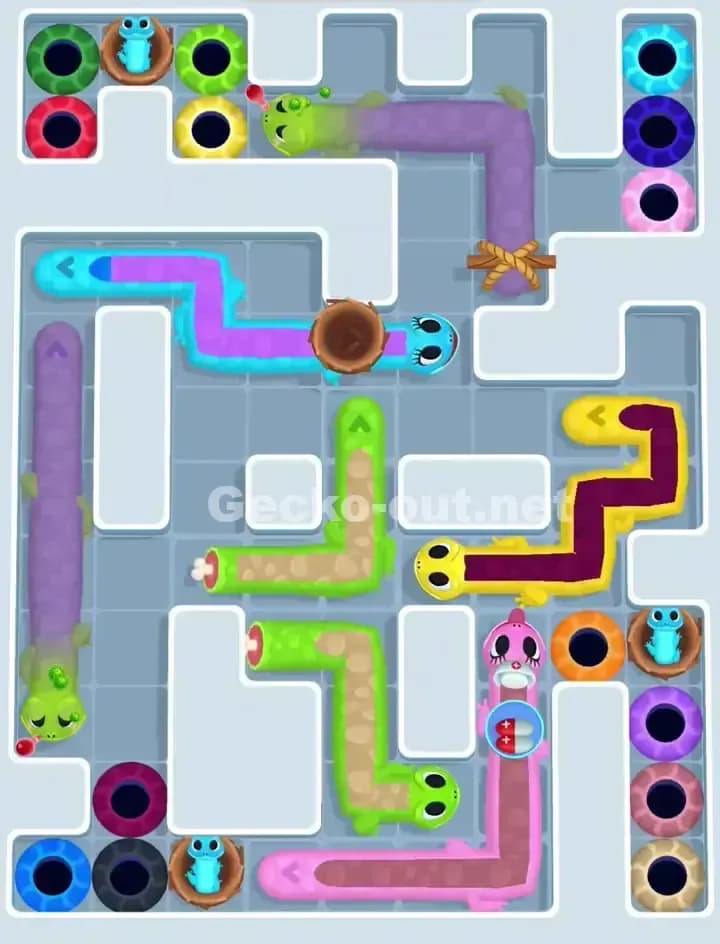
Gecko Out Level 1116 Solution Walkthrough | Gecko Out 1116 Answer
How to solve Gecko Out level 1116? Get step by step solution & cheat for Gecko Out level 1116. Solve Gecko Out 1116 easily with the answers & video walkthrough.
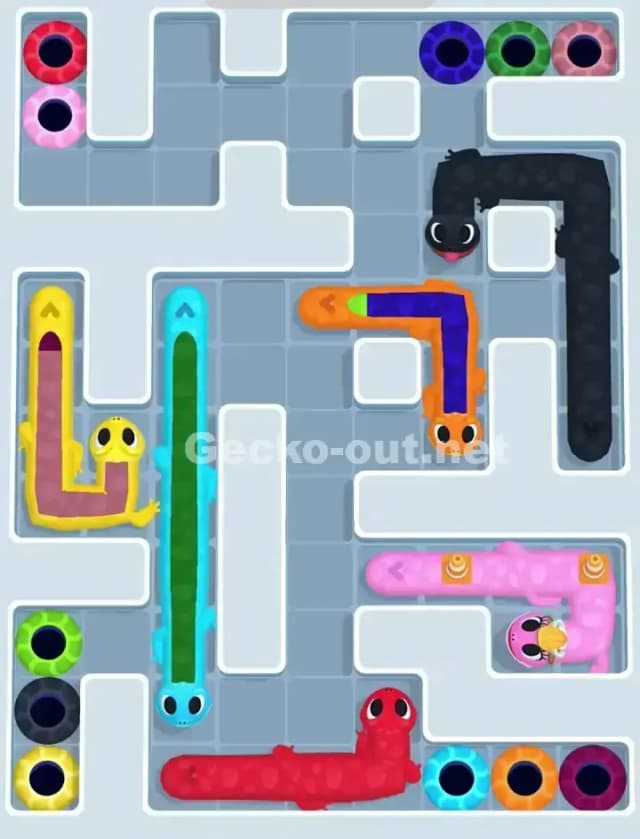

Gecko Out Level 1116: Board Layout, Rules, and Win Condition
The Starting Board and Gecko Lineup
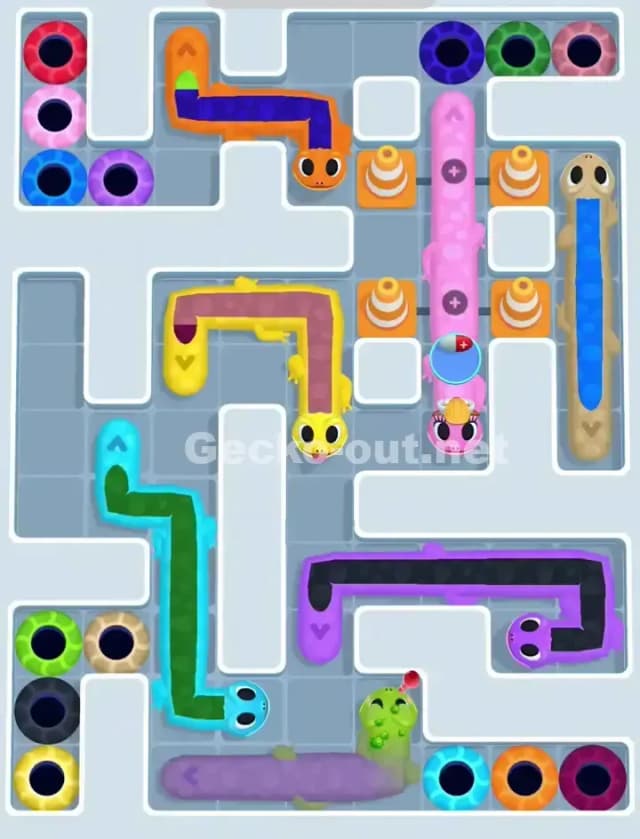
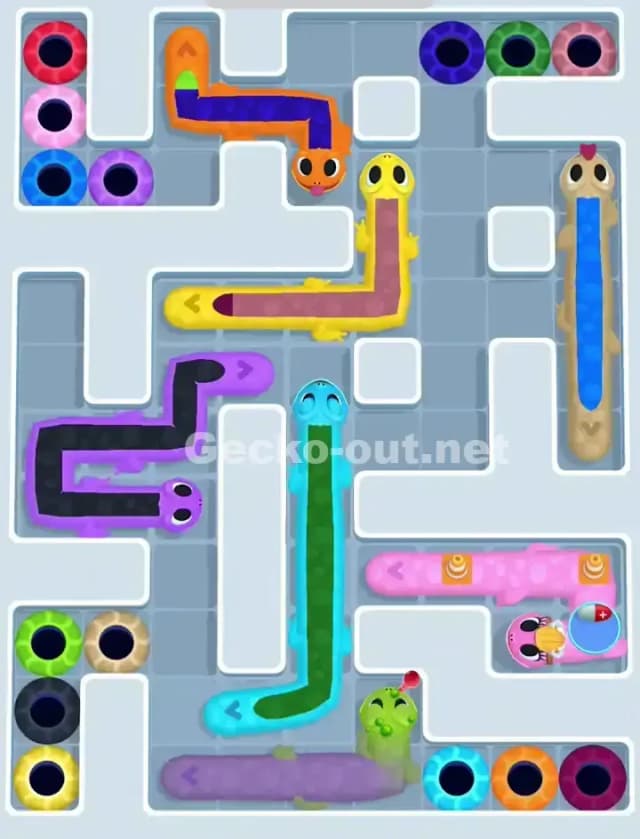
Gecko Out Level 1116 is a densely packed puzzle with seven geckos spread across the board, each desperate to reach their matching-colored escape hole. You'll find a red gecko paired with a pink gecko on the left side, a blue gecko, a purple gecko, an orange gecko (actually a gang of three linked orange geckos that move as one unit), a yellow gecko, a cyan gecko, a green gecko, and a magenta gecko positioned near the lower-right exit. The board layout is a maze of white walls creating narrow corridors, toll gates marked with circular plus-sign symbols, and a somewhat intimidating network of choke points that'll test your planning skills. The three orange geckos are linked together—they're a "gang"—meaning when you drag one head, all three bodies follow in lockstep, which makes them incredibly bulky and prone to jamming tighter corridors.
Win Condition and Timer Pressure
You win Gecko Out Level 1116 when all seven geckos reach their escape holes before the timer runs out. The timer pressure isn't just background flavor—it's a genuine threat. You can't afford to waste moves redoing paths or getting geckos stuck in dead ends. The strict time limit means you need to plan your moves carefully before you commit, because backtracking costs precious seconds. Every drag counts, and any collision or misstep ripples through the remaining geckos, potentially forcing you to restart. This is why understanding the path-following mechanic matters so much: when you drag a gecko's head, its body traces that exact path behind it, and if that path crosses an occupied tile or a wall, the drag fails and wastes time.
Pathing Bottlenecks and Logical Traps in Gecko Out Level 1116
The Orange Gang Choke Point
The single biggest bottleneck in Gecko Out Level 1116 is the linked orange gecko gang occupying the center-upper area of the board. Because these three geckos move as one unit and their bodies are long, they occupy an enormous footprint. There's a narrow corridor they need to navigate to reach their exit holes on the right side, and that corridor simply doesn't have room for them to move freely if other geckos are already occupying adjacent spaces. If you don't move the orange gang first or park other geckos safely out of the way, you'll find yourself unable to route the orange trio anywhere without causing a cascade of collisions. This bottleneck effectively gates your progress—nothing else can exit comfortably until the orange gang is either completely clear or positioned in a way that doesn't block the center lanes.
The Pink Gecko's Vertical Squeeze
The pink gecko on the right side sits in a tight vertical corridor that's really only wide enough for one gecko at a time. If you're not careful about the sequence, you might route a different gecko through that same vertical space, and then pink gets stuck waiting for a path that no longer exists. What makes this sneaky is that the pink exit isn't far away, but the route to it is so constrained that one misjudgment blocks it entirely. You need to mentally reserve that vertical lane for pink early on, or find an alternative route for her that doesn't compete for that same space.
The Cyan-and-Green Lower Corridor Tangle
On the lower half of Gecko Out Level 1116, the cyan gecko and green gecko are positioned close to each other, and both need to snake through a winding path to reach their escape holes at the bottom. The problem? Their natural routes overlap significantly. If you move green first and it takes up the main corridor, cyan ends up with nowhere to go but a long, inefficient detour. Conversely, if cyan goes first, green has to take the scenic route around it. The trap here is assuming there's a "one true path" when actually you need to choreograph their movements so they don't deadlock each other mid-route.
The Moment the Solution Clicked
I'll be honest—my first two attempts at Gecko Out Level 1116 felt chaotic. I was dragging geckos willy-nilly, and by the halfway mark, I had three geckos stuck in a tangle with no clear exit path, and the timer was already low. But then I stepped back and realized: I needed to think backwards from the exits. I identified which gecko absolutely had to go last (usually the one with the fewest routing options), then worked out the reverse sequence. Once I mapped out that the orange gang needed to move first to clear the center, and that I could use the yellow and cyan geckos as "spacers" to create temporary safe zones, the whole puzzle suddenly made sense. It shifted from feeling impossible to feeling like a logical, step-by-step dance.
Turn-by-Turn Path Strategy to Beat Gecko Out Level 1116
Opening: Clear the Orange Gang First
Start by routing the orange gecko gang straight to their exit holes. This is counterintuitive—you might think "big obstacle last"—but actually, the orange gang is so large that it blocks almost everything else. By moving it first, you're essentially opening up the entire center board for everyone else. Drag the gang's head smoothly along the available path toward their exit, making sure no other gecko is in the way. Once they're out, you've reclaimed huge swaths of space and made the rest of Gecko Out Level 1116 significantly more navigable. Park the other geckos mentally in "safe zones" that don't interfere: put the red gecko on the far left, the blue gecko in its waiting area, and so on. Think of it as clearing the table before you set it.
Mid-Game: Orchestrate the Pink and Vertical Corridor Exit
Once the orange gang is safely away, focus on moving the pink gecko while that vertical right-side corridor is still clear and unobstructed. Pink's escape route is short but exclusive—no other gecko should be using it. By routing pink early in this phase, you guarantee she gets out without competition. Then, you can confidently use that freed-up corridor for the blue gecko if needed, or leave it as a buffer. The key mid-game move is keeping long geckos (like cyan and green) away from short, narrow corridors. Instead, use the longer, winding paths for them so they don't fight for space with shorter geckos that could zip through tighter gaps.
End-Game: Exit Order and Last-Minute Rush
For the final stretch of Gecko Out Level 1116, prioritize the yellow gecko and cyan gecko, as they have slightly more flexible routes and can exit quickly without jamming others. The magenta and green geckos can follow. If you're running low on time, commit to moving rather than overthinking—a slightly suboptimal but executed path beats a perfect path you never drew because you ran out of time. Avoid the trap of trying to optimize every single movement in the final seconds; instead, focus on getting geckos out rather than getting them out perfectly. The last gecko, if it's green or magenta, should have a clear shot to its exit hole with no competition.
Why This Path Order Works in Gecko Out Level 1116
Head-Drag Pathfinding Prevents Body Collisions
The core logic of Gecko Out Level 1116 relies on the fact that you drag the gecko's head and the body follows that exact path. By moving the orange gang first, you're not tightening a knot—you're actually unraveling the board's initial tangle. The body-follow rule means every gecko has a "memory" of its path: if you drag red's head in a certain direction, red's body will trace that line, and no other gecko can occupy that line once red is traveling it. By strategically moving the bulkiest gecko first, you're essentially marking out large areas as "used" early, which paradoxically frees up the remaining space for everyone else. It's counterintuitive, but it works because you're preventing future collisions rather than causing them.
Timer Management: When to Pause vs. Commit
The timer in Gecko Out Level 1116 is aggressive enough that you can't stare at the board forever, but it's also not so fast that you need to rush blindly. The sweet spot is spending your first 15–20 seconds doing a full visual scan: identify the orange gang bottleneck, note the pink vertical corridor, spot the cyan-green overlap zone. Then spend another 10 seconds mentally walking through your move sequence. Once you start dragging, commit confidently—hesitation and second-guessing burn time faster than a slightly suboptimal move. If you mess up mid-drag (a gecko hits a wall and bounces back), accept it, learn from it, and move forward quickly rather than resetting and trying again from scratch.
Booster Strategy: Optional But Available
Gecko Out Level 1116 doesn't require boosters if you follow this path order, but an extra-time booster is helpful as a safety net if you're on your first or second attempt and want breathing room to learn the board. A hint booster can also speed up your initial analysis phase. However, the hammer or clearing tool isn't necessary here because there are no frozen exits or locked tiles blocking your path—you're working purely with space and timing. I'd recommend playing it through without boosters first to build your pattern-recognition skills; then, if you're still stuck after three attempts, drop a quick-time extension and try again with fresh confidence.
Mistakes, Fixes, and Logic You Can Reuse in Other Gecko Out Levels
Mistake 1: Moving the Longest Gecko Last
The Error: Many players leave the orange gang for the end, thinking "I'll handle the tricky bit after the easy exits are done."
The Fix: Move the longest gecko first so it doesn't block anyone else's path in the endgame rush.
Reusable Logic: On any Gecko Out level with a gang or particularly long gecko, prioritize moving it early to open space, not late.
Mistake 2: Routing Multiple Geckos Through the Same Narrow Corridor
The Error: You drag cyan and green through the same vertical choke point back-to-back, not realizing one gecko's body occupies that space while the other is traveling.
The Fix: Map out two separate routes—one high, one low—so they don't compete.
Reusable Logic: Always identify corridors that are one-gecko-wide and reserve them for the gecko that has no other option, or choreograph the order so one exits completely before the other enters.
Mistake 3: Ignoring Toll Gates and Plus-Symbol Obstacles
The Error: You assume all paths are open and drag a gecko head toward an exit without checking if there's a toll gate in the way.
The Fix: Do a quick visual scan of your intended route before dragging; confirm every segment is actually passable.
Reusable Logic: Treat obstacles as path-changers, not path-blockers—they force you to take longer routes, but those routes are still valid if you plan ahead.
Mistake 4: Panicking and Resetting When a Gecko Gets Stuck
The Error: One gecko hits a wall or collision, and you panic, close the level, and start over, wasting your timer.
The Fix: If a drag fails, immediately move a different gecko to create space, then retry.
Reusable Logic: Deadlock is rarely permanent in Gecko Out levels—shuffle other geckos to create openings rather than giving up.
Mistake 5: Trying to Make Every Path Perfect
The Error: You spend 30 seconds drawing a mathematically optimal route for one gecko, and by the time it's done, you've burned half your timer.
The Fix: Draw a functional path quickly, execute it, and move to the next gecko.
Reusable Logic: On any timed puzzle, "good enough and done" beats "perfect and impossible."
How to Reuse This Strategy on Similar Levels
If you encounter another Gecko Out level with a gang gecko or multiple long geckos competing for space, apply the same principle: move the largest obstruction first to maximize flexibility for everyone else. Similarly, on levels with frozen exits or locked tiles, use the same bottleneck-identification technique—find the single point through which multiple geckos must pass, and choreograph their order accordingly. The pattern recognition you build on Gecko Out Level 1116 transfers directly to gang-heavy or corridor-choked levels.
Final Encouragement
Gecko Out Level 1116 is definitely a tough one—don't feel bad if it takes a few attempts. The board is genuinely complex, with overlapping constraints and a real timer threat. But here's the thing: once you map out that orange gang bottleneck and the pink vertical corridor, the rest of the puzzle unlocks logically. You're not fighting randomness or impossible geometry; you're solving a choreography puzzle, and choreography always has a solution if you plan the sequence correctly. Stick with the opening move (orange gang first), keep the mid-game lanes clear, and commit to your final exits without overthinking. You've got this—Gecko Out Level 1116 is beatable with a clear head and a solid plan.