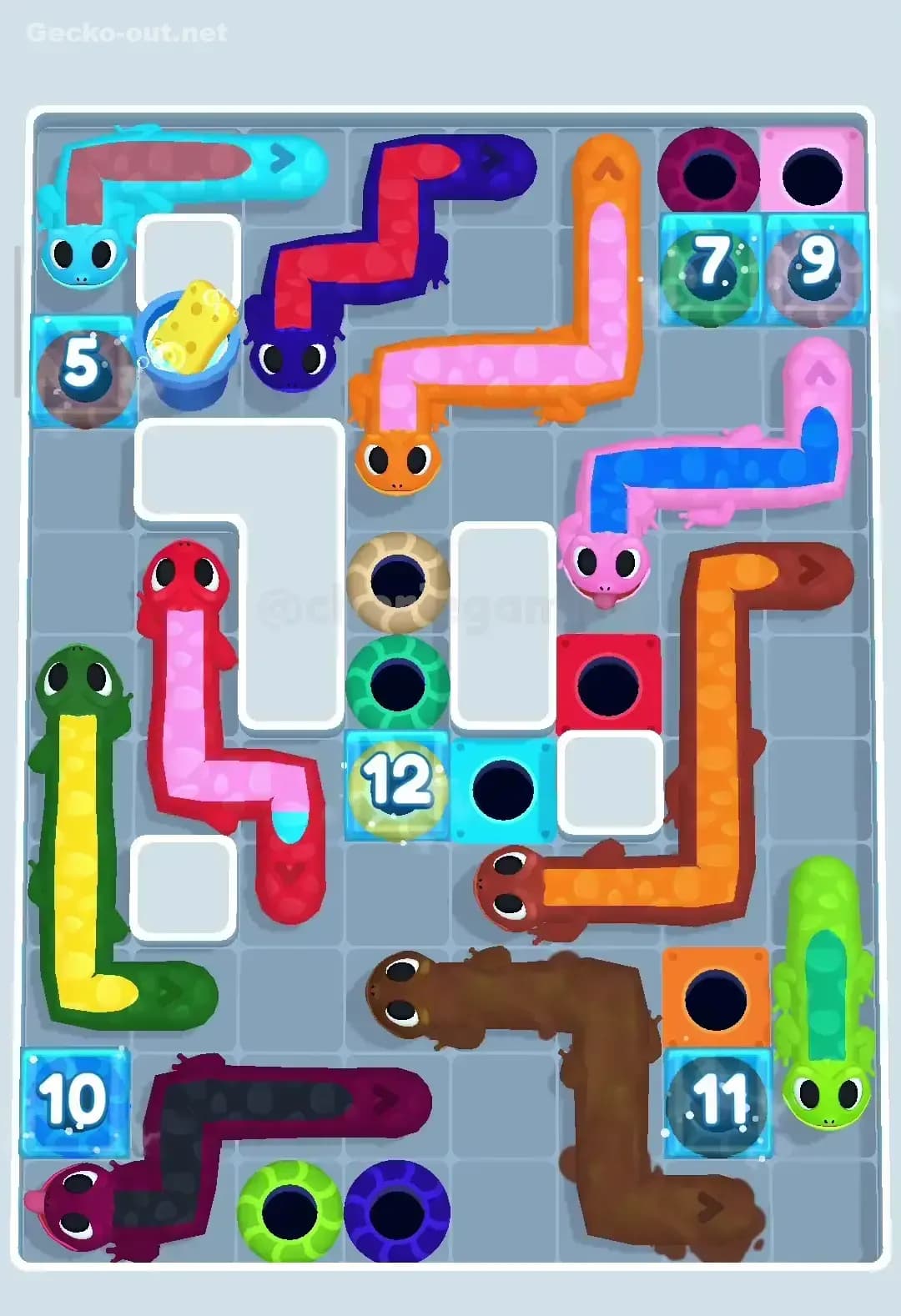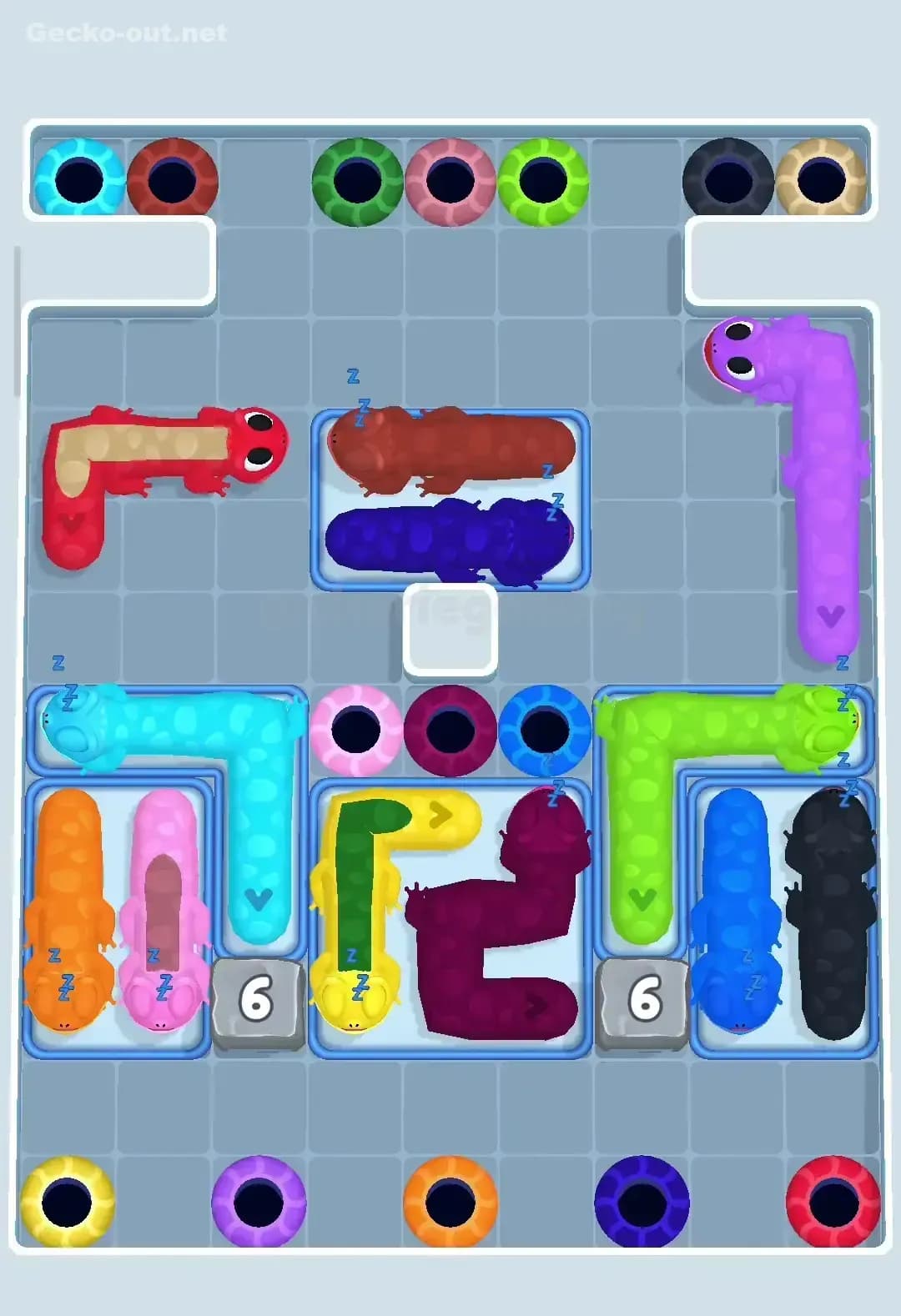
Gecko Out Level 280 Solution Walkthrough | Gecko Out 280 Answer
How to solve Gecko Out level 280? Get step by step solution & cheat for Gecko Out level 280. Solve Gecko Out 280 easily with the answers & video walkthrough.
Gecko Out Level 280: Board Layout, Rules, and Win Condition
Starting Board: Packed Ice Baths and Edge Exits
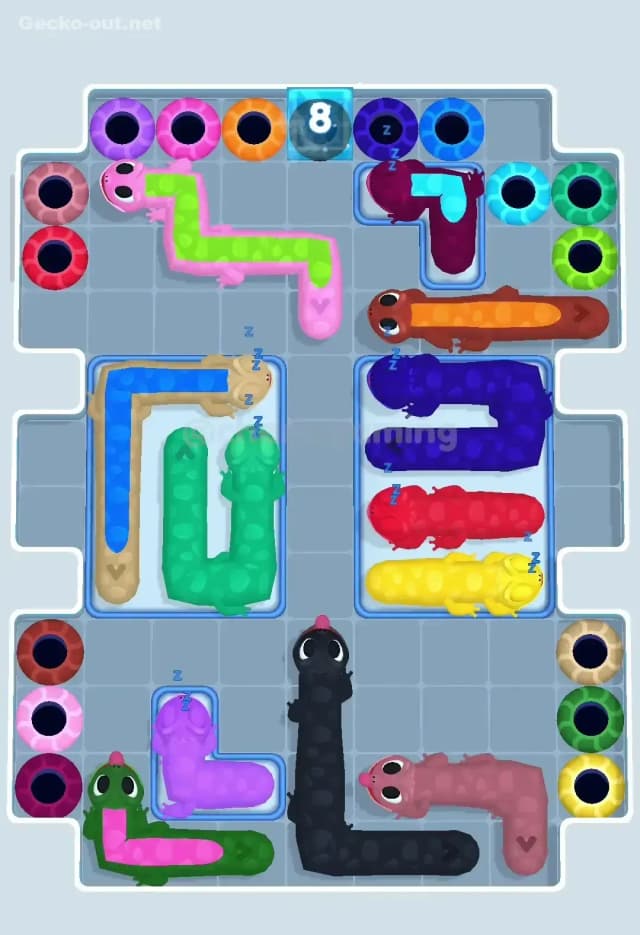
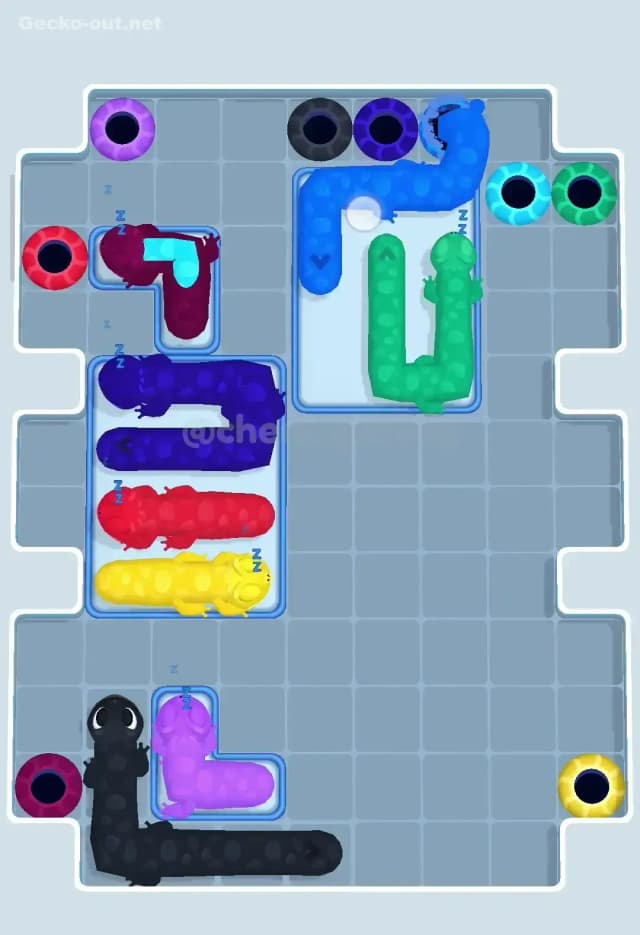
In Gecko Out Level 280 you start on a tall, narrow board that’s absolutely stuffed with geckos. You’ve got a mix of awake geckos on the outer lanes and big sleepy “gangs” lying together in icy trays in the middle. The left tray holds a long blue gecko wrapped around a tall green one. The right tray is even tighter: dark blue, red, and yellow geckos stacked like sardines.
Around the edges sit all the colored holes: pink, green, yellow, blue, red, orange, brown, and black exits. A few exits are “sleeping” (dark with a Z symbol), so those colors can’t escape until later. There’s also a frozen time tile with a big “8” near the top center; if you route any gecko through it, you get a big chunk of bonus time, which matters a lot in Gecko Out 280.
The bottom half of the board is where things really feel cramped. A tall black gecko stands in the central column and a chunky tan‑pink one curls beside it. On the bottom-left corner you’ve got a green gecko wrapped around a shorter pink one, plus a purple gecko sleeping in a tiny ice tray. Everything is already touching everything else, so any careless drag instantly creates a traffic jam.
Timer, Pathing, and the Real Win Condition
Like every stage, the official win condition in Gecko Out Level 280 is simple: get every gecko to the hole that matches its color before the timer hits zero. But the real challenge is how the timer and the “body-follows-head” rule interact. Every turn you’re not just moving a head: you’re drawing a path that the entire body commits to.
If you snake a long route through the middle, that body becomes a wall that other geckos must path around. With the strict timer in Gecko Out 280, you can’t afford to redraw lots of paths. You need short, decisive routes that either exit immediately or park a gecko somewhere that doesn’t choke the board. The level is won when you use those paths to unwrap the central ice trays without ever blocking your own exits.
Pathing Bottlenecks and Logical Traps in Gecko Out Level 280
The Central Black Gecko Corridor
The single biggest bottleneck in Gecko Out Level 280 is the vertical corridor controlled by the tall black gecko near the bottom center. That lane is basically the spine of the entire board: it connects the lower area to the right-side exits and gives you space to slide geckos out of the ice trays.
If you move the black gecko sideways too early, you block both the tan‑pink gecko and the route that the right-side gang (blue, red, yellow) needs later. I treat that black gecko like a removable wall: I keep it mostly vertical until I’m ready to send it straight to its black exit, and I never leave its body curled across the middle row.
Subtle Traps: Frozen Packs and Top-Row Exits
There are a few less obvious traps that make Gecko Out 280 nastier than it first looks:
- The left ice tray (blue + green) opens into a narrow gap. If you wake the wrong gecko first and curve it upward, you’ll seal off the entrance to the tray and have to redraw a ton of paths.
- The right tray’s triple stack is deceptive: the dark blue gecko wants the top-right exits, but the red and yellow ones need room to swing out under it. If you let blue curl horizontally across the middle, the others have no way past.
- At the top edge, multiple exits sit close together. It’s very easy to draw a cute zigzag path for the neon green‑pink gecko that accidentally covers the tile you want another gecko to use for a clean straight shot later.
These are the kind of mistakes that don’t fail you immediately; they waste time and force you into messy reroutes.
When the Level Suddenly Makes Sense
The first time I played Gecko Out Level 280, I tried to wake every sleeping gecko as soon as possible. It felt natural—more pieces on the board, more options, right? Instead I ended up with a dense ball of geckos in the middle and no room to turn anything.
The breakthrough came when I treated the ice trays as “late game” and focused on clearing the awake outer geckos first. Once I realized that the board opens from the edges inward, and that the black corridor is sacred space, the level went from chaotic to almost scripted. That “ohhh” moment is what this guide is aiming to give you up front.
Turn-by-Turn Path Strategy to Beat Gecko Out Level 280
Opening: Clear Outer Geckos and Grab the Time Boost
Your first moves in Gecko Out 280 should target the awake geckos that can exit with minimal shuffling:
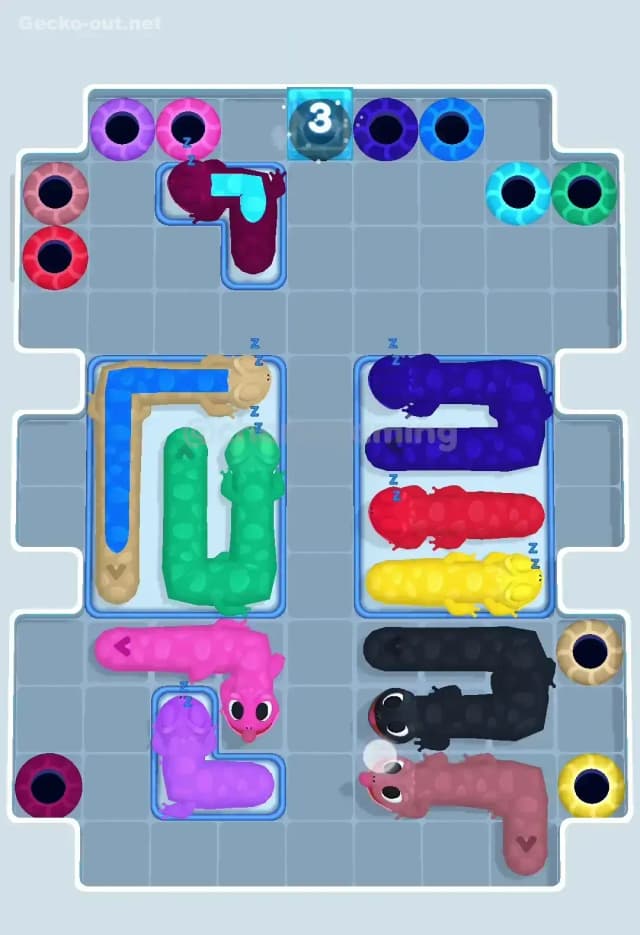
- Use the neon green‑pink gecko near the top-left. Drag its head in a short arc through the frozen “8” tile to add time, then curve directly into its matching pink exit. Keep the path tight to the wall so you don’t clutter the center.
- On the right side, the long orange gecko has a pretty clean route to its orange exit on the upper edge. Slide it straight along the outer row rather than dipping into the middle.
- At the bottom-left, free the small pink gecko first. Drag it around the green gecko and out to the nearest pink hole on the left wall. Then reposition the green one into an L shape that hugs the corner so it’s ready to leave later without cutting through the board.
During this opening, try not to touch the black gecko, the tan‑pink one, or any ice trays. Your goal is just to simplify the edges and buy time.
Mid-game: Protect Lanes While Waking the Ice Trays
Once a few exits are cleared and you’ve got extra seconds from the “8”, you can start waking the sleepers in Gecko Out Level 280.
- Begin with the small isolated purple gecko in the tiny bottom-left tray. Pull it upward, slide it along the left side, and into its purple exit. Its movement slightly opens the central area without disturbing the main bottleneck.
- Now crack the left big tray. Wake the tall green gecko first and pull it straight down and around, aiming it toward its green exit on the left or bottom edge. Only then path the long blue gecko out; route it along the perimeter to its blue hole, avoiding any horizontal run across the middle.
- When the left tray is empty and your lower-left corner is mostly clear, gently nudge the black gecko if needed so there’s just enough room to unlock the right tray. Wake the red gecko first; send it to a side wall “parking spot” if its exit lane is still busy, but keep its body tight and away from the central column.
Throughout this phase, always check: “Will the tail of this move slice across the center and trap something later?” If yes, redraw shorter.
End-game: Exit Order and Low-Time Decisions
By the end-game of Gecko Out 280, you should have only the right tray’s blue and yellow geckos, the black gecko, the tan‑pink one, and maybe the big green left to exit. The order here matters:
- Finish clearing the right tray: send the yellow gecko first if its exit is on the lower-right; its short body frees space for the dark blue one to swing up to the top-right exits.
- With the right tray empty, commit to the black gecko. Drag it in a clean vertical or slight zigzag directly into its black exit on the right edge, never looping sideways.
- Use the space left by the black gecko to turn the tan‑pink gecko toward its pink exit. It often needs a quick U-turn in the central lane, so make sure nothing is parked there.
- Any remaining green or side geckos can now thread through the gaps with straight lines.
If you’re low on time, prioritize the longest bodies (black, dark blue) first; short geckos can usually be flicked into place in the final few seconds.
Why This Path Order Works in Gecko Out Level 280
Using Body-Follow Pathing to Untangle, Not Tighten
The key idea in this Gecko Out Level 280 plan is that every long body becomes a temporary wall. By clearing outer geckos first and routing their bodies strictly along the perimeter, you leave the central lanes empty for the later, more awkward pieces.
Waking the left tray before the right gives you a big “buffer” zone: those geckos can stretch into newly freed edges instead of curling back inward. Finally, taking the black gecko late means its long body never traps the still-sleepy right tray gang; instead, it exits right after they do, turning the main bottleneck into a final clean path.
Managing the Timer: When to Think vs. When to Swipe
In Gecko Out 280, you actually have time to stare at the board—just not every move. I like to pause for a few seconds at three moments: before waking any ice tray, before moving the black gecko, and when only 3–4 geckos remain. Those are the decision points where a bad route forces huge redraws.
Outside of those, play briskly. When you already know a gecko has a direct, obvious exit path along the wall, don’t overthink it; draw the shortest line and go. The earlier you grab that “8” time tile, the more breathing room you get for the tricky mid-game choices.
Boosters: Optional, Not Required
You can beat Gecko Out Level 280 without boosters, and I recommend doing so. But if you’re stuck:
- A
+Timebooster helps most right before you open the first big ice tray, giving you extra seconds to plan those dense moves. - A
Hammer-style unblocker is best saved for the very end if you accidentally freeze two long geckos against each other; use it to remove a single blocking tile so one can slide past. - Hints in this level tend to show single exits, not the overall order, so I’d only use them if you genuinely can’t spot a route for one specific color.
Mistakes, Fixes, and Logic You Can Reuse in Other Gecko Out Levels
Common Mistakes on Gecko Out Level 280 (and How to Fix Them)
- Moving the black gecko first and parking it sideways across the center. Fix: treat the black gecko as late‑game; keep it vertical until almost everything else is gone.
- Waking both big ice trays immediately. Fix: clear easy outer exits, then do left tray, then right tray. Fewer active bodies means fewer accidental walls.
- Drawing pretty zigzags instead of minimal paths. Fix: whenever a gecko can reach its hole with a straight or nearly straight line along the wall, commit to that short route.
- Parking geckos in front of locked or sleeping exits. Fix: never end a path directly on a dark, frozen exit; leave at least one tile of space so you can approach later from a different angle.
- Ignoring the “8” time tile. Fix: intentionally route your first or second gecko through it; consider that part of the puzzle, not a bonus.
Reusing This Logic in Other Knot-Heavy Levels
The habits you build on Gecko Out 280 carry over nicely to other tough Gecko Out levels:
- Think “edges first, core last” whenever there are central ice trays or gang geckos.
- Respect long geckos as mobile walls; plan when and where each one will act as a barrier and when it will disappear.
- Use short parking paths along the perimeter to hold geckos that can’t exit yet, instead of curling them through future lanes.
On frozen-exit or toll-gate stages, the same principle holds: don’t camp on tiles that you know will change state later.
Final Encouragement for Gecko Out Level 280
Gecko Out Level 280 looks overwhelming because everything is crammed together and the timer feels unforgiving. Once you see that the puzzle is really about protecting the central corridor, clearing outer geckos first, and waking the ice trays in a controlled order, it becomes a smart, satisfying level instead of a stressful one.
Stick to the path order, keep your routes tight to the walls, and treat each long gecko as a temporary wall you’re carefully placing. With that mindset, Gecko Out 280 stops being luck-based and turns into a puzzle you can beat consistently—and honestly, it feels great when all those tangled bodies finally slip cleanly into their matching holes.