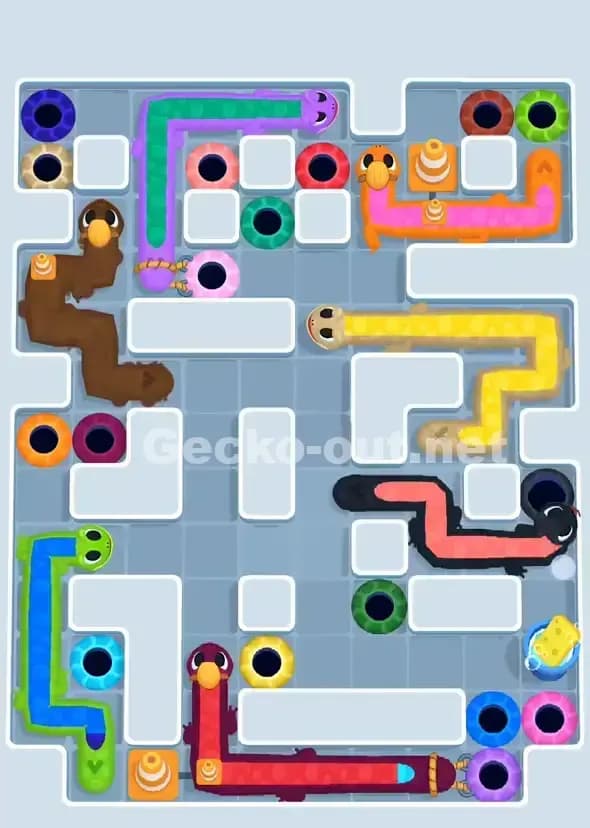
Gecko Out Level 925 Solution Walkthrough | Gecko Out 925 Answer
How to solve Gecko Out level 925? Get step by step solution & cheat for Gecko Out level 925. Solve Gecko Out 925 easily with the answers & video walkthrough.


Gecko Out Level 925: Board Layout, Rules, and Win Condition
Understanding the Board Layout and Starting Position
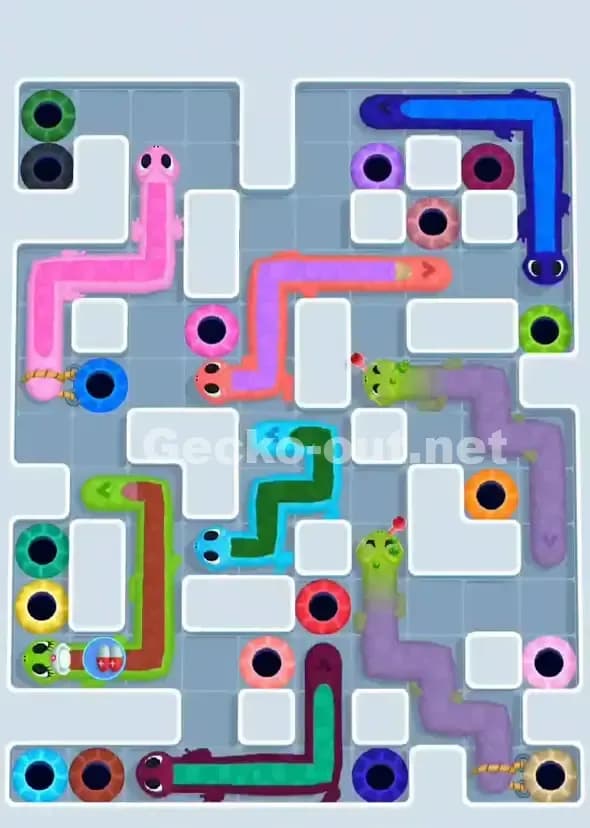
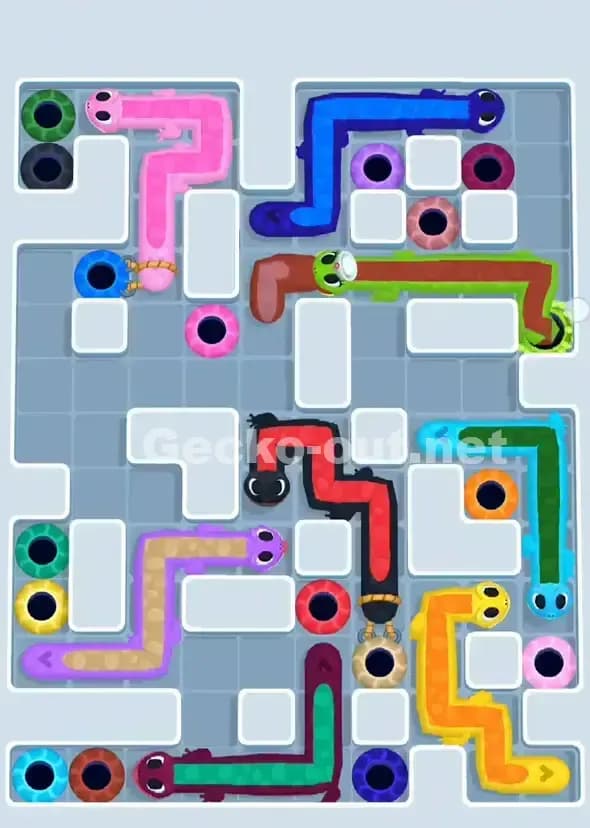
Gecko Out Level 925 is a densely packed puzzle that features eight geckos spread across the board in a tangle of overlapping paths and tight corridors. You're working with green, pink, blue, red, orange, yellow, cyan, and purple geckos—each one must find and exit through a matching-colored hole before time runs out. The board is crammed with white wall obstacles that create narrow choke points, and there are a few frozen or specially marked exit zones that add layers of complexity. What makes Gecko Out Level 925 particularly tricky is that several geckos are already positioned in ways that can easily lock each other in place if you're not careful with your drag sequence.
The starting configuration places the green gecko in the top-left corner, a pink gecko stretched vertically down the left side, a blue gecko locked at the top-right, and additional geckos (red, orange, yellow, cyan, purple) distributed across the middle and lower sections. Many of these creatures are already touching or nearly adjacent to walls, which means your path choices have zero margin for error. The timer is unforgiving—you'll typically have around 90 to 120 seconds depending on the difficulty modifier—so hesitation or backtracking costs precious seconds.
Win Condition and Timer Pressure
Your win condition is straightforward: guide all eight geckos into their matching-colored holes before the timer reaches zero. Unlike simpler Gecko Out levels, Level 925 demands that you understand the entire board layout before you commit to moving even one head. If you drag a gecko's head incorrectly, its body follows that exact path, potentially blocking exits that you'll need for other geckos a few moves later. The timer transforms Gecko Out Level 925 from a spatial puzzle into a race against the clock, forcing you to balance careful planning with decisive action.
Pathing Bottlenecks and Logical Traps in Gecko Out Level 925
The Critical Bottleneck: Pink Gecko's Vertical Stretch
The single biggest bottleneck in Gecko Out Level 925 is the pink gecko, which runs vertically down almost the entire left side of the board. Because of its length and starting position, this gecko occupies a corridor that other geckos need to traverse to reach their exits. If you move the pink gecko first and drag its head down carelessly, you'll create a barrier that blocks the blue and green geckos from accessing the pathways they need. Conversely, if you ignore the pink gecko too long, it'll still be in the way when you're trying to hustle your last two geckos out the door. The solution isn't to move it first or last—it's to move it with surgical precision at exactly the right moment in your sequence, ensuring it doesn't occupy the lanes that other geckos depend on.
Subtle Problem Spots That Trap Players
The first sneaky trap in Gecko Out Level 925 involves the red gecko in the center-right area. Its starting position sits close to both a wall configuration and the orange gecko's potential path. Players often drag the red gecko straight toward what looks like its exit, only to discover that the path they've chosen blocks the orange gecko from reaching its own hole. You need to ensure that red's route curves slightly inward, leaving the outer corridor free for orange's eventual exit.
The second trap is the cyan gecko in the lower-middle section. It's tempting to move cyan early because it looks isolated and simple, but cyan's hole is actually accessible via multiple routes, and moving it prematurely can lock down a central corridor that blue, purple, and yellow all need. Delaying cyan's move often turns out to be the winning strategy, because by the time you reach it, you'll have cleared enough of the board that cyan can slip through in one clean drag with no obstruction.
The third subtle problem is the overlap zone in the top-right corner where the blue gecko's long body curves around frozen or special-status exit zones. Blue isn't just a normal gecko—its exit has visual markers suggesting it's either icy or gang-linked, meaning the path you take must approach from a very specific angle. Dragging blue's head the "wrong way" will cause the body to collide with walls or other geckos and fail immediately.
My Personal Reaction to the Difficulty
Honestly, Gecko Out Level 925 frustrated me the first time I attempted it. I watched my pink gecko block the board, then my red gecko's path trapped orange, and suddenly I had maybe 20 seconds left with three geckos still on the board—it felt impossible. But the moment I restarted and tackled the level with a written plan (even just mental checkpoints: "green first, pink second, blue/cyan middle, then the rest"), everything clicked. That's when I realized Gecko Out Level 925 isn't about quick reflexes—it's about reading the board like a logic puzzle, then executing that plan with confidence.
Turn-by-Turn Path Strategy to Beat Gecko Out Level 925
Opening: Green and Blue First, Then Stabilize
Start by guiding the green gecko (top-left) toward its hole in the upper area. Its path is relatively open, and clearing it immediately gives you breathing room and removes a piece from the crowded left corridor. Drag green's head in a smooth arc toward its matching-colored exit—this should take 5–8 seconds and clears roughly 15% of the board's obstruction.
Next, move the blue gecko at the top-right. Blue's long body is tricky, but its exit is closest to its current position if you drag the head downward and slightly inward. Avoid the temptation to drag it leftward; that path wraps around frozen zones and will fail. Route blue downward, curve it around the white walls, and drop it into its hole. With green and blue clear, you've removed two long-bodied geckos that would otherwise jam everything.
At this point, pause for 3–5 seconds and visually confirm that the left corridor (where pink currently sits) and the center lanes are becoming clearer. Your board should feel less claustrophobic already.
Mid-Game: Pink, Red, and Orange in Sequence
Now tackle the pink gecko. Drag its head downward along the left edge, but do it strategically—ensure the path stays close to the western wall and doesn't drift into the center lanes where other geckos need to travel. Pink's exit is somewhere on the lower-left quadrant, and approaching it along the left edge keeps the central arteries open for the remaining geckos. This move takes about 8–10 seconds and is crucial because pink will no longer block lateral movement.
Immediately after pink exits, guide the red gecko toward its hole. Red is positioned in the center-right area, and its safest path curves downward and slightly left, ensuring it doesn't cross the lanes needed by orange or yellow. Route red carefully—this isn't a race—because a hasty path will definitely jam orange. Spend 6–8 seconds on red's move and confirm its body settles into its hole cleanly.
Next, move the orange gecko. With red now out of the way, orange has clear access to the right-side corridors. Drag orange's head downward along the right perimeter, following the wall contours, and deposit it into its hole. This move should feel smoother than red's because you've now cleared the center lanes significantly. Orange takes 5–7 seconds.
End-Game: Yellow, Cyan, and Purple Under Time Pressure
At this point, you should have 40–50 seconds remaining. The yellow gecko (lower-left area) is next because its path to its matching hole is now fully exposed after pink and the other geckos have exited. Drag yellow's head toward its hole with smooth, deliberate movements—no sharp turns that might cause the body to clip walls. Yellow should be out in 4–6 seconds.
Now move the cyan gecko (lower-center). Cyan's path was always flexible, but now that most of the board is clear, you can drag its head straight toward its hole without worrying about blocking anything else. Cyan exits in 3–5 seconds, leaving you with the final gecko and hopefully 20–30 seconds on the clock.
Finally, drag the purple gecko (right-side area) to its matching hole. By now, you have almost a clear board, so purple's path is straightforward—just follow the wall contours and drop it in. If you're running very low on time (under 10 seconds), don't panic; purple's journey is short, and as long as you don't drag it into a wall out of nervousness, it'll reach its hole.
Why This Path Order Works in Gecko Out Level 925
Head-Drag Pathing and the Body-Follow Principle
The reason this sequence works for Gecko Out Level 925 is rooted in how gecko physics function: the head's path determines the body's trajectory exactly. By moving shorter-bodied or less-obstructing geckos first (green, blue), you create "lanes" that longer geckos (pink, red, orange) can later use safely. This is the opposite of the trap many players fall into—moving long-bodied geckos first and then realizing they've created an unnavigable maze.
The pink gecko is the exception: it's long but also blocking, so moving it early-to-mid (not first) is the sweet spot. By the time you move pink, you've already exited two geckos, so pink's corridor is less critical. When pink exits, it opens up the lateral pathways that red and orange absolutely need. This domino effect—clearing small obstacles that unblock big corridors—is the secret to untangling Gecko Out Level 925.
Timing: Pausing vs. Committing
Early in your run (opening phase), take 5–10 seconds to plan your first two moves and briefly trace them with your eyes before dragging. This small pause saves you from hasty mistakes that would cost 30+ seconds restarting. Once you've confirmed that green and blue are heading toward open exits, commit and move quickly—no second-guessing.
During the mid-game phase, you have more information (some geckos are already out), so you can move a bit faster. However, still take 2–3 seconds between each gecko to ensure the next path is clear. By the end-game, the board is so open that you can almost drag on autopilot; here, your only risk is running out of time, so speed up slightly but maintain accuracy.
Booster Strategy for Gecko Out Level 925
The good news: Gecko Out Level 925 is designed to be beatable without boosters if you follow this path order. You should not need an extra-time booster if you execute the sequence above with reasonable speed (aim for 65–75 seconds total, leaving 15–45 seconds as buffer). However, if you've attempted the level 2–3 times and consistently end up with one gecko left and 5 seconds on the clock, a +30 Second Time Booster is a legitimate insurance policy during your next attempt. It's not cheating; it's recognizing your execution speed and buying yourself a margin.
The Hint Booster is unnecessary here because this guide maps the full solution. The Hammer Tool (for breaking walls) would only be useful if you made an error and needed to break out of a failed path, which again shouldn't happen if you follow the plan.
Mistakes, Fixes, and Logic You Can Reuse in Other Gecko Out Levels
Common Mistakes and Immediate Fixes
Mistake 1: Moving pink gecko first. This absolutely locks the left corridor and forces every other gecko to take circuitous, time-consuming routes. Fix: Move pink third, after green and blue are safely out.
Mistake 2: Dragging red gecko toward the center instead of the right edge. This immediately blocks orange's path and forces you to restart. Fix: Always drag red downward and rightward along the wall, keeping the center free.
Mistake 3: Assuming cyan's path is simple and moving it early. Cyan actually unlocks central corridors when moved late, making later geckos faster. Fix: Move cyan second-to-last, right before purple.
Mistake 4: Hesitating or second-guessing mid-drag. Releasing and re-dragging a gecko wastes 5–10 seconds and risks a misclick. Fix: Commit to your drag path once you've started; moving decisively is faster and more accurate than chickening out halfway.
Mistake 5: Underestimating timer pressure and moving too slowly early on. If you take 45 seconds on the first four geckos, you're doomed. Fix: Green and blue should be out by the 20-second mark.
Reusable Logic for Similar Levels
This approach—clear short obstacles first, then move long/blocking geckos strategically, then fill in the gaps—works across the entire Gecko Out franchise. Whenever you encounter a level with:
- Gang geckos or long-bodied obstacles: Move them mid-sequence, not first.
- Frozen exits or special zones: Approach from the safest angle identified early in your planning phase.
- Tight central corridors: Prioritize clearing the perimeter geckos so the center becomes a highway.
- Multiple geckos of the same color: Handle the one with the most open path first, then tackle the trapped one once the board breathes.
The logic generalizes because Gecko Out Level 925 is a masterclass in spatial planning under time pressure—solve this, and you'll recognize similar bottleneck patterns in levels 926, 950, and beyond.
Final Encouragement
Gecko Out Level 925 is legitimately tough, but it is absolutely beatable with a clear plan and steady execution. The first time through might be frustrating, but once you've beaten it using this guide, you'll have internalized the rhythm: recognize the bottleneck → clear the obstacles in the right order → commit and move quickly → celebrate. You've got this.