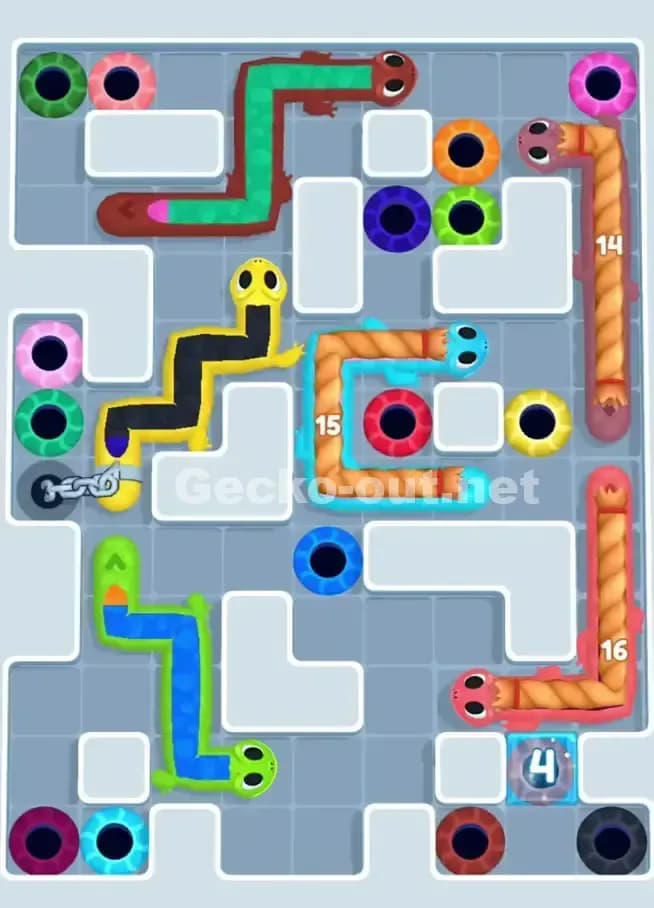
Gecko Out Level 1036 Solution Walkthrough | Gecko Out 1036 Answer
How to solve Gecko Out level 1036? Get step by step solution & cheat for Gecko Out level 1036. Solve Gecko Out 1036 easily with the answers & video walkthrough.
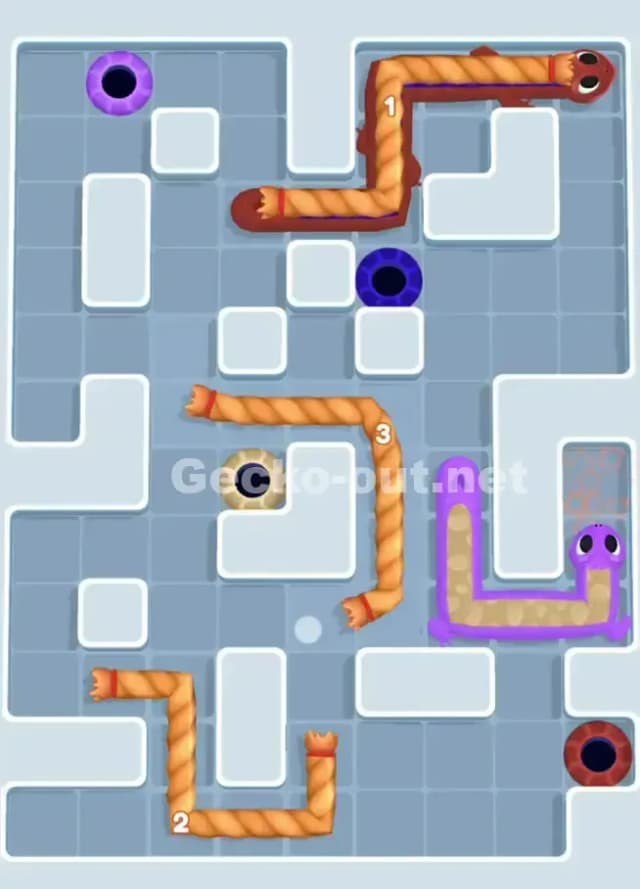
Gecko Out Level 1036: Board Layout, Rules, and Win Condition
Understanding the Starting Board
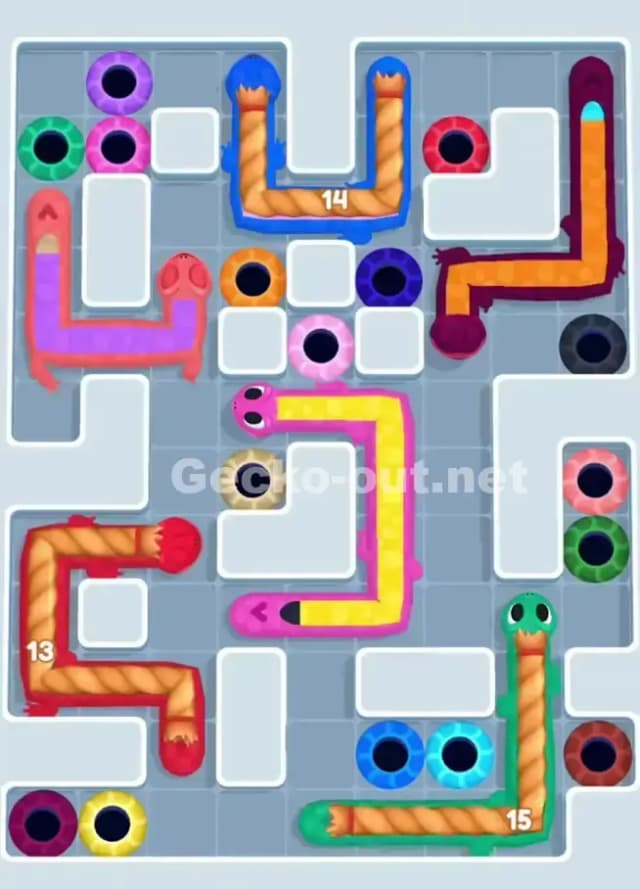
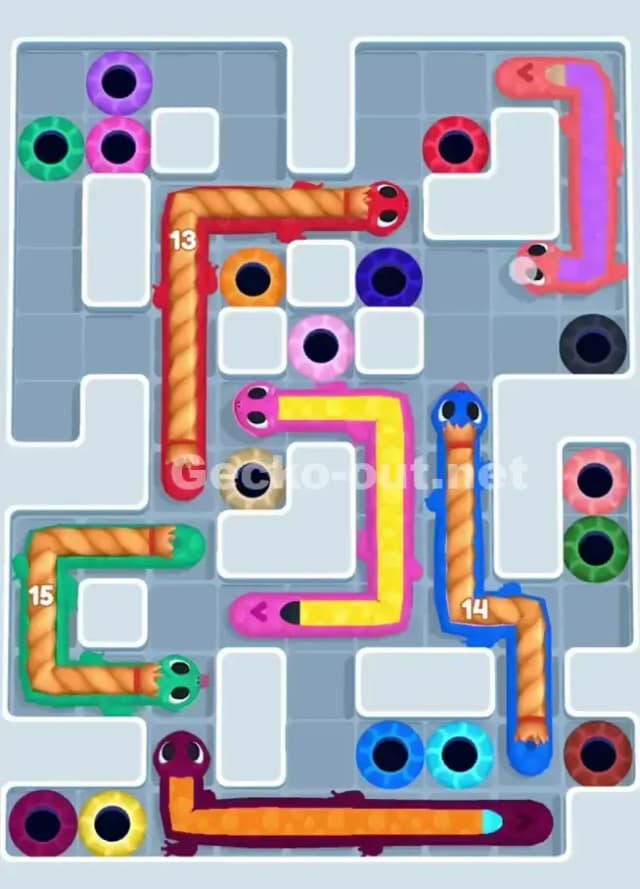
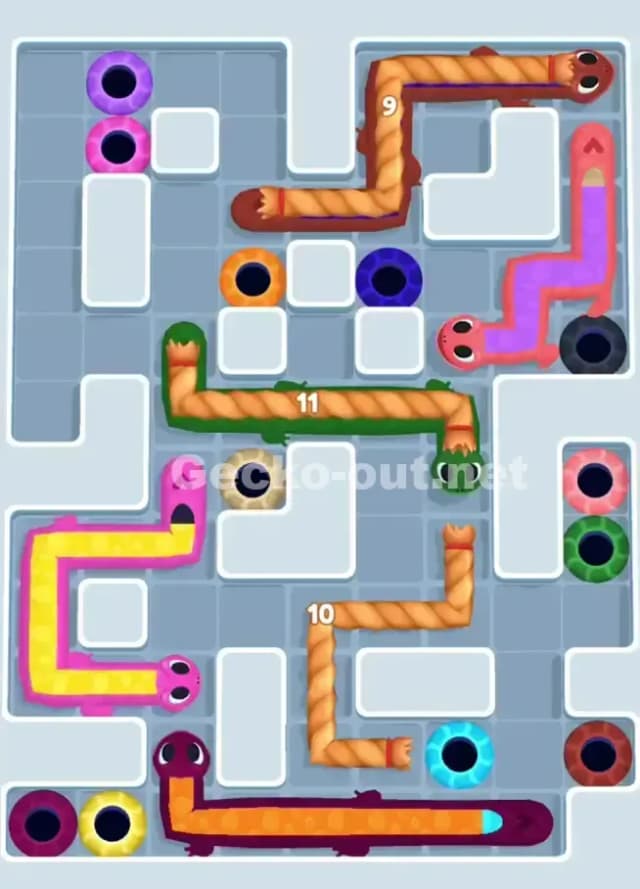
Gecko Out Level 1036 is a complex, multi-gecko puzzle that demands careful spatial planning and precise pathing. You're working with a dense board packed with nine individual geckos in various colors: green, pink (multiple shades), blue, orange, red, purple, and yellow. Several of these geckos are long-bodied "gang" geckos—meaning their bodies stretch across multiple grid cells—which dramatically increases the challenge. The board is heavily segmented by white walls that create narrow corridors and tight choke points, making it impossible to move multiple geckos simultaneously without triggering costly collisions. At the top left, you'll see clustered head positions; the center features a large, winding blue gecko body (marked as "14") that acts like a central spine; the bottom half contains additional long geckos (including one marked "13" in warm tones and another marked "15" in green and orange) that crisscross the available space. Each gecko must reach a hole matching its color to escape, and the timer is unforgiving—you won't have time for trial and error.
The Win Condition and Timer Pressure
In Gecko Out Level 1036, you win only when all nine geckos have successfully exited through their matching-color holes before the timer expires. The timer typically gives you between 90 and 120 seconds depending on your difficulty setting, which sounds generous until you realize that a single misdrag can waste 15–20 seconds undoing and repositioning a gecko's path. The drag-and-follow mechanic means every pixel of the route you create becomes the gecko's body trajectory; there's no second-guessing mid-drag without restarting. Because the board is so compact and the geckos are so intertwined, the real pressure isn't speed—it's planning. You must mentally map out the exit sequence before you start dragging, or you'll find yourself stuck with a gecko whose body blocks the only corridor another gecko needs.
Pathing Bottlenecks and Logical Traps in Gecko Out Level 1036
The Central Corridor Choke Point
The biggest bottleneck in Gecko Out Level 1036 is the narrow vertical corridor in the middle-right area of the board, through which the blue gecko (the long "14" body) must pass to reach its exit. This gecko's sheer length means it occupies roughly a third of the board's usable space at any given moment. If you route it inefficiently or leave it partially blocking side passages, you'll strangle the exits for the purple, red, and cyan geckos that also need access to that zone. The cardinal rule: move the blue gecko out first or route it along a path that deliberately hugs the edges, creating a "cleared lane" for smaller geckos to thread through behind it. I've seen runs fail in the final 20 seconds because someone forgot that the blue gecko's tail was still occupying a crucial intersection.
Subtle Problem Spots: The Gang Geckos and the Overlap Trap
The orange-and-red gecko (marked "13") at the bottom left is deceptively long, and its exit hole isn't immediately obvious from the starting position. Players often drag it too aggressively toward the center, only to realize its body wraps around a wall and blocks the yellow gecko's path. Similarly, the green-and-orange gecko ("15") at the bottom right has a body that curves around the right edge; if you don't leave enough clearance as you extract it, its tail will wedge against the pink gecko heads clustered at the top, creating a domino-style jam that wastes precious seconds untangling. A third trap: the pink geckos at the top left look separate but occupy a tight cluster. Dragging one without first moving another out of the way will cause an overlap—the game penalizes you by either reverting the move or forcing a restart.
The "Aha" Moment
Honestly, Gecko Out Level 1036 frustrated me on my first two attempts because I kept thinking "I just need to move fast" rather than "I need to move smart." The real breakthrough came when I realized that the timer isn't the enemy—poor planning is. Once I spent 30 seconds on the starting board, tracing invisible paths with my finger and identifying which gecko had to go first to unlock the others, the puzzle snapped into focus. That's when I understood: Gecko Out Level 1036 is really testing whether you can think three moves ahead, not whether you have reflexes.
Turn-by-Turn Path Strategy to Beat Gecko Out Level 1036
Opening: Establish a Safe Parking Strategy
Start by moving the yellow gecko at the bottom left. It's small, relatively isolated, and its exit is clear and nearby. Dragging it out in the first 10 seconds accomplishes two things: it frees up one exit hole (so you can see where it leads, reinforcing your mental map) and it removes one body from the board, reducing congestion. Next, tackle the cyan and blue geckos positioned near the bottom center; these are also compact and their exits are reachable without threading through the central corridor. As you clear these smaller, isolated geckos, you're psychologically priming yourself: you're seeing successful exits, and you're building confidence. Meanwhile, deliberately avoid the blue gang gecko ("14") and the long orange gecko ("13")—park your attention away from these for now. Think of your first three moves as "clearing the easy wins" and "establishing a board with fewer obstacles."
Mid-Game: Managing the Corridor and Repositioning Long Bodies
Once you've cleared 3–4 smaller geckos, it's time to commit to the blue gang gecko (the "14" body). This is where Gecko Out Level 1036 becomes a true chess puzzle. You need to drag the blue gecko's head in such a way that its body travels along the outside edge of the central corridor, not down the middle. This means routing it counterclockwise or clockwise around the white walls, depending on which side of the board its exit hole is on. Watch carefully: if you accidentally send it straight through the middle, it'll block the purple and red geckos' paths permanently. As you extract the blue gecko, you're creating a "cleared highway" for the remaining long geckos. The orange gecko ("13") can now be routed more aggressively because it's no longer competing with the blue for space. Similarly, the green-orange gecko ("15") can slide out the right side without fear of collision. The key is sequencing by body length: move the longest geckos first so that the shorter ones have unobstructed corridors.
End-Game: Final Exits and Avoiding Last-Second Jams
By the time you reach the final 2–3 geckos, your board should feel almost empty. The remaining geckos are typically the pink ones clustered at the top left or a single purple or red gecko whose exit is now accessible. At this stage, work deliberately and avoid rushing. If you have more than 25 seconds remaining, take a breath and double-check your drag path before committing; a misclick now could waste more time than moving at a deliberate pace. If you're running low on time (under 15 seconds with geckos still on board), you need to gamble a bit: make a calculated drag toward the gecko's exit, commit fully, and move to the next one immediately. Hesitation is your enemy when the timer is ticking down in Gecko Out Level 1036.
Why This Path Order Works in Gecko Out Level 1036
The Head-Drag Body-Follow Logic
The strategy outlined above works because it respects the fundamental rule of Gecko Out Level 1036: the body cannot occupy a space the head hasn't already cleared. By routing the longest geckos first, you ensure their bodies don't create permanent roadblocks. Once a long gecko is off the board, the corridor it occupied becomes available for every other gecko. This is the opposite of a "greedy" approach where you'd route the nearest gecko first, regardless of size. Gecko Out Level 1036 punishes greed; it rewards foresight. When you drag the blue gang gecko out along the perimeter, you're not just moving it—you're actively designing the board state that makes the next gecko's path trivial.
Timing Your Pauses and Commits
The timer in Gecko Out Level 1036 is forgiving enough to allow for two or three deliberate pauses where you stop, study the remaining board, and plan the next move. I recommend pausing after every 2–3 geckos, especially after extracting a long one. Use that pause to trace potential paths for the next target gecko with your eyes, imagining the drag before you touch the screen. This 5–10 second "planning pause" often saves 20–30 seconds later because you'll move without hesitation. The worst players are the ones constantly undoing drags because they didn't think it through; the best players are the ones who plan, then commit fully.
Boosters: Optional, But Useful at Specific Moments
Gecko Out Level 1036 doesn't require boosters if you execute the strategy above flawlessly. However, if you find yourself with 4+ geckos remaining and fewer than 20 seconds left, a Time Booster is your safety net—it typically adds 30–45 extra seconds, giving you a comfortable margin. A Hint Booster is less useful here because the paths aren't ambiguous; you need spatial reasoning, not hints. I'd recommend saving boosters for your second or third attempt if your first run gets tight, rather than using them preemptively. Gecko Out Level 1036 is absolutely beatable without them if you follow the opening, mid-game, and end-game sequence outlined above.
Mistakes, Fixes, and Logic You Can Reuse in Other Gecko Out Levels
Common Mistakes and How to Fix Them
Mistake 1: Routing the blue gang gecko straight through the center. This creates an impassable blockade for three or four other geckos. Fix: Before you drag, imagine the gecko's body as a thick line. If that line would intersect with other geckos or block an exit, reroute along the perimeter. Gecko Out Level 1036 teaches you that "the long way around" is often faster than "the straight line."
Mistake 2: Moving the clustered pink geckos without planning. You'll accidentally cause an overlap because one gecko's body will bump into another's head. Fix: Always move a gecko out of a cluster before moving one still inside it. Create a staged exodus: extract the most isolated gecko first, then the next one becomes isolated, and so on.
Mistake 3: Forgetting that a gecko's entire body must be off the board before you can reuse its exit corridor. Players often drag a second gecko toward an exit, only to find the first gecko's tail is still in the way. Fix: Trace the full body path mentally and confirm the exit is completely clear before dragging.
Mistake 4: Panicking when the timer drops below 30 seconds. This leads to sloppy drags and resets. Fix: Remind yourself that even 30 seconds is usually enough for 2–3 final geckos if you move deliberately. Panic moves almost always fail; calm moves almost always succeed.
Mistake 5: Not accounting for the walls around exit holes. Some geckos can only access their exit from one specific direction; dragging them from the wrong angle means their body wraps around a wall and can't proceed. Fix: Study each exit hole's surroundings before planning the final drag. Gecko Out Level 1036 often has exits in corners, which means only one or two valid approach angles.
Reusing This Logic on Similar Levels
The strategy framework from Gecko Out Level 1036—*prioritize by body length, route long geckos along perimeters first, then fill in shorter geckos—*applies directly to any level with gang geckos or frozen exits. When you encounter a level with a "locked" or "icy" exit (which you can't use until a certain condition is met), the same principle applies: move the geckos that can exit freely first, then handle the locked ones last. Similarly, if you face a level with toll gates (exits that require a specific key or payment), the opening sequence should prioritize collecting the key, then using it—again, longest-body geckos first, because they create the most congestion.
Final Encouragement
Gecko Out Level 1036 is tough, no question about it. The density of geckos, the length of the gang bodies, and the intricate wall layout make it a genuine test of puzzle-solving rather than reflexes. But it's absolutely beatable with a clear plan and a willingness to think ahead. I've seen players go from failing five times in a row to crushing it on the sixth attempt simply by spending 30 seconds planning before moving at all. You have everything you need to beat Gecko Out Level 1036—trust the sequence, move with intention, and don't let the timer bully you into rushing. Good luck out there!