Gecko Out Level 876 Solution Walkthrough | Gecko Out 876 Answer
How to solve Gecko Out level 876? Get step by step solution & cheat for Gecko Out level 876. Solve Gecko Out 876 easily with the answers & video walkthrough.



Gecko Out Level 876: Board Layout, Rules, and Win Condition
The Starting Board: Multiple Geckos, Tight Corridors, and Interlocking Pathways
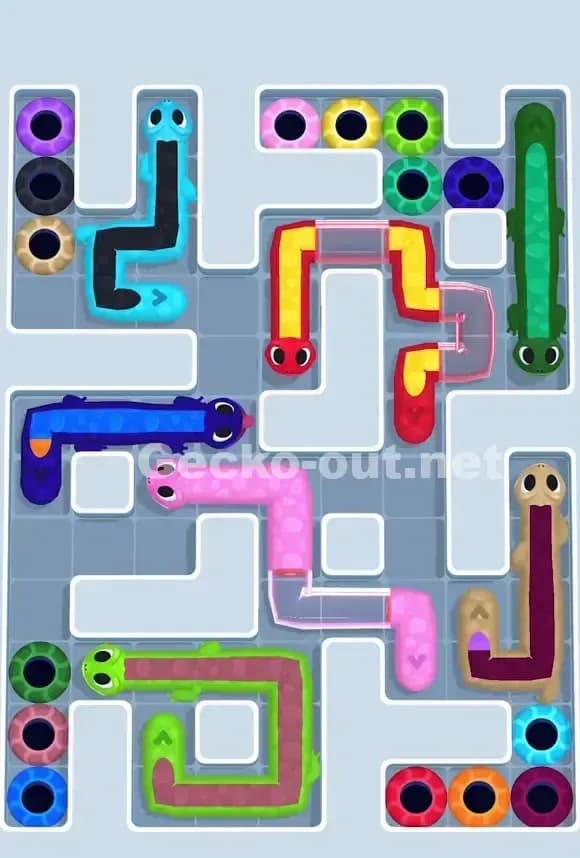
Gecko Out Level 876 is a complex, multi-gecko puzzle that'll test your patience and planning skills. You're looking at roughly eight geckos spread across the board in various colors: pink, yellow, green, red, blue, purple, cyan, and orange. They're positioned in clusters at the edges and corners, which immediately tells you that the exit holes are going to be bottlenecks. The board itself is a maze of white walls and locked passages that force every gecko to navigate through shared corridors. What makes Gecko Out 876 especially tricky is that several geckos are arranged in tight gang formations—meaning they're connected and must move as a unit, which reduces your flexibility when you're trying to untangle the initial knot. The timer is generous but not infinite, so you can't afford to waste moves on failed paths.
Win Condition and How Movement Rules Create the Challenge
To beat Gecko Out Level 876, every single gecko must reach its matching-colored hole before the timer hits zero. That sounds straightforward, but here's where the head-drag mechanic becomes crucial: when you drag a gecko's head, its body follows the exact path your finger traces. If another gecko's body is in the way, you can't proceed—which means a poorly planned first move can lock the entire board. The timer pressure means you need to solve the puzzle logically before you start dragging, not trial-and-error your way through. Gecko Out 876 forces you to mentally path multiple geckos simultaneously and figure out which one truly needs to move first.
Pathing Bottlenecks and Logical Traps in Gecko Out Level 876
The Central Corridor Choke Point
The biggest bottleneck in Gecko Out Level 876 is the vertical purple passage running through the middle-left of the board. This narrow corridor is the only viable route for at least three geckos to reach their exits, and if you send two geckos down it before properly repositioning the third, you'll create a traffic jam that's nearly impossible to undo. The purple gecko itself is part of a gang formation, so moving it impacts adjacent geckos—and that's where the trap snaps shut. You absolutely cannot drag the purple gecko down its exit hole until you've already cleared the cyan and orange geckos out of the lower-middle section. If you don't respect this order, you'll waste five or six moves trying to wiggle geckos around each other.
Three Subtle Problem Spots That Trip Up Most Players
First, the red and tan geckos in the upper section look like they have a direct path to the right, but there's a locked gate blocking the obvious exit. You have to route them through the central area first, which compounds the congestion problem. Second, the blue and purple geckos on the right side are positioned so close to a white wall that dragging them requires precision—one sloppy pixel and you'll bounce off the wall instead of moving forward, wasting a move. Third, and this one gets me every time, the cyan gecko at the bottom-center has a deceptively long body, so when you drag it toward its exit, you have to account for the tail wrapping around walls. If you don't plan for that extra length, the tail will collide with a wall and stop the gecko short of its hole.
A Moment of Frustration, Then Clarity
Honestly, my first two attempts at Gecko Out Level 876 were disasters. I dragged the pink gecko first because it looked isolated, and I felt good about that. Then I went for the yellow gecko next, and suddenly I'd blocked the only path for the red gecko. I spent the next three minutes watching my timer tick down while I shuffled geckos back and forth, and I failed with about eight seconds left. But here's the thing—once I sat back and mentally traced all the paths without dragging anything, the solution became crystal clear. Gecko Out 876 isn't actually that hard; it just demands respect for the order of operations. Once I understood which gecko truly needed to move first (spoiler: it's the cyan one at the bottom), everything fell into place.
Turn-by-Turn Path Strategy to Beat Gecko Out Level 876
Opening: Establish the Critical Clear Zone
Start by dragging the cyan gecko upward and to the right, routing it around the bottom-middle obstacles toward its exit hole on the far right. This gecko has the longest body, so moving it first clears the lower-center corridor for everyone else. Don't try to get it all the way to its exit in one move; instead, park it in a safe alcove just before the final turn. This creates a "staging area" where you can reposition it later without it interfering with other geckos' paths. Next, move the orange gecko straight up into the left-center area. It's a shorter gecko, so it'll fit snugly in the gap you've created. By moves two and three, you've essentially carved out breathing room on the board, and the remaining geckos have clearer sight lines to their exits.
Mid-Game: Reposition Long Geckos and Keep Lanes Open
Now tackle the green gecko on the left side. It's part of a gang with the red gecko above it, but the red gecko can actually wait a bit longer. Drag the green gecko down and to the right, carefully threading it through the bottom corridor. The key here is to avoid crossing back over the path the cyan gecko took—you want to use different routes for different geckos so they don't tangle up. Once green is parked near its exit, move the yellow gecko from the top-left. It has a straightforward path downward, but you need to ensure the pink gecko (which shares a wall with yellow) doesn't block its route. The pink gecko should move next: drag it down, around the gang formation, and toward the lower-right area. This repositioning takes about five moves, but it systematically eliminates the congestion. Pause here and confirm that the central purple corridor is now mostly clear—if it's not, you've made a mistake and should restart rather than compound the error.
End-Game: Critical Exit Order and Time Management
With four geckos parked near their exits, you're now in the final stretch of Gecko Out Level 876. The last four geckos are the red (upper-left gang), blue (right side), purple (center), and the cyan gecko (which you staged earlier). Drag red down through the now-clear central corridor to its exit—this should take one smooth move. Blue comes next, heading down and to the left toward its hole. Then tackle purple, which has a slightly longer path but should move without obstruction. Finally, drag cyan from its staging area to its exit hole on the far right. This exit order avoids any last-minute collisions and minimizes the risk of running out of time. If you're low on time (say, 15 seconds left with two geckos to go), don't panic—just focus on one gecko at a time and drag decisively. Hesitation wastes more time than a slightly suboptimal path.
Why This Path Order Works in Gecko Out Level 876
How Head-Drag Pathing and Body-Follow Rules Untangle Instead of Tighten
The genius of this strategy for Gecko Out Level 876 is that it respects the body-follow mechanic by moving geckos in order of descending body length. Longer geckos take up more space, so if you move them first, shorter geckos can squeeze around them more easily. Conversely, if you move short geckos first and then try to snake a long gecko through, the long gecko's tail will inevitably clip something. By starting with cyan (longest), then orange, green, yellow, and pink (progressively shorter), you're always creating space rather than consuming it. The gang geckos (red and purple) are saved for last specifically because they can only move as units—they don't offer flexibility, so you want to move them when the board is already mostly clear. This order also leverages the multi-path nature of Gecko Out 876: instead of everyone funneling through the central corridor at once, each gecko uses a slightly different route, which means no two geckos ever occupy the same space.
When to Pause and Read Versus When to Commit and Move Quickly
Gecko Out Level 876 rewards deliberate planning at the start but speed at the finish. I recommend spending the first 15–20 seconds just tracing paths with your eyes, not your finger. Identify the choke points, the gang formations, and the exit holes. Once you're confident in your opening sequence (cyan → orange → green → yellow → pink), commit to those moves without second-guessing. Don't pause between individual gecko moves unless you've hit an unexpected obstacle. However, if you hit an obstacle (a gecko doesn't move where you expected, or a path is blocked), stop immediately and reassess—don't just keep dragging and hope. The timer is forgiving enough that you have time to pause and recalculate without panicking. Most players fail Gecko Out 876 not because they run out of time, but because they panic and start making random moves, which actually wastes more time.
Booster Strategy: When They're Actually Needed
Here's my honest take on boosters for Gecko Out Level 876: you don't need them. The level is challenging, but it's solvable with pure logic and careful execution. That said, if you've failed twice and you're frustrated, an extra-time booster is a low-risk safety net—it gives you 20–30 additional seconds, which is usually enough to finish a puzzle you've already mostly figured out. A hint booster is less useful here because the puzzle isn't about finding a hidden trick; it's about executing a clear plan. If you're really stuck, a hint would tell you which gecko to move first, which is actually helpful—but again, if you've read this guide, you already know that answer (it's cyan). Skip boosters on your first few attempts, and only grab one if you're sure you know what to do but you're running short on time.
Mistakes, Fixes, and Logic You Can Reuse in Other Gecko Out Levels
Five Common Mistakes and How to Fix Them
Mistake 1: Moving the shortest gecko first. Players often start with pink or yellow because they look "easy," but this is backwards. Shorter geckos are more flexible and can squeeze into gaps later. Fix: Always move longest-bodied geckos first to establish clear corridors.
Mistake 2: Ignoring gang formations until the very end. In Gecko Out 876, red and purple are glued together, but players often try to work around them early, which creates unnecessary complexity. Fix: Mentally lock gang geckos in place during your initial planning, and only move them when the board is nearly empty.
Mistake 3: Dragging a gecko all the way to its exit hole in one move. This sounds efficient, but it often means the gecko's body lingers on the board longer than necessary, blocking other geckos. Fix: Stage longer geckos in safe alcoves before their final move, so they're out of the way while you're positioning other geckos.
Mistake 4: Forgetting about body length when planning turns. A gecko's head might fit through a tight corner, but if the body doesn't follow, the move fails. Gecko Out 876 teaches you to always trace the full path, not just the final position. Fix: Before dragging, run your finger along the expected path and confirm the entire body can follow.
Mistake 5: Panicking when the timer drops below 30 seconds. In Gecko Out 876, 30 seconds is plenty if you still have only two or three geckos left. Most players freeze up and start making random moves. Fix: Take a breath, identify the next gecko to move, and drag it decisively. One or two clean moves often finish the level with time to spare.
Reusing This Logic on Similar Levels
The principles from Gecko Out Level 876 apply directly to any multi-gecko, gang-formation, or frozen-exit level. First, always prioritize moving long-bodied geckos early to clear corridors. Second, treat gang geckos as single units during initial planning—don't try to outthink them until the board is clear. Third, use staging areas (safe alcoves near exit holes) to park geckos temporarily, which reduces congestion. Finally, move in descending order of body length, which naturally avoids collisions. These tactics are universal, and once you've mastered Gecko Out 876, you'll see similar bottleneck patterns in levels 877, 890, and beyond. The game rewards systematic thinking over reflexes, so if you can plan this level, you can plan anything.
Final Encouragement
Gecko Out Level 876 is genuinely tough, but it's absolutely beatable once you respect the mechanics and plan your moves. Don't let the initial tangle of geckos intimidate you—that's exactly what the level designers intended. The puzzle only feels impossible if you try to wing it. Spend 20 seconds planning, then execute with confidence, and you'll clear Gecko Out 876 with time to spare. You've got this.