
Gecko Out Level 780 Solution Walkthrough | Gecko Out 780 Answer
How to solve Gecko Out level 780? Get step by step solution & cheat for Gecko Out level 780. Solve Gecko Out 780 easily with the answers & video walkthrough.


Gecko Out Level 780: Board Layout, Rules, and Win Condition
Understanding the Starting Board
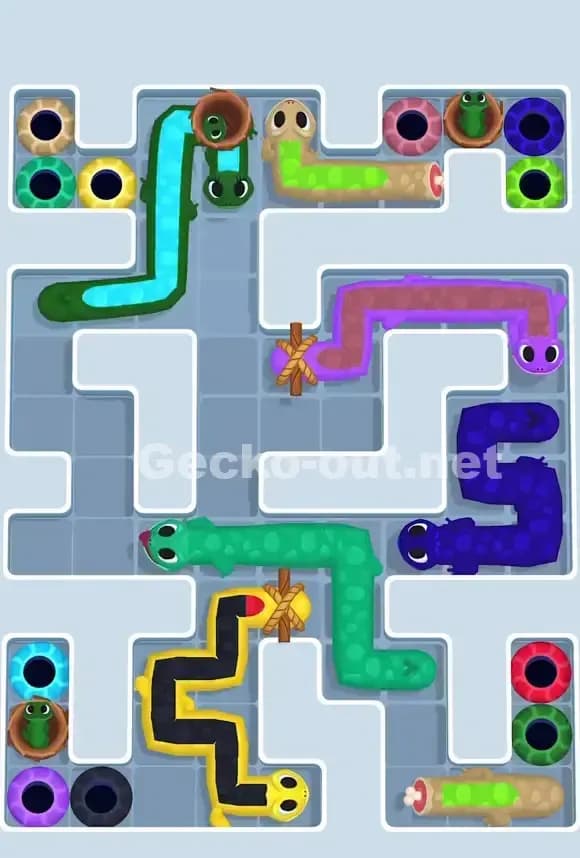
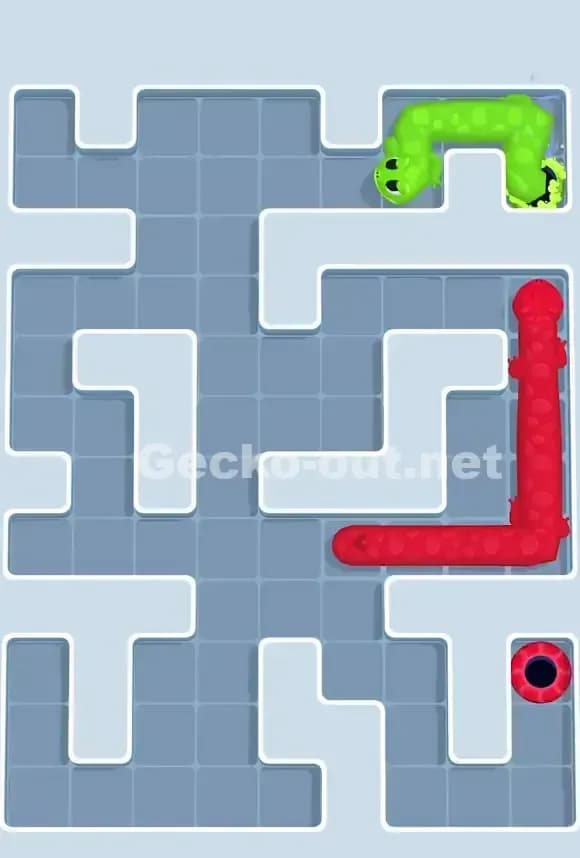
Gecko Out Level 780 is a densely packed multi-gecko puzzle that'll test your spatial reasoning and timing. You're facing roughly eight geckos spread across the board in a complex, interlocking layout. The geckos come in multiple colors—greens, blues, purples, cyans, oranges, and reds—each of which must reach a hole of matching color to escape. What makes Gecko Out 780 challenging is that many of these geckos are gang-linked, meaning they move together as a unit, which dramatically reduces your maneuvering flexibility. Several geckos are also positioned in tight clusters with walls creating narrow corridors, and there are blocked or icy exits that you cannot use until certain conditions are met. The board feels like a jigsaw puzzle where every piece is fighting for space, and the timer is counting down from the moment you start.
The Win Condition and Time Pressure
To beat Gecko Out Level 780, you must guide every single gecko to its matching-colored hole before the timer expires. The clock is your ruthless enemy here—there's no room for trial-and-error or leisurely dragging. Every path you draw with a gecko head must be intentional, because that body will follow every pixel of movement you make. If you accidentally drag a gecko into a wall or another gecko, you waste precious seconds unwinding that mistake. The combination of gang geckos, narrow choke points, and the strict timer means Gecko Out 780 demands a clear mental map before you start dragging.
Pathing Bottlenecks and Logical Traps in Gecko Out Level 780
The Central Corridor Bottleneck
The biggest single bottleneck in Gecko Out Level 780 is the central vertical corridor that runs through the middle of the board. Multiple geckos need to pass through or near this narrow space to reach their exit holes, and gang-linked geckos exacerbate the problem because they can't squeeze around each other. If you send the wrong gecko through first, you'll lock out others and create a traffic jam that's nearly impossible to untangle in the time remaining. This is the choke point that will make or break your run.
Subtle Problem Spots That Trap Players
The first trap is the upper-left cluster. Two or three geckos are stacked closely together, and if you drag one head without planning the body's path, the body will collide with the companions and create an instant jam. You can't just drag and hope—you need to visualize the entire route before you commit. The second trap is the gang-gecko linkage on the left side, where two geckos are bonded together. Many players forget that when one head moves, both bodies move in tandem, which means you need to find a path wide enough for both of them simultaneously. A third trap is the frozen or locked exit on the right side of the board. You can't send a gecko straight to that hole until you've cleared the board enough, or it might be permanently blocked until a specific condition is met. Attempting to force a gecko into a locked exit wastes time and sometimes locks you out of winning entirely.
The Moment It Clicks
Honestly, when I first looked at Gecko Out Level 780, I felt a spike of frustration—it looked like pure chaos. But the turning point came when I realized that the bottleneck wasn't a problem; it was the solution. By deliberately sending the longest gang-gecko through the central corridor first, I could clear space for the smaller geckos to navigate around the edges. Suddenly, what looked like an unsolvable knot became a sequence of deliberate, orderly moves. That shift from panic to clarity is what makes this level so satisfying to beat.
Turn-by-Turn Path Strategy to Beat Gecko Out Level 780
Opening: Establishing Control
Start by identifying the two longest or most restricted geckos on your board—these are the ones that will jam everything else if you don't move them first. In Gecko Out Level 780, I recommend tackling the left-side gang-gecko immediately. Drag its head carefully downward and to the left, finding the safest path to the central corridor without colliding with any other gecko body. This might feel slow, but you're buying yourself space. Once that gang is through, the upper-left cluster becomes accessible. Move one gecko from that cluster next—again, be deliberate about the path—and "park" it near its exit hole but not into it yet. Don't commit to the final exit move until you're certain the path will remain clear.
Mid-Game: Keeping Lanes Open and Resequencing
Once the longest geckos are positioned and partially cleared, shift your attention to the medium-length geckos. In Gecko Out Level 780, there are a few geckos that are neither gang-linked nor extremely long, and these are your mobility pieces. Use them to snake through the remaining tight spaces. Never draw a path that blocks an exit or corridor you'll need later. For instance, if a green gecko's exit is on the right side and another gecko's body is currently blocking the approach, don't move that blocking gecko further right—move it somewhere else first. The mid-game is where you're actively untangling the knot by repositioning pieces rather than removing them. Keep your eye on the timer; if you've burned more than 30–40% of the total time and you're still moving large gang geckos, you're likely behind pace. Speed up your decision-making without sacrificing accuracy.
End-Game: Final Exits and the Clock
As you enter the last phase, you should have most of the board clear and only 2–3 geckos left to guide home. This is where you can afford to move slightly faster because there are fewer obstacles. Send the shortest or most unobstructed geckos to their exits first, leaving the most complex path for last. If you're genuinely running low on time (say, under 10 seconds), don't panic—remember that the final gecko can often take a direct route if the board is clear. If you find yourself with a gecko still on the board when the timer is critically low, use a Time Booster if you have one available, but ideally, you won't need it because your sequencing kept you ahead of the clock.
Why This Path Order Works in Gecko Out Level 780
Head-Drag Pathing and the Body-Follow Rule
The strategy for Gecko Out Level 780 succeeds because it respects the fundamental rule: the body follows the head's exact path. By moving the longest geckos first, you're using their bodies as temporary walls that define safe corridors for smaller geckos. Once a long gecko is positioned and not moving, it becomes an obstacle that smaller geckos navigate around, rather than a source of chaotic collisions. This turns the puzzle from a scramble into a choreographed sequence. Gang-linked geckos are handled by finding a path wide enough for both bodies, which usually means using the central corridors or outer edges—never the tight inner spaces. The head-drag system is actually your advantage here because it forces you to think deliberately rather than react frantically.
Balancing Speed and Pause
Gecko Out Level 780 punishes both indecision and recklessness equally. The right approach is to pause and read the board during the first 20% of the timer, identifying which gecko to move and roughly where its path should go. Once you've locked in that mental map, commit to smooth, confident drags—no second-guessing mid-path. Most players either pause too long (wasting precious time) or move too fast (causing collision disasters). Aim for a middle ground: 10 seconds of planning, then 50+ seconds of steady execution. If you feel yourself panicking mid-run, pause briefly, take a breath, and refocus on the next single gecko rather than worrying about the entire board.
Booster Strategy for Gecko Out Level 780
Here's the honest truth: Gecko Out Level 780 doesn't require boosters if you execute the path sequence correctly. That said, if you're stuck in the mid-game and the timer is dropping faster than expected, a Time Booster is your safety net—it'll add 20–30 seconds, giving you breathing room to finish without panic-induced errors. A Hint Booster is less useful here because the solution is deterministic (move gang geckos first, then medium geckos, then finals), not random. A Hammer or Smash tool would only help if a gecko gets truly wedged, which shouldn't happen if you're following this guide. Use boosters as a backup only, not a crutch.
Mistakes, Fixes, and Logic You Can Reuse in Other Gecko Out Levels
Common Mistakes and Solutions
Mistake #1: Dragging a medium-length gecko to its exit hole too early, only to realize another gecko's body is now blocking the only path for a longer gecko. Fix: Complete a full mental inventory of which geckos must move first, then execute in that order without jumping ahead.
Mistake #2: Forgetting that gang-linked geckos move as a unit and attempting to squeeze them through a corridor that's only wide enough for one gecko. Fix: When you identify gang-linked geckos, trace their combined width and find paths that accommodate both bodies, or split them using longer routes.
Mistake #3: Running out of time because you spent 70% of the timer moving the first two geckos slowly and carefully. Fix: Plan your moves mentally before dragging, then execute at a steady pace rather than a crawl. You don't need pixel-perfect paths if you're moving in the right direction.
Mistake #4: Accidentally dragging a gecko into a wall or another gecko body and having to undo the move or restart. Fix: Use shorter, deliberate drags rather than one long drag across the entire board. Multiple short drags give you more control points to pause and assess.
Mistake #5: Forgetting about a locked or icy exit and attempting to send a gecko to a hole that isn't accessible yet. Fix: Before moving any gecko, scan the board for any grayed-out or frozen-looking exits and note which geckos can't use them until conditions change.
Reusing This Strategy on Similar Levels
The logic you've mastered in Gecko Out Level 780—move the longest/most restricted piece first, then sequence smaller pieces around it—is a universal principle for gang-gecko and multi-color puzzles. Any level with gang-linked geckos, narrow central corridors, or high piece count will benefit from this approach. Levels with frozen exits require the same "read the board, identify restrictions, plan the sequence" methodology. If you encounter a level with many colored geckos and limited space, ask yourself: "Which gecko, if moved first, will unlock the most space for others?" That's your starting move.
You've Got This
Gecko Out Level 780 is genuinely tough—it combines spatial reasoning, time management, and the penalty of irreversible drags into one unforgiving puzzle. But here's the thing: it's absolutely beatable with a clear plan and methodical execution. You now know the bottleneck, the trap spots, and the winning sequence. The geckos are counting on you. Go clear that board, and remember—slow, deliberate planning followed by confident execution will beat Gecko Out 780 every time.