Gecko Out Level 225 Solution Walkthrough | Gecko Out 225 Answer
How to solve Gecko Out level 225? Get step by step solution & cheat for Gecko Out level 225. Solve Gecko Out 225 easily with the answers & video walkthrough.

Gecko Out Level 225: Board Layout, Rules, and Win Condition
Starting Board: Knotted Geckos and Frozen Tiles
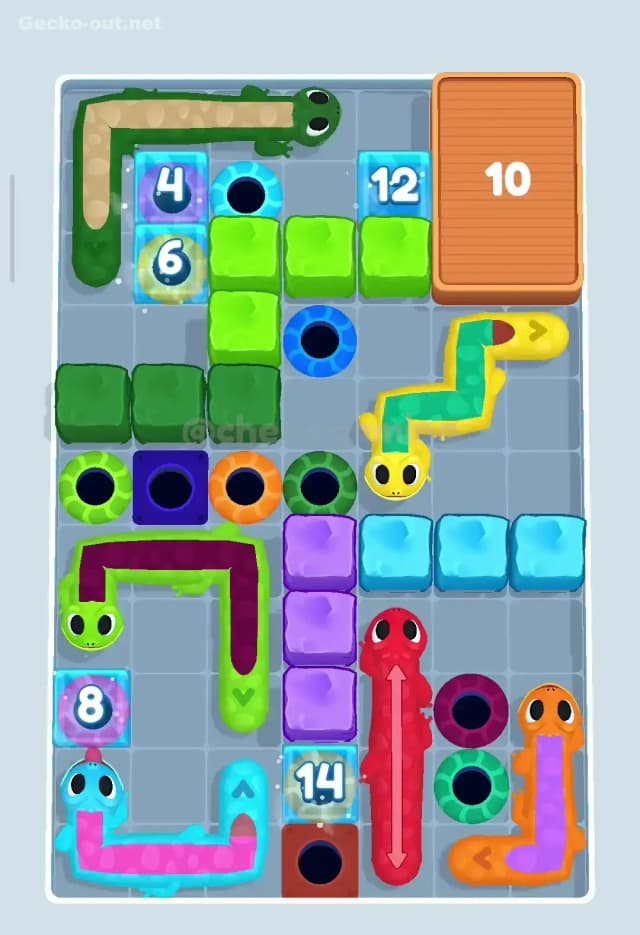
Gecko Out Level 225 throws seven geckos at you on a very cramped board. You’ve got:
- A long dark‑green gecko stretched along the very top row.
- A yellow–turquoise zigzag gecko on the upper‑right side.
- A “gang” pair on the left: a bright green U‑shaped gecko wrapped around a shorter magenta one in the middle.
- A short cyan–pink gecko in the lower‑left corner.
- A tall red gecko standing in the lower‑right corridor.
- An orange gecko tucked beside the red one.
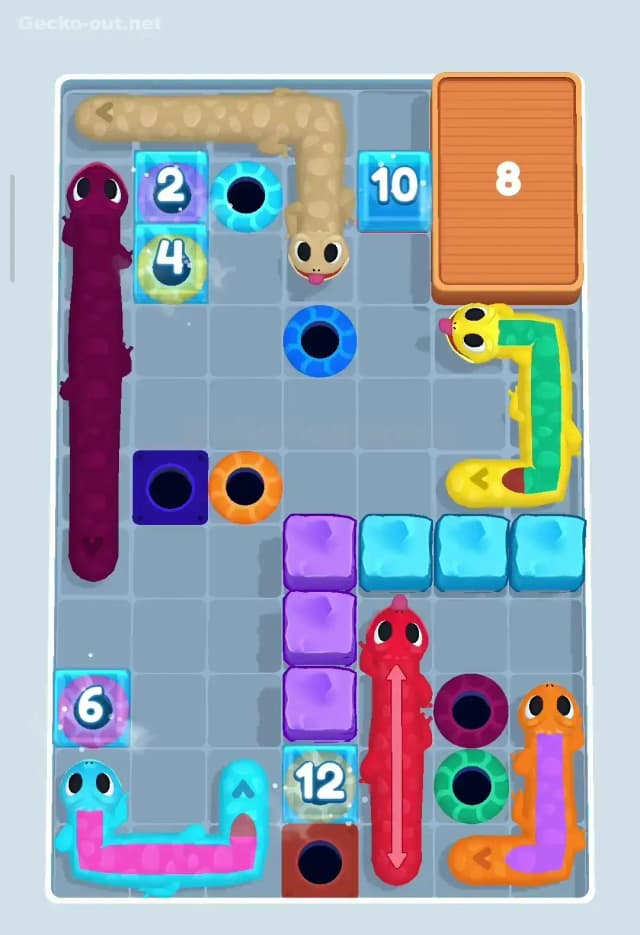
Between them are solid green and purple wall blocks, plus a whole line of ice/timer tiles with numbers like 4, 6, 8, 12, and 14. These numbered ice tiles are your timed obstacles and time boosts: you can’t ignore them, but you also don’t want to waste moves just dancing on them.
Each colored gecko must reach its matching hole: you can see a cluster of exits in the middle row (green, dark/purple, orange), plus individual exits at the bottom (red), left side (cyan), and elsewhere. Because movement is path‑based, every curve you drag the head through is exactly how the body will snake along the board.
Win Condition and How the Timer Shapes the Level
To beat Gecko Out 225 you must:
- Get all seven geckos into their same‑colored holes.
- Do it before the overall timer (shown on the wooden timer board) drops to zero.
- Avoid crossing paths through blocked ice, other geckos, and locked exits.
The tricky part is that while you’re planning nice clean routes, the clock just keeps ticking. Dragging long, zigzag paths costs real time, and tiny corrections (like wiggling a head back and forth) are surprisingly expensive here. Gecko Out Level 225 is less about wild experimentation and more about committing to a clean plan and executing it in one or two attempts.
If you’re used to leisurely levels, this one feels tight: you basically get one “read the board carefully” moment, then you have to move with confidence.
Pathing Bottlenecks and Logical Traps in Gecko Out Level 225
The Main Bottleneck: The Red–Orange Right Corridor
The single worst choke point in Gecko Out 225 is the vertical corridor on the right:
- The tall red gecko occupies most of this lane.
- The orange gecko and two adjacent holes sit at the bottom of the same area.
- Above them are blue ice blocks that narrow the space even more.
If you move red too early, you either block orange’s future route or cover the 14‑second ice tile near red’s exit. If you move orange badly, you lock red in so it can’t ever snake through to the bottom hole. Treat that right‑side column as “end‑game territory” and leave real exits there for later.
Subtle Problem Spots That Ruin Good Runs
A few less obvious traps in Gecko Out Level 225:
-
The U‑shaped green around the magenta gecko
If you send the outer green to its hole before the inner magenta, the magenta loses its clean path and you’re forced into a long, slow detour that eats the timer. -
The three‑hole row in the middle
There’s a row with three adjacent exits (green, dark, orange). Filling the wrong one first can force another gecko to loop all the way around the block of purple walls, costing both time and space. -
The yellow zigzag gecko near the top right
Drag it the wrong way and its tail will lie across the only open route for the top green gecko to reach its exit. It looks safe to park, but a bad parking job turns it into a hard wall.
When the Level “Clicks”
The first time I played Gecko Out Level 225, I kept trying to free the red gecko first because it looks so obviously blocked. Every attempt ended with orange trapped or the center completely jammed. The moment the level started to make sense was when I reversed my thinking:
“What if red is last, and I treat that corridor as sacred until then?”
Once I started solving from the left side, cleared the gang geckos, and used the yellow gecko only as a temporary bridge, Gecko Out 225 went from “impossible knot” to “tight but fair puzzle.”
Turn-by-Turn Path Strategy to Beat Gecko Out Level 225
Opening: Clear the Left Side and Set Up Parking
In the opening of Gecko Out Level 225, focus on the left and center, not the right:
- Free the cyan–pink gecko first
- Its exit is close to its starting corner on the left.
- Drag its head around the nearby ice/timer tile (8) in a short, efficient curve into its hole.
- Don’t snake it deep into the middle; keep the route compact so you don’t block later paths.
- Handle the magenta–green gang pair
- Slide the outer green U slightly so the magenta gecko can slip out of the “cage.”
- Guide magenta first towards its matching dark/purple hole in the middle row.
- Only after magenta is in place do you curve the bright green U towards the green hole in that same row.
- Try to send both along the same basic corridor so they don’t leave their bodies lying across future routes.
- Park the yellow zigzag safely
- From its starting spot on the right, drag yellow upward and slightly left into the space just under the top green gecko, stopping before any exit.
- Think of yellow as a flexible wall: it keeps the right side from being cluttered, while leaving the center free.
At the end of the opening, you want the left half mostly cleared and the central three‑hole row partially filled (magenta and green done), with yellow tucked up high and the whole right corridor untouched.
Mid-Game: Open Lanes Without Locking the Right Side
Mid‑game in Gecko Out 225 is about creating clean vertical lanes:
- Route the long top green gecko
- Bring its head down along the left or middle, weaving around the green wall blocks.
- Aim it toward any remaining green exit while avoiding laying its tail across the line of purple blocks in the center.
- Keep its path hugging the outer wall as much as possible so there’s still space for red and orange later.
- Reposition yellow for its exit
- From its parking spot under the top green, slide yellow in a shallow curve to its matching hole (often on the right or in the central cluster).
- Avoid zigzagging: a straight or gently curved path is faster and leaves less tail in the way.
- Leave the red–orange corridor open
- Resist the urge to “test move” the red gecko. Every unnecessary drag eats time and can accidentally seal off the 14‑second tile or orange’s route.
- As long as the left and center are solved, you can now see very clearly how red and orange have to move.
End-Game: Exit Order and Saving a Run When Time’s Low
For the end‑game of Gecko Out Level 225, the cleanest order is usually:
- Orange gecko
- Drag orange out of its cramped nook into the small side pocket near its hole.
- Curve it into its matching orange exit in the middle row before committing red.
- This clears the corridor so red can slide past without blocking anything.
- Red gecko (while touching the 14 tile)
- Pull red downward over the 14‑second ice tile and into the red hole at the very bottom.
- Passing through the 14 tile late acts as a tiny time insurance if you were a bit slow earlier.
If you’re low on time:
- Skip any fancy curves with red; draw the straightest possible path down.
- Don’t try to optimize every second tile—just make sure you don’t clip another gecko or wall and have to redraw.
Why This Path Order Works in Gecko Out Level 225
Using Body-Follow Pathing To Untangle, Not Tighten
The whole plan for Gecko Out 225 leans on one rule: the body follows the exact path of the head.
- By clearing cyan and the gang pair first, you use their bodies to “sweep” around the left side, then remove them entirely, leaving a clean board.
- Parking yellow high keeps its body acting as a temporary wall, then you retract that wall when you send it to its exit.
- Saving red for last means its long body never lies across crucial central lanes; it only occupies the right corridor when nobody else needs it.
This is the difference between tightening the knot and pulling it loose: you want each gecko’s trail to vanish from critical areas as early as possible.
Timer Management: When to Think vs. When to Move
In Gecko Out Level 225, I’d split your mental timing like this:
- First 5–10 seconds: don’t move anything. Scan the exits and mentally choose your opening (cyan → magenta → green).
- Middle section: move confidently but not frantically. If you’re drawing long loops with the head, pause and redraw a shorter route instead.
- Final 10–15 seconds: commit. No more big rethinks—just execute the orange then red sequence cleanly.
The numbered tiles (like 8 and 14) are nice boosts, but you should treat them as bonuses for routes you already wanted to take, not as destinations you’re forcing geckos to visit.
Boosters: Optional, Not Required
Boosters in Gecko Out 225 are very much “break glass in case of frustration” tools:
- A time booster is most useful right before you start the red–orange end‑game, if you regularly reach that stage with almost no time left.
- A hammer/clear‑tile booster can bail you out if you keep mis‑parking yellow or blocking the central cluster of holes.
But with the path order above—left side first, yellow parked smartly, right corridor last—you don’t actually need any boosters to finish Gecko Out Level 225.
Mistakes, Fixes, and Logic You Can Reuse in Other Gecko Out Levels
Common Mistakes in Gecko Out Level 225 (And How to Fix Them)
- Moving red first
- Problem: you clog the entire right side and trap orange.
- Fix: Promise yourself red moves only after the gang pair, cyan, yellow, and top green are done.
- Exiting the outer green before magenta
- Problem: magenta loses its clean path out of the U and has to take a massive detour.
- Fix: Always free “inner” geckos before “outer” ones when they’re wrapped together.
- Parking yellow in the middle
- Problem: its zigzag tail lies across the main lane and forces every other gecko to go around.
- Fix: Park yellow high and tight under the top green, then send it to its hole in one clean move later.
- Drawing fancy, looping paths
- Problem: the timer melts away while your geckos go sightseeing.
- Fix: In Gecko Out Level 225, if your path isn’t mostly straight or gently curved, erase and redraw simpler.
Reusing This Logic on Other Knot-Heavy Levels
What you practice on Gecko Out 225 carries over really well:
- Clear “inside” geckos before the ones wrapped around them.
- Treat the longest gecko in the tightest corridor as an end‑game piece, not an opener.
- Use temporary parking positions instead of exits when you just need a gecko to act as a movable wall.
- Think in terms of lanes: which vertical or horizontal channels must stay open until the very end?
Any Gecko Out level with gang geckos, frozen exits, or big central block clusters rewards this same mindset.
Final Encouragement
Gecko Out Level 225 looks brutal at first, but once you respect the right‑side corridor and solve from the left outwards, it’s absolutely beatable without boosters. Give yourself one calm planning pause, stick to the exit order—cyan → magenta → green → top green → yellow → orange → red—and you’ll feel the whole knot unwind under your fingers.