Gecko Out Level 19 Solution Walkthrough | Gecko Out 19 Answer
How to solve Gecko Out level 19? Get step by step solution & cheat for Gecko Out level 19. Solve Gecko Out 19 easily with the answers & video walkthrough.


Gecko Out Level 19: Board Layout, Rules, and Win Condition
What The Starting Board Looks Like
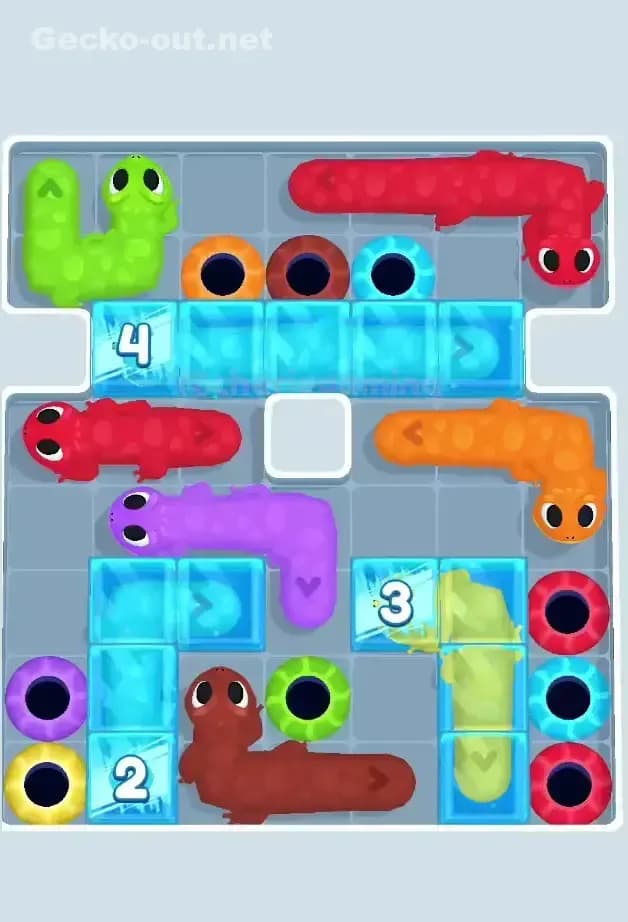
In Gecko Out Level 19 you’re dropped into a very cramped board with seven geckos: green, orange, purple, yellow, brown, and two reds. The top edge is almost completely full: a short green gecko curls in the top‑left corner and a long red gecko stretches across the top‑right. Just below them runs a frozen horizontal lane of ice tiles marked with a “4” – that’s your main bridge between the left and right sides of the map. Above this bridge sit three exits for orange, brown, and one extra color.
The bottom half of Gecko Out 19 is even messier. A purple gecko sits across the middle, a second red gecko and a brown gecko occupy the lower lanes, and the orange and yellow geckos lock up the right side. There are two more frozen “gates” here: a “2” gate near the bottom‑left exits and a “3” gate along the right edge that connects the bottom‑right exits to the icy bridge up top. Every gecko’s exit is present, but nearly all of them are shielded behind one of those numbered ice corridors.
How The Win Condition And Timer Shape The Puzzle
You still win Gecko Out Level 19 the classic way: every gecko must reach a hole of its own color, with the head dragging a path and the body perfectly tracing that path. No overlapping bodies, no sliding through walls, and you can’t park on top of locked or frozen exits. If the timer hits zero before the last tail disappears into a hole, you fail the level.
What makes Gecko Out 19 tricky is how the timer interacts with path‑based movement. Any time you draw a long, wiggly route “just to see what happens,” you’re forcing the full body to follow that exact snake. That burns time and can twist geckos into even worse knots. The numbered ice gates add a second constraint: you need multiple passes through them, but you can’t afford to waste those passes on messy routes. So the whole level becomes a race to plan clean, efficient paths that both open the gates and keep critical corridors free for later geckos.
Pathing Bottlenecks and Logical Traps in Gecko Out Level 19
The Main Bottleneck Corridor
The single biggest bottleneck in Gecko Out Level 19 is the icy bridge marked “4” just under the top exits. Almost everyone wants a piece of that bridge: the orange gecko needs it to reach the orange exit on the upper row, the brown gecko often uses it to curl into its top exit, and the long red gecko blocks it from the right side if you move it too early. Since the bridge needs four clean passes to fully “open” (or to be safely used without freezing anyone out), wasting even one traversal with a bad path means you’ll jam the board or run the clock down.
The second critical choke is the “3” vertical gate on the right, between the yellow gecko and the top section. Until you work that gate a few times, the yellow gecko can’t reach its exit, and the orange/red geckos can’t freely move between the top and bottom right. Treat that right‑side gate as your second main artery: if it’s clogged, every other plan collapses.
Subtle Problem Spots That Catch You Out
First subtle trap in Gecko Out 19: the “2” gate near the bottom‑left exits. It looks like a handy shortcut to throw any gecko through, but every pass through that gate matters. If you burn both hits early with a long, wandering gecko, you’ll block the purple and brown geckos from getting clean shots to their exits later. Use short, controlled passes here.
Second trap: parking a gecko half‑on, half‑off the icy lanes. Because bodies follow exactly, parking the head in a safe spot can still leave the tail draped across the main highway, especially with the long red and the brown gecko. They look “out of the way,” but their tails silently close the bridge or right‑side gate.
Third trap: drawing big loop‑de‑loops across ice just to melt it. It’s tempting to zigzag to chew through the gate counts, but you end up filling every open cell with body segments. When another gecko tries to move, there’s literally no legal path left.
When The Level Finally “Clicks”
I’ll be honest: the first couple of attempts at Gecko Out Level 19 feel awful. You open one gate and instantly discover you’ve blocked another. Once I realized the board is basically three numbered doors chaining into each other—2‑gate at the bottom‑left, 3‑gate on the right, 4‑bridge up top—it finally clicked. The solution isn’t about one magic path; it’s about deciding which geckos are “gate openers” and which geckos are “finishers.” After that mental shift, the puzzle becomes way cleaner: short geckos soften the gates, longer geckos mostly travel once, straight to their exits.
Turn-by-Turn Path Strategy to Beat Gecko Out Level 19
Opening: Clear Gates Without Jamming The Board
In the opening of Gecko Out 19, ignore the long top red gecko. If you move it first, its body sprawls across the bridge and no one else can use that lane. Instead:
-
Use the purple and brown geckos to work the “2” gate at the bottom‑left. Drag purple through the gate toward its purple exit, then back out to hug the left wall. Do the same with brown, nudging it upward so it no longer blocks the center. Those two tidy passes are usually enough to “use up” the 2‑gate efficiently.
-
Next, turn to the right side. Take the yellow gecko up through the “3” gate once, then park it along the right wall, not in the middle. Follow with the short red gecko: send it through the same gate, then curl it down toward the bottom‑right exits. You want two clean, almost straight runs here.
-
Only after the bottom and right are de‑kinked should you start touching the 4‑bridge. Use the green gecko first: drag it out of the top‑left corner onto the icy bridge and back, opening space without committing to an exit yet. The goal for the opening is simple: all three numbered gates should have been used by short, direct paths, and no gecko should be blocking the center lanes.
Mid-game: Maintain Lanes And Line Up Exits
Mid‑game in Gecko Out Level 19 is all about lane discipline. Every time you move a gecko, ask yourself which gate or corridor you’re about to close.
At this point, try to finish the “3” gate and start scoring exits on the bottom. Use the yellow gecko to make its second or third pass through that vertical gate and guide it onto its matching exit near the lower side. Because it’s already parked near that gate, this is a quick move that doesn’t tie up the rest of the board.
Next, bring the purple gecko home through the freed‑up “2” gate. The bottom‑left area should now be fairly clear; run purple in a mostly straight shot from the center to its hole. Don’t curl it around the middle or you’ll re‑block the bridge.
Now your focus shifts to the brown and orange geckos for the top exits. Use brown to cross the 4‑bridge and slide into its upper exit, making sure its body doesn’t end its path across the entire width of the bridge. If necessary, route it slightly downward in the center before going up into the top lane so that the tail drops out of the way quickly.
The orange gecko usually follows a similar route: up the right side, across the 4‑bridge, and into the orange hole. Because orange is fairly long, draw the most direct line you can; you want its tail to clear the right‑side gate as soon as possible.
End-game: Exit Order And Handling Low Time
By the end‑game of Gecko Out 19, you should have purple, yellow, and brown already gone, with orange either already out or one move away. The board is now mostly about the two red geckos and the short green one.
Exit order here matters a lot. I recommend:
- Finish orange if it isn’t gone yet.
- Send the short red gecko from the lower area to the nearest red exit in the bottom‑right. Keep its path away from the 4‑bridge; you don’t want it re‑occupying that lane.
- Use the green gecko to drop down from the top‑left along the left side and into the green exit in the lower center. Draw a simple L‑shaped path: across a bit from its corner, then straight down.
- Finally, slide the long top red gecko across the now‑empty bridge and down into the remaining red exit.
If you’re low on time, prioritize geckos that already sit near an open path. Don’t redraw perfect “pretty” routes; take the shortest safe line from head to exit, even if it looks slightly awkward. You can also pause your finger/drag for a second on the board to mentally trace a path before committing, which saves more time than you’d think.
Why This Path Order Works in Gecko Out Level 19
Using Body-Follow Pathing To Untangle The Knot
The solution for Gecko Out Level 19 leans into the body‑follow rule instead of fighting it. Short geckos like purple, yellow, and the lower red act as scouts to open the 2‑ and 3‑gates with very compact paths. Because their bodies are short, they vacate the lanes quickly and leave room for longer geckos later. Long geckos—orange, brown, and the top red—ideally move only once through each critical lane, heading straight for their exits with minimal extra turns. That’s why waiting on the top red until the very end is so important; its massive body could otherwise lock the bridge for the entire level.
Balancing Planning Time And Fast Execution
Gecko Out 19 punishes impulsive moves and over‑planning in equal measure. The sweet spot is: plan in chunks, then commit. At the start of each phase (opening, mid‑game, end‑game), spend a couple of seconds just reading the board: which gates still matter, and which exits are free? Once you know, draw confident, mostly straight paths. Hesitating mid‑drag and redrawing paths wastes precious timer and often leaves stray tails blocking something you forgot to check.
Boosters: Optional, Not Mandatory
You can absolutely clear Gecko Out Level 19 without boosters if you follow this structure. If you’re really stuck, a single hint booster can be useful early on to show which gate to open first, but I’d avoid using hammer‑style tools or extra‑time boosts unless you’re practicing. Extra time in particular tends to encourage sloppy pathing; you’ll learn the level much better by sticking to clean routes. Treat boosters as a safety net for a final attempt, not your primary strategy.
Mistakes, Fixes, and Logic You Can Reuse in Other Gecko Out Levels
Common Mistakes And How To Fix Them
- Moving the long top red gecko first and blocking the 4‑bridge. Fix: ignore it until you’ve exited at least two smaller geckos and opened the other gates.
- Burning all the “2” gate passes with one messy route. Fix: send two short, straight passes with purple and brown instead of one long zigzag.
- Parking geckos on the icy lanes. Fix: always finish a move with the head on a side wall or near an exit, so the body retracts off the main roads.
- Forgetting about the right‑side “3” gate. Fix: treat opening that vertical corridor as a core objective of the opening, not an afterthought.
- Drawing decorative loops when you’re unsure. Fix: pause, visualize a direct line from head to exit, then draw only that line.
Reusing This Logic On Other Tough Levels
The habits you build on Gecko Out Level 19 carry straight into other knot‑heavy Gecko Out stages. Any time you see numbered gates or frozen exits, assign roles: which geckos will open gates with short trips, and which will be late‑game finishers? Keep one or two long geckos untouched until the board is partially cleared, and always think in terms of “lanes” you must keep open—top bridges, side corridors, or central cross‑roads. On levels with gang‑linked geckos, this becomes even more important, because a single bad route can lock multiple bodies across the same corridor.
Final Encouragement For Gecko Out 19
Gecko Out Level 19 looks brutal the first time you see all those ice numbers and overlapping bodies, but it’s absolutely beatable once you respect the three main gates and stick to clean, purposeful paths. Treat small geckos as key‑holders, save the long ones for last, and always picture where each tail will end up before you lift your finger. Once you’ve done it once, you’ll replay Gecko Out 19 and wonder how it ever felt impossible.