Gecko Out Level 286 Solution Walkthrough | Gecko Out 286 Answer
How to solve Gecko Out level 286? Get step by step solution & cheat for Gecko Out level 286. Solve Gecko Out 286 easily with the answers & video walkthrough.
Gecko Out Level 286: Board Layout, Rules, and Win Condition
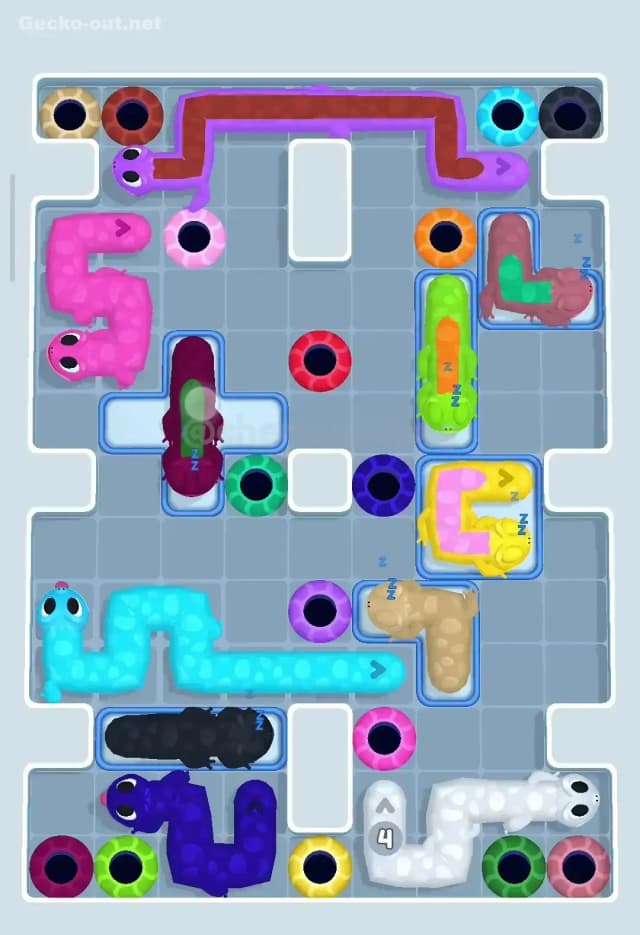
Starting layout in Gecko Out Level 286
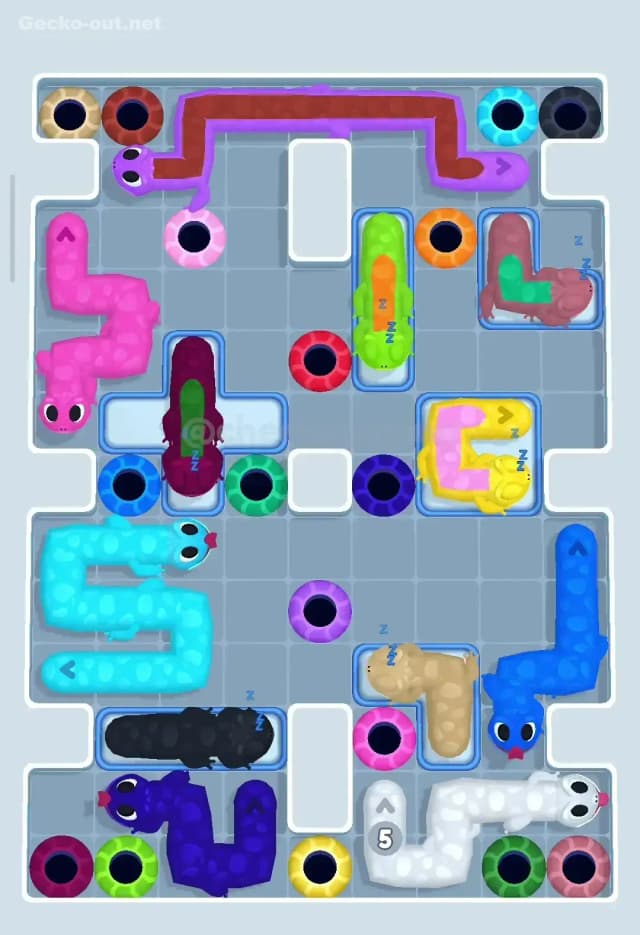
When you first load Gecko Out Level 286, it looks like a complete traffic jam. You’ve got a mix of awake and sleeping geckos, several of them trapped inside icy trays, and almost every color of exit hole scattered around the board. The long purple gecko stretched across the very top corridor immediately stands out; its body spans nearly the whole width and locks the upper center. Down the left side, a chunky pink gecko and an S‑shaped light‑blue gecko twist through the middle rows, eating up most of the central floor.
The lower half of Gecko Out 286 is dominated by big bodies: the S‑shaped cyan near the left, a long white gecko hugging the bottom, and a dark blue U‑shaped gecko near the bottom‑left exits. In the middle columns you’ve got several frozen “gang” stacks: a dark red gecko sharing a tray with a green one, a vertical green gecko in an icy track on the right, a yellow-and-pink pair in a right‑center tray, and a sleeping black gecko in a long icy lane at the bottom. Their exits are spread from top‑left to bottom‑right, so it’s not obvious which should move first.
Color‑matched exits ring the board: double tan holes at the top‑left, bright rings in the center, and a cluster of exits around the bottom corners. Some exits sit right beside sleeping geckos, teasing you, but blocking the central routes if you rush the wrong one. Gecko Out Level 286 is basically a knot of long bodies around a frozen core.
Why the timer and drag-path movement matter
The win condition in Gecko Out 286 is the same as always: every gecko must reach a hole of its own color before the timer hits zero. But the way drag‑path movement works is what makes this level nasty. When you drag a head, the tail traces every step you drew. If you take a scenic route, you leave a fat, twisty wall behind that other geckos can’t cross.
With the strict timer in Gecko Out Level 286, you don’t have time to experiment with ten different routes for each gecko. You need a planned order and fairly direct paths. Every detour costs both seconds on the clock and usable board space. The puzzle is really about designing paths that clear lanes for later geckos while not “cementing” a giant body across a critical exit.
Pathing Bottlenecks and Logical Traps in Gecko Out Level 286
The main choke geckos and corridors
The single biggest bottleneck in Gecko Out 286 is the S‑shaped light‑blue gecko in the lower left–center. Its body snakes across the middle rows and sits right between several central exits and the icy trays. Until you move it, the tan gecko in the bottom‑right tray and the sleeping black gecko at the bottom don’t have real routes to their exits.
The top corridor with the long purple gecko is the second major choke point. As long as purple is lying there, the tan exits at the top‑left are half‑blocked, and the path from upper left to upper right is sealed. Finally, the cluster of frozen gang geckos in the middle—especially the red/green stack and the yellow/pink pair—act like movable walls. Once you wake and move them, the entire center of Gecko Out Level 286 opens; before that, they’re just cumbersome obstacles.
Sneaky problem spots that ruin clean runs
There are a few subtle traps that make Gecko Out 286 feel unfair until you notice them:
- The narrow lanes between the icy trays and the central exits look like safe parking, but one sloppy path there can block two exits at once.
- The white gecko at the very bottom has its head near several exits. If you route it in a tight U shape, its body can permanently seal the lower corridor, trapping the dark blue and black geckos.
- The yellow and pink geckos in the right‑center tray share such a cramped starting area that exiting the wrong one first makes the other’s route awful. It’s easy to lock the second color behind a wall of your own making.
How Gecko Out 286 went from chaos to “click”
I’ll be honest: the first time I played Gecko Out Level 286, it felt like everything I moved made the level worse. I’d clear a gecko, feel smart for about two seconds, and then realize I’d just turned an open lane into a solid wall. The “click” moment came when I stopped trying to solve individual geckos and started thinking in layers: first free the long corridors, then empty the trays, then clean up the small leftovers.
Once that mindset kicked in, Gecko Out 286 went from impossible to “tight but fair.” The board is designed so that if you clear the big bodies first and respect the center lanes, the frozen and gang geckos suddenly have straightforward, almost boring paths.
Turn-by-Turn Path Strategy to Beat Gecko Out Level 286
Opening: first clears and safe parking zones
In Gecko Out Level 286, your opening goal is to free the main corridors without blocking exits.
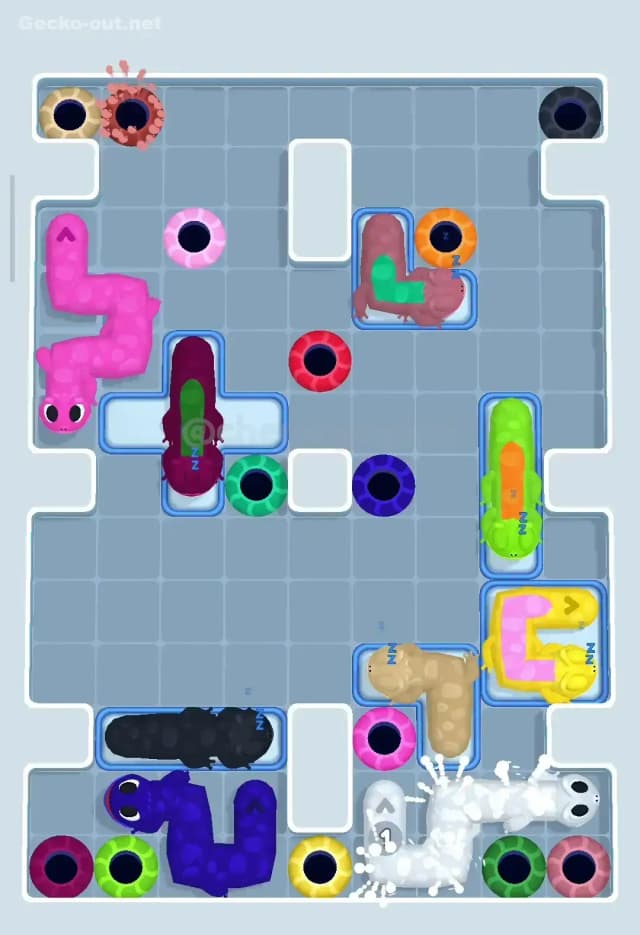
- Start with the long purple gecko at the very top. Drag it along the upper wall straight to its exit, keeping the path as flat as possible so you don’t dip into the middle. Once purple is gone, the top row becomes a clean highway.
- Next, clear the dark blue U‑shaped gecko near the bottom‑left. Guide it tightly around the bottom corner to its exit, again hugging the outer wall. This removes one of the worst obstacles near the lower exits.
- Now look at the white gecko at the bottom. Move it along the extreme bottom edge toward its hole, avoiding any sideways wobble into the central column. When done right, you’ve carved out a wide lane along the entire bottom.
Use the empty strip in the top‑middle and the open space under the left pink gecko as temporary parking later—try to keep those clear in your early moves.
Mid-game: keeping lanes open while you wake the board
With the outer edges opened, the mid‑game of Gecko Out 286 is all about the S‑shaped light‑blue gecko and the frozen trays.
- Move the S‑shaped light‑blue from the lower middle toward its exit in the left half of the board. Draw a fairly straight S that hugs the already‑cleared left edge, so its final body doesn’t cut across the central exits.
- Once light‑blue is out, you can start attacking the icy trays. Free the dark red/green gang stack in the center‑left first: slide it straight up or down, using the cleared vertical lane, then curve into the correct exit. Don’t snake around the center holes yet.
- After that, handle the vertical green gecko in the right‑side tray. Bring it out along the right wall toward its hole. This opens a clean right‑side corridor and gives breathing room to the yellow/pink stack.
- Finally, exit the yellow gecko from the right‑center tray before the pink one. Yellow has the more awkward route; once it’s gone, pink can turn the corner comfortably.
Through all of this, keep an eye on the central exits. Whenever you draw a path that passes between two holes, ask yourself: “Will this body stop anyone else from turning into those?” If the answer is “maybe,” redraw more tightly along a wall.
End-game: final exits, choke points, and low-time tactics
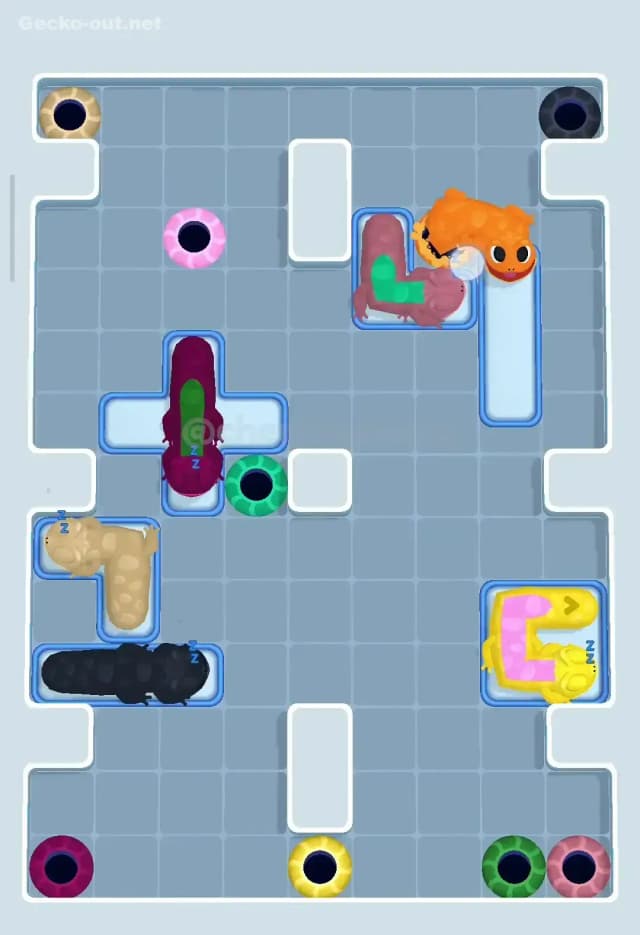
The end‑game of Gecko Out Level 286 is usually a cluster of short, previously sleeping geckos: the tan one in the lower tray, the black one in the long icy lane, and any small stragglers near the top‑left exits.
- Free the black gecko from its bottom icy lane using the already‑cleared bottom row. Make a single, smooth path up to its exit without looping back over the center.
- Then bring the tan gecko out of its tray and guide it up to the double tan exits at the top‑left, sliding along the open left wall and then across the now‑empty top row.
- Clean up any leftover small geckos (like the upper‑left pink) using direct, no‑nonsense paths straight to their holes.
If you’re low on time, don’t panic. At this stage, paths are short; you can commit quickly. It’s better to make a slightly sub‑optimal but direct line than to hesitate and run out of seconds.
Why This Path Order Works in Gecko Out Level 286
Using body-follow pathing to untangle instead of tighten
This plan for Gecko Out 286 works because it respects the body‑follow rule. By clearing the long outer geckos first and tracing them along the walls, you “frame” the puzzle without clogging the center. When the S‑shaped light‑blue and the icy gang geckos finally move, they inherit wide, straight corridors. That turns complicated knots into simple one‑turn paths, instead of forcing you to weave around earlier mistakes.
Balancing planning time vs. fast execution
On Gecko Out Level 286, I like to use the first attempt almost as a scouting run: don’t worry if you fail the timer; just watch which exits get accidentally blocked. Once you understand the order—outer lanes, S‑blue, trays, bottom sleepers—you can run it again with confident, fast drags. Spend your thinking time before you touch a gecko; once you start moving, commit and trust the outline.
Boosters in Gecko Out 286: helpful but optional
Boosters are totally optional here. If you’re stuck, an extra‑time booster can be nice the first time you try the full route, just to reduce stress. A hammer‑style tool that clears a single obstacle isn’t really necessary if you follow the wall‑hugging paths; Gecko Out Level 286 is designed to be solvable cleanly. I’d save boosters for levels with true hard locks rather than this timing‑tight but fair layout.
Mistakes, Fixes, and Logic You Can Reuse in Other Gecko Out Levels
Common errors on Gecko Out Level 286 (and how to fix them)
- Moving the S‑shaped light‑blue gecko too early and parking it across the center. Fix: only move it after the bottom and top corridors are clear, and route it along the left edge.
- Letting the white bottom gecko curl upward into the middle. Fix: keep its entire path glued to the bottom row until it’s ready to turn directly into its hole.
- Exiting pink before yellow in the right‑center tray. Fix: always clear the harder‑to‑route yellow first, then let pink use the freed space.
- Drawing fancy zigzags to “use space.” Fix: shorter paths are almost always better; they leave more room for others and cost less time.
- Ignoring the top‑left tan exits until the end. Fix: plan early how the tan gecko will reach them along the left wall so you don’t accidentally seal the route with other bodies.
Reusing this logic on knot-heavy or gang-gecko stages
The strategy from Gecko Out 286 carries over nicely to other knotty Gecko Out levels:
- Clear long edge geckos first, hugging walls so they become borders, not obstacles.
- Treat frozen or gang geckos like temporary walls until you’ve opened clean lanes for them.
- Decide an exit order based on who blocks whom, not on who looks nearest to a hole.
- Use open strips as deliberate parking zones and try to keep them free until the late game.
Final encouragement for clearing Gecko Out 286
Gecko Out Level 286 looks brutal at first glance, but once you see it as a sequence—outer lanes, S‑shaped bottleneck, icy trays, then sleepers—it becomes a satisfying, almost rhythmic solve. You don’t need pixel‑perfect dragging or boosters; you just need to respect the corridors and keep your paths clean. Stick to the order in this guide, adjust the exact curves to your own style, and Gecko Out 286 will go from “impossible mess” to one of those levels you clear and immediately think, “Okay, that was actually pretty fun.”