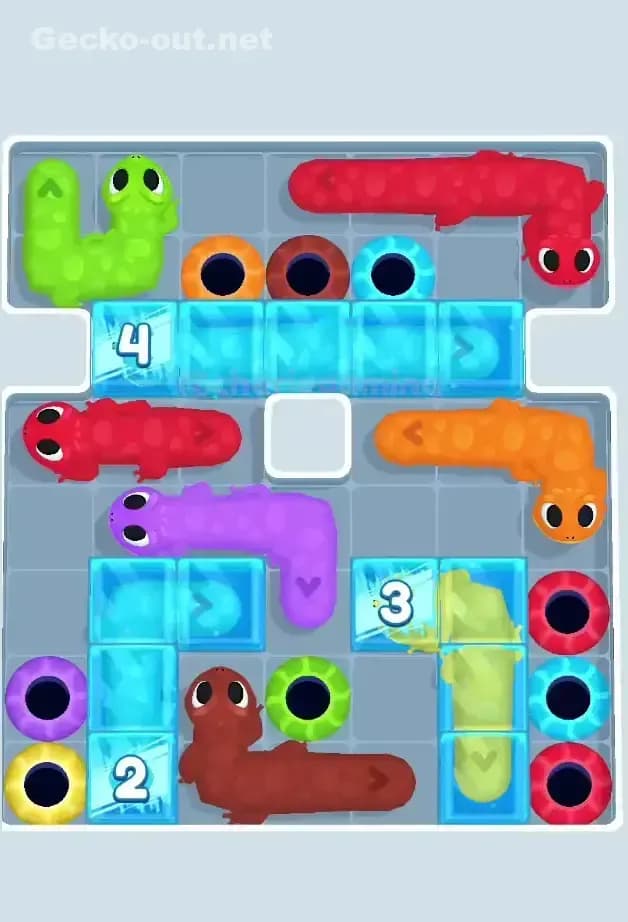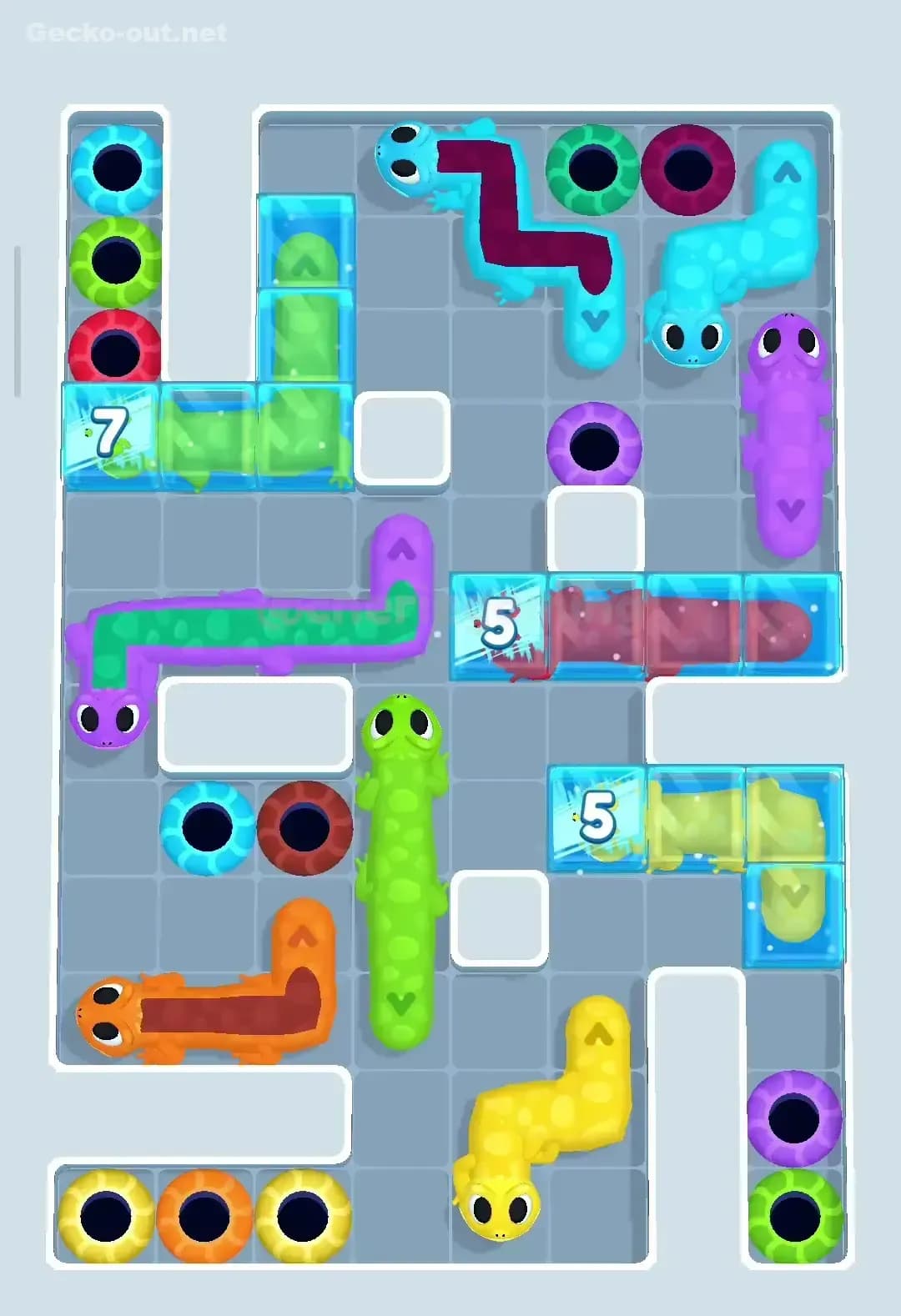
Gecko Out Level 20 Solution Walkthrough | Gecko Out 20 Answer
How to solve Gecko Out level 20? Get step by step solution & cheat for Gecko Out level 20. Solve Gecko Out 20 easily with the answers & video walkthrough.
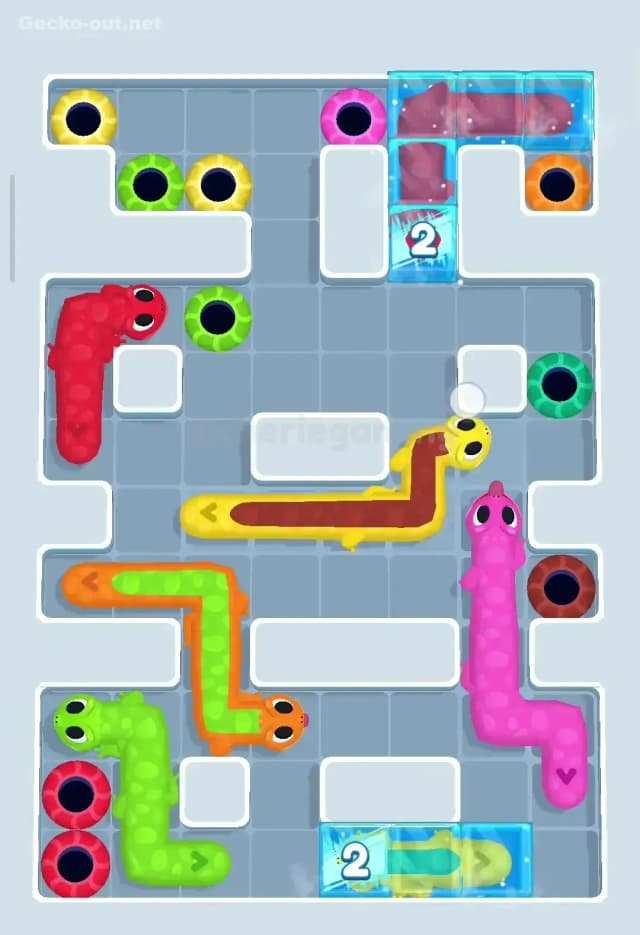

Gecko Out Level 20: Board Layout, Rules, and Win Condition
How the Board Looks and What’s On It
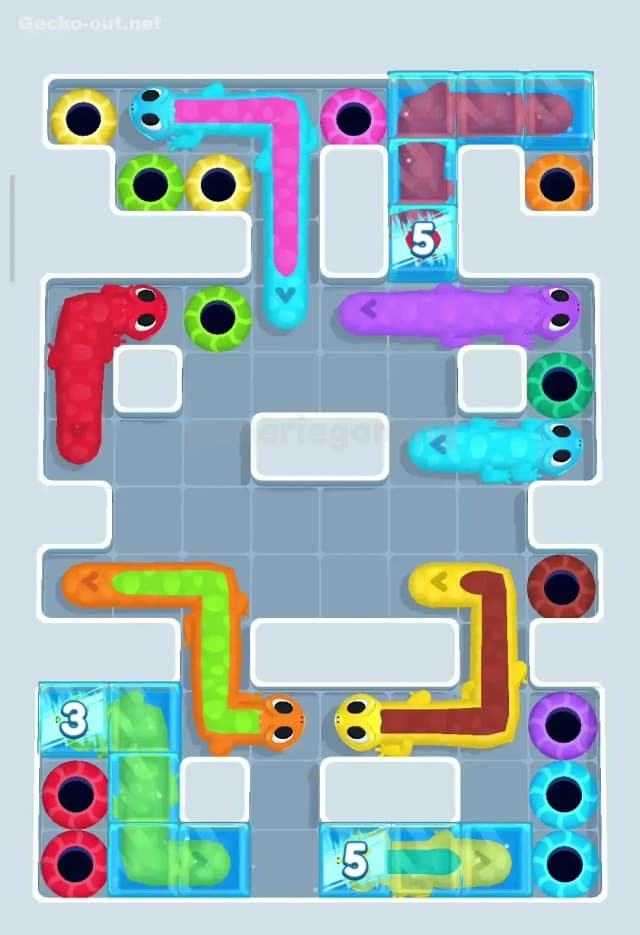
Gecko Out Level 20 throws a lot at you at once. You’ve got a ring-shaped board with a hollow center and narrow corridors around the outside. Most of the geckos start already stretched out in L- and U‑shapes along the edges, which means the grid looks tangled before you even touch anything.
You’re dealing with several colors: red, purple, orange, yellow, a couple of light‑blue geckos, and a green gecko that starts frozen in ice near the bottom. Some exits sit right next to their geckos; others are on the far side of the ring, forcing you to drag long, awkward paths that wrap around walls. A few exits are grouped together in color “banks,” so clearing one color often means threading past exits that belong to someone else.
On top of that, Gecko Out 20 uses icy blocks with countdown numbers (like 3 and 5). Those mark frozen geckos or blocked corridors that only unlock after enough actions (usually exits) happen. Until the ice melts, those geckos are dead weight: they still block space, but you can’t move them. The combination of frozen bodies, gang‑style shared colors, and narrow channels is what makes this level feel like a knot rather than a simple maze.
Win Condition and Why the Timer Hurts Here
The win condition is classic: every gecko must slither into a hole of its own color before the timer hits zero. If even one is still outside, you fail Gecko Out Level 20. Because you drag the head and the body traces the exact line you draw, every path you make is also a temporary wall for all the other geckos.
This level punishes random swiping. The corridors are so tight that one badly drawn curve can cut off an entire half of the map. The timer is strict enough that you can’t rebuild paths endlessly, but you also can’t just spam moves. You need a plan for which color leaves first, which ones you “park” in safe corners, and how you’ll open the frozen sections at the right time.
Pathing Bottlenecks and Logical Traps in Gecko Out Level 20
The Main Bottleneck: The Central Ring Corridor
The single biggest bottleneck in Gecko Out 20 is the loop of corridor that runs just inside the outer walls. Almost every gecko has to pass through some part of this ring to reach its exit. If you block any of the vertical segments of that loop with a badly parked gecko, the rest of the board locks up.
The red and purple geckos, along with the yellow/brown gang gecko on the lower right, all want to use the same right‑side lanes. Meanwhile, the orange and frozen green geckos fight for space on the lower left once the ice breaks. Think of the ring as a one‑lane road: you must keep a clean lane open along either the inside edge or the outside edge at all times.
Subtle Problem Spots That Catch You
-
The frozen green gecko near the bottom left sits under a “3” ice block and covers a pair of exits. If you don’t plan for it, you’ll happily exit three other geckos, the ice will melt, and suddenly that green body is clogging the entire corner just when you need clean paths.
-
The upper‑right section with the ice‑blocked red segments and a “5” is another trap. That area looks like free wall space early on, but once the ice melts, the red body appears in the exact corridor you were using. If you’ve parked someone there, you’re stuck.
-
The right‑side exit bank is tight. The purple and yellow/brown geckos both want to swing their tails through there. If you exit the wrong one first, the remaining gecko has to turn around in very little space, often colliding with walls or exits of other colors.
When Gecko Out 20 Finally “Clicks”
I’ll be honest: Gecko Out Level 20 feels unfair on the first few attempts. I kept solving 80% of the board, then hitting a frozen gecko or a suddenly‑appearing red body that made my beautiful path useless. The frustration comes from that “I was so close” feeling.
It started to make sense when I stopped thinking “How do I get this one gecko out?” and started asking “If I move this gecko here, what space will still be usable for everyone else later?” Once I treated every path as temporary scaffolding rather than a final decision, the solution clicked. You’re not just freeing geckos; you’re choreographing traffic.
Turn-by-Turn Path Strategy to Beat Gecko Out Level 20
Opening: Clear Space Without Closing Lanes
-
Start with the purple gecko on the right. Drag its head along the outer edge, hugging the wall, and send it cleanly to its purple exit in the right‑side bank. Keep the path as straight and tight to the wall as possible so you don’t cut into the central ring.
-
Next, take the upper light‑blue gecko. Route it down and around along the top and right edges, then into its matching blue exit near the right side. Again, you’re hugging edges so the middle lanes stay pristine.
-
Use the early turns to “park” the red gecko in the upper left and the yellow/brown gang gecko at the lower right. Slide them into corners where their bodies run flush against walls and don’t jut into the central ring. Parking correctly here is key: you want their tails out of the way until the frozen pieces thaw.
By the time you’ve exited two or three geckos, the “3” ice over the green gecko will melt. Don’t rush it yet; just note that the bottom-left corner is now live.
Mid-Game: Protect the Ring and Prepare for Ice Breaks
-
Move the orange gecko on the lower left along the inner edge of the ring, taking it to its orange exit without straying into the central tiles more than necessary. If you can, trace its route along the exact boundary between walls and the ring.
-
Now address the newly thawed green gecko. Its corner is cramped, so first check that no other gecko is blocking the lower ring lane. Drag the green gecko in a short, efficient path straight to its green exit. Don’t do fancy loops; the longer the tail, the more likely you are to cut off someone else.
-
After enough exits, the “5” ice on the upper-right red segments opens. At this stage, you should have most of the right side already cleared. Guide the red gecko so that its path hugs the outer left wall, then curves through the now‑open upper ring to its red exit.
Throughout mid‑game, never let a gecko rest in the vertical channels that connect top and bottom. If you need to pause a gecko, coil it tightly in a dead‑end corner, not in the ring.
End-Game: Exit Order and Low-Time Panic Plan
By the time you reach the final two geckos (usually the yellow/brown gang gecko and the last light‑blue one), the board is open but the timer is low.
-
Exit the yellow/brown gang gecko first. Use the freed right‑side lanes to swing it in a smooth L‑shape into its matching exit. Because its body is long, any awkward detour can block both right‑side exits and trap the last gecko.
-
Finish with the last light‑blue gecko. At this point, you should have a clean, nearly empty ring. Just drag quickly and directly to its exit. If you’re under heavy time pressure, don’t overthink the path—just avoid unnecessary loops.
If you realize you’ve boxed yourself in near the end, it’s usually faster to restart Gecko Out 20 and apply the proper exit order than to try to untangle everything with only a few seconds left.
Why This Path Order Works in Gecko Out Level 20
Using Body-Following to Untie the Knot
This plan works because it respects the body-follow rule. Every route deliberately hugs walls or already-cleared edges, so the trailing body becomes a “temporary wall” that doesn’t cut off future paths. When you send purple and blue out first along the outer right wall, you’re freeing the right‑side ring instead of clogging it.
Exiting orange and green in sequence on the left pushes their tails along the bottom and left edges, keeping the center open. Saving the long yellow/brown gecko until the end means you’re never forced to drag its big body through a crowded corridor. Instead, you give it the whole ring to itself as a final lap.
Timer Management: When to Think vs. When to Swipe
On Gecko Out Level 20, I like to spend the first 5–10 seconds just reading the board: spot the ice blocks, notice which exits are buried, and mentally mark “no‑parking zones” in the ring. Once you’ve locked in the exit order—purple, blue, orange, green, red, yellow/brown, last blue—you should shift into execution mode and swipe confidently.
The only times you should pause mid-run are right when new ice melts. Each thaw changes how safe the nearby corridors are. Glance, adjust your mental model, then keep going. Hesitating on every gecko wastes more time than carefully planning the start.
Boosters: Optional, Not Essential
You don’t need boosters to beat Gecko Out 20 if you follow this route.
- Extra time: nice but unnecessary. It mainly helps if you’re still learning the exit order.
- Hammer/unfreeze tools: tempting for the green gecko in the corner, but using them early actually makes the board more chaotic. It’s easier to play around the frozen body and let it thaw naturally.
- Hints: they’ll usually highlight one or two moves, but they won’t teach the overall traffic pattern. Use them only if you’re totally stuck on which gecko should go next.
Mistakes, Fixes, and Logic You Can Reuse in Other Gecko Out Levels
Common Gecko Out 20 Mistakes and How to Fix Them
-
Parking in the ring: Leaving a gecko’s midsection in a vertical or horizontal ring corridor is the #1 way to soft‑lock the level. Fix: always park in corners or dead‑ends, never on the main loop.
-
Freeing green too late: If you ignore the bottom-left ice until the end, the green gecko wakes up into a crowded board. Fix: plan to exit it right after the ice melts and before the big yellow/brown gecko moves.
-
Overdrawing paths: New players draw wide, curvy routes because it feels fun. On Gecko Out Level 20 that just bloats the bodies. Fix: think “minimal path.” If a straight 3‑tile line works, don’t make it 7 tiles.
-
Exiting the long gang gecko too early: Sending the yellow/brown gecko out first usually sweeps its tail across half the map and blocks later exits. Fix: keep it parked until most other colors are gone.
-
Panic dragging under time pressure: When the timer turns red, it’s tempting to just swipe wildly. Fix: even when low on time, stick to edges and avoid crossing the ring diagonally. A short, clean path is faster than a messy one that forces a restart.
Reusing This Logic in Other Knot-Heavy Levels
The habits you build on Gecko Out 20 carry over beautifully to later stages:
- Identify the main “highway” corridors and mark them as no‑parking zones.
- Exit short, easy geckos first to free space, then deal with long or gang geckos once the board is open.
- Treat frozen geckos and countdown ice as future obstacles—plan where their bodies will appear, not just where they are now.
- Hug walls with your paths so bodies become harmless borders instead of central blockades.
Final Encouragement
Gecko Out Level 20 looks brutal at first, but it’s absolutely beatable once you see it as a traffic puzzle rather than a simple maze. With a clear exit order, respect for the central ring, and tight, efficient paths, you’ll go from “I keep getting stuck at the end” to clearing the level with a few seconds still on the clock. Stick with this plan, tweak it to your own swiping style, and Gecko Out 20 turns from a wall into a very satisfying win.