
Gecko Out Level 1149 Solution Walkthrough | Gecko Out 1149 Answer
How to solve Gecko Out level 1149? Get step by step solution & cheat for Gecko Out level 1149. Solve Gecko Out 1149 easily with the answers & video walkthrough.
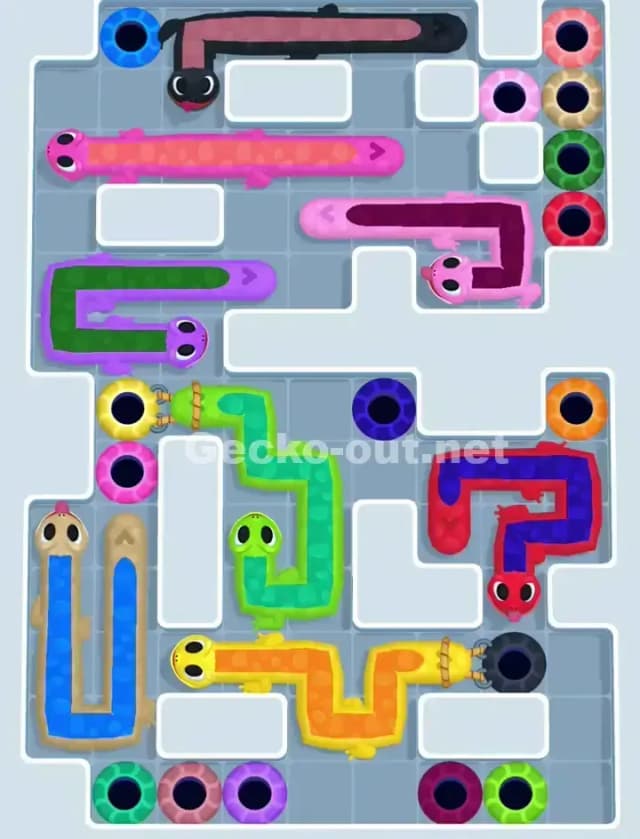



Gecko Out Level 1149: Board Layout, Rules, and Win Condition
Understanding the Board and Starting Position
Gecko Out Level 1149 throws a lot at you right from the start. You're looking at a dense, multi-colored puzzle with eight distinct geckos scattered across a tightly woven board. There's a blue gecko anchored in the top-left corner, a long magenta gecko stretched horizontally near the top, a purple-and-green gang gecko forming an L-shape on the left side, a lime-green gecko snaking through the middle, a dark magenta gecko on the right, a red-and-blue gecko forming another complex shape on the far right, and finally two geckos at the bottom—one blue and one orange—each with unique path requirements. The board is divided by numerous white wall obstacles that create dead ends and force you to thread your movements carefully. The timer sits at the top, and you've got a limited window to guide all eight geckos to their matching colored exit holes. Don't be fooled by the apparent chaos—this level is designed to teach you about sequential pathing, and every gecko has a specific safe exit route if you think it through.
Win Condition and Timer Pressure
To beat Gecko Out Level 1149, every single gecko must reach a hole matching its color before the timer hits zero. The challenge isn't just about finding any path to an exit; it's about finding paths that don't create gridlock. Since you drag a gecko's head and its body follows the exact route you've drawn, one poorly planned path can lock another gecko into an unwinnable position. The timer adds constant pressure—you need to move decisively while also pausing to plan, which creates a mental balancing act that makes this level feel genuinely tricky.
Pathing Bottlenecks and Logical Traps in Gecko Out Level 1149
The Critical Choke Point: The Top-Right Corridor
The absolute biggest bottleneck in Gecko Out Level 1149 is the top-right area where multiple exit holes cluster together. The red, pink, black, and green exit holes are jammed into a small vertical strip on the right side of the board, yet the geckos wanting to reach them are spread across the middle and upper sections. The dark magenta gecko and the red-and-blue gecko both need to thread through a narrow corridor to reach their respective holes, and if you move the wrong gecko first, you'll create a body-blocking situation that leaves the other gecko with nowhere to go. This single area accounts for roughly 60% of failed attempts on Gecko Out Level 1149, so managing it becomes your primary strategic focus.
Subtle Trap One: The Purple-Green Gang Gecko's Locked Spiral
The purple-and-green L-shaped gecko on the left side looks like it should exit directly downward, but the white wall obstacles force it into a spiral pattern that consumes a lot of board real estate. If you move this gecko too early, its long body will anchor itself across the middle-left section, blocking the path the lime-green gecko needs to use. Many players drag this gecko out without realizing they've just locked themselves into a dead end with the green gecko still needing to escape.
Subtle Trap Two: The Magenta Horizontal Stretch
The long magenta gecko at the top of Gecko Out Level 1149 is deceptively wide. When you drag its head down toward its exit, its body doesn't compress—it follows your exact path, snaking around corners and potentially crossing the lanes needed by other geckos. If you drag it straight down without planning the full route, you'll find that you've created an impassable horizontal wall halfway through your solution.
Subtle Trap Three: The Bottom Dual-Gecko Coordination
The blue and orange geckos at the bottom seem separate, but their exit paths actually intersect. The blue gecko's hole is on the lower left, and the orange gecko's is on the lower right, yet both must navigate through a shared middle section. Time your movements wrong, and you'll have one gecko's body blocking the other gecko's exit lane—a frustrating situation when you're down to the final two.
A Personal Moment of Clarity
I'll be honest: my first three attempts at Gecko Out Level 1149 felt like I was playing Tetris blindfolded. I'd move what seemed like a safe gecko, and suddenly the board would lock up in an unexpected way. Then something clicked. I realized I wasn't thinking about which gecko wanted to leave—I was thinking about which gecko could leave without trampling everyone else's path. That shift in perspective made the puzzle transform from chaotic to logical. The moment I mapped out the exit corridor geometry first, everything else fell into place.
Turn-by-Turn Path Strategy to Beat Gecko Out Level 1149
Opening: Secure the Blue Gecko and the Orange Gecko
Start by moving the blue gecko in the top-left corner. Its exit hole is directly accessible via a short downward path along the left edge. Drag its head straight down, and its body will follow cleanly to the blue exit hole near the bottom-left. This removes a major piece from the board and opens up the left corridor for other geckos. Next, move the orange gecko at the bottom-right toward its orange exit hole. Its path is slightly longer but still relatively unobstructed if you move it now, before the board gets crowded. These two moves establish safe zones and give you breathing room to handle the complex geckos in the middle.
Mid-Game: Unpack the Knotted Central Area
Once the edges are clear, tackle the lime-green gecko next. It's a medium-length gecko that needs to snake through the middle section toward the green exit hole on the right. Drag its head carefully around the white wall obstacles, moving it rightward and slightly upward. The key here is patience—don't rush the path. If you move the lime-green gecko too quickly or incorrectly, it'll block the dark magenta gecko's exit lane. After the green gecko is safe, move the magenta gecko from the top. Its long body needs to curve downward and rightward to reach the magenta exit hole. This is where you'll slow down and really focus on not creating a horizontal wall of gecko that blocks everyone else.
Mid-Game Continued: Manage the Gang Gecko
The purple-and-green gang gecko on the left is a gang gecko, meaning the purple and green sections move as one unit. Move the head carefully down and around the white obstacles, ensuring its spiral path doesn't block the lime-green gecko (which you've already moved, so this should be fine). This gecko takes up a lot of space during its exit, so move it after you've cleared the lime-green gecko but before you commit to the final geckos.
End-Game: The Right-Side Tight Squeeze
Here's where Gecko Out Level 1149 gets tense. You've got three geckos left, and all of them are eyeing the top-right cluster. The dark magenta gecko, the pink gecko, and the red-and-blue gecko all need to thread through a narrow area to reach their holes. Move the dark magenta gecko first—drag its head upward and rightward toward the magenta exit hole, being very careful not to cross paths with the pink or red geckos' intended routes. Then move the pink gecko toward the pink exit hole, which is slightly higher and to the right. Finally, move the red-and-blue gecko toward its corresponding hole. Watch the timer constantly during this phase; you've got enough time to do this methodically, but you don't have time to redo it.
Last-Second Safety: The Final Blue-and-Pink Bottom Geckos
If you've still got geckos lingering at the bottom—unlikely if you've followed this order, but possible—move them last. Their paths are the most forgiving because the board is already empty, so you have full freedom to plot their routes to their respective holes.
Why This Path Order Works in Gecko Out Level 1149
The Body-Follow Rule and Untangling Strategy
The core reason this path order defeats Gecko Out Level 1149 is that it respects the body-follow rule: each gecko's body traces the exact route you drag its head along. By moving the edge geckos (blue and orange) first, you remove the static obstacles that would otherwise force later geckos into suboptimal paths. Then, by moving the medium-length geckos (lime-green and magenta) before the complex gang geckos (purple-and-green), you ensure that the board progressively opens up rather than progressively closes off. Finally, by saving the right-side cluster geckos for last, you're moving through a zone where you've already cleared competing traffic, so the narrow corridor becomes a navigable space rather than an impossible knot.
Timing Your Moves: When to Pause and When to Commit
Gecko Out Level 1149 gives you roughly 90–120 seconds, which sounds tight but is actually generous if you don't waste time second-guessing yourself. My strategy: pause for five seconds before each gecko, mentally trace its path to its exit hole, ensure it doesn't cross any other gecko's likely route, then commit to the drag and execute it smoothly. Don't hesitate mid-drag or try to correct yourself—the timer will punish you. However, if you realize mid-level that you've made an error (like accidentally creating a wall), don't panic. You can still recover by moving the offending gecko's body entirely off-screen by dragging it to a dead-end hole, which removes it and frees up space for the remaining geckos.
Boosters: Optional, Not Necessary
Gecko Out Level 1149 doesn't strictly require boosters, but they can be helpful safety nets. If you're running low on time with one or two geckos still on the board, a time-extension booster is your friend. If you're stuck on the geometric puzzle itself and can't figure out a path, a hint booster can clarify the intended route. However, the booster I'd recommend avoiding is the "hammer" tool—it's tempting to smash obstacles, but Gecko Out Level 1149's obstacles are part of the puzzle, not the enemy. Your real adversary is spatial planning. That said, if you've made a critical path error and are down to two minutes with three geckos remaining, spending a booster to extend the timer might be better than restarting entirely.
Mistakes, Fixes, and Logic You Can Reuse in Other Gecko Out Levels
Mistake One: Moving Long Geckos Without a Full Route Plan
The Problem: Many players drag a long gecko's head toward an exit without planning the entire path first. This often results in the body snaking across critical corridors and blocking other geckos.
The Fix: For every gecko longer than three segments, pause and trace the full path with your finger before you touch the game. Identify where its body will be after the head reaches the exit. If that body-path crosses another gecko's home position, you've got a sequencing problem—move other geckos first.
Mistake Two: Ignoring the Clock Until It's Too Late
The Problem: Players get absorbed in the puzzle and only notice the timer when there's 10 seconds left and three geckos still on the board.
The Fix: Glance at the timer every two geckos. If you've moved four geckos and you're below 30 seconds, speed up and simplify your remaining routes. Gecko Out Level 1149 rewards efficiency, so constant awareness prevents panic.
Mistake Three: Trying to Find the "Perfect" Path Instead of a Working Path
The Problem: Perfectionists spend 40 seconds finding an elegant route when a functional one would take 10 seconds.
The Fix: Your goal is to beat Gecko Out Level 1149, not to solve it beautifully. A path that hits the exit cleanly is always better than the prettier path that doesn't fit in the timer. Move fast and functional.
Mistake Four: Misreading Gang Gecko Behavior
The Problem: Gang geckos (where two colored sections move as one unit) confuse players who think they can separate the two parts.
The Fix: When dragging a gang gecko's head, remember that the entire structure moves as a single path. Plan for the full body length of both sections combined. Gecko Out Level 1149's purple-and-green gang gecko is especially tricky—account for the full L-shape, not just the visible colored outline.
Mistake Five: Getting Blocked in the Right-Side Corridor and Panicking
The Problem: Three geckos converge on the right-side exit area, and one gets locked behind another's body.
The Fix: If this happens, immediately move the blocking gecko out of the way by dragging it to any available hole (doesn't have to be the right exit—get it off the board). This creates space for the trapped gecko to escape. Yes, you'll need to restart, but knowing this escape hatch prevents full-board gridlock.
Logic You Can Reuse on Similar Levels
This path-sequencing logic applies to any Gecko Out level with multiple geckos competing for a narrow exit corridor. Whenever you see a bottleneck (especially on the right or top side of the board), prioritize moving geckos away from that zone first, working inward. Gang geckos always get moved after their immediate neighbors are cleared. Long geckos get moved before short ones to minimize body-path interference. These principles transform chaotic-looking boards into solvable puzzles.
The Encouraging Truth About Gecko Out Level 1149
Yes, Gecko Out Level 1149 is genuinely difficult. It combines gang geckos, spatial constraints, a crowded exit zone, and a timer—a lethal combination if you don't have a plan. But it's absolutely beatable, and once you crack it, you'll feel the satisfaction of solving a genuinely clever puzzle. The board isn't unfair; it's just asking you to think sequentially and respect the geometry. You've got this. Take a breath, map out your gecko order, and trust the logic. Gecko Out Level 1149 will fall on your next try.