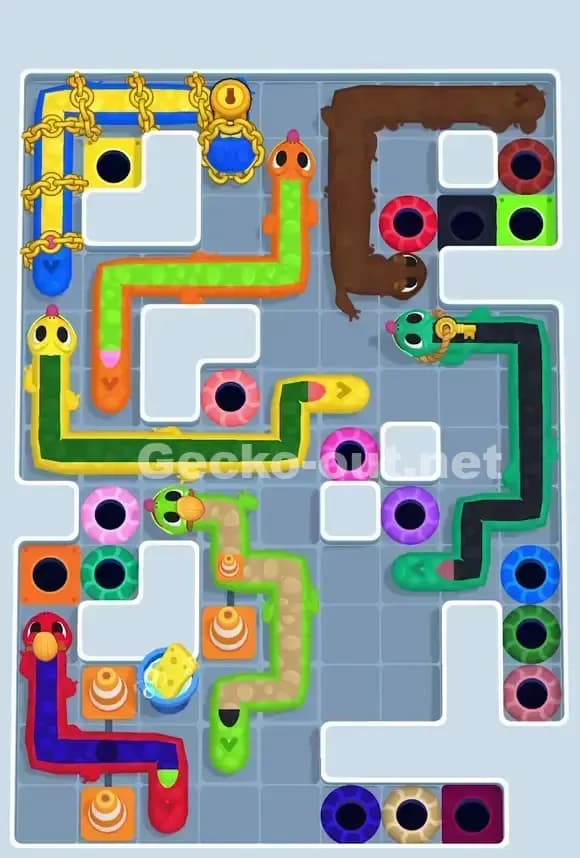
Gecko Out Level 716 Solution Walkthrough | Gecko Out 716 Answer
How to solve Gecko Out level 716? Get step by step solution & cheat for Gecko Out level 716. Solve Gecko Out 716 easily with the answers & video walkthrough.
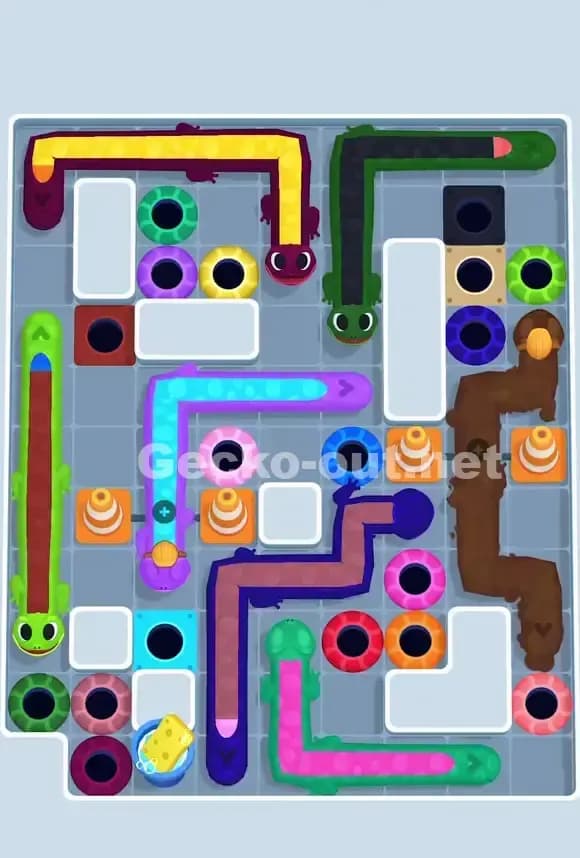
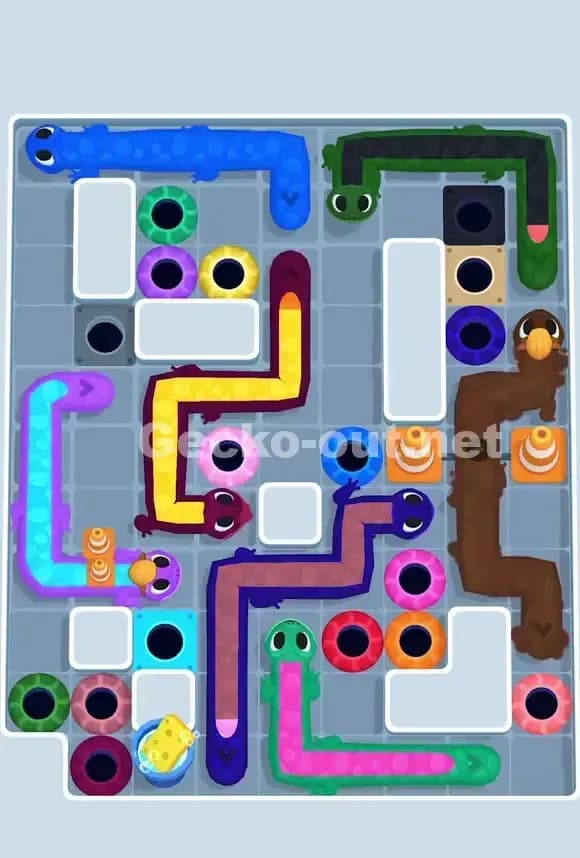
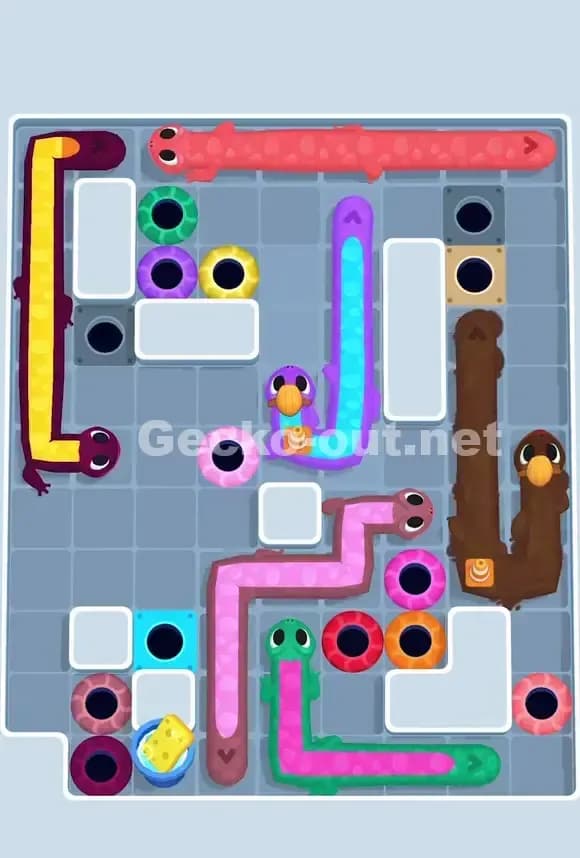
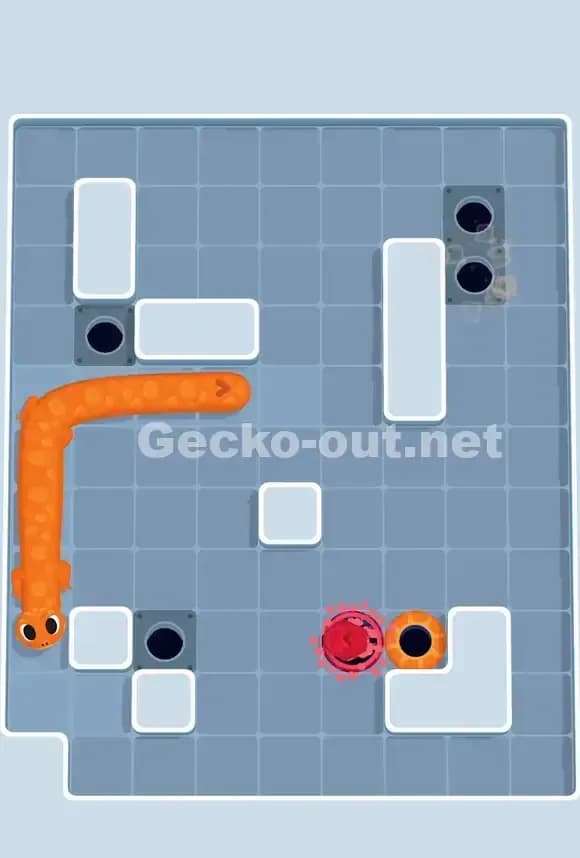
Gecko Out Level 716: Board Layout, Rules, and Win Condition
Starting Board and Key Obstacles
Gecko Out Level 716 is a complex multi-gecko puzzle with seven geckos of different colors spread across a densely packed grid. You're working with green, yellow, purple, pink, blue, brown, and red geckos, each needing to reach its matching-colored exit hole before time runs out. The board is crammed with white rectangular obstacles (walls that block direct paths), colored toll gates, warning holes, and tight corridors that create natural chokepoints. The layout feels intentionally claustrophobic—there's almost no wasted space, and most geckos are positioned far from their exits, meaning you'll need to navigate long, winding paths through shared corridors.
What makes Gecko Out Level 716 particularly tricky is that several geckos are physically close to each other but heading in completely different directions. The green gecko on the left side has a notably long body that'll stretch across multiple cells as you drag its head toward the green exit. The purple and pink geckos in the upper-middle area are tangled near several toll gates, and the brown gecko on the right side creates a wall-like barrier that other geckos can't pass through once it's positioned. This spatial collision problem is the core puzzle you're solving.
Win Condition and Timer Pressure
You win Gecko Out Level 716 when all seven geckos have successfully exited through their matching-colored holes before the timer hits zero. The timer is your constant pressure—it forces you to think ahead and execute paths efficiently rather than trial-and-error your way through the board. Every second counts, and hesitation compounds as geckos queue up waiting for their turn. The drag-based pathing system means you can't just "nudge" a gecko; once you drag a head, the entire body follows that exact route. If your path is inefficient or creates a traffic jam, you're eating precious time and potentially blocking exits for other geckos.
Pathing Bottlenecks and Logical Traps in Gecko Out Level 716
The Critical Choke Point: The Brown Gecko Corridor
The single biggest bottleneck in Gecko Out Level 716 is the brown gecko and its control of the right-side corridor. This gecko is long and sits in a position where its body, once moved, will occupy a major transit lane. Multiple other geckos need to pass through or near that area to reach their exits, but if you move the brown gecko carelessly, you'll block the path for the blue gecko and potentially the orange-adjacent exits. The brown gecko must be one of your first moves, but you need to drag it in a way that clears the corridor rather than blocking it further. This is where most players lose time—they move it without thinking and suddenly realize it's now a wall preventing other geckos from leaving.
Hidden Traps: The Toll Gates and Gang Mechanics
Gecko Out Level 716 features several toll gates (colored barriers that require a specific action or sequence to pass) scattered throughout the middle section. The purple and pink geckos are near these gates, and dragging them without understanding gate mechanics will leave them stuck. Additionally, some geckos appear to be "ganged" or linked—moving one affects positioning constraints for others nearby. The yellow gecko and purple gecko have this dynamic; if you move the yellow gecko too aggressively into shared space, you'll compress the purple gecko and lock yourself into a dead-end path. The warning holes (fake exits that look like real ones but eject geckos back onto the board) are positioned to catch hasty players, especially the pink and cyan-colored decoys in the lower-middle zone.
The Moment It Clicks
I'll be honest—my first three attempts at Gecko Out Level 716 felt chaotic and overwhelming. I kept moving geckos reactively, assuming I'd find space as I went, and every time I'd hit a dead-end with three geckos still on the board and thirty seconds left. The breakthrough came when I stopped treating this as a "move geckos out as fast as possible" puzzle and started treating it as a "create a logical sequence where each gecko's exit doesn't interfere with the next gecko's path" problem. Once I mapped out the exit order first—instead of just dragging—suddenly the board opened up. That shift from reactive to strategic is what Gecko Out Level 716 teaches you, and it's genuinely satisfying once it lands.
Turn-by-Turn Path Strategy to Beat Gecko Out Level 716
Opening: Establishing Safe Parking and Clearing the Brown Gecko
Start by moving the brown gecko on the right side first. Drag its head downward and around the lower-right corridor, creating a clear lane for other geckos to move rightward without hitting its body. This gecko is a bottleneck, so removing it from the critical center corridor is your priority. Park it in a position where its exit is close and direct—you'll come back to finish it, but the goal here is to clear the space it's blocking. Next, tackle the green gecko on the far left. This long gecko has room to extend downward safely; drag its head to wind it around the left-side wall and toward the green exit at the bottom-left. This move opens the left corridor and establishes your first clean exit, building momentum and reducing board congestion.
After those two, move the yellow gecko. It's in the upper-middle area and can be dragged upward through an open space before curving toward its exit. The yellow exit is accessible if you path carefully around the white obstacles. By clearing yellow early, you reduce the number of geckos competing for the central corridors. These three initial moves should consume about 30–40 seconds and leave you with roughly half the board clear.
Mid-Game: Maintaining Open Lanes and Repositioning Long Bodies Safely
Now you're facing the trickier geckos: purple, pink, blue, and red. The purple gecko should go next. Identify the toll gate near it and determine whether you need to bypass it or activate it. Drag purple's head carefully through the least-obstructed path toward its exit, avoiding the warning holes in the lower-middle zone. Once purple is out, pink becomes more accessible—they were competing for space, and removing purple opens up real estate. Drag pink around the central area, keeping its path wide and avoiding overlaps with any remaining geckos.
The blue gecko is in the middle-right area and has a decent exit path if the brown gecko is already parked. By this point, brown should be mostly out of the way (or nearly exited), so blue can move relatively freely. Drag it downward and toward its exit without hesitation. The red gecko is in the lower-left area and can be managed last among this group. Keep these mid-game moves purposeful—every second you spend hesitating is a second the timer is eating, and you still have exits to manage.
End-Game: Final Exits and Last-Second Timing
In your final 30–40 seconds, you should have only one or two geckos left. If you've executed the sequence above, they're typically geckos that were far from their exits or had minimal space to move. Drag their heads with confidence; you've already cleared the board, so there shouldn't be unexpected collisions. Watch the timer closely—if you're below 15 seconds with two geckos still on the board, focus on whichever gecko has the shortest path to its exit and finish it first. Never let a gecko queue up behind another one in the final stretch, as that creates a deadlock where both fail. If you genuinely can't make it in time, a booster (extra time or a hint) used in the final 10 seconds can save your run, but a well-sequenced approach shouldn't require it.
Why This Path Order Works in Gecko Out Level 716
Head-Drag Pathing and Body Following
The strategy above works because it respects the fundamental rule: the body always follows the exact path you drag the head through. By moving bottleneck geckos (brown, green) first, you're not fighting a wall of bodies later. Each subsequent gecko has a clearer board to navigate, and you're not trying to untangle a knot—you're dismantling it systematically. The body-follow rule means overcomplicating a path is pure waste; the simplest, most direct drag line is usually best.
Balancing Speed and Precision
Gecko Out Level 716 tests your ability to work quickly without being reckless. The timer is generous enough that you don't need to rush, but tight enough that dithering kills you. The recommended sequence buys you mental clarity: you know which gecko moves next and why. That certainty lets you execute faster because you're not second-guessing yourself. Pause for two seconds at the start of each move to trace your path mentally, then commit to a smooth drag. This rhythm—brief pause, quick execution—is faster than rushed guessing.
Booster Necessity and Placement
For Gecko Out Level 716, boosters are optional if you follow this strategy. However, if you're running low on time with one gecko left, an extra-time booster in the final 10 seconds is a practical safety net and well worth it. A hint booster early on (first 20 seconds) can save you from misdirecting the brown gecko, but once you understand the board layout, hints become redundant. The hammer-style tool isn't necessary here since there are no frozen exits or locked geckos to break; stick with time if you're going to spend currency.
Mistakes, Fixes, and Logic You Can Reuse in Other Gecko Out Levels
Five Common Mistakes and How to Fix Them
Mistake 1: Moving Geckos Toward Exits Without Clearing Blockages First. Players often assume they'll find a path and don't realize they've locked themselves in. Fix: Always move the gecko that's physically blocking others before moving those others, regardless of their exit proximity. In Gecko Out Level 716, that's the brown gecko.
Mistake 2: Dragging Paths That Are Too Tight or Inefficient. Every winding extra cell wastes time and body space. Fix: Before dragging, imagine the simplest line from head to exit; take it. Avoid spirals, zigzags, or unnecessary detours.
Mistake 3: Ignoring Warning Holes and Mistaking Them for Real Exits. The cyan and pink fake exits in the lower section will eject geckos back onto the board. Fix: Study the color coding carefully; if an exit's color doesn't match the gecko, it's a trap. Gecko Out Level 716 uses this specifically to punish careless players.
Mistake 4: Letting Multiple Geckos Queue Behind Each Other. Once two geckos are in the same corridor trailing each other, you've created a deadlock. Fix: Stagger your moves so that each gecko has clear space when it exits. Never drag a gecko into a corridor occupied by another gecko waiting to leave.
Mistake 5: Panicking and Using Boosters When You're Still in Control. Many players burn an extra-time booster at the 45-second mark when they're actually on pace. Fix: Only use boosters in the final 15 seconds if you're genuinely going to miss the deadline. Gecko Out Level 716 is beatable without them if you stay focused.
Reusing This Logic on Similar Levels
The bottleneck-first, gang-gecko-awareness, and sequential-clearance approach transfers directly to any Gecko Out level with multiple geckos, frozen exits, or tight corridors. If you see a gecko whose body position blocks major transit, move it early. If you see geckos that are physically close but heading different directions, mentally tag them as competitors and plan which one clears first. The principle—clear the board systematically rather than reactively—is the core skill Gecko Out Level 716 develops.
Final Encouragement
Gecko Out Level 716 is genuinely tough, but it's absolutely solvable with a clear plan and calm execution. The difficulty isn't about reflexes or luck; it's about reading the spatial puzzle correctly and committing to a logical sequence. Once you've beaten this level, you'll notice yourself approaching other Gecko Out puzzles with more confidence and strategic clarity. Gecko Out Level 716 is your training ground, and you've got this. Take a deep breath, move the brown gecko first, and watch the puzzle unravel.