
Gecko Out Level 942 Solution Walkthrough | Gecko Out 942 Answer
How to solve Gecko Out level 942? Get step by step solution & cheat for Gecko Out level 942. Solve Gecko Out 942 easily with the answers & video walkthrough.


Gecko Out Level 942: Board Layout, Rules, and Win Condition
Starting Board and Gecko Inventory
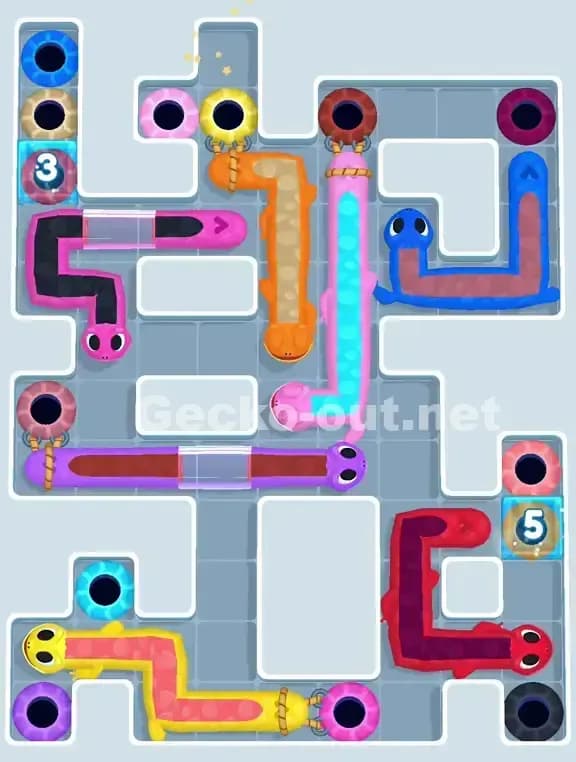
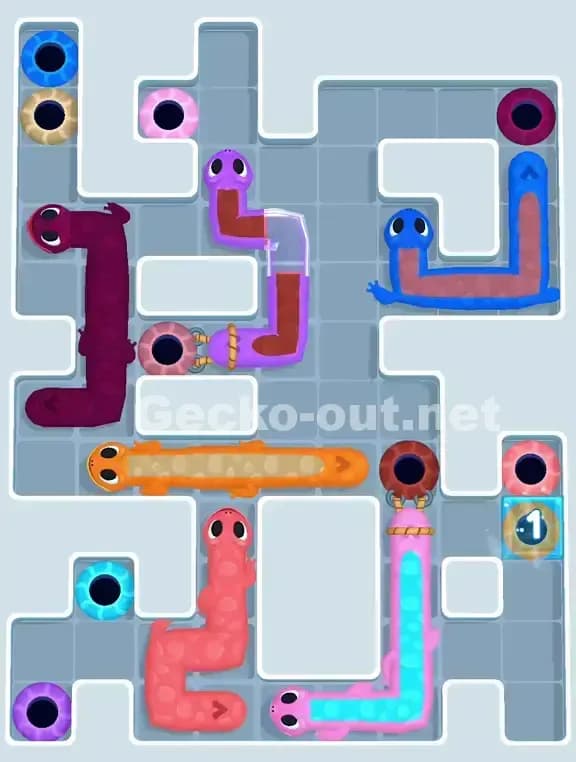
Gecko Out Level 942 is a sprawling, multi-gecko puzzle with eight geckos of varying colors and body lengths spread across a tight, winding maze. You've got a blue gecko in the top-left corner, a tan/beige gecko stacked directly below it, and a pink gecko with a "3" timer badge sitting in that same column—this left side acts like a vertical launch pad. Moving rightward, you'll find a pink gecko, a yellow gecko, a red gecko, and a magenta gecko clustered around the upper-middle and right sections, each one trying to thread through narrow corridors. Lower down, there's a long purple gang gecko spanning the bottom-middle area, a yellow gecko with red accents near the bottom-left, and a red gecko forming a blocky shape in the bottom-right corner. The board is littered with white wall obstacles that create a maze-like structure, forcing each gecko to navigate specific pathways to reach their color-matched exit holes. The timer sits at a moderate threshold—you'll have enough time to succeed if you're methodical, but rushing or backtracking will punish you hard.
Win Condition and Timer Pressure
To win Gecko Out Level 942, every single gecko must reach an exit hole matching its color before the timer hits zero. The catch is that each gecko's path is determined by exactly where you drag its head; the body follows that route tile-by-tile, and if any part of the body overlaps a wall, another gecko, or gets stuck in a dead end, you'll need to restart or undo. The timer creates constant pressure—you can't dawdle or second-guess yourself too much—but it's generous enough that a well-planned sequence will get you across the finish line with time to spare. This is where understanding the geometry of the board and pre-planning your exit sequence matters most.
Pathing Bottlenecks and Logical Traps in Gecko Out Level 942
The Central Vertical Corridor Bottleneck
The biggest choke point in Gecko Out Level 942 is the tall cyan (light blue) vertical corridor running down the center-right of the board. Multiple geckos—especially the long orange and magenta ones—need to pass through or around this narrow channel, and if you drag one gecko through carelessly, its body will block the path for everyone else. I noticed on my first attempt that I sent the orange gecko straight down that corridor early, only to realize I'd essentially locked out two other geckos that needed the same route to reach their exits on the opposite side. The solution is to route longer geckos around the perimeter first, keeping that central corridor clear for the final, shorter geckos that can zip through quickly.
The Left-Side Stack and the Pink "3" Timer Badge
On the far left, you've got three geckos stacked vertically in a tight column: blue, tan, and the pink gecko with the "3" timer badge. That badge means this pink gecko is part of a linked gang or has a special mechanic—it can't move independently until certain conditions are met, or it moves in lock-step with another gecko. This creates a classic Gecko Out Level 942 trap: if you ignore it and try to solve the puzzle without accounting for the gang mechanic, you'll suddenly realize that one gecko is physically blocking two others from exiting. You must identify which gecko it's linked to, solve that pair together, and then liberate the geckos trapped behind them.
The Bottom-Left Yellow Gecko and the Red Corner Knot
The yellow gecko with red segments on the bottom-left is a medium-length body that needs to snake through a cramped L-shaped corridor. Right next to it (bottom-right corner) is the red gang gecko forming an almost-square shape. These two don't share the same exit, but their pathways are dangerously close, and dragging one of them without a clear picture of the other's route will cause a collision. I'll admit, I had a moment of real frustration here on my second run—I kept trying different angles for the yellow gecko, and each time I'd accidentally nudge the red gecko's head into a wall. The breakthrough came when I realized I had to commit to the red gecko's exit first, lock it in place, and only then carefully route the yellow gecko around it.
Turn-by-Turn Path Strategy to Beat Gecko Out Level 942
Opening: Clear the Left-Side Stack and Liberate the Long Geckos
Start by dragging the blue gecko (top-left) directly down and to its matching blue exit hole on the right side of the board. This clears the top of the left stack and gives you breathing room. Next, address the tan gecko below it—drag it to its tan/beige exit hole, likely positioned on the left-center area. Now comes the crucial move: before you touch the pink "3" timer gecko, figure out which gecko it's ganged with by examining its visual connections or testing a light drag. Once you know the pair mechanic, drag both the pink gecko and its linked partner together to their respective exits. This sequence might seem counterintuitive—why not clear the pink gecko first?—but the gang mechanic means you'll waste moves and time if you try to move it solo. By solving the pair together, you free up the entire left corridor and create a clear staging area for the middle and right geckos.
Mid-Game: Route Long Geckos Around the Central Corridor
Once the left side is clear, shift your attention to the orange and magenta geckos occupying the upper-middle and right regions. These are long bodies with lots of turning potential, and they're not part of a gang. Drag the orange gecko in a wide arc around the board's perimeter—don't send it straight down the cyan central corridor. Instead, loop it down the left side (now that space is free), around the bottom, and then up to its orange exit hole on the right. This seems like a longer path, but it keeps the central corridor open and prevents a traffic jam. Follow up by routing the magenta gecko similarly; if it needs to exit on the right side, drag its head along the right edge of the board, creating a vertical path downward. At this point, you should have four or five geckos already exited, and the board is visibly less crowded. Pause for a moment—actually, take a breath and scan the remaining geckos and their target exits. This brief mental reset prevents panic moves later.
End-Game: Exit Order and Avoiding Last-Second Collisions
With the clutter gone, you're left with the cyan gecko, the red gecko, the yellow gecko with red segments, the purple gang gecko, and possibly one or two others still on the board. Here's where move order becomes critical. Drag the red gecko (bottom-right corner) to its red exit hole first, as this clears the bottom-right corner and opens up space for the yellow gecko to maneuver. Next, route the yellow gecko carefully around the now-empty space, dragging its head through the L-shaped corridor to its yellow exit. The purple gang gecko might be linked to another gecko or might have a frozen exit restriction—check whether it can move freely or if it's locked. If it's locked, you'll need a hammer tool or will need to approach it last. For any remaining short geckos (like the cyan), drag them in straight lines when possible, because you're likely running low on time, and every wasted move counts. Aim to have all geckos exited with at least 5–10 seconds on the timer to avoid a last-second failure.
Why This Path Order Works in Gecko Out Level 942
Head-Drag Pathing and Body-Follow Logic
The reason this sequence works is rooted in how Gecko Out Level 942's mechanics operate. When you drag a gecko's head, its body must follow the exact path your drag traces. This means the body occupies each cell along that path for as long as the gecko hasn't fully exited. If you drag a long gecko down a narrow corridor, that entire corridor is blocked for the next 10–15 seconds. By clearing shorter geckos and gang pairs first, you're methodically removing obstacles from high-traffic routes, which means later geckos have more spatial options and fewer collision risks. The order I've outlined—left stack, then perimeter-routed long geckos, then corner/remaining geckos—follows a logic of "progressively shrink the problem." Each gecko you exit makes the next gecko's path simpler and faster.
Timer Management: When to Pause and When to Commit
Gecko Out Level 942 gives you enough time to win, but only if you're not constantly second-guessing. At the opening, spend 15–20 seconds studying the board, identifying the gang geckos (look for visual chains or the timer badges), and mentally tracing the exit holes. Once you start moving, commit to each drag with confidence—hesitant, wobbly drags often veer off-course and create mistakes. However, if you realize mid-drag that you're about to hit a wall, don't release the mouse or tap; instead, adjust your drag path in real-time by curving away from the obstacle. The timer will tick down during your planning phase, but that's an investment; rushing without a plan wastes far more time restarting. I found that on successful runs, I spend the first 30 seconds planning, then 90–120 seconds executing with minimal pauses.
Booster Strategy: When They're Needed
For Gecko Out Level 942, boosters are optional, not required. If you've got an extra-time booster available and you find yourself with 15 seconds left and two geckos still on the board, use it—those 30 extra seconds might be the difference between a win and a heartbreaking loss. However, if you're running cleanly through the sequence, you shouldn't need to burn a booster. A hammer tool (if available) is useful for breaking frozen exits or gang links, but again, the puzzle is solvable without it if you route your geckos carefully. I'd recommend saving boosters for your second or third attempt if you're stuck on the same mistake repeatedly; they're a learning aid, not a crutch.
Mistakes, Fixes, and Logic You Can Reuse in Other Gecko Out Levels
Five Common Gecko Out Level 942 Mistakes and How to Fix Them
Mistake 1: Dragging the Gang Gecko Solo. Players often try to move the pink "3" timer gecko on its own, only to discover it won't budge or moves erratically. Fix: Always identify gang links before moving any gecko with a badge or visual chain. Drag both members of the pair simultaneously or in immediate succession, treating them as a unit.
Mistake 2: Using the Central Cyan Corridor for Long Geckos. Shoving the orange or magenta gecko straight down the middle-right corridor seems efficient, but it blocks everyone else. Fix: Route long geckos around the board's outer edges. Sacrifice a few extra grid squares to keep main corridors open for other geckos.
Mistake 3: Exiting Geckos in Color Order Instead of Spatial Order. A player might think, "I'll exit all blue geckos, then all red geckos," but this ignores whether a blue gecko's exit is blocked by a red gecko still on the board. Fix: Exit geckos based on which ones can actually reach their holes right now, prioritizing those that are blocking others. Spatial order, not color order.
Mistake 4: Ignoring Frozen or Locked Exits. Some exits in Gecko Out Level 942 might appear sealed off by ice or barriers. Players assume those geckos are stuck and panic. Fix: Check whether a frozen exit requires a hammer tool or a specific action to unlock. If so, plan to tackle that gecko last, after you've freed up the hammer or unlock condition.
Mistake 5: Dragging Too Quickly and Overshooting Curves. In a rush, players drag a gecko's head in a sloppy arc that hits a wall or veers into another gecko. Fix: Drag slowly and deliberately, especially around corners. It's okay if a move takes 2–3 seconds instead of 1; precision saves you far more time than speed.
Reusing This Approach on Similar Puzzles
The strategy of clearing the left stack first, then routing long geckos around perimeters, then handling corner geckos applies beautifully to any Gecko Out level with multiple gangs, long bodies, and tight corridors. If you encounter another level with a central bottleneck, remember that perimeter routes are your friend. If you see a gecko with a timer badge or visual chain, pause and solve the gang as a unit before moving on. This logic scales: the more geckos and obstacles you have, the more important it becomes to understand spatial relationships and avoid head-on collisions.
Final Encouragement
Gecko Out Level 942 is genuinely tough—it's a multi-gecko, gang-linked puzzle with a compressed board and real time pressure. But it's absolutely beatable once you internalize the core lesson: geckos exit in order of spatial logic, not color or instinct. The first time through might take three or four attempts, and that's completely normal. By your second or third run with this walkthrough in mind, you'll recognize the bottlenecks instantly, and your solve time will drop by half. You've got this, and once you beat Gecko Out Level 942, similar high-difficulty levels will feel far more approachable.