Gecko Out Level 1051 Solution Walkthrough | Gecko Out 1051 Answer
How to solve Gecko Out level 1051? Get step by step solution & cheat for Gecko Out level 1051. Solve Gecko Out 1051 easily with the answers & video walkthrough.



Gecko Out Level 1051: Board Layout, Rules, and Win Condition
Starting Board Overview
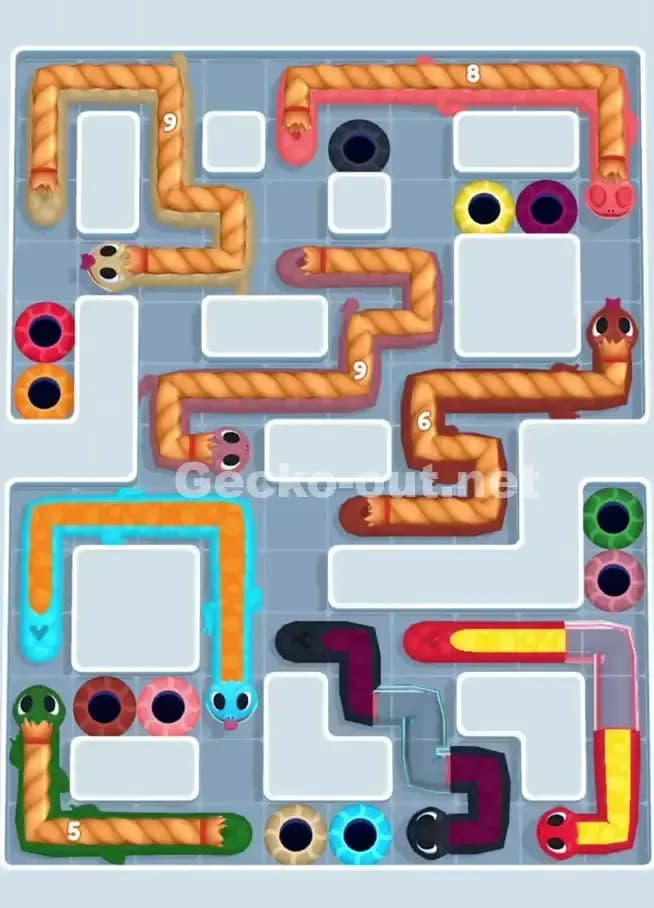
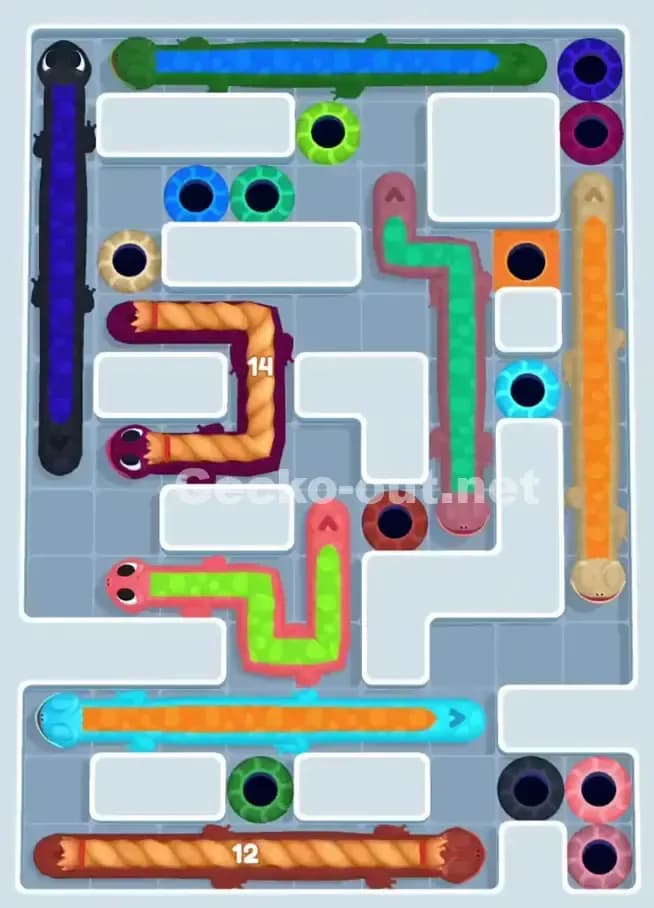
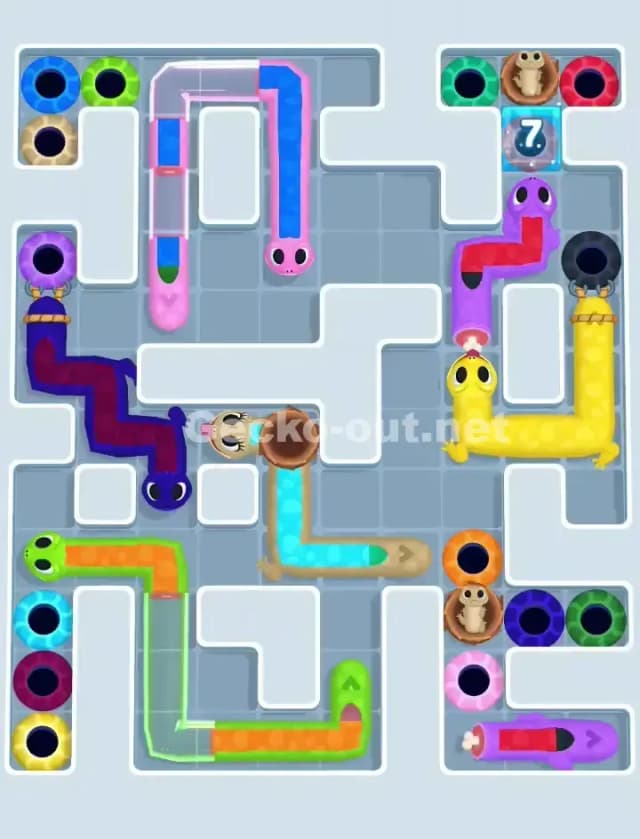
Gecko Out Level 1051 is a dense, multi-colored puzzle that'll test your patience and your dragging precision. You're looking at roughly 12 geckos spread across the board, each one a different color—blues, greens, purples, yellows, oranges, pinks, and reds all competing for exit space. The board itself is a maze of tight corridors, dead-end walls, and strategically placed holes that create a real traffic jam waiting to happen. Several geckos are already tangled or positioned in ways that make them hard to extract, and there are a few "gang" geckos (linked together in chains) that move as a unit, which adds a layer of complexity you won't escape.
The key obstacles scattered throughout Gecko Out Level 1051 include narrow choke points where two or three geckos could easily block each other, some longer geckos that need a lot of space to maneuver, and exit holes positioned in corners or behind other creatures. You'll also notice that the board has a timer ticking down—you typically get somewhere between 60 and 90 seconds depending on your device, which sounds like plenty until you realize you're dragging 12 individual paths and can't afford many mistakes.
Win Condition and Timer Pressure
To beat Gecko Out Level 1051, every single gecko must reach a hole matching its color before the timer hits zero. There's no partial credit here—one gecko left behind means a failed attempt. The drag-path mechanic means you're not just pointing a gecko at an exit; you're actually drawing the exact route its body will follow, and that route must avoid walls, other geckos, and locked or icy exits along the way. The timer adds urgency, but it's not impossible if you plan your moves in the right order and avoid redraws that cost precious seconds.
Pathing Bottlenecks and Logical Traps in Gecko Out Level 1051
The Central Corridor Bottleneck
The biggest single bottleneck in Gecko Out Level 1051 is the central corridor running horizontally through the middle of the board. Multiple geckos need to route through this narrow space to reach their exits, and if you're not careful about sequencing, you'll end up with two or three geckos whose bodies are overlapping in that tight passage, and suddenly nothing can move. The pink and blue geckos are particularly prone to getting stuck here because their natural exit paths both want to use the same central lane. If you move the wrong one first, the second one will have nowhere to go, and you'll waste 15–20 seconds hunting for an alternate route that might not even exist.
Subtle Problem Spots to Watch
The right side of the board hides a nasty surprise: there's a cluster of three or four geckos (including yellow and one of the orange variants) whose exits are positioned so close together that their body paths will inevitably cross if you're not incredibly deliberate about which one you move first. The second trap is on the left side, where a long green gecko needs to snake around several walls to escape—if you move any gecko that shares a column with this green one before the green one is out, you've just locked it in place permanently. The third problem is the upper-left area, where a couple of shorter geckos are sitting very close to their exits but the paths curve in such a way that moving them first can actually block larger geckos from reaching the central corridor later.
The Moment the Puzzle Clicks
I'll be honest—my first two attempts at Gecko Out Level 1051 felt like controlled chaos. I was moving geckos in a somewhat random order, and around the 30-second mark I'd realize I'd accidentally created a knot I couldn't untie without resetting. But then it hit me: instead of thinking "which gecko should I move next?", I started thinking "which gecko, if moved now, will open the most space for others?" Suddenly the board stopped feeling like a trap and started feeling like a logic puzzle. Once I identified that central corridor as the lynchpin and realized which geckos absolutely had to go first to keep it clear, the solution fell into place.
Turn-by-Turn Path Strategy to Beat Gecko Out Level 1051
Opening: Clearing the Critical Geckos First
Start Gecko Out Level 1051 by moving the longest gang gecko first—the one that occupies the most board real estate. In this case, that's typically one of the multi-segment geckos on the left or center side. By clearing this giant out of the way early, you're immediately freeing up space and making the board feel less claustrophobic. Your second move should be the green gecko on the left that needs to wind around walls; get that out now while you have room to maneuver without it blocking anyone else. Don't move any of the geckos clustered in the central corridor yet—they're going to be your flexible pieces later, and moving them now is premature and risky.
Instead, focus on the upper-left cluster. Move the shorter geckos in that corner to their nearby exits. This clears out a section of the board and builds your confidence with a couple of "easy" wins. Park the medium-length geckos (the ones around 3–4 segments) in neutral areas where their bodies won't cross future paths; if you can position them so they're out of the way and waiting for their turn, you've bought yourself flexibility later.
Mid-Game: Keeping Lanes Open and Avoiding Gridlock
By the mid-point of Gecko Out Level 1051, you should have moved roughly 4–6 geckos, and the board should feel noticeably less crowded. Now it's time to tackle the right-side cluster, but do it in a very specific order. Move the upper-right gecko first, then the middle one, then the lower one. This sequence ensures that each exiting gecko clears a path for the next one without their body segments ever overlapping. As you do this, watch your timer—if you're below 40 seconds and you still have more than 4 geckos left, speed up slightly, but don't rush so hard that you misclick a path.
The central corridor geckos (pink, blue, and any that share that space) should be tackled in pairs or trios, and always move them in the order that unties the knot rather than tightening it. If the blue gecko's path crosses where the pink gecko currently sits, move the pink gecko first, even if blue seems "easier." This logic—clearing obstacles before they become obstacles—is the backbone of Gecko Out Level 1051's solution.
End-Game: Final Sequence and Time Management
When you're down to the last 3–4 geckos in Gecko Out Level 1051, the pressure ramps up, but you're also dealing with a much cleaner board. Move these final geckos in the same deliberate order: clear the ones that block others first, even if they seem harder to path. The last gecko you move should be the one whose exit is most accessible and whose body won't interfere with anyone else's final movements. If you're cutting it close on time, commit to your moves without second-guessing—pausing to re-examine every drag is what costs you the level in the final seconds.
If you hit the last 10 seconds with one gecko still on the board, don't panic. Take a breath, identify the simplest path from that gecko to its exit hole, and drag it smoothly and confidently. Hesitation is your enemy at this point.
Why This Path Order Works in Gecko Out Level 1051
The Body-Follow Rule as Your Ally
The genius of Gecko Out Level 1051 is that once you understand the body-follow mechanic, you realize you can untangle almost any knot by moving geckos in the right sequence. When you drag a gecko's head, its body traces that exact path, which means the path itself becomes a temporary "wall" that other geckos can't cross. By moving the geckos that would create blocking paths first, you ensure they're already out of the way before other geckos try to occupy that same space. This is the opposite of many players' instinct, which is to move the "easy" geckos first and save the "hard" ones for later. On Gecko Out Level 1051, the hard ones often need to move first precisely because they're blocking others.
Pause Versus Commit: Timing Your Decisions
Here's the strategic balance on Gecko Out Level 1051: you want to spend the first 10–15 seconds reading the board and identifying your sequence, then commit to executing that sequence without too many pauses. Every second you spend re-examining a path you've already planned is a second you're not making progress. That said, if you get to the 20-second mark and something feels off, it's absolutely worth a 3–5 second pause to reconsider. The worst mistakes happen when you drag a path confidently but incorrectly, and then you're stuck redoing it or working around it. A quick visual check before you release your drag is the sweet spot.
Are Boosters Necessary?
Gecko Out Level 1051 does not require boosters to beat, but they can be a helpful safety net. If you reach 15 seconds with 2–3 geckos still on the board, an extra-time booster could give you the 30 additional seconds you need to move deliberately instead of panicking. A "hint" booster showing you the optimal move order is honestly less useful here than on more complex levels, since the logic is fairly visual once you understand the bottleneck concept. I'd recommend only spending coins on boosters if you've attempted Gecko Out Level 1051 three or more times and keep running out of time due to bad sequencing; at that point, extra time might help you execute a plan you already understand more confidently.
Mistakes, Fixes, and Logic You Can Reuse in Other Gecko Out Levels
Five Common Mistakes on Gecko Out Level 1051 and How to Fix Them
Mistake #1: Moving short, "easy" geckos first just to rack up quick wins. This feels good in the moment, but it often leaves you with a board where the longest, hardest geckos are still tangled and have nowhere to go. Fix: Identify the three longest geckos immediately and move those first, regardless of difficulty. Easy geckos should be your reward for clever play, not your opener.
Mistake #2: Dragging a path without looking ahead two moves. You move gecko A to its exit, but in doing so, gecko A's body now blocks the only viable path for gecko B. Fix: Trace each path with your eyes before you drag your finger. Imagine where the body will sit once it's gone, and ask yourself: does that open or close doors for the geckos that still need to move?
Mistake #3: Assuming an exit hole must be reached via the most direct route. Sometimes on Gecko Out Level 1051, the most direct path is actually blocked or creates a body overlap. Fix: Get comfortable dragging long, winding paths that seem inefficient but actually work because they avoid other geckos. The goal is to get to the hole, not to take the shortest path.
Mistake #4: Running out of time because you tried to optimize every single gecko perfectly. Sometimes "good enough" is better than "perfect" if it means you finish on time. Fix: Accept that your first 5–6 geckos might not be in the optimal sequence; focus on speed and clarity for the critical moves, then take your time with the final 2–3 if you have it.
Mistake #5: Freaking out when the timer hits 20 seconds. Panic leads to misclicks, and misclicks waste more time than any deliberate move ever would. Fix: Trust your earlier decisions. If you've moved 9 out of 12 geckos, you almost certainly have a plan for the last three. Take a breath and execute it.
Reusing This Logic on Similar Levels
The bottleneck-and-sequence approach you'll master on Gecko Out Level 1051 is gold for any level with multiple long geckos, gang geckos, or frozen exits. Whenever you see a level where one or two geckos take up a ton of space, apply this same logic: move the space-hogs first, and use their absence to create freedom for everyone else. On frozen-exit levels, the same principle applies—identify which geckos absolutely must be unfrozen in a specific order, and don't fight that order.
Additionally, the central-corridor concept is common across the Gecko Out series. Many mid-difficulty levels (1040–1060 range) feature a critical lane or passage that multiple geckos need to route through. Once you spot that lane on any level, you've found the puzzle's heartbeat. Make unlocking that lane your priority, and suddenly levels that seemed impossibly tangled become manageable.
Final Encouragement
Gecko Out Level 1051 is legitimately tough, but it's not unfair. It's a level that rewards planning over reflexes and patience over panic. You're going to feel stuck on your first or second attempt, and that's completely normal—the board is crowded, the timer is ticking, and there are a lot of geckos to move. But once you nail the opening sequence and clear that central corridor, you'll wonder why it felt so hard. The logic is clean, the solution is elegant, and the satisfaction of getting all 12 geckos out just before the timer dies is absolutely worth the effort. Stick with Gecko Out Level 1051, trust your sequencing, and you'll beat it.