Gecko Out Level 698 Solution Walkthrough | Gecko Out 698 Answer
How to solve Gecko Out level 698? Get step by step solution & cheat for Gecko Out level 698. Solve Gecko Out 698 easily with the answers & video walkthrough.
Gecko Out Level 698: Board Layout, Rules, and Win Condition
Starting Board: Geckos, Colors, and Obstacles
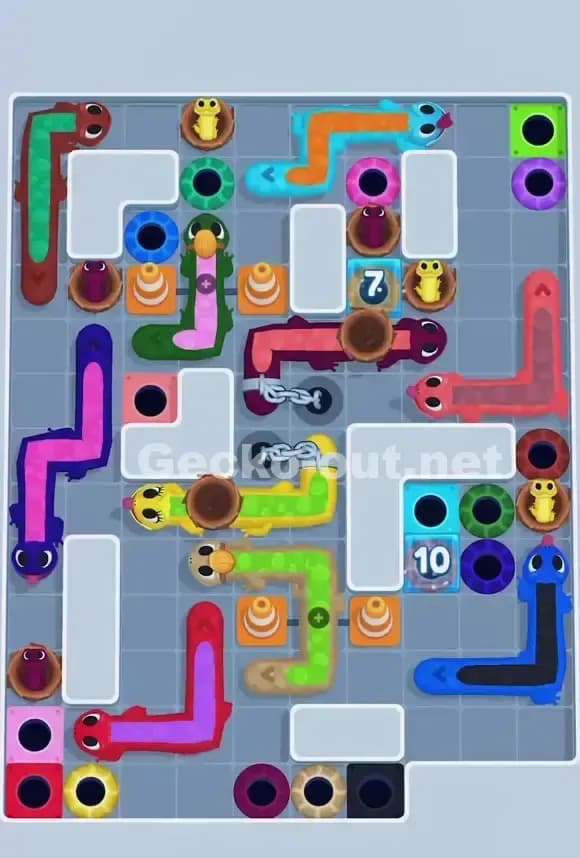
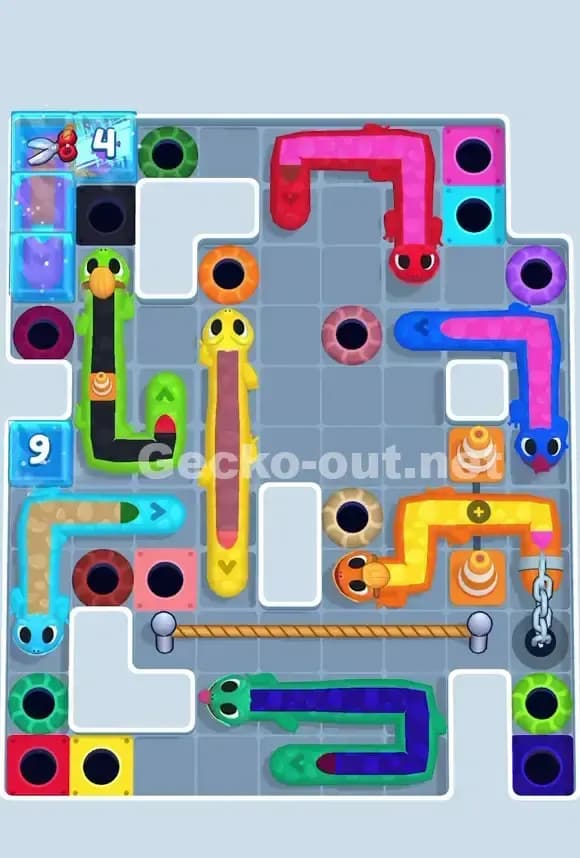
Gecko Out Level 698 is a densely packed puzzle that demands careful spatial planning. You're looking at roughly ten geckos spread across the board in a mix of colors—reds, yellows, greens, blues, pinks, and purples—each needing to reach its matching colored exit hole. The board itself is a maze of white wall obstacles that create natural corridors and choke points. What makes Gecko Out 698 particularly tricky is that several geckos are gang-linked (meaning they move as a single unit), and the exit holes are scattered in ways that force you to thread long bodies through narrow passages without tangling them up. You'll also spot a handful of toll gates and warning holes scattered throughout, which means you can't just brute-force your way through—you need to plan the exact sequence of exits.
Win Condition and Timer Pressure
To beat Gecko Out Level 698, every single gecko must reach its matching hole before the timer runs out. The timer starts at around 5 minutes (displayed in the top-left corner), which sounds generous until you realize how many false moves can waste precious seconds. The moment you drag a gecko head, its body follows the exact path you draw, and if that path conflicts with a wall, another gecko, or a locked exit, the move fails and you burn time restarting. This means you can't afford to be experimental—you need to visualize each path before you commit to dragging.
Pathing Bottlenecks and Logical Traps in Gecko Out Level 698
The Central Corridor Choke Point
The biggest bottleneck in Gecko Out Level 698 is the central vertical corridor running down the middle of the board. Three or four geckos need to pass through this narrow lane to reach their exits on the opposite side, and if you send them in the wrong order, you'll lock the entire puzzle. The yellow and pink gang-geckos are particularly problematic here because they're long and occupy multiple grid squares at once. If you drag the yellow gecko through the corridor before clearing a path on the other side, its body will block the route for the next gecko, and you'll be stuck. This is the moment where most players panic and restart—so I always clear this corridor last, after parking other geckos safely in "holding zones" along the sides.
Subtle Problem Spot #1: The Magenta L-Shaped Trap
On the right side of Gecko Out Level 698, there's a magenta L-shaped gecko that looks straightforward to route but has a nasty habit of tangling with the purple gecko below it. The L-shape means the body occupies both horizontal and vertical space, so if you don't drag it in a wide enough arc to avoid the purple gecko's path, they'll overlap and you'll fail. I've watched players try to take a "shortcut" by dragging the magenta gecko straight down, only to realize the purple gecko is already partway through that route. The fix is to always drag magenta in a clockwise loop that gives purple plenty of room to move later.
Subtle Problem Spot #2: The Cyan Boomerang Gecko's Hidden Dependency
There's a cyan boomerang-shaped gecko on the left side of Gecko Out Level 698 that depends entirely on whether you've cleared the red gecko above it. The boomerang can't extend downward unless the red gecko has already exited, so if you get the turn order wrong, you'll waste time trying to drag the cyan gecko through a space that's still occupied. This is a classic "hidden dependency" trap—nothing on the board tells you about this linkage until you try to move the cyan gecko and hit an invisible wall.
Subtle Problem Spot #3: The Warning Holes in the Lower Section
The lower third of Gecko Out Level 698 contains a couple of warning holes (those orange concentric circles that aren't actual exits). Players often mistake these for real holes and attempt to route geckos toward them, wasting precious seconds. The rule is simple: if the hole's color doesn't match the gecko's color, it's not the goal—keep moving.
Personal Reaction: The Moment Everything Clicked
I'll be honest—my first five attempts at Gecko Out Level 698 felt like controlled chaos. I'd get three or four geckos out smoothly, then suddenly realize the last batch had no valid path and the timer was down to thirty seconds. It was frustrating. But then I sketched the board on paper (literally drew it out), numbered the geckos by exit order, and tested the sequence in my head before touching the controller. The moment I realized that parking the red gecko in a "safe zone" on the left while I routed the yellow gecko through the center would actually free up the corridor for everyone else—that's when the puzzle shifted from impossible to inevitable. It's all about patience and foresight.
Turn-by-Turn Path Strategy to Beat Gecko Out Level 698
Opening: Clear the Flanks First
Start Gecko Out Level 698 by routing the easiest, shortest geckos first—specifically, the single-cell or two-cell geckos on the extreme left and right edges. These include the small red gecko in the top-left corner and the green gecko on the far right. By getting these out of the way, you remove visual clutter and open up the outer lanes for longer geckos later. Drag the red gecko to its matching red hole (also on the left side) in a simple downward path—no obstacles, clean exit. Then handle the green gecko similarly on the right. This should take you less than thirty seconds total and frees up approximately 20% of the board's real estate.
Next, deal with any gang-geckos that don't depend on the central corridor. Look for blue, orange, or yellow segments that can be routed along the outer edges without crossing the main vertical lane. These secondary moves should be quick and confidence-building—you're establishing momentum and proving to yourself that the puzzle is solvable.
Mid-Game: Reposition Long Geckos into Holding Zones
Once the flanks are clear, identify the three longest geckos on your board—likely the magenta L-shape, the cyan boomerang, and one of the yellow segments. Here's the key insight for Gecko Out Level 698: you don't have to route these geckos all the way to their exits immediately. Instead, drag them into "holding zones"—safe areas of the board where they'll stay still and won't block other geckos' paths. For example, drag the cyan boomerang into the left-side pocket and leave it there. Drag magenta into a safe corner on the right. This keeps them visible and ready but out of the main flow.
While these long geckos are parked, route the mid-sized geckos (the pink, purple, and second yellow segments) through the paths they'll eventually use. This is a "dry run" that reveals any hidden dependencies or path conflicts you might have missed. If you discover a conflict now (before committing the long geckos), you can adjust your holding zones or route order.
The golden rule for Gecko Out Level 698's mid-game is: don't commit a long gecko to its final path until you're absolutely certain the destination is clear and no other gecko will need that route later.
End-Game: Exit Order and Last-Second Timing
With roughly two minutes left on the timer, it's time to move the holding-zone geckos to their final exits. Start with the easiest one—likely the cyan boomerang if it has a direct, simple path. Drag it from its holding zone straight to the matching cyan exit. Then immediately move to magenta.
For the very last gecko(s) in Gecko Out Level 698, use the central corridor if you've been saving it. By this point, all other geckos are gone, and the corridor is completely open. Drag the final gecko(s) through with confidence, nice and slow if you need to—the board is yours now.
If you're low on time (under forty-five seconds) and have two geckos remaining, check whether both can exit simultaneously. Sometimes Gecko Out Level 698's layout allows two geckos to reach their holes in parallel without overlapping. If so, don't drag them sequentially—drag one, then immediately drag the other while the first one is still moving. The game allows concurrent movement, so you can save ten to fifteen seconds this way.
Why This Path Order Works in Gecko Out Level 698
Head-Drag Pathfinding and the Body-Follow Rule
The brilliance of the strategy for Gecko Out Level 698 lies in understanding that you're only controlling the head—the body is a passenger that traces your exact path. This means a long gecko's body can't "cut corners" or optimize its route; it goes where you tell the head to go, even if that's inefficient. By parking long geckos in holding zones, you're essentially solving the puzzle in two phases: first, figure out which spaces are safe, then commit the big pieces. This is way smarter than trying to thread a five-cell gecko through a narrow corridor in one shot, risking collision with another gecko's body.
Another reason the turn-by-turn plan works is that it respects the principle of "reversibility." If you clear the flanks first, you can always undo those moves mentally if something goes wrong mid-game. But if you try to route a gang-gecko through the center first, you've locked the entire puzzle's future—there's no going back. The plan for Gecko Out Level 698 maximizes flexibility early and commits to irreversible moves only when you're certain.
Managing the Timer: Pause and Read vs. Commit and Move
Here's my personal timing philosophy for Gecko Out Level 698: spend the first ninety seconds pausing and reading the board. Use that time to identify all the geckos, their exit colors, the major obstacles, and the obvious dependencies. Don't drag anything yet. This mental investment pays dividends later because you're not making impulsive moves.
Once you've read the board, commit to the first three moves with confidence. These should be the short, simple geckos. Don't second-guess yourself—dragging slowly and hesitantly eats more time than dragging decisively. By the time you've parked the long geckos in holding zones, you should have spent about two minutes total, leaving you three full minutes for the tricky mid- and end-game sequences. That's more than enough time if you've planned correctly.
If you find yourself with less than one minute remaining and still have three or more geckos to exit, it's time to consider a booster. Specifically, the "extra time" booster (usually available for a small in-game cost) can add ninety seconds to the clock. This isn't a sign of failure—it's a sign that you discovered a valid path that just needs a few more seconds to execute. Use the booster, take a breath, and finish the puzzle.
Booster Strategy: When and Why
In Gecko Out Level 698, boosters are optional, not required, if you follow the turn-by-turn plan correctly. However, I'd keep the "extra time" booster in your back pocket as a safety net. The "hint" booster is less useful here because the puzzle is deterministic—there's a specific correct sequence, and hints don't magically reveal it. The "hammer" or obstacle-removal booster can be helpful if you've accidentally locked two geckos in a position where no forward move exists, but again, proper planning prevents this. My recommendation: attempt Gecko Out Level 698 two or three times without boosters. If you're still stuck, use the extra time booster on your next attempt—not because you're weak, but because you've earned the right to see what success feels like, and that knowledge will help you execute the plan faster on future attempts.
Mistakes, Fixes, and Logic You Can Reuse in Other Gecko Out Levels
Common Mistake #1: Dragging Without Reading the Destination
Players often drag a gecko toward what they think is an exit hole, only to discover mid-path that it's a warning hole or a hole of the wrong color. In Gecko Out Level 698, this burns ten to twenty seconds. The fix is stupidly simple: before you drag any gecko, trace your finger (or cursor) along the path to the destination and confirm the hole's color matches. Yes, this feels slow. But it's faster than restarting the drag and repositioning the gecko.
Common Mistake #2: Ignoring Gang Dependencies
Gecko Out Level 698 includes gang-geckos where two or three segments move as one. Players often treat them as separate geckos and try to route them independently, causing collision errors. The fix: always test a gang-gecko's movement by dragging it partway and watching the entire chain follow. If it gets stuck, you've immediately learned that the route is blocked and can try a different path. Don't assume a gang-gecko can take the same route as a single gecko of the same color.
Common Mistake #3: Filling the Board Too Densely
This is the meta-mistake that leads to most Gecko Out Level 698 failures. Players route the first five geckos to their exits as quickly as possible, then realize the remaining geckos have nowhere to move because bodies are spread across the board. The fix: always maintain empty lanes. Before you drag a gecko to its exit, confirm that at least one clear corridor remains for the next gecko. In Gecko Out Level 698, the central vertical lane and the left/right edge lanes are your lifelines—protect them until the very end.
Common Mistake #4: Rushing the Final Geckos
With two or three geckos left and thirty seconds on the clock, players panic and drag hastily, causing them to miscalculate a path and hit a wall. The fix: slow down in the endgame. You've already won the puzzle by getting this far—the final geckos are formality. Take a full five seconds to plan each final path, drag smoothly and deliberately, and celebrate when they exit. Rushing causes more failures in the last minute than any other factor.
Common Mistake #5: Not Parking Geckos Strategically
Players try to use the entire board as a "buffer zone" for long geckos, spreading them out chaotically. In Gecko Out Level 698, this reduces flexibility because later geckos can't navigate around unpredictably placed bodies. The fix: designate specific holding zones (like the left-side pocket, right-side pocket, and one safe corner) before you start dragging. Always park geckos in the same zones so your mental map stays consistent.
Logic You Can Reuse on Similar Levels
These principles scale perfectly to other gang-gecko, knot-heavy, or frozen-exit levels in the Gecko Out series:
-
Read first, drag second. Before touching any gecko, spend time understanding the board's layout, dependencies, and bottlenecks. This applies universally.
-
Route simple geckos first. Shorter geckos have fewer path options, so route them early while the board is open. Long geckos adapt better to constrained spaces, so save them for later.
-
Maintain clear corridors until the end. On every Gecko Out level, identify the board's main throughways (central lanes, edges, major passages) and protect them. Don't let gecko bodies clutter these corridors until the very last moves.
-
Use holding zones strategically. On levels with gang-geckos or long chains, always park them in designated safe areas before committing them to final paths.
-
Test with the first gecko. When you encounter a new obstacle type (like a frozen exit or a toll gate), route a dummy gecko through it first to understand the mechanics. Then apply that knowledge to your main plan.
Final Encouragement
Gecko Out Level 698 is legitimately tough—it's designed to punish impulsiveness and reward careful planning. But it's absolutely beatable, and I promise that the moment you see all ten geckos exit safely, you'll feel the satisfaction of having solved a genuinely complex puzzle. The key is patience, a clear mental model of the board, and the discipline to execute the plan calmly. You've got this. Now go clear Gecko Out 698!