Gecko Out Level 626 Solution Walkthrough | Gecko Out 626 Answer
How to solve Gecko Out level 626? Get step by step solution & cheat for Gecko Out level 626. Solve Gecko Out 626 easily with the answers & video walkthrough.
Gecko Out Level 626: Board Layout, Rules, and Win Condition
Starting Board Overview
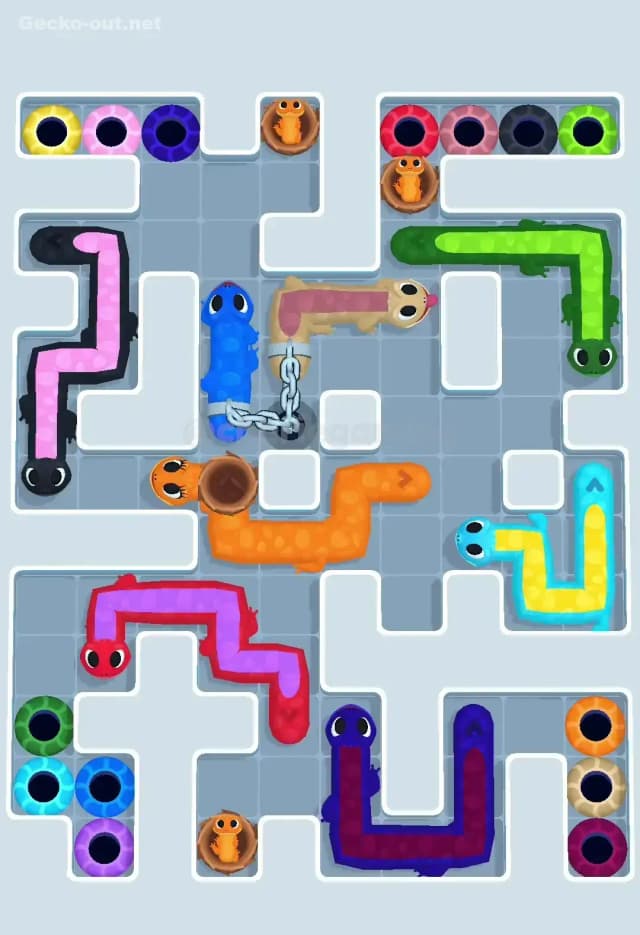
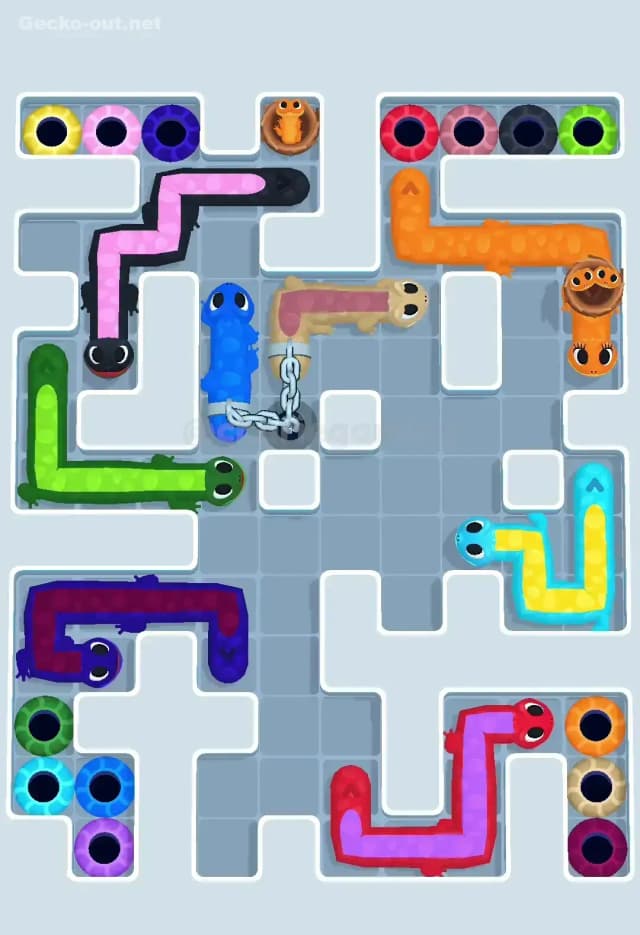
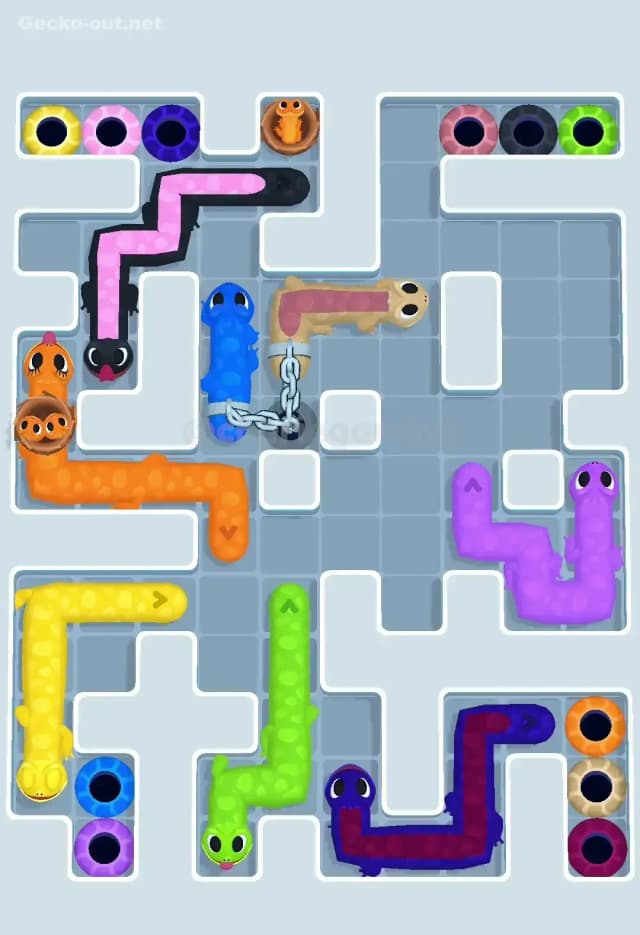
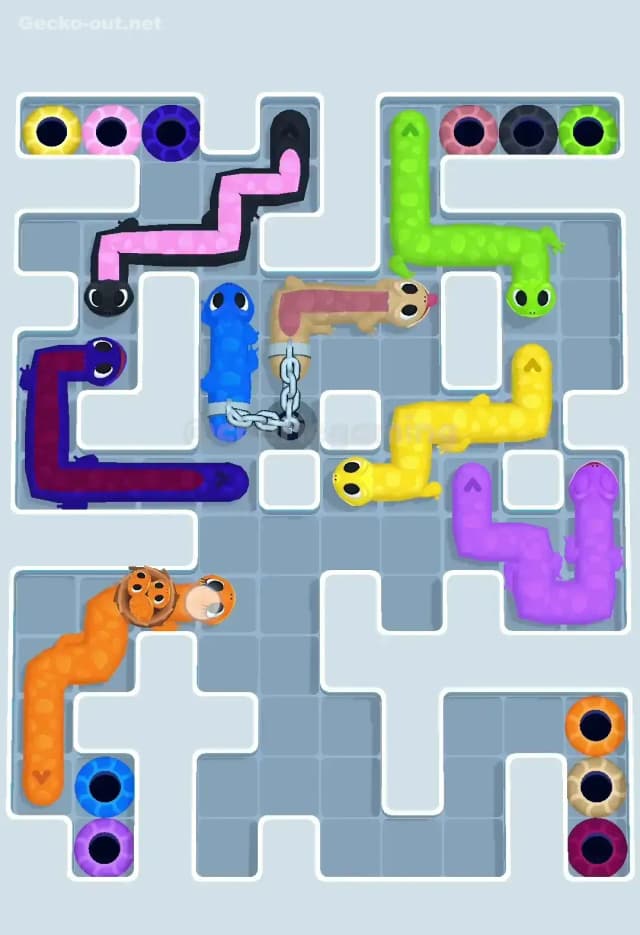
Gecko Out Level 626 throws you into a maze of narrow corridors filled with long, twisty geckos. You’ve got a full rainbow here: tall black-and-pink gecko on the left wall, a bright green gecko hugging the right edge, an orange snake running across the middle, a dark purple U-shaped one in the bottom-right corner, a red–magenta pair near the bottom-left, a small blue–yellow zigzag on the lower-right side, and a linked “gang” pair in the center (a blue vertical gecko chained to a beige horizontal one). On top of that, several tiny baby geckos sit in baskets, acting as warning holes you must not block off.
Each color has one or more matching holes grouped in four clusters: top-left, top-right, bottom-left, and bottom-right. The exits sit just beyond tight bends, so every drag you make with one head can easily trap another gecko behind a corner. Gecko Out 626 is a classic knot level: bodies criss-cross central lanes, and the gang-gecko chain divides the board into awkward zones that initially don’t talk to each other.
Timer, Pathing, and Win Condition
To clear Gecko Out Level 626, every gecko has to slither into a hole of the same color before the timer hits zero. If even one gecko is still wandering around (or worse, stuck behind a blocked corridor), you fail the level. Because the game uses drag-path movement, the body copies every turn you draw with the head. That’s the core puzzle here: you’re not just deciding which gecko moves first, you’re deciding which trail of body segments will occupy which lane at which time.
In Gecko Out 626, the timer is strict enough that you can’t test random routes for everyone. You get time to plan once or twice, then you need to commit. Every wasted loop—like dragging a long gecko in a circle just to “try something”—eats precious seconds and leaves their body sprawled across critical crossroads. The win condition is less about speed-dragging and more about sequencing: move short geckos first to open space, reposition the gang pair without letting their chain barricade the board, then send the long ones home in a clean exit order.
Pathing Bottlenecks and Logical Traps in Gecko Out Level 626
The Central Gang-Gecko Blockade
The single biggest bottleneck in Gecko Out Level 626 is the chained gang in the middle: the tall blue gecko and the beige gecko linked together. That chain sits right where you’d love to pass through with other bodies. If you drag one head carelessly, the paired gecko swings across the central lanes like a door, walling off the left from the right.
It’s tempting to rush them out early because they feel “in the way,” but if you do, their bodies sprawl through the same corridors that your orange, purple, and green geckos later need to cross. Treat the chain pair as a rotating gate: use them to open space for others first, then send them to their exits once the nearby lanes are cleared.
Subtle Traps and Misleading Spots
There are a few quieter problem zones in Gecko Out 626:
- The small blue–yellow zigzag gecko in the lower-right corner looks harmless, but its exit path runs through a choke point next to the big purple U-shaped gecko. If you move the purple too early, you’ll block the zigzag’s clean line.
- The orange gecko in the middle loves to stretch its tail across the only side entrance into the left half of the board. One sloppy drag and you’ve blocked both the red–magenta geckos and the vertical black-and-pink one.
- The long green gecko on the right side wants to go straight to its exit cluster at the top-right, but its body will sweep along the outer wall. If you send it first, it can trap the gang pair and cut off paths up from the bottom.
All of these traps are logical: nothing is random. The board punishes you only when you don’t think about where a long body will end up after following the head.
When It Starts To Make Sense
Personally, Gecko Out Level 626 felt like a mess on my first tries. I’d clear one gecko, then realize I’d sealed two exits behind a tangled body. The moment it clicked was when I started treating each corridor like a lane in traffic: who has to pass through this lane, and in what order?
Once I decided: “Right-side zigzag first, then open space with the purple U, then slowly rotate the gang pair while keeping a central corridor free,” the level stopped feeling chaotic. I wasn’t guessing anymore—I was running a script. That’s the mindset that turns Gecko Out 626 from frustrating to actually pretty satisfying.
Turn-by-Turn Path Strategy to Beat Gecko Out Level 626
Opening: Clear The Right Side And Set Up The Center
- Start with the short blue–yellow zigzag gecko in the lower-right. Its route to the matching hole is short and direct. Drag its head along the open corridor to its exit without looping around other geckos. This removes a piece from the densest corner.
- Next, partially move the dark purple U-shaped gecko in the bottom-right. Don’t send it out yet; instead, pull its head up just enough to park its body along the outer right wall, leaving a vertical lane through the middle clear. You’re basically “stacking” it neatly.
- Now gently adjust the green gecko on the right edge so its body hugs the outer perimeter and doesn’t jut into the central crossroad. If you can position it so its body runs straight up and then left toward its exits later, that’s perfect.
Your goal in the opening is simple: free the lower-right corner and keep a clean central corridor from bottom to top so the chain pair and the orange gecko can slide through later.
Mid-game: Rotate The Knot Without Closing Lanes
- Turn to the central gang geckos: drag the blue head a short distance so the beige partner swings into a less obstructive position. Think of it as rotating a bar across a doorway—you want the “door” fully open, not half blocking both sides.
- With that gap created, move the long orange gecko in the middle. Guide its head toward the side that has more free exits (usually toward the bottom-right cluster), hugging walls so its tail doesn’t sweep across the left-side entrances.
- Once orange is mostly out of the central zone, you can reposition the red–magenta gecko at the bottom-left. Thread it through whatever space the orange body has freed, but avoid drawing paths that cross in front of exits you haven’t used yet. Park it in a U-shape that leaves the bottom-left exit cluster accessible.
- Finally, straighten the vertical black-and-pink gecko along the left edge. Slide it up or down in a clean line so its body no longer blocks the route between the left exits and the middle corridors.
In this phase of Gecko Out 626, you’re mostly “re-stacking” snakes: long bodies go to walls, short ones stay near their exits, and the center remains as clear as possible.
End-game: Exit Order And Low-Time Recovery
- When the board looks less tangled, start sending geckos out in this rough order:
- First, whichever gecko is already closest to its correct exit with a straight or gentle path (often the right-side green or the bottom-right purple).
- Next, the red–magenta gecko on the bottom-left, threading it into its matching holes without looping into the center.
- Then, the vertical black-and-pink gecko, which can now climb up or down into its exit cluster without bumping anyone.
- Save the gang pair for late, when most lanes are empty. Drag their head in a clean arc straight into their color holes, making sure the linked partner has room to follow. Because other bodies are gone, their swinging motion no longer hurts you.
If the timer is low and you’re mid-tangle, prioritize geckos with the fewest turns to exit. One quick trick in Gecko Out Level 626: if you’re unsure which move to make under time pressure, choose the gecko that can reach its exit without crossing any intersection. Those moves are almost always safe and fast.
Why This Path Order Works in Gecko Out Level 626
Using Body-Follow Pathing To Untie The Knot
The plan works because it respects the body-follow rule. By clearing short geckos first and parking long ones along walls, you prevent bodies from cutting across central lanes. When you move the gang pair while the middle is still busy, their linked swing slices through traffic; when you wait until only a few geckos remain, the same motion is harmless.
Gecko Out Level 626 looks like you need wild, looping paths, but you actually want the opposite: simple, almost boring lines. Every time you’re about to drag a head through a twisty route, imagine the full tail tracing that same twist—if that mental picture blocks an exit, don’t do it.
Balancing Planning And Speed On The Timer
On this level, you win by front-loading your thinking. Take the first few seconds to scan:
- Where are the big U-shapes?
- Which short geckos can exit without anybody moving?
- Which two corridors are the true “highways” across the board?
Once you’ve answered those, you should commit to your order and drag confidently. Pausing mid-run to re-evaluate every move kills you on the timer more than one small positioning mistake ever will. Treat Gecko Out 626 like a speed puzzle with a pre-written script, not a live improvisation.
Boosters: Nice To Have, Not Mandatory
You can beat Gecko Out Level 626 without any boosters. Still:
- A time-extension booster is the most useful, especially while you’re learning the route. Pop it if you’re entering the end-game with several geckos still inside.
- A hammer-style “remove obstacle” booster is overkill here and can even be misleading—removing one blocker doesn’t fix the overall lane order.
- Hints are okay if you’re completely stuck, but they often show only the next move, not the global plan. Use them to learn good parking spots, then replay the level cleanly.
Mistakes, Fixes, and Logic You Can Reuse in Other Gecko Out Levels
Common Mistakes Specific To Gecko Out 626
-
Moving the gang geckos first
You swing the chain right through the middle, park both bodies across shared lanes, and suddenly half the board is unreachable. Fix: treat the chain pair as late-game exits; early on, only nudge them enough to open space. -
Letting the orange middle gecko sprawl
Dragging it in a big loop feels powerful, but its tail usually lands across the left entrances. Fix: hug one wall and give the left side a clear vertical lane. -
Exiting the purple U too early
Sending the bottom-right purple gecko out first often blocks the easy route for the small zigzag gecko. Fix: clear the short zigzag first, then re-stack purple flush against the wall before exiting. -
Ignoring the timer while “experimenting”
Long test paths waste time and leave bodies in bad positions. Fix: if you don’t see a clear reason for a move, don’t drag it. Reset and try a different sequence instead of improvising.
Reusing This Logic In Other Knot-Heavy Levels
The logic you use in Gecko Out Level 626 applies almost perfectly to other tough Gecko Out levels:
- Clear short, obvious exits first to make breathing room.
- Park long bodies along walls and outside edges, not in the middle.
- Treat gang geckos as moving doors—rotate them to open lanes, then exit them last.
- Visualize the full tail path before you drag, especially near exits and choke points.
Once you start viewing corridors as limited “lanes” and geckos as cars that must pass through them in a set order, knot-heavy layouts stop feeling random.
Yes, Gecko Out Level 626 Is Beatable
Gecko Out 626 looks brutal at first glance, and the chain pair in the center can be seriously intimidating. But with a simple plan—clear the lower-right zigzag, stack the big bodies on the edges, rotate the gang pair late, and exit geckos in a calm order—the level becomes surprisingly manageable.
Stick with that structure for a few runs, and you’ll feel the shift from guessing to knowing what to do. Gecko Out Level 626 is tough, sure, but it’s absolutely beatable once you respect the lanes, think a couple of moves ahead, and let the bodies follow clean, intentional paths.