Gecko Out Level 1066 Solution Walkthrough | Gecko Out 1066 Answer
How to solve Gecko Out level 1066? Get step by step solution & cheat for Gecko Out level 1066. Solve Gecko Out 1066 easily with the answers & video walkthrough.

Gecko Out Level 1066: Board Layout, Rules, and Win Condition
Understanding the Starting Board
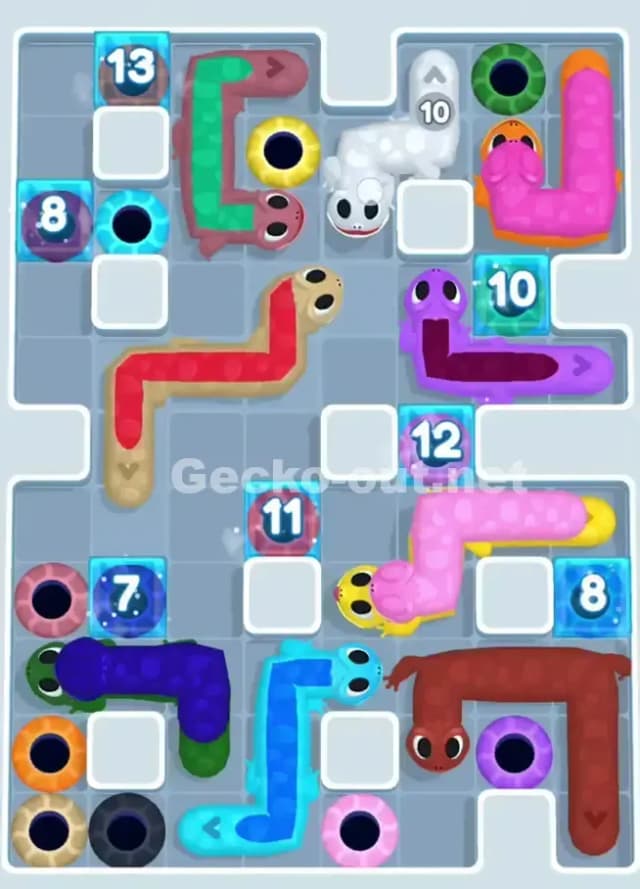
Gecko Out Level 1066 is a multi-gecko puzzle that'll test your spatial reasoning and planning skills right away. You're looking at a board packed with eight geckos of different colors—including red, green, blue, purple, pink, yellow, and orange varieties—all tangled together in a fairly complex arrangement. The geckos aren't just scattered randomly; they're positioned in long, curving L-shapes and S-curves that overlap and block each other's direct paths to their matching holes. You've got two bonus tokens (the numbered markers showing 13, 8, 10, 12, 11, and 7) scattered across the board, and there are plenty of white empty cells that will serve as temporary "parking spots" for geckos you need to move out of the way.
The board itself is densely packed, with multiple geckos' bodies taking up critical corridor space. What makes Gecko Out Level 1066 particularly tricky is that several geckos are positioned in such a way that moving one immediately creates or removes a bottleneck for others. The timer starts at a standard countdown, and you'll need to get every single gecko into its matching-colored hole before time runs out.
The Win Condition and Timer Pressure
To win Gecko Out Level 1066, you must guide all eight geckos to their respective exit holes—each gecko's body must follow an uninterrupted path from its starting head position to a hole of the same color. The timer adds constant pressure; if even one gecko hasn't reached its hole when the countdown hits zero, the entire level fails and you'll restart from scratch. This means you can't afford to dawdle or overthink individual moves once you've committed to a sequence. You'll need to drag each gecko's head along a clear path, watching as its body snakes behind it, and you must never allow the body to cross walls, other geckos, or any obstacle that blocks the route.
Pathing Bottlenecks and Logical Traps in Gecko Out Level 1066
The Central Corridor Bottleneck
The biggest bottleneck in Gecko Out Level 1066 is the tight vertical corridor running through the center-left portion of the board. Multiple geckos—particularly the green gecko and the blue gecko—have portions of their bodies occupying this narrow space. Because both of these geckos need to move, and their bodies are quite long, you can't exit one gecko without first clearing the path for others. The green gecko's L-shaped body especially acts as a "gate-keeper"; until you reposition it into its hole or move it completely out of the way, the blue gecko and the red gecko both remain gridlocked. This is the single most important constraint on Gecko Out Level 1066, and recognizing it early will save you from wasting moves and precious timer seconds.
Subtle Problem Spots to Watch
The second major issue is the pink gecko's position in the right-center area. It's a fairly long gecko positioned horizontally, and its body crosses over a space that would otherwise be a convenient escape route for the yellow gecko. If you're not careful about the order in which you move these two, you'll find yourself in a situation where the pink gecko's body is blocking the only clear path for yellow to reach its hole. The trick is to move pink out first, clearing that corridor completely before committing yellow to its exit path.
Another subtle trap lies with the small orange and tan geckos in the bottom-left corner. They're crammed next to each other and compressed against the board's edge. Moving one forces you to contend with the other immediately, and if you're not precise with your head-drag path, their bodies can tangle or jam against the wall. I found this spot particularly frustrating on my first attempt—I kept trying to force both out simultaneously, which only created a tighter knot.
The "Aha" Moment
Honestly, the first time I tackled Gecko Out Level 1066, I felt that familiar spike of frustration around the midpoint. I'd moved three geckos successfully and thought I was on a roll, but then I realized the remaining five were all blocked in a domino-chain of dependencies. That's when it clicked: I wasn't solving the puzzle in the wrong order—I was solving it in the most dangerous order. Once I restarted with a plan to clear the central corridor first and park the long geckos in empty cells while I worked on others, the whole board suddenly felt manageable. The breakthrough was understanding that sometimes the most direct path isn't the first gecko you're tempted to move.
Turn-by-Turn Path Strategy to Beat Gecko Out Level 1066
Opening: Clear the Gateway Geckos First
Start Gecko Out Level 1066 by focusing on the green gecko. Even though it might not be your first instinct, this long green gecko is the linchpin holding everything back. Drag its head down and around the board toward its matching exit hole. The body will follow the exact path you draw, so make sure you're creating a smooth curve that doesn't cross any walls. Once the green gecko is safely in its hole, you've opened up the central corridor and removed the primary bottleneck. Next, move the blue gecko. Its path is now clearer, and you can route it around the board to its hole without worrying about green blocking your way. Park any geckos that need to move out of the way—use those empty white cells as temporary holding spots. Don't force a gecko into its hole if it means creating a traffic jam for others; it's okay to make a gecko wait.
Mid-Game: Manage Long Geckos and Preserve Exit Routes
With the central corridor opening up, you'll have more flexibility in Gecko Out Level 1066's middle phase. Now tackle the red gecko, which has a fairly long body taking up space in the lower-left area. Drag it carefully toward its exit, ensuring its path doesn't wrap around any other gecko that still needs to move. The trick here is to work methodically: move one gecko at a time, always looking two or three moves ahead to spot potential conflicts. This is where patience pays off—yes, the timer is running, but a few seconds spent planning prevents restarting from the beginning.
Around this point, address the pink gecko before moving yellow. Route pink out of the way, clearing that right-center corridor. Once pink is safely in its hole, yellow can make its exit without complications. For the remaining mid-length geckos (like the purple and orange varieties), use empty cells strategically. If moving a gecko to its hole would block another gecko's path, move it to an empty cell first, complete other geckos, and then slide it into its hole when the board has cleared.
End-Game: Finish Strong Without Time Panic
In the final stretch of Gecko Out Level 1066, you should have at most three to four geckos remaining on the board. By this point, you've created enough empty space that their exit paths should be relatively straightforward. Look at the timer—if you're in good shape (more than 20–30 seconds remaining), take a moment to confirm your final paths visually before committing. Speed up your moves slightly, but don't let panic cause you to drag a gecko's head into a wall by accident. Finish with the smallest geckos (the tan and orange pair in the bottom-left, or the small yellow gecko), since their short bodies are less likely to create conflicts in the now-sparse board. Execute these last moves with confidence, and you'll watch Gecko Out Level 1066 unlock.
Why This Path Order Works in Gecko Out Level 1066
Head-Drag Pathing Untangles Instead of Tightens
The power of this strategy lies in understanding how the head-drag mechanic works in Gecko Out Level 1066. When you drag a gecko's head, its body always follows that exact path, cell by cell. This means moving a gecko creates a "shadow" of blocked cells that your other geckos must navigate around. By prioritizing geckos that block the most other geckos—like the green and blue varieties in the central corridor—you systematically remove these shadows, opening up more navigable space for everyone else. Contrast this with the temptation to move smaller, easier geckos first; that approach leaves the bottleneck in place and forces you to thread every remaining gecko through an ever-tighter maze. The intentional strategy is about collapsing the knot, not tightening it.
Timer Management: Know When to Pause and When to Push
Gecko Out Level 1066 gives you a timer, but it's not as punishing as some levels if you're strategic about your pace. At the opening, slow down—spend 10–15 seconds scanning the entire board and mentally mapping out the first three or four moves. This "setup phase" is an investment that pays dividends in speed later. During the mid-game, you can afford to move a bit faster since you've already eliminated the major obstacles. In the final 30 seconds, if you're down to one or two geckos, move with purpose and speed. If you're still looking at three or more geckos with under 20 seconds left, you might need to restart and execute a tighter plan. The key is that moment-to-moment assessment—don't watch the timer in a panic; instead, pause it mentally every 30 seconds and ask yourself, "Am I on track?"
Booster Strategy for Gecko Out Level 1066
In most attempts, you won't need boosters to beat Gecko Out Level 1066 if you follow this plan. However, if you're stuck in your first few runs and keep failing with 10–15 seconds remaining, a Time Booster is the most efficient rescue tool. It'll buy you 20–30 extra seconds, which is usually enough to complete the last two geckos without panicking. A Hint Booster is less useful here since the solution is more about execution than discovery. Avoid using a hammer or similar destructive tool unless you're absolutely stuck on a physical jam (like two small geckos tangled at the bottom-left corner that won't separate normally). Save boosters as a genuine safety net, not a crutch.
Mistakes, Fixes, and Logic You Can Reuse in Other Gecko Out Levels
Common Mistakes and How to Fix Them
Mistake 1: Moving the "easy" geckos first. Players often zoom straight for the smallest or most visible gecko, thinking quick wins will give them momentum. On Gecko Out Level 1066, this almost always leaves you deadlocked. Fix: Always identify the bottleneck first, even if it's not the smallest gecko. Move it, clear the corridor, then move others.
Mistake 2: Forgetting to use empty cells. Some players assume every gecko must go directly to its hole. On Gecko Out Level 1066, you'll be much more efficient if you temporarily park geckos in empty cells while you clear paths for others. Fix: Before moving a gecko to its final hole, confirm that its exit path doesn't block a gecko still on the board. If it does, move it to an empty cell instead, complete other geckos, and circle back.
Mistake 3: Panic-dragging and hitting walls. When the timer gets low, it's easy to swipe a gecko's head without checking the exact grid path. On Gecko Out Level 1066, a single misplaced cell can mean the gecko stops short of its hole or gets jammed. Fix: Even under time pressure, drag slowly and deliberately. A two-second slower drag beats a restart every time.
Mistake 4: Not accounting for body overlap. Geckos' bodies are long, and it's easy to forget that a body occupies multiple cells. A gecko's body might block an exit route for another gecko even after the head is long gone. Fix: Before committing to a move, mentally trace the full body path and ask, "Does this body occupy a cell another gecko needs to pass through?"
Mistake 5: Underestimating the pink gecko's sprawl. Because pink is on the right side of the board, players sometimes overlook how its horizontal body cuts across critical space. On Gecko Out Level 1066, ignoring pink's position usually means getting stuck. Fix: Treat long horizontal geckos with the same priority as long vertical ones. Clear pink early.
Reusing This Logic on Similar Levels
The strategy you've learned on Gecko Out Level 1066 translates perfectly to other knot-heavy levels. Whenever you encounter a board with multiple long geckos overlapping and a central bottleneck, apply the same diagnostic: identify which gecko(s) block the most others, move those first, and use empty cells as temporary parking spots. If a level has "gang" geckos (pairs or groups linked together), treat them as a single unit and clear them as a gateway. For frozen-exit levels (where certain holes are icy and require special approaches), use the same head-drag and body-follow logic—just be extra cautious that your path avoids the frozen zones until you've acquired a thaw booster or special tool.
Final Encouragement
Gecko Out Level 1066 is genuinely tough, I won't sugarcoat it. The tight board, multiple long geckos, and time pressure combine to create a puzzle that demands both strategy and precision. But here's the truth: once you understand the bottleneck-first approach and commit to using empty cells wisely, it becomes a much more solvable challenge. You've got this. Take it slow on your first run, map out the central corridor strategy, and execute with focus. Gecko Out Level 1066 will feel like a major victory when you clear it—and that feeling is 100% earned.