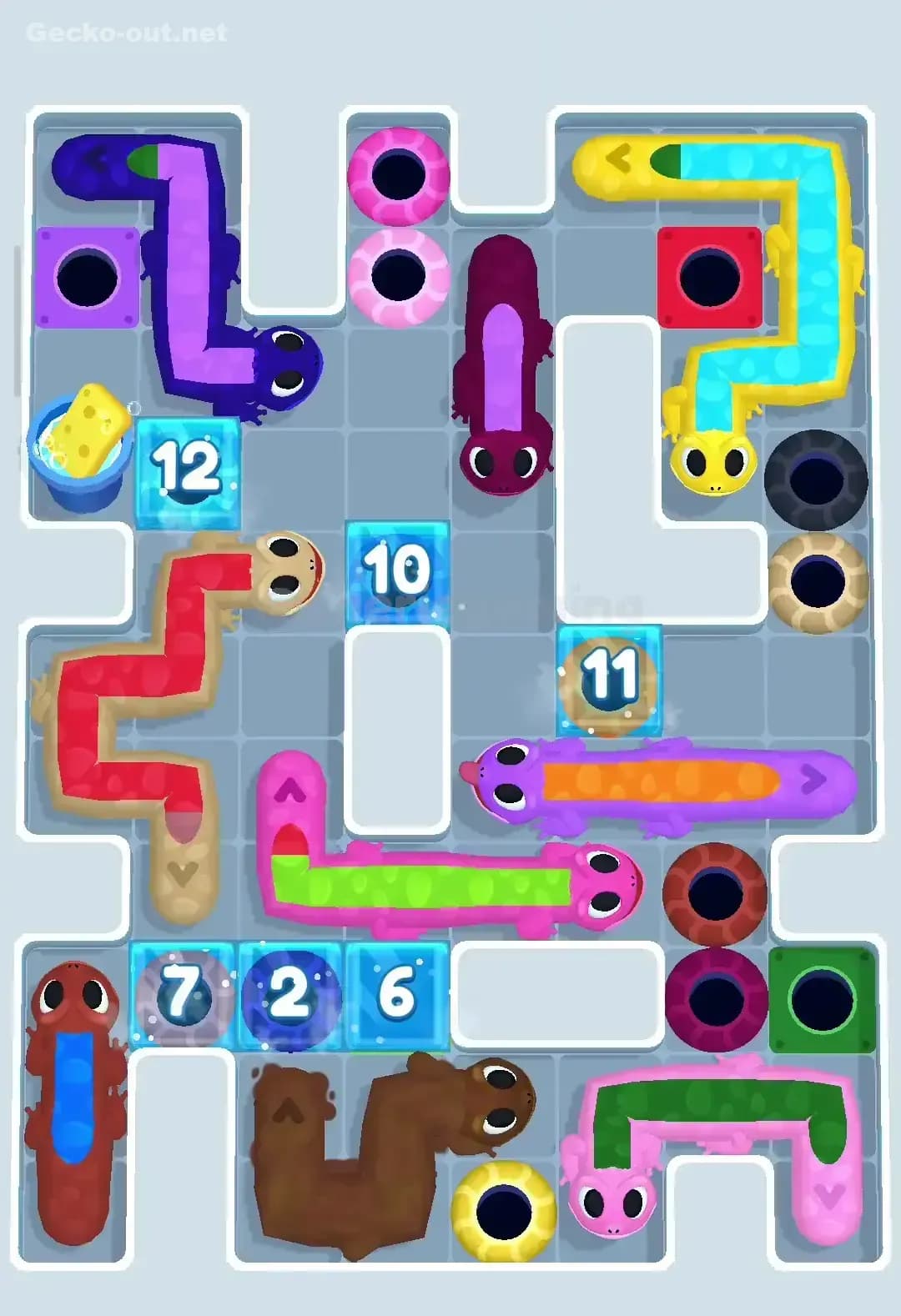
Gecko Out Level 300 Solution Walkthrough | Gecko Out 300 Answer
How to solve Gecko Out level 300? Get step by step solution & cheat for Gecko Out level 300. Solve Gecko Out 300 easily with the answers & video walkthrough.



Gecko Out Level 300: Board Layout, Rules, and Win Condition
What You See When Level 300 Loads
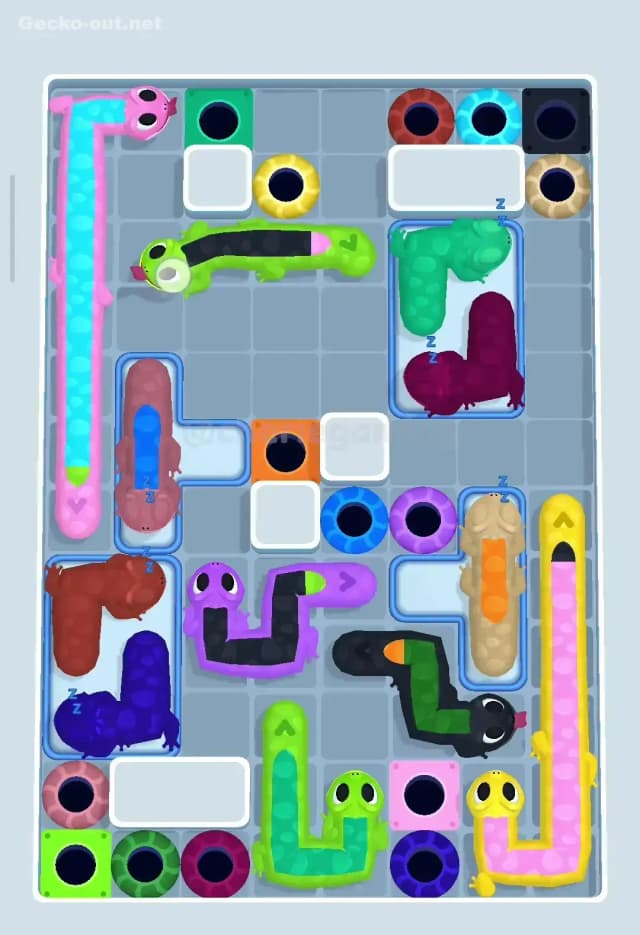
When Gecko Out Level 300 starts, you’re looking at a cramped vertical board packed with around a dozen geckos in bright colors: long U‑shapes, chunky L‑shapes, and a couple of short, blocky bodies. Several of them are curled on light-blue “beds” with little Zs over their heads, but you can still drag them like normal once there’s space.
Colored holes ring the top, middle, and bottom of the board. Each hole’s rim matches a gecko’s body color: cyan, yellow, red, purple, green, brown, and so on. A tight cluster of multi-colored exits sits in the central third of the board, surrounded by a few solid white blocks that act as permanent walls. There are also some colored square tiles that work like toll spots: they eat up pathing space and are easy to forget about when you’re drawing a long route.
The layout in Gecko Out 300 is basically one giant knot. The largest U‑shaped geckos hug the left and right sides, while medium geckos block the central corridor and the bottom. Every meaningful path to an exit has to squeeze past one of these “tanks,” so your job is to peel them away in the right order.
Win Condition And Why The Timer Matters Here
As always in Gecko Out Level 300, each gecko must reach the hole with the same color rim. You drag a head and the body perfectly traces that path. You can’t cross walls, other geckos, frozen tiles, or holes that belong to another color.
The timer is strict enough that you don’t get to experiment endlessly. If you draw a long, winding route that later blocks someone else, you probably won’t have time to “undo” it with more clever paths. Gecko Out 300 forces you to think about future traffic: any route you draw leaves a permanent gecko-shaped wall behind. The win condition is really “get everyone out while leaving corridors open,” not “just reach the exits.”
Pathing Bottlenecks and Logical Traps in Gecko Out Level 300
The Central Exit Cluster Is The Real Boss
The biggest bottleneck in Gecko Out Level 300 is the central cluster of exits and toll tiles. Several different colors need to pass through this same middle strip, but it’s initially choked by a couple of mid-sized geckos that sit upright in narrow channels.
If you move the wrong gecko first, you lay its body straight through the only usable lane and nobody else can cross. That’s why your early exits should be geckos that can escape along the edges, freeing space without clogging the center. Once the central cluster is open, the rest of the level becomes surprisingly manageable.
Sneaky Traps Around The Edges
There are a few subtle traps in Gecko Out 300. One is the bottom-left corner, where colored holes and square tiles sit right where your brain wants to “park” a gecko temporarily. If you use that area as a parking lot, you later realize those cells were needed as clean lanes to thread long bodies through.
Another trap is the tall U‑shaped gecko on the right side. If you send it to its exit too early, its body snakes around and blocks the side lane that other geckos need to reach the lower exits. Finally, the sleeping geckos on their blue slabs in the middle and bottom look harmless, but once you wake and move them, they can form thick barriers you can’t route around.
When Gecko Out 300 Finally Clicks
I’ll be honest: Gecko Out Level 300 feels overwhelming at first glance. There’s a lot of color noise and the board looks full. The first few attempts, I kept getting to the last two geckos and realizing some giant body was sitting across the only remaining path.
The turning point was when I stopped trying to free everyone at once and instead treated the level like a traffic puzzle. Once I decided “central exits stay clear until the end” and worked edge to center, Gecko Out 300 went from chaotic to logical. After that, I beat it twice in a row without using any boosters.
Turn-by-Turn Path Strategy to Beat Gecko Out Level 300
Opening: Clear Top Lanes And Wake The Board
For your opening in Gecko Out Level 300, focus on the top third of the board. The tall cyan‑and‑pink U‑shaped gecko on the left and the smaller purple‑and‑black gecko near the top are the safest first exits.
- Send the tall cyan‑pink gecko up and around along the left wall, then curve it into its matching cyan hole near the top. Draw the path tight to the wall so its body doesn’t jut into the central lane.
- Next, route the small purple‑black gecko through the shallow gap toward its purple exit in the central cluster. Keep that route short and direct; don’t loop it through the middle more than necessary.
With those gone, you can gently reposition the vertical brown gecko that starts near the top center. Slide it slightly toward its matching hole without fully committing to the exit yet; use it as a temporary divider that doesn’t invade the central lane. The goal of the opening is simple: free some space at the top and sides while leaving the middle as open as possible.
Mid‑Game: Rotate Through The Center Without Locking It
Mid‑game in Gecko Out Level 300 is where most runs die. This is when you deal with the geckos clustered around the center and bottom-left.
Start by working the left column: exit the large brown L‑shaped gecko and the dark blue one below it by routing them down and out through their matching holes in the lower-left cluster. Draw their paths hugging the left wall and bottom edge so these bodies become “outer walls” you can work around, not barriers across the center.
Then focus on the green‑and‑black gecko on the right side. Instead of sending it straight to its hole, temporarily park it in a compact L against the right wall, leaving the vertical lane next to it free. This gives you space to move the central tan gecko on its blue slab and the red‑and‑green gecko just to its right.
Exit the tan gecko first via the central exits; its path is short and doesn’t have to cross many lanes. After that, route the red‑green gecko to its green hole, curving it cleanly through the now‑open middle. At the end of mid‑game, you want the central cluster mostly cleared, with only a couple of large geckos left on the right and bottom.
End‑Game: Exit Order And Panic Control
The end‑game in Gecko Out Level 300 is about not panicking when the timer is low and the last bodies are long. By now, you should mainly have the big turquoise gecko on its slab on the right, the maroon gecko near it, the tall yellow‑pink U‑shaped gecko at the bottom-right, and maybe one leftover from earlier if you were conservative.
Exit the maroon gecko first, using the side lane you preserved. Its route is fairly short and opens even more space on the right. Then send the turquoise gecko through the middle while you still have time to draw a careful path; it’s easy to accidentally overloop it and block holes.
Leave the tall yellow‑pink gecko for last. Draw its path hugging the bottom and then curling up into its matching hole. Since its body is so long, any earlier exit tends to cut off routes for others. If you’re very low on time here, it’s worth committing to a slightly sub‑optimal but fast path as long as you don’t cross another exit’s lane.
Why This Path Order Works in Gecko Out Level 300
Using Head‑Drag Pathing To Untie The Knot
The whole plan for Gecko Out Level 300 abuses the “body follows the exact route” rule. By exiting early geckos along the outer walls, you intentionally turn them into boundaries that don’t interfere with the center corridors.
If you instead zigzag them through the middle, their bodies become permanent walls in exactly the worst places. The suggested order—edge geckos first, short central geckos second, giant bottom-right gecko last—means each new path either replaces an existing obstacle or opens a lane, never closes one you’ll need later.
Playing The Clock: When To Think Vs. When To Swipe
In Gecko Out 300, you should spend the most thinking time before your first move and at the transition into mid‑game. It’s worth pausing for a few seconds to visualize where the big bodies will lie after they exit. Once you’re confident in the rough order (top edges → left column → center → right side → bottom-right giant), start moving decisively.
During the last three exits, don’t overthink tiny optimizations. Drawing an extra bend to save a hypothetical future path doesn’t matter when there are only one or two geckos left. At that point, quickly draw clean, direct paths and trust the structure you set up earlier.
Boosters: Nice Safety Net, Not Required
For Gecko Out Level 300, boosters are optional. You can clear the level with no power‑ups if you stick to the order and pathing ideas above.
If you really struggle with the timer, an extra-time booster helps most during your first few learning runs; pop it at the beginning so you can afford to pause and read the board. A hammer-style remover is best saved for a late mistake—like if you accidentally snake a body across the central exits and need one gap reopened. Hints are least useful here because they usually highlight a single move, not the long-term lane management that actually solves Gecko Out 300.
Mistakes, Fixes, and Logic You Can Reuse in Other Gecko Out Levels
Common Gecko Out Level 300 Misplays (And Quick Fixes)
Players make a few repeatable mistakes in Gecko Out Level 300:
- Exiting the huge yellow‑pink bottom-right gecko too early, which slices across paths that others still need. Fix: commit to making it your last or second-to-last exit.
- Using the bottom-left cluster as casual parking, then realizing those cells were critical lanes. Fix: treat that corner as “reserved” for exits only.
- Drawing fancy looping paths for short geckos, wasting time and clogging space. Fix: always aim for the shortest, tightest route that hugs walls.
- Moving every gecko a little instead of fully exiting a few. Fix: finish what you start—once you begin moving a gecko and see a clear route, get it all the way out.
Reusing This Logic On Other Knot‑Heavy Levels
The strategy that cracks Gecko Out Level 300 scales beautifully to other tough stages. Whenever you open a knot-heavy level or one with gang geckos and frozen slabs, ask yourself:
- Which exits share the same corridor, and which gecko is the “gatekeeper” of that corridor?
- Which bodies are so long they should clearly be last?
- Where can I route early geckos so their final bodies become harmless borders instead of central walls?
If you keep outer‑wall paths for early exits, preserve at least one central lane until the late game, and consciously choose a “final boss” gecko to save for the end, you’ll see similar success in other advanced Gecko Out levels.
Final Encouragement For Gecko Out 300
Gecko Out Level 300 looks brutal, but it’s absolutely beatable without relying on luck or brute-force retries. Once you respect the central bottleneck, commit to the edge-first exit order, and keep that bottom-right monster gecko for last, the puzzle transforms from chaos into a tidy checklist.
Give yourself a couple of runs to practice the routes, don’t panic when the board feels jammed, and remember that every path you draw is a new wall you control. With that mindset, Gecko Out 300 stops being a brick wall and turns into one of the most satisfying clears in the game.